
The market seems comfortable in the high 80s, volatility is down quite a lot and even intraday swings are now worth less than $1/bbl. So what changed? For once, the “they are running out of ammo” seems to be playing out at least from the US side as they are “Low-Keying it”, which sounds smart as the only tool that worked for them is the naval blockade, it takes time though, and time is a luxury they don’t have, unless they are not worried about the midterms but about legacy… if that is already lost why bother wasting precious military arsenal, rebuild stocks and go at it again later, with clear intention to finish the job... is a possibility.
From the Iranian side, we can see more propaganda than actual attacks, and for those reported and verified by 3rd parties, they are hit-and-miss lately. They don’t have the accuracy or the capabilities they had at the start of the conflict.
In the meantime, barrels are flowing. How many? If you ask the US is 9Mnbd, if you ask Iran is 0Mnbpd, if you ask commercial ship-trackers is 4.5Mnbpd.. (quite a convenient number)
The idea of keeping us in the dark is still holding because there is a lot of money to be made yet, but something odd started to surface. ADNOC went on a PR campaign last few weeks, complaining about how resilient they have became but in doing so they broke the first rule about dark transits: you do not talk about dark transits.
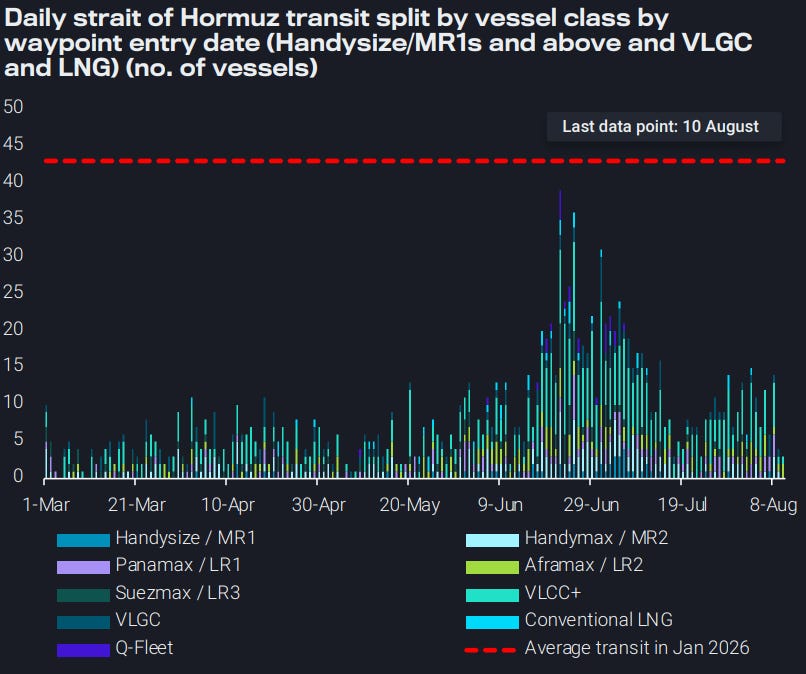
Yes, we all make charts and shuffle commercial data, AIS inferences, but there is a lot more going on inside the Persian Gulf. Vessels transiting partially laden, Iranian fuel oil loading in Iraq, STS within coastal waters, fixtures failing, etc..
Look at any Bloomberg/Reuters article mentioning Sinokor: They declined to comment, the few Greek owners participating in the trade… aren’t bragging about how much money they are making…and trust me, they always make sure you notice when they are. Not this time.
So why is ADNOC making this public? They might be feeling US support fading away, the need for more navy escorts, or just signaling goodwill.
Saudi approach has been different, talking down any Houthis endeavor, adapting to the changing market conditions, and loading what they can. We don’t know how many barrels they are exporting either, with some figure putting Yanbu export at around 3Mbpd, some lower, but there are some difficulties indeed as this week they reactivated Ras Tanura exports with two visible dockings.
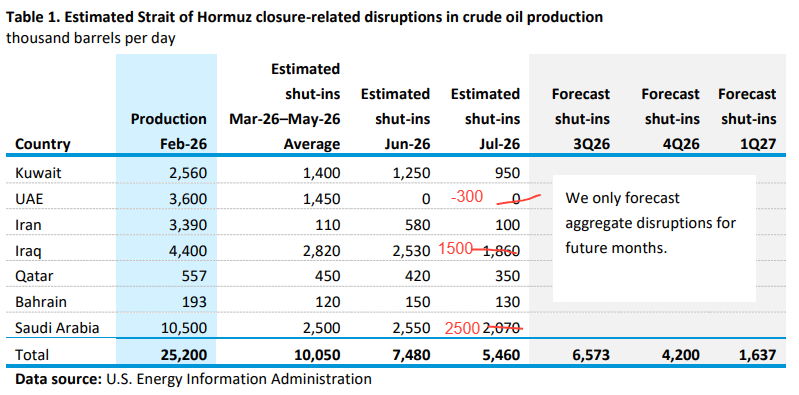
Iraq and Kuwait are getting some help from ADNOC, explicitly publicized as well, and loadings are more consistent, well above Jun records.
Even EIA on their short-term outlook acknowledges we are better of these past weeks…But are we?
We have two problems big enough to keep the market confused, hence the step back from trading we are witnessing this week.
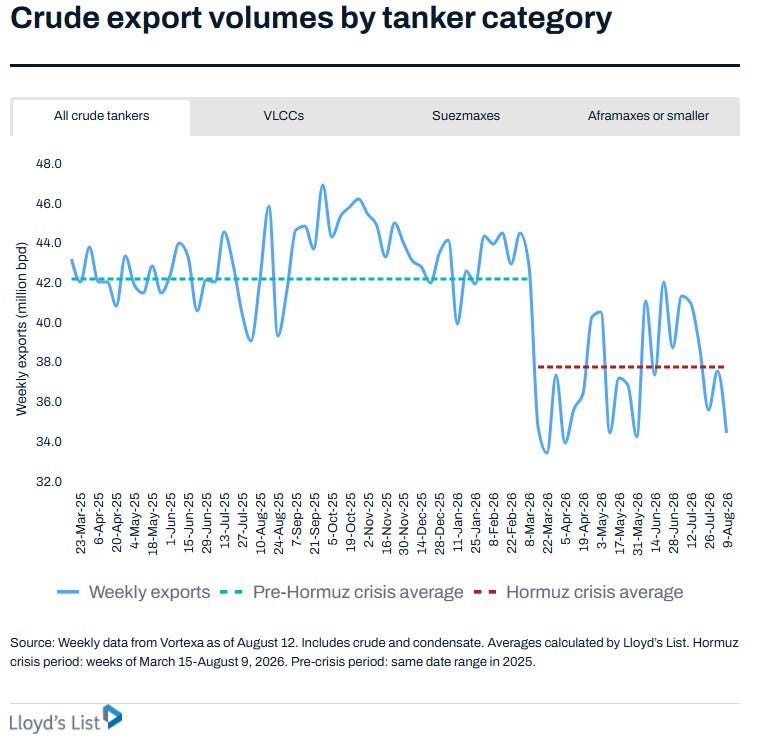
First off, we are facing a cliff in crude exports, explained by the short interruption on Hormuz in late July, US exports nosediving and Russian crude being redirected inwards as domestic refinery throughput is said to be recovering from the lows last month (best case they managed to bring back ~700kbd). These lower volumes exported are part of the problem, price wise we already have been through this in the last spike to 90. The market is pricing a bounce and that’s why we are not breaching the top of the range… yet.
This anticipated reduction in barrels for the export market created a second order of effects. We have barrels in the wrong place.
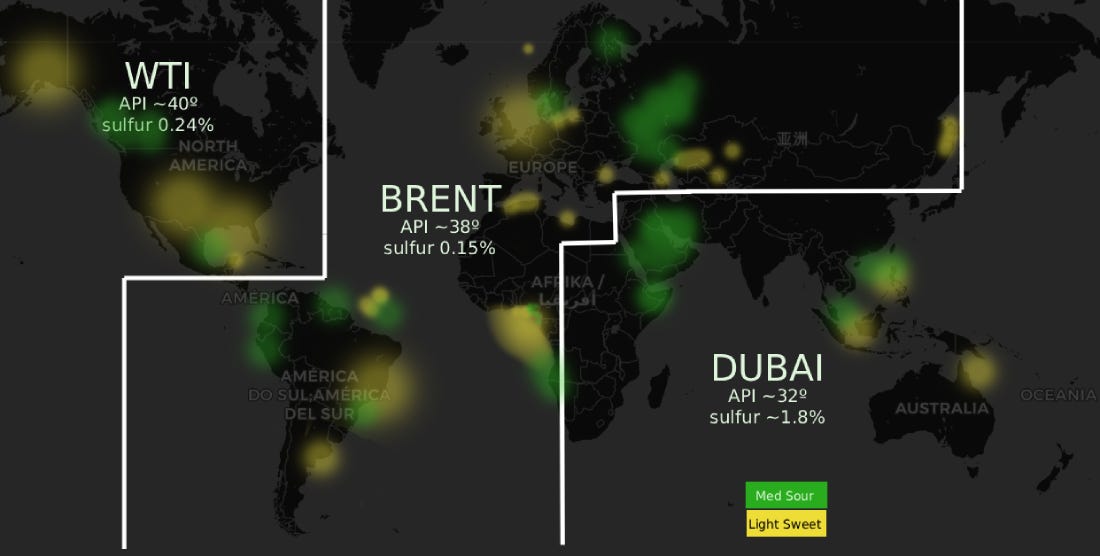
Assume we are in normal times, we have 3 global benchmarks that price availability of barrels in a defined period in a defined place for defined product characteristics, each on their own sphere of influence. The global distribution of different grades would look something like this, not volume-weighted, but geographically… this is kind of the starting point the benchmarks were designed around.
Remember the mini-glut? That forced some Middle Eastern barrels (green) to the left of the map. Remember the “biggest strike since WWII”? That forced the yellow thing to the right of the map.
This trading cycle looks something like this
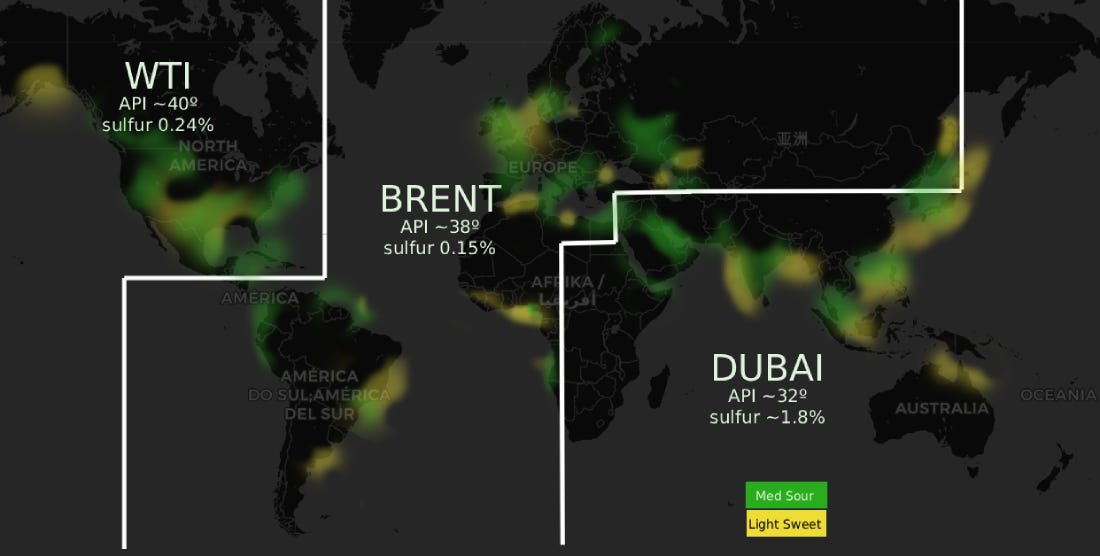
We have enough barrels to sustain current refinery runs, both sides of the world but they happen to be the wrong kind of barrels, or at the very least, the barrels that don’t set the price. US and Europe are (in the physical sense) short light sweet grades, call it CPC, Asia scooping WTI and Brazilian, but at the same time they are awash with Med sours arriving from UAE as a reminiscence of the great flooding, and later those Yanbu barrels that won’t make it to Asia and have been redirected to the US/Latam.
East of Suez on the other hand, is not short med-sours yet, they are still grappling with some excess that left the strait in droves as well as some unloved WAF cargoes, but it will be soon as we approach the “Yanbu/Hormuz cut off” of last month (it manifest itself t+25 in Asia)
The light sweets they bought in reaction to that middle east cut-off is already showing itself in India and later in Asia.
What’s the effect in markets you may say? Flat prices are….. flat, look at the curve, volatility has been dampened but you have phys differentials close to this year highs (ignoring the outliers) Dubai firmly at +10, Dated at +4.. so the market is selective, the barrels you need are right there, but for the barrels you want you need to pay.
The victim of all these mess are optimal refinery slate, translating into more refined products pain ahead.
Is starting to sort itself out nonetheless, Japan, Korea and Taiwan bought collectively 6Mb from the USGC in just one day, to be delivered in Oct/Nov. What did they buy? Mars, the med-sour. So once this Mars VLCCs are within pricing range of the benchmark that prices med-sours (Dubai) then we’ll start to see a normalization.
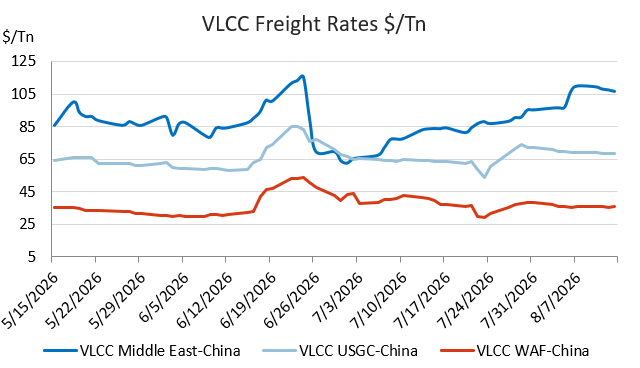
Barrels in the wrong place need to be moved. Tanker rates barely gave way and are again bouncing back towards YTD highs, while total liftings are down 15% in a month.
Comments
Nothing yet. Say the first thing.
Sign in to join the conversation.