
How does a 10-ton sculpture get into a museum? It’s a question I’ve been asking since long before I became an exhibition designer at the Guggenheim. Here’s what I’ve learned.
For years, my ultimate museum curiosity has been how big and heavy pieces of art get into museums. This curiosity has plagued me for as long as I can remember.
I cannot look at a sculpture without trying to figure out how it got inside.
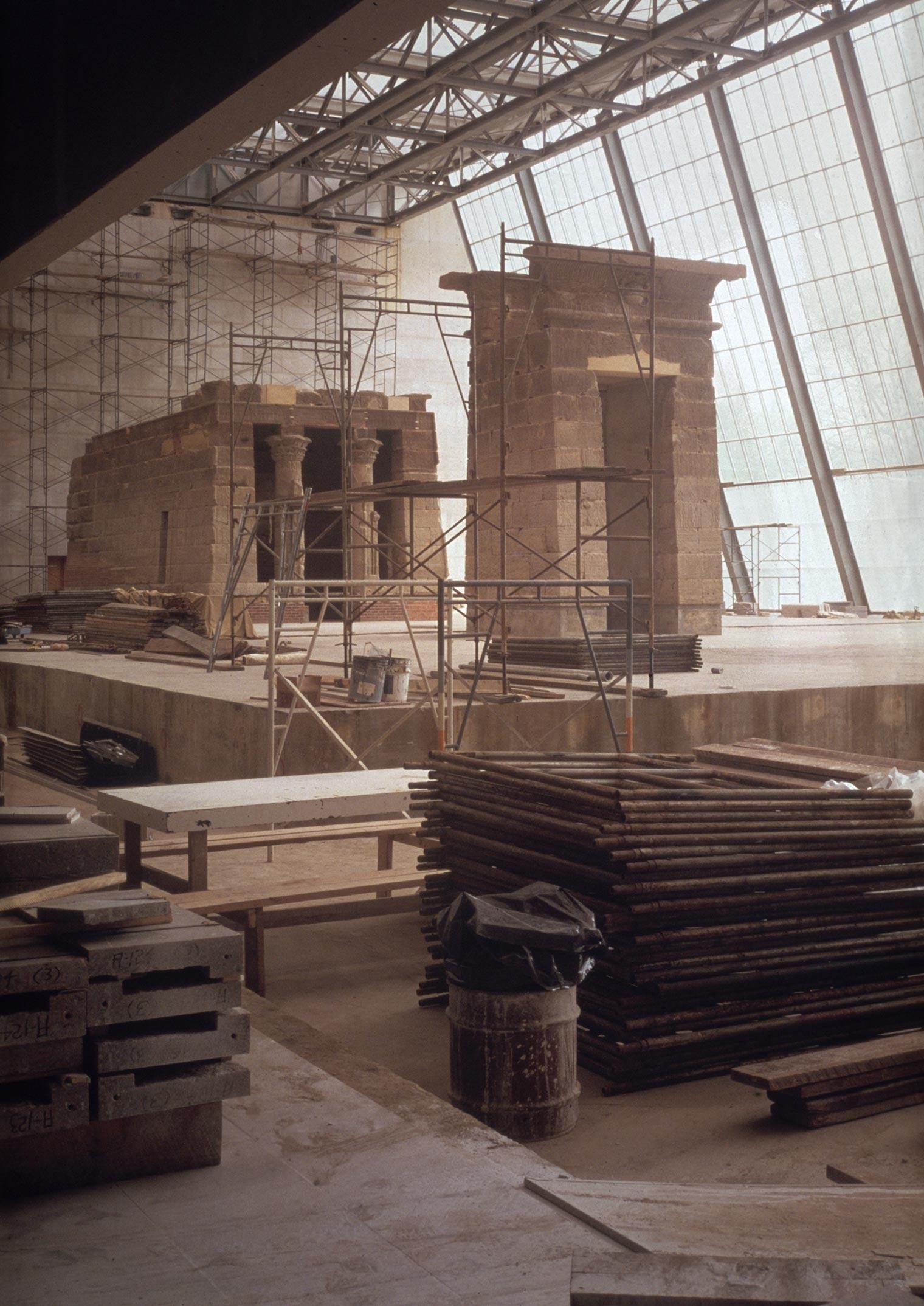
Like you’re telling me that an entire Egyptian temple built in 15 BC is sitting inside the MET, and I’m just supposed to appreciate it for the history and art?! No, I will be examining the entrances and exits.
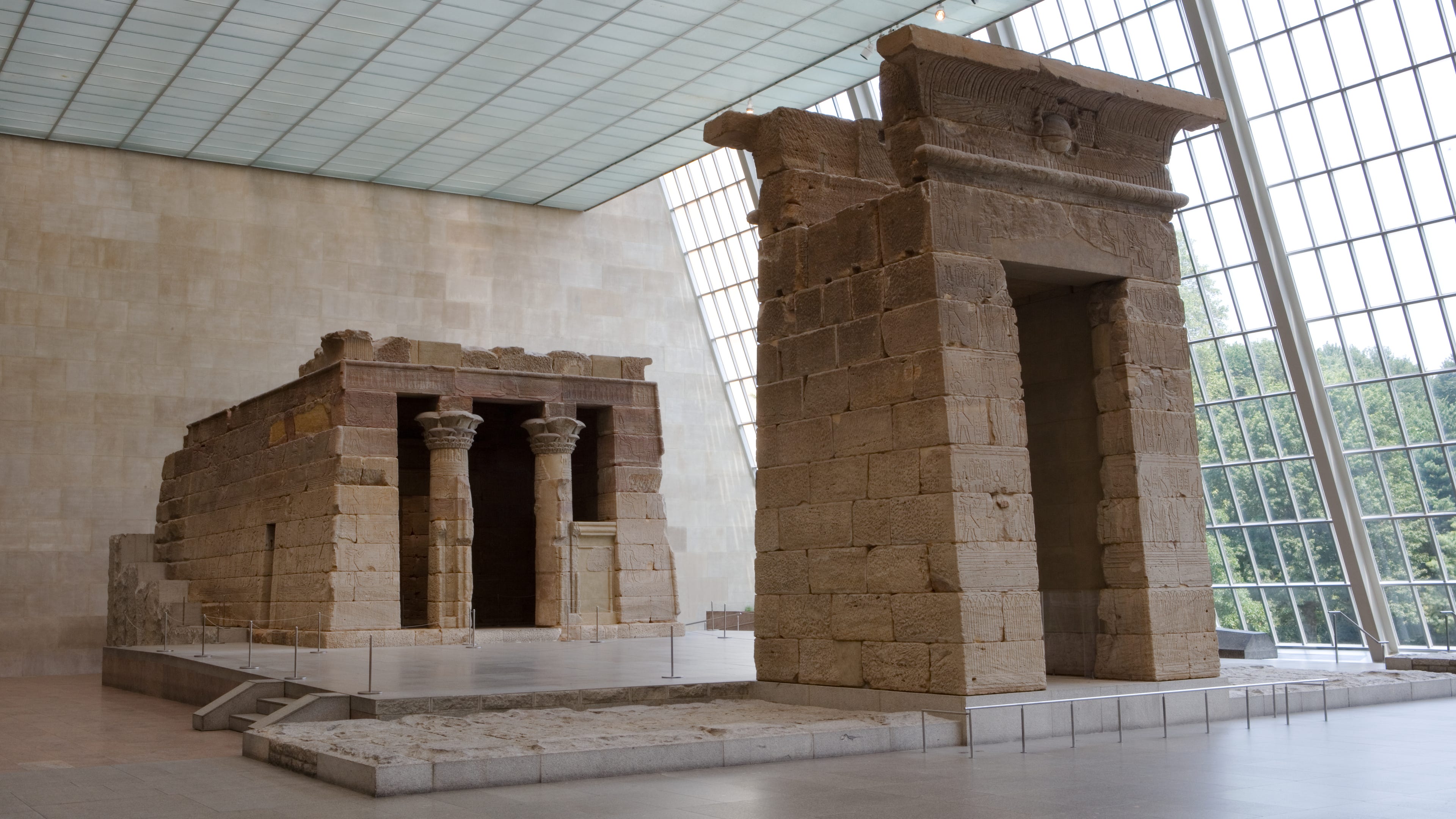
Since I started my role as an exhibition designer for the Guggenheim, my curiosity has begun to satiate. I am very excited to share my findings.
So, how did that sculpture get inside the museum?
Long story short: very carefully.
Before a sculpture is officially selected for an exhibition - before contracts are signed, before a loan agreement is drafted, before anyone calls the shipper - someone has to confidently answer one simple question: will it fit?
And it’s more complicated than it sounds.
Every museum has physical constraints: the maximum door widths and heights, the size of the elevator car, and ceiling heights both in the loading docks and the galleries themselves. These aren’t abstract numbers. They are hard limits, and they have no wiggle room (even as hard as we sometimes try).
It’s less of a 12-foot-tall-sculpture-cannot-fit-inside-a-10-foot-gallery problem and more of an 8-foot-1 ⅜-inch-wide-piece-cannot-fit-inside-a-8-foot-wide elevator problem.
And yes, sometimes the tolerance is down to an ⅛ of an inch.
Let’s say the artist and curator are insistent that a 5 foot 11 7/8 inch wide piece be part of the show, and the max allowance through the door is 6 feet. Let’s boogie. We can (likely!) do that. It will be tough, people will sweat, but we can make it happen.
For works with strange proportions (i.e. long & narrow or shaped in weird way), museums will sometimes build a physical mock-up to test it. So, a cardboard, wood, or foam box is constructed to the exact outer dimensions of the object, then carried around the museum to make sure the artwork will fit.
Does the box fit down the hallway? Check.
Can it make that tight bend near the coat check? Check.
Can it fit in a diagonal in the elevator? Yikes. Nope. We have to find another way.
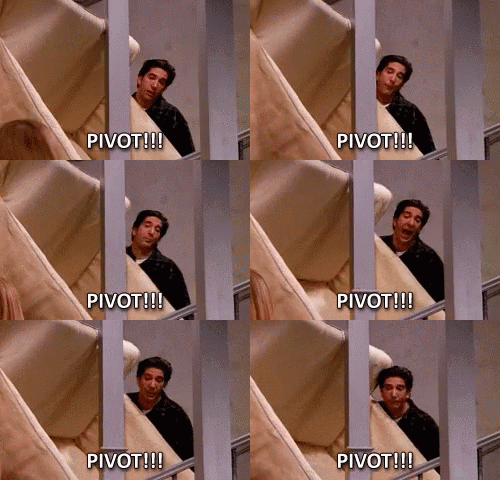
I have yet to witness this test, but the image of it sounds very comical. Just two guys carrying a big cardboard box with utmost seriousness around an empty museum. I laugh, but it is a very important test. The last thing we want is to ship a sculpture from Hong Kong to New York only to learn that it can’t make the bend around the corner.
The mock-up is our only chance to get it wrong.
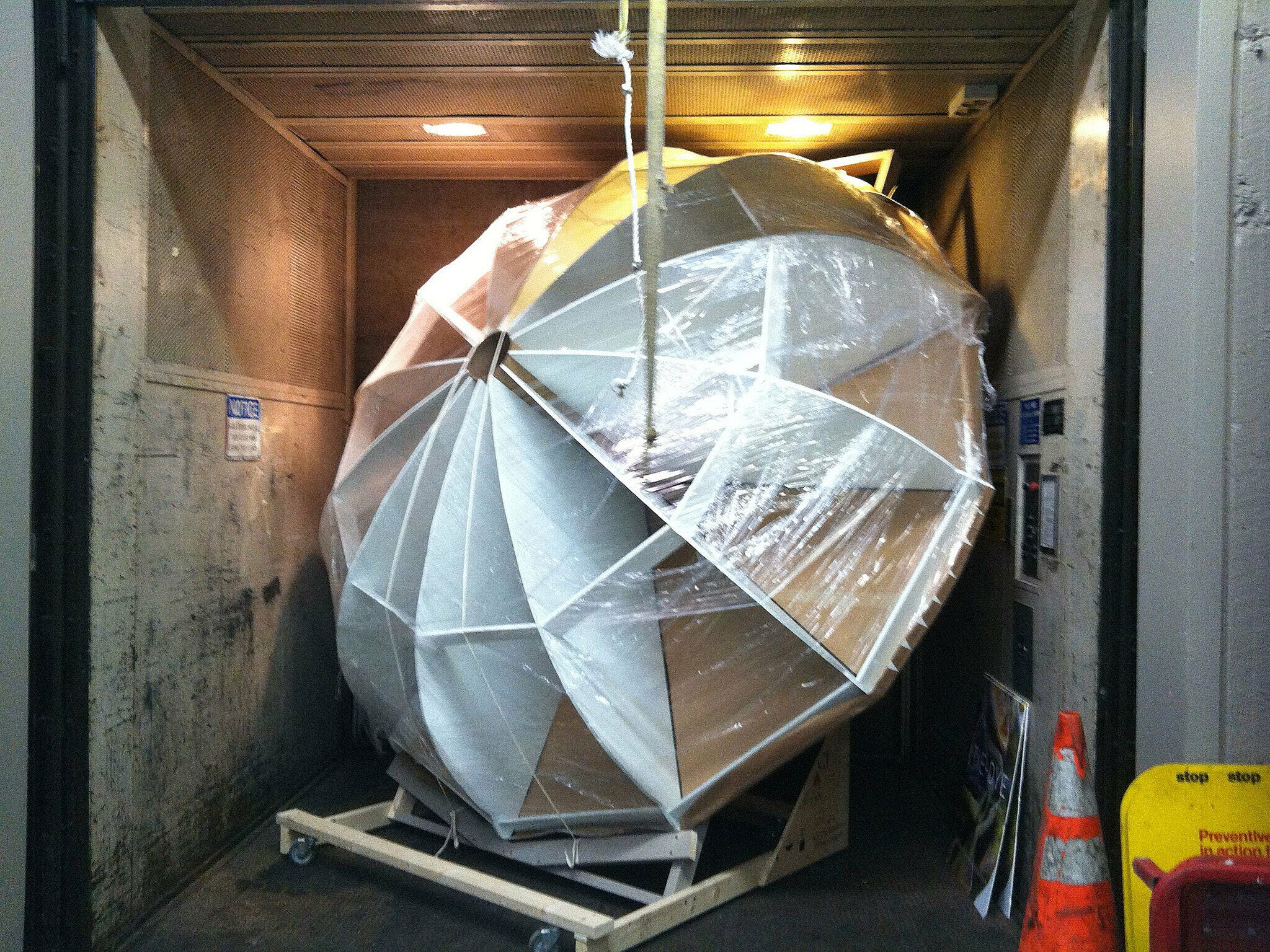
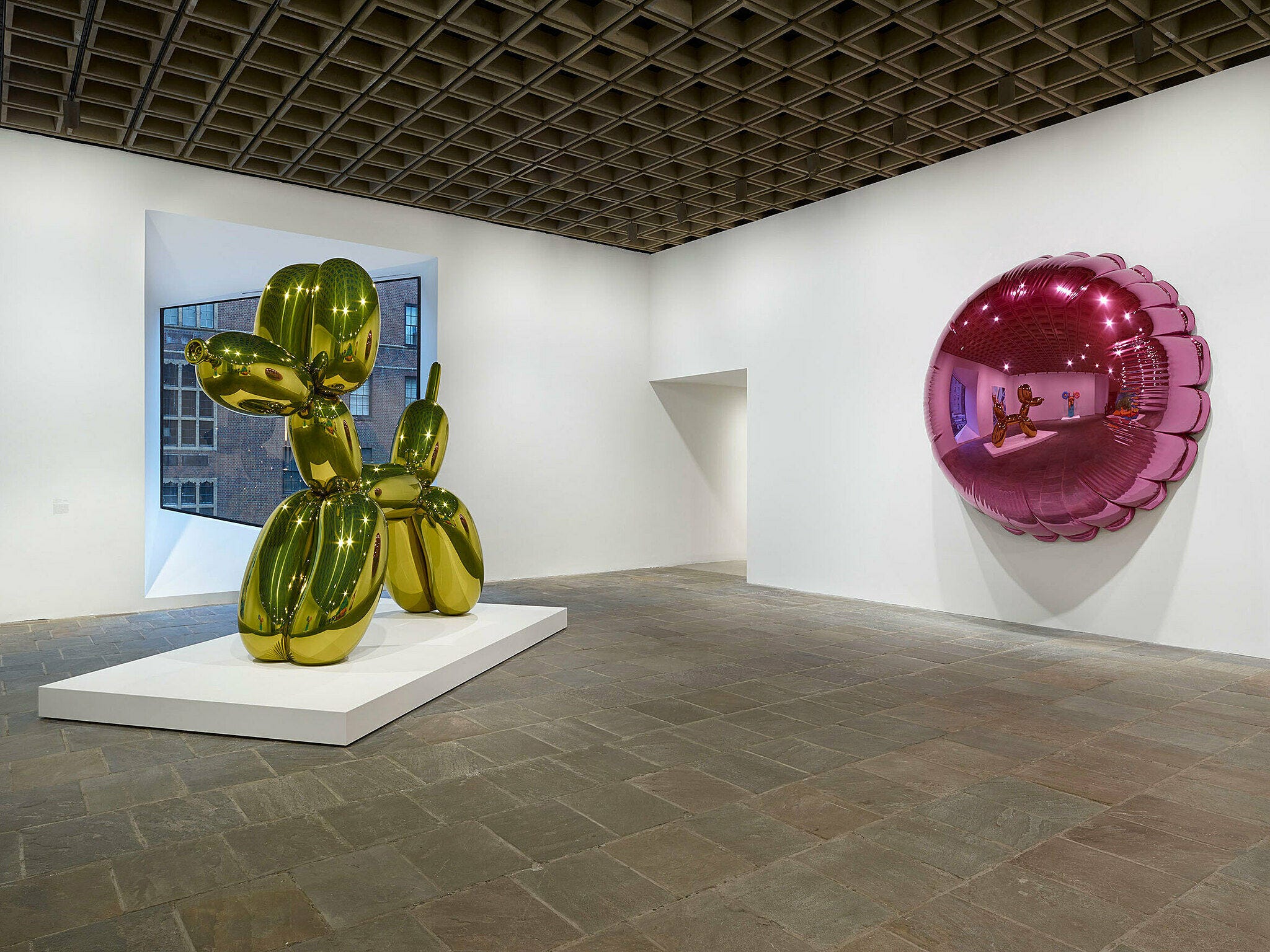
Then there’s the question of entry.
Most museums have a loading dock and a freight elevator. But not every object fits in a freight elevator, and not every city gives you room to have a big loading dock. So some museums get creative.
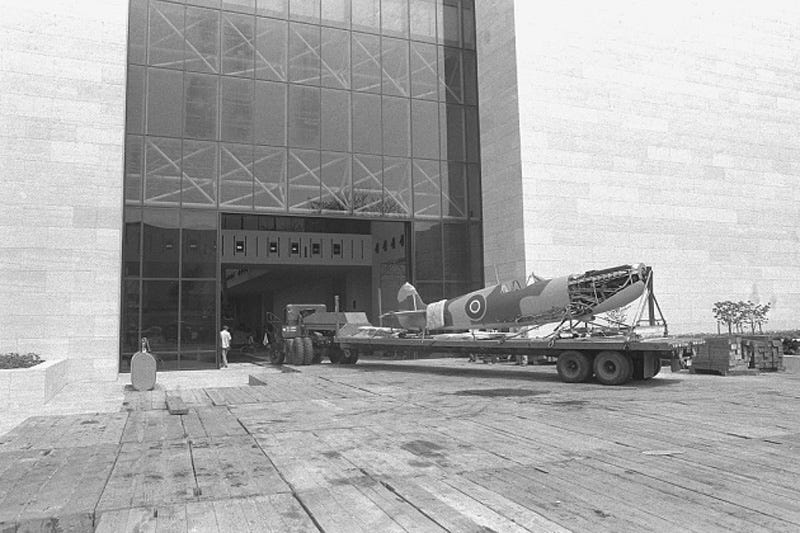
When you enter the main hall of the Air and Space Museum in Washington D.C., one of the first things you notice are the tall floor-to-ceiling windows letting light spill into the space. Those windows are also serving a different purpose: they are designed to open on a large scale, specifically to accommodate the oversized aerospace objects that would never fit in a conventional entry point.
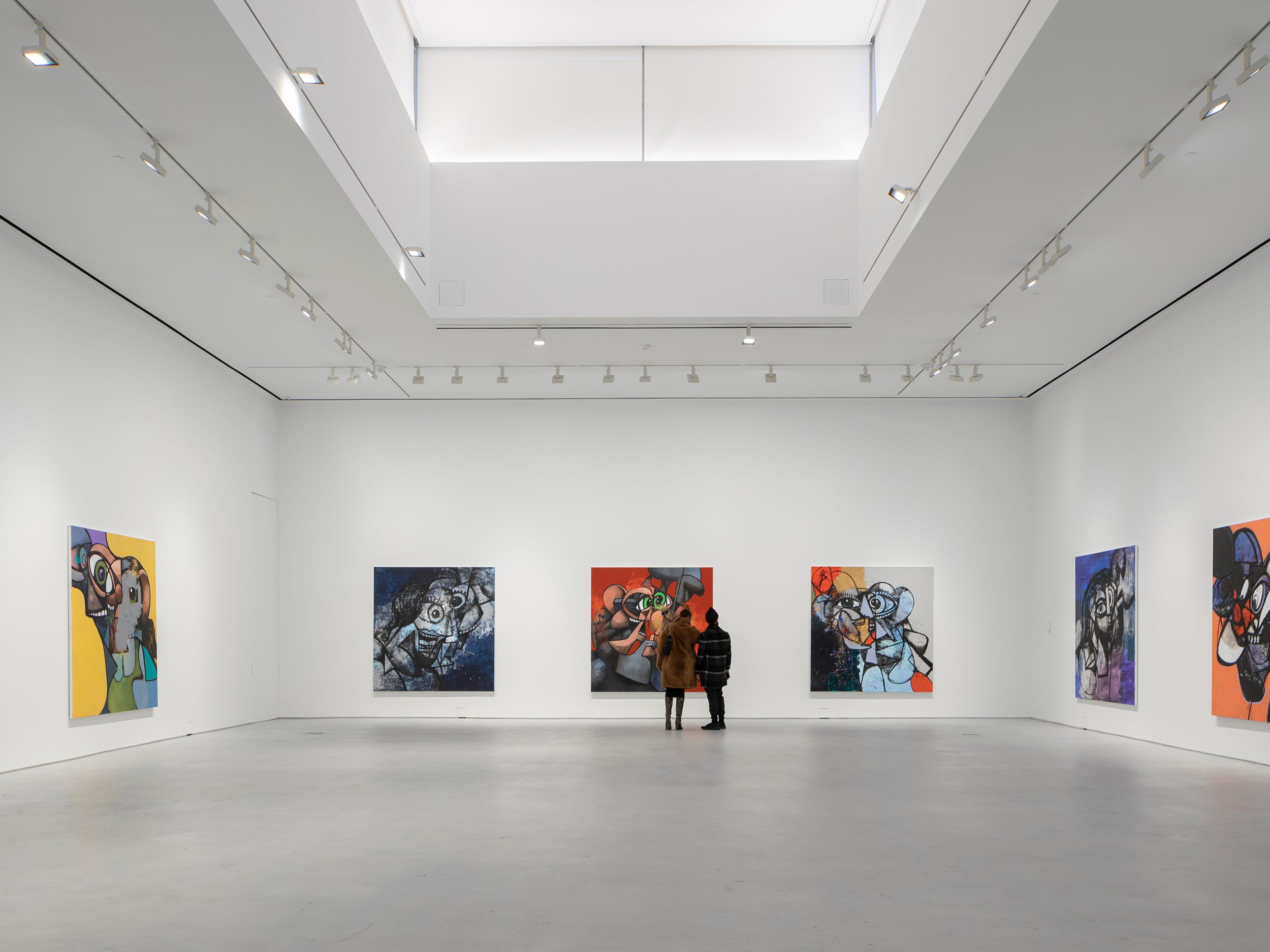
Hauser & Wirth on 22nd Street in Manhattan takes a different approach. The uppermost gallery has a glazed ceiling hatch that looks like a skylight. But, once again, it is doing double duty: it can open wide enough for a sculpture to be lowered in by crane from the street. You would never know the skylight wasn’t purely decorative.
And that, my friends, is good design.
Ok, that was a lot, but there is still one final step before a sculpture can enter the building: the engineering approval.
If I haven’t made it abundantly clear yet, these objects are heavy, and we need to make sure that the building can even support their weight plus the weight of the public that will be surrounding it for up to 40 hours/week.
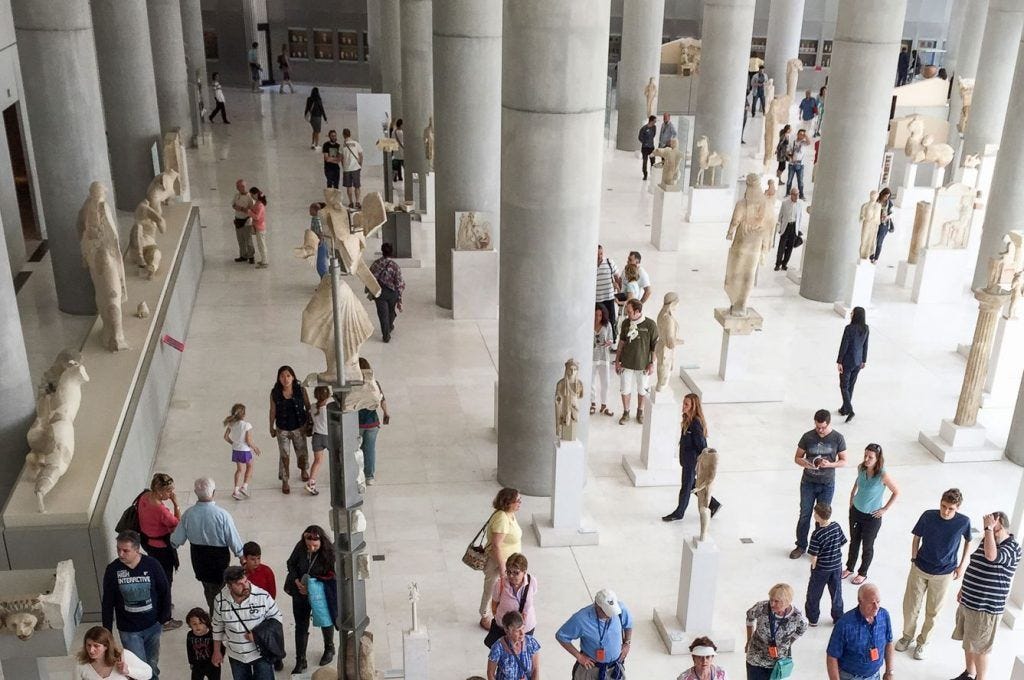
A floor that can support several hundred visitors moving through a gallery may require additional reinforcement or plates beneath a sculpture to distribute a sculpture’s load over a greater area.
Currently at the Guggenheim, we have nearly 10,000lb of sculpture concentrated in one gallery. The engineers were working on the load distribution for months.
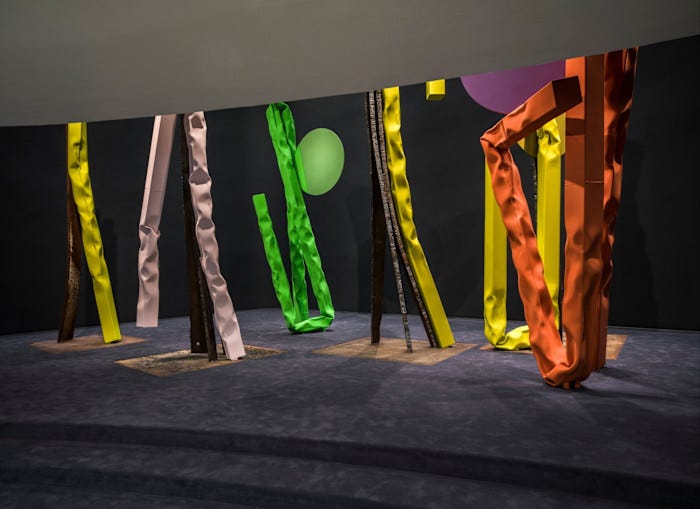
The sculpture has arrived at the museum. It’s game time.
Nine times out of ten, a sculpture will be delivered to a museum in a crate inside a flat-bed truck.
Whether a crate is opened in the loading dock or near the work’s final position depends on the object and the comfort of the install team and conservator. The work is then moved into place using either a forklift (for heavy objects) or a flatbed pull cart, a low platform on wheels that is manually pushed/pulled (for medium-heavy objects).
The object is being moved, and is being accompanied by no less than four people: one registrar, the person operating the forklift or pull cart, at least two art-handlers, and maybe a conservator. The pathway to the sculpture’s final location has been planned, and sometimes it has been rehearsed (cue the cardboard box again!).
(Substack will not let me add a caption to this video. This is a clip from the Carol Bove installation - peep at the bottom of the video as She Wolf is being transported to its final spot. The sculpture is being accompanied by five individuals to make sure it arrives safely.)
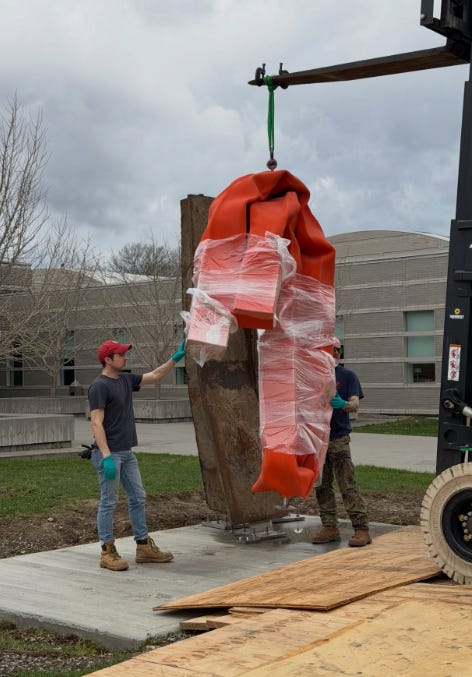
Wood sheets go down on the floor to protect the surfaces. For particularly heavy pieces, we will also sometimes place steel plates first to distribute the weight, so you’re not concentrating thousands of pounds on a single point of flooring.
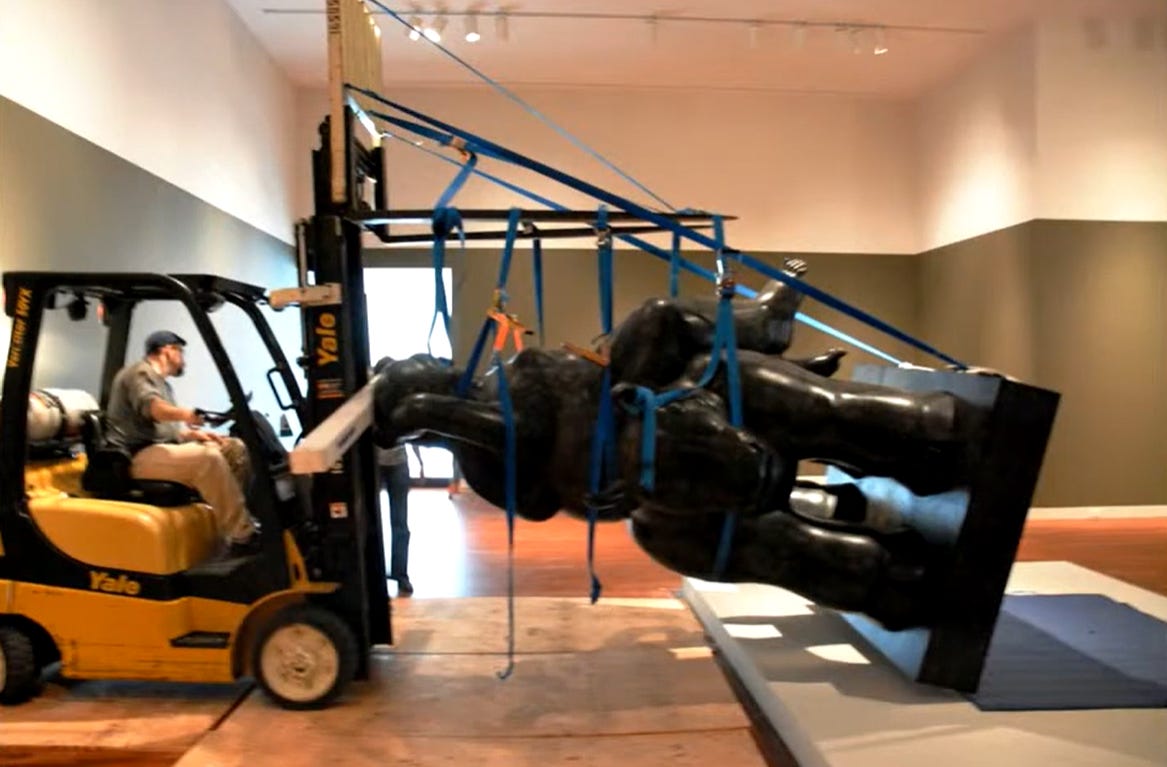
While it’s being moved, the rule of thumb is simple: keep the weight as low as possible for as long as possible. The higher the object is off the ground, the higher the likelihood that the object can tip. A reminder that, above all, all museum people’s primary job is to protect the art. We do not want this thing to tip.
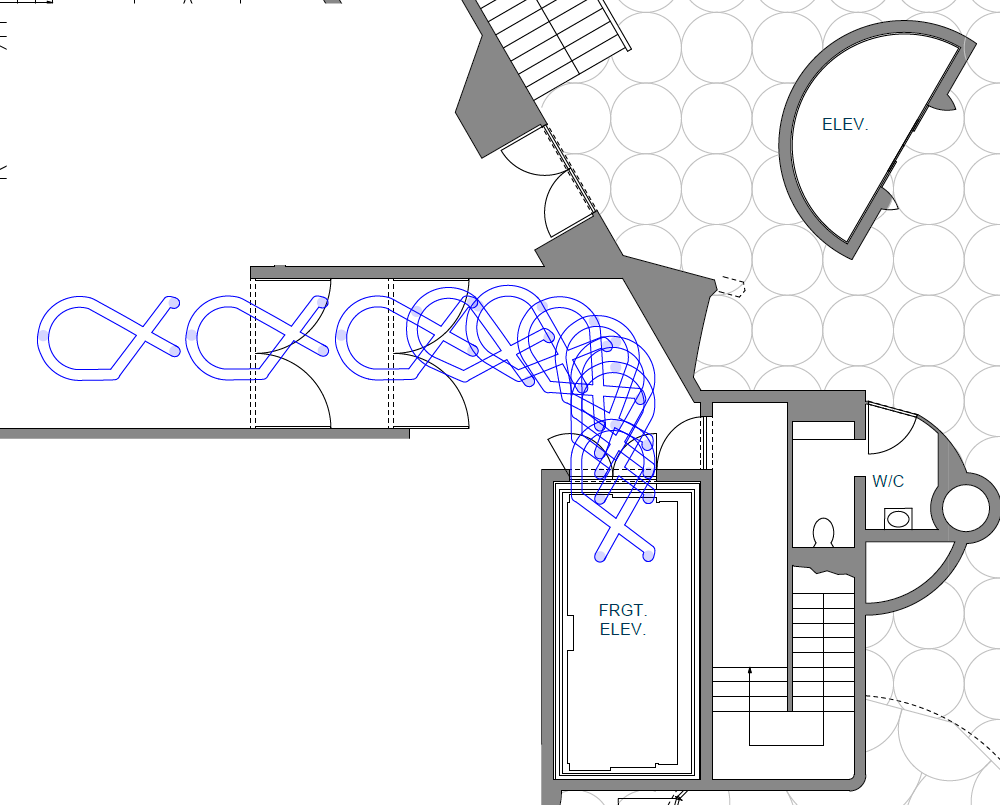
Sometimes a part of my job is to create diagrams of these planned paths. Carefully showing which corners an object can clear, which columns may require a sculpture to be repositioned.
Again, in case you forgot, how heavy and big objects get into museums is my ultimate curiosity, so you can only imagine my excitement whenever I’m asked to make one of these diagrams.
We’ve arrived in the general area. Now we need to get the sculpture from the vehicle to its final spot. The methods change depending on how heavy the work is.
Some works, like busts, mid-scale bronzes, and stone pieces that weigh several hundred pounds, are manageable to be moved by humans. But, of course, they still need the proper equipment.
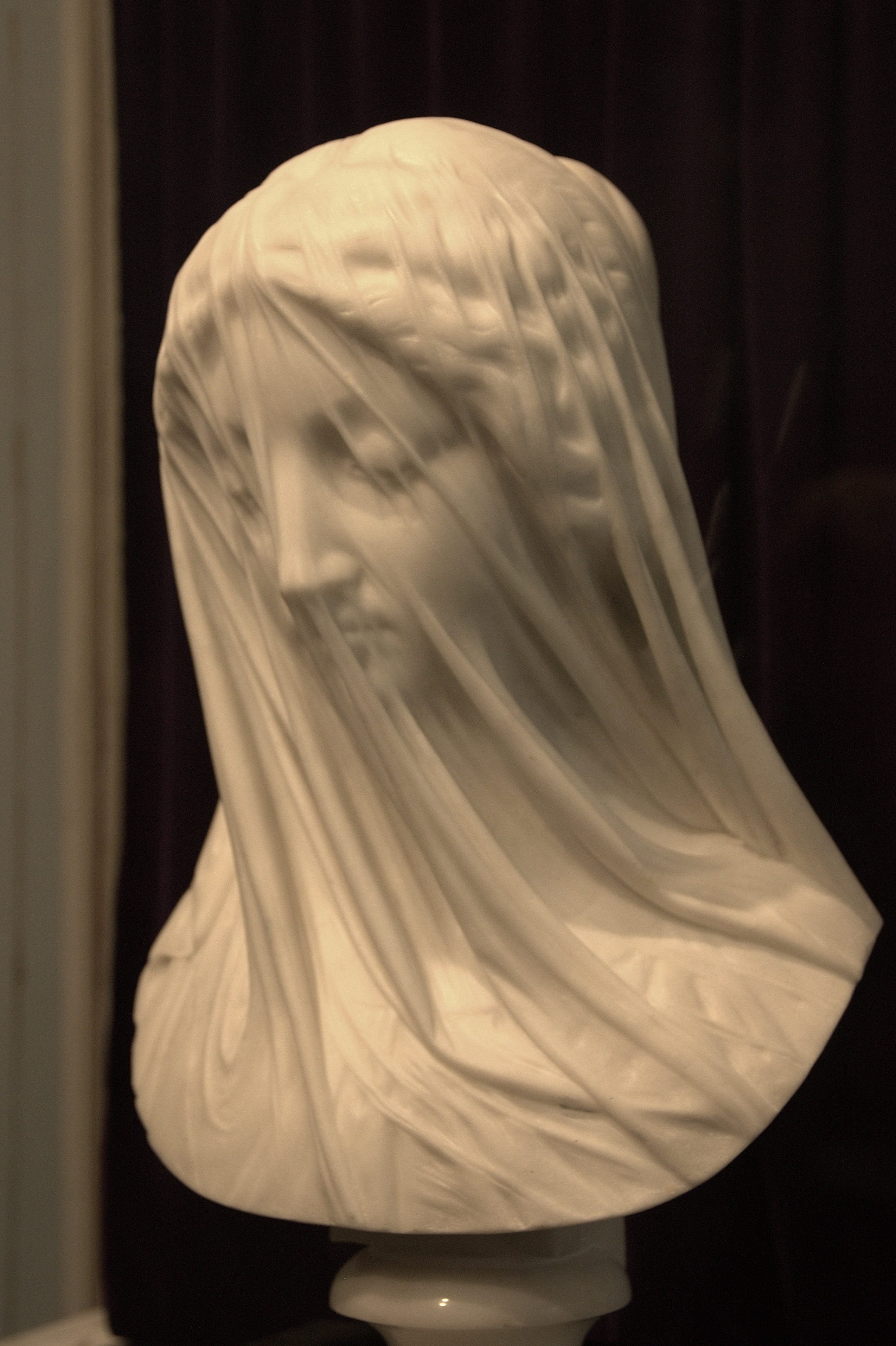
Before anything, the object is examined. A conservator or registrar will first assess the work along with the art handler: they’ll determine where it’s structurally sound, where it’s vulnerable, and where you cannot put a hand without risking damage. Again, above all, we have to protect the work. This step is non-negotiable.
Then, moving it is a two-person job (at least).
The process is this. One art handler supports the object, keeping it stable while the other tips it ever so slightly, just wide enough to fit a very thin piece of wood, called a shim, beneath one corner. Then, while the one art handler continues to support it, the other uses a pry bar to gain a little more clearance to slide a wide, flat sheet of slippery yet robust plastic beneath the sculpture.
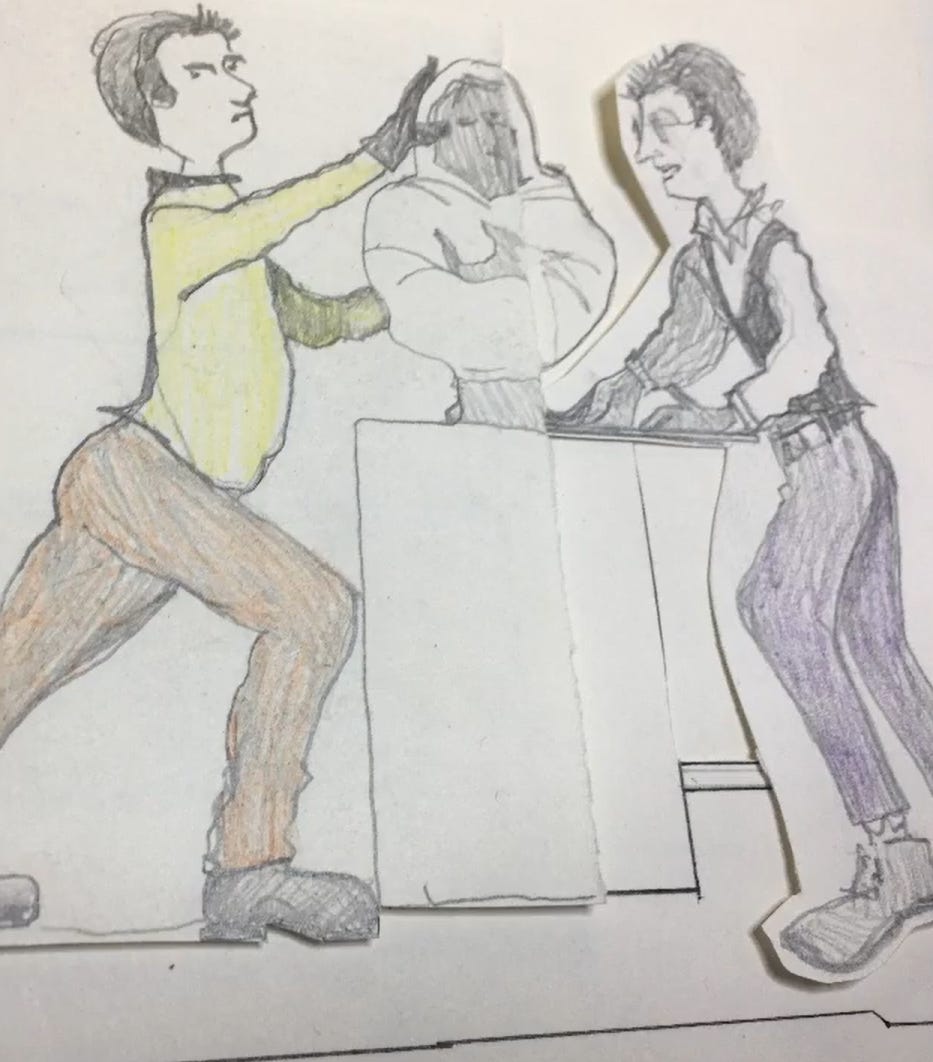
With this plastic in place, the piece can be slid across a floor, repositioned by inches, or lifted slightly without scratching anything below it or stressing anything above.
It sounds like a minor thing. But, if you watch an art handler use one, it doesn’t look minor at all. There’s a real skill to reading how a piece wants to move, and that $40 sheet of plastic is what makes moving a priceless piece of art possible.
But what about sculptures that are too heavy for humans to lift?
That’s where the gantry comes in.
In a nutshell, a gantry is a portable crane. It’s a steel frame on wheels that can easily be assembled on site. It has a horizontal I-beam at the top with a hoist attached to it and then a hook and a series of chains attached to the hoist (this is so hard to describe in words tbh).
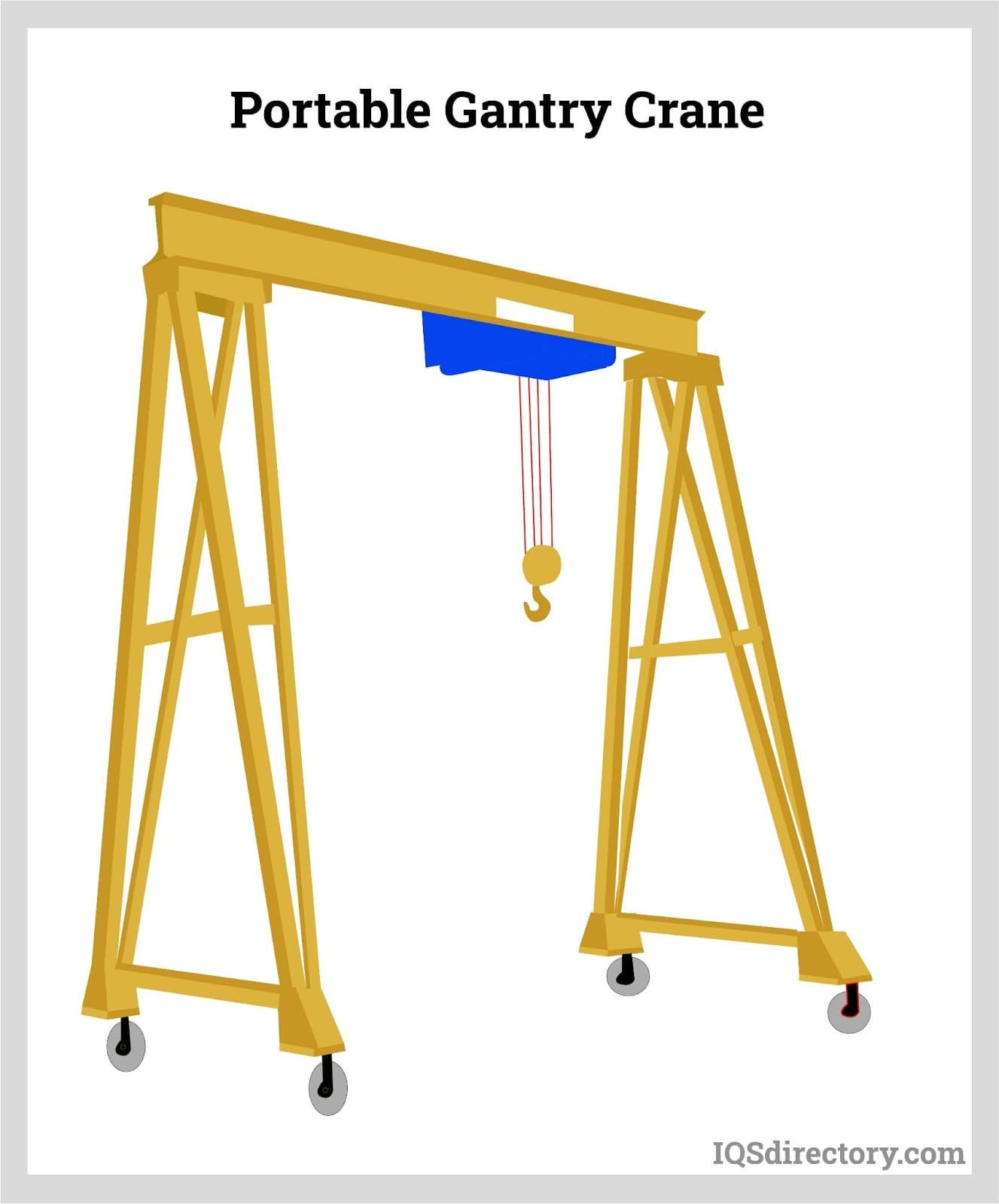
I have to be honest, I really do not understand the physics behind a gantry, but it acts the same as a pulley system (which I also do not fully understand).
I will do my best to describe it. A hoist at the top of the frame connects to the object you’re lifting via a hook and a series of chains. Pull the chain, and the object rises. But it’s not a 1:1 effort - it’s closer to 5:1. The weight is distributed across multiple pulls and points in the system, so the force required to lift something enormous is a fraction of what you’d expect.
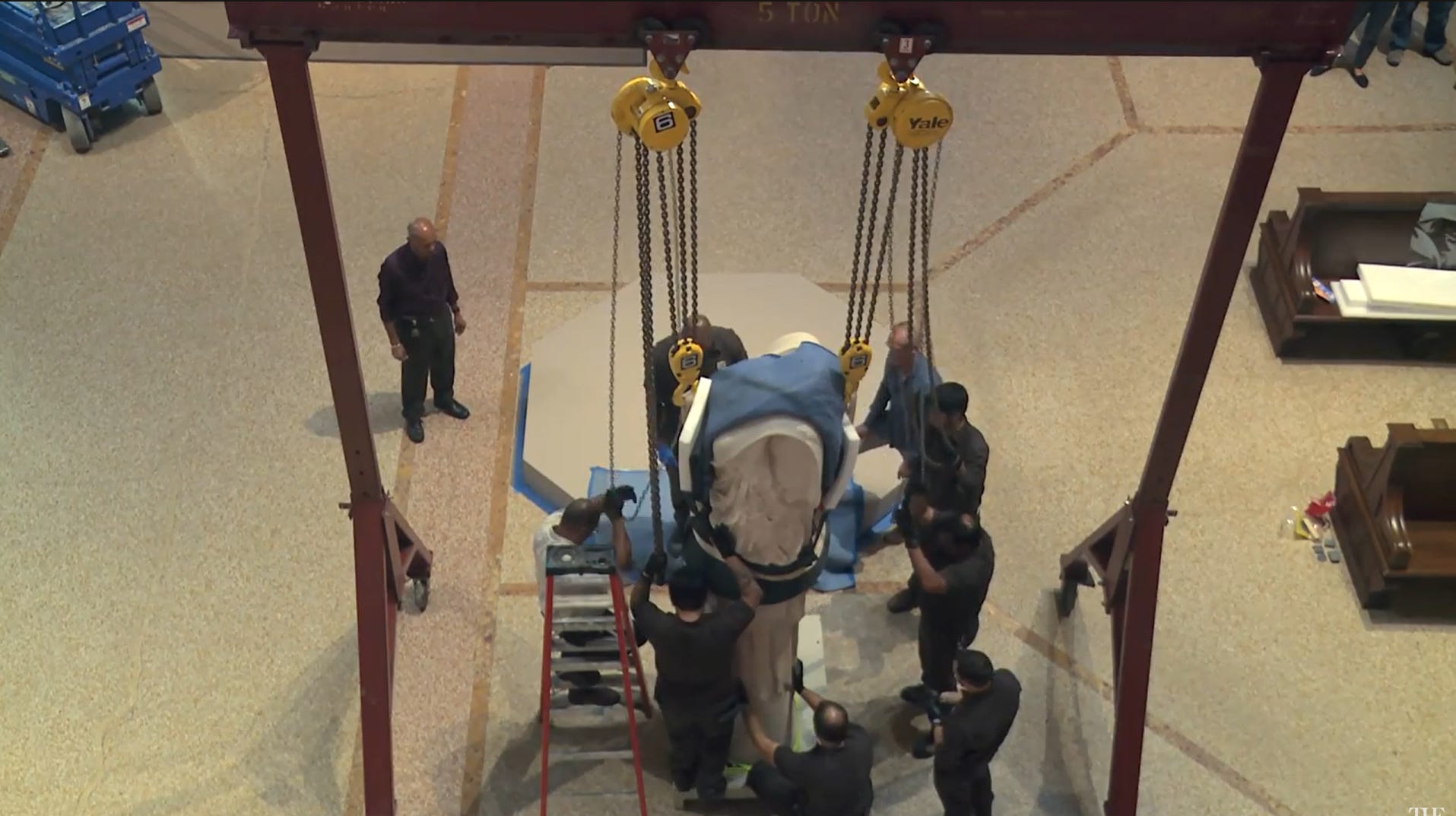
The way I think about it is that it’s similar to riding a bike up a hill at a lower gear. You are still biking up a hill, but lowering the gear makes it easier because you are doing more revolutions within the same distance than if you were at a higher gear.
Does that make sense?

Before anything is strapped, again, the team does an assessment. A registrar, an art handler, sometimes a conservator. Where is the piece structurally sound? Where are the lifting points? What surfaces cannot be touched?
For major works, a lot of this information is known before the piece even arrives. Artists (or their studios, or their estates) often provide an artist’s manual: a document that travels with the work and specifies exactly how it should be handled, installed, stored, and transported. These manuals will arrive at the museum well ahead of install, so there are few surprises on site.
Sometimes, large or heavy objects will also come with removable hardware like a hook or attachment point designed specifically for installation. They are used to safely bear the load during installation and then detach once the piece is in place.
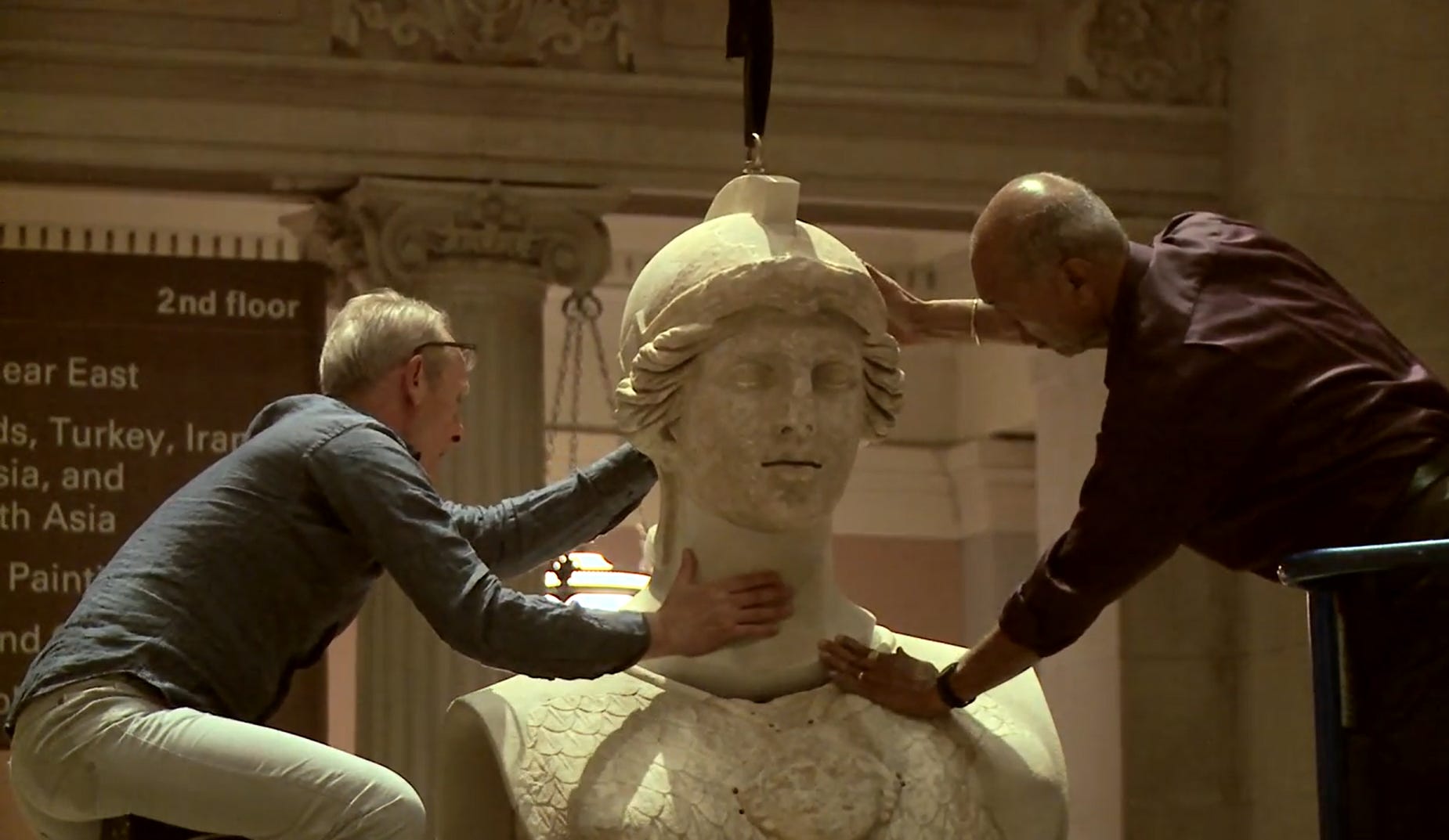
Once the piece is safely strapped in, the work is lifted just barely off of the cart or forklift (again, we don’t want to lift anything too far into the air!) and into it’s approximate final position. The work is then slowly lowered until it is hovering just barely off the ground, like maybe by one inch.
Then, everyone stops, and the artist and design team are called in. The work hovers. The curator steps back and looks. The artist, if present, looks. The exhibition designer looks. There’s a lot of nodding and thinking and walking around the piece. Nobody says much.
This is the moment when the final placement gets decided, confirmed, or quietly adjusted.
No render tells you how an object actually occupies a room, so this is our window to get it just right.
Once everyone agrees, the piece is fully lowered to the ground. Hardware is attached. And depending on the work’s weight, its center of gravity, and other art requirements, it gets secured down to the floor or anchored to the pedestal.
At the Guggenheim, because our floors are ramped, it is imperative that all sculptures be bolted to the ground, and sometimes a shim will be added to help the work stand straight and avoid any chance of tipping.
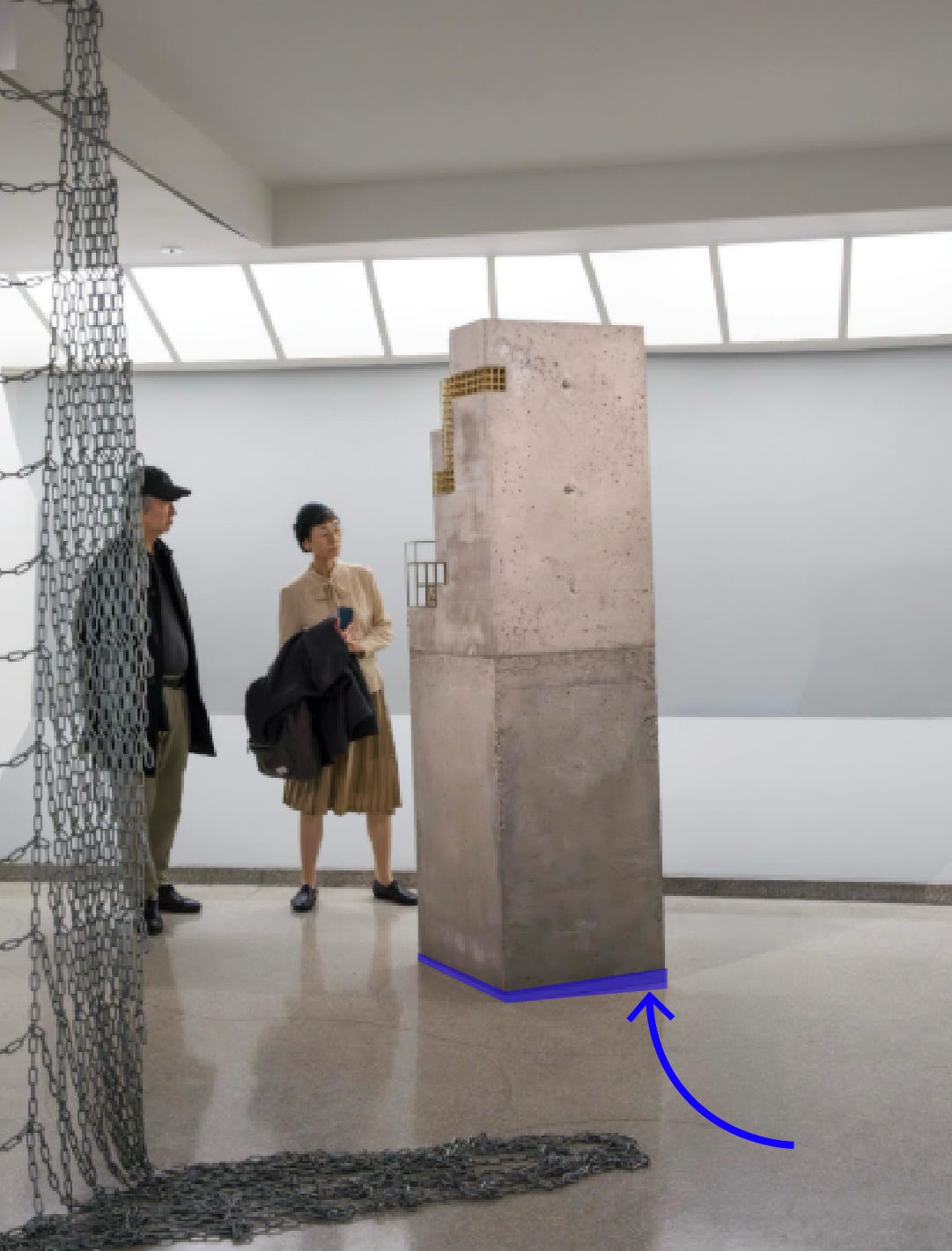
Not every sculpture arrives upright, intact, and ready to place.
A sculpture might travel on its side. Think of a totem pole. It would be a bit silly for it to travel in its upright position, right?
Some sculptures will arrive lying flat on a truck, move flat through the building, then tipped right-side-up only once it is in final position. The sequence here matters: tip it too early and suddenly you have to navigate a 14-foot tall totem pole through a corridor that can’t accommodate it (this is also where the cardboard mock-up can help plan for).
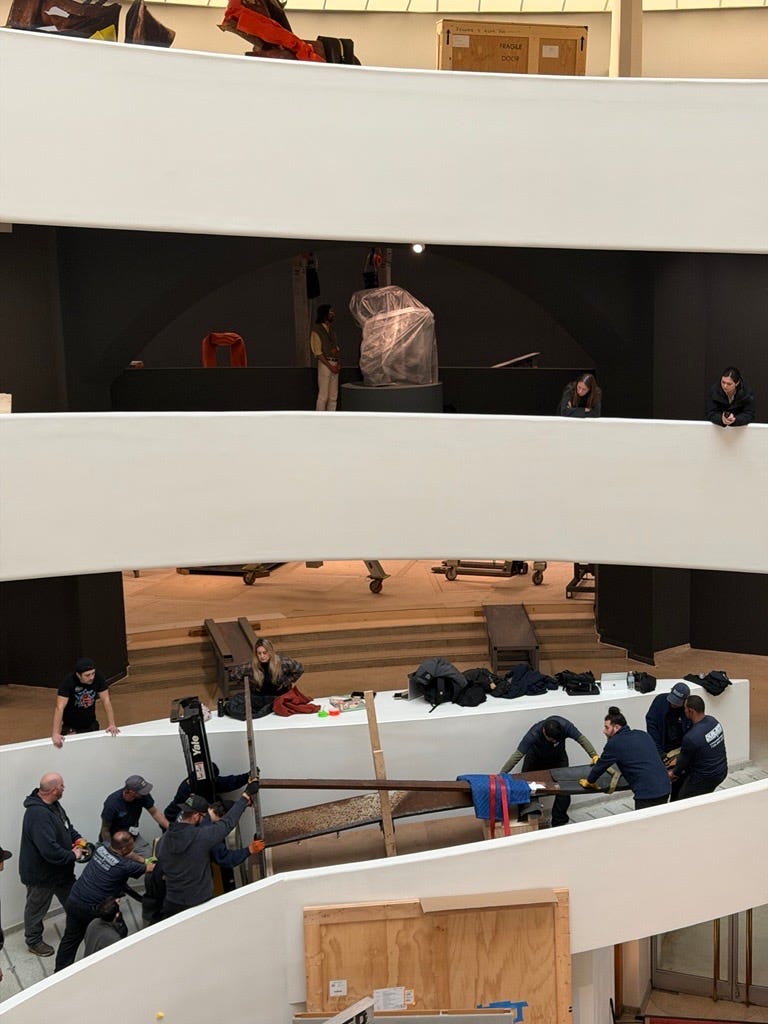
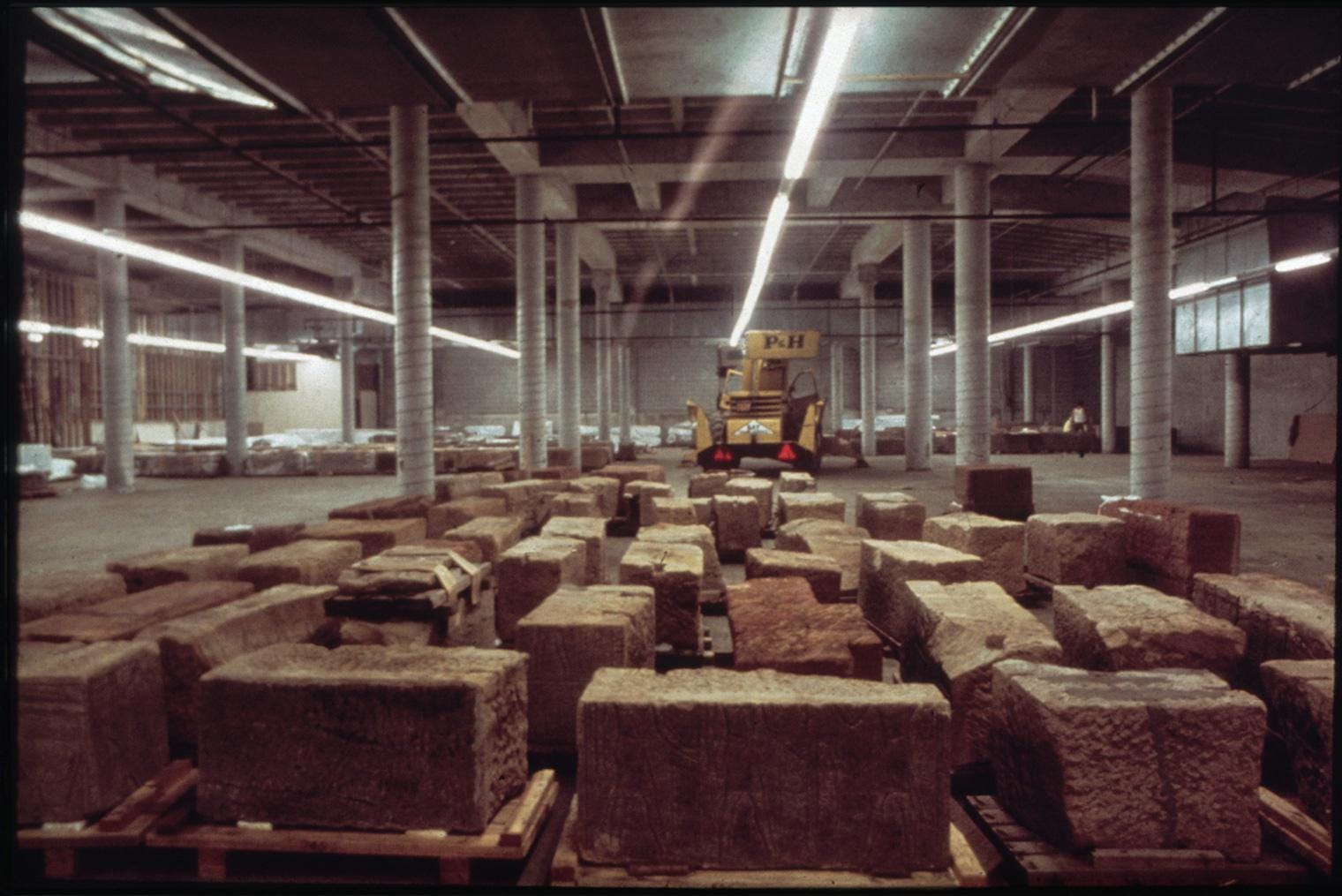
Sometimes the sculpture will arrive in one piece, but depending on its size and weight, it’s not uncommon for the artwork to be shipped in pieces to be carefully put together on site.
Remember the MET’s Temple of Dendur that I mentioned earlier? The temple was deconstructed into separate numbered bricks, then arrived at the museum to be reassembled inside the Egyptian Wing like a giant, very delicate LEGO set.
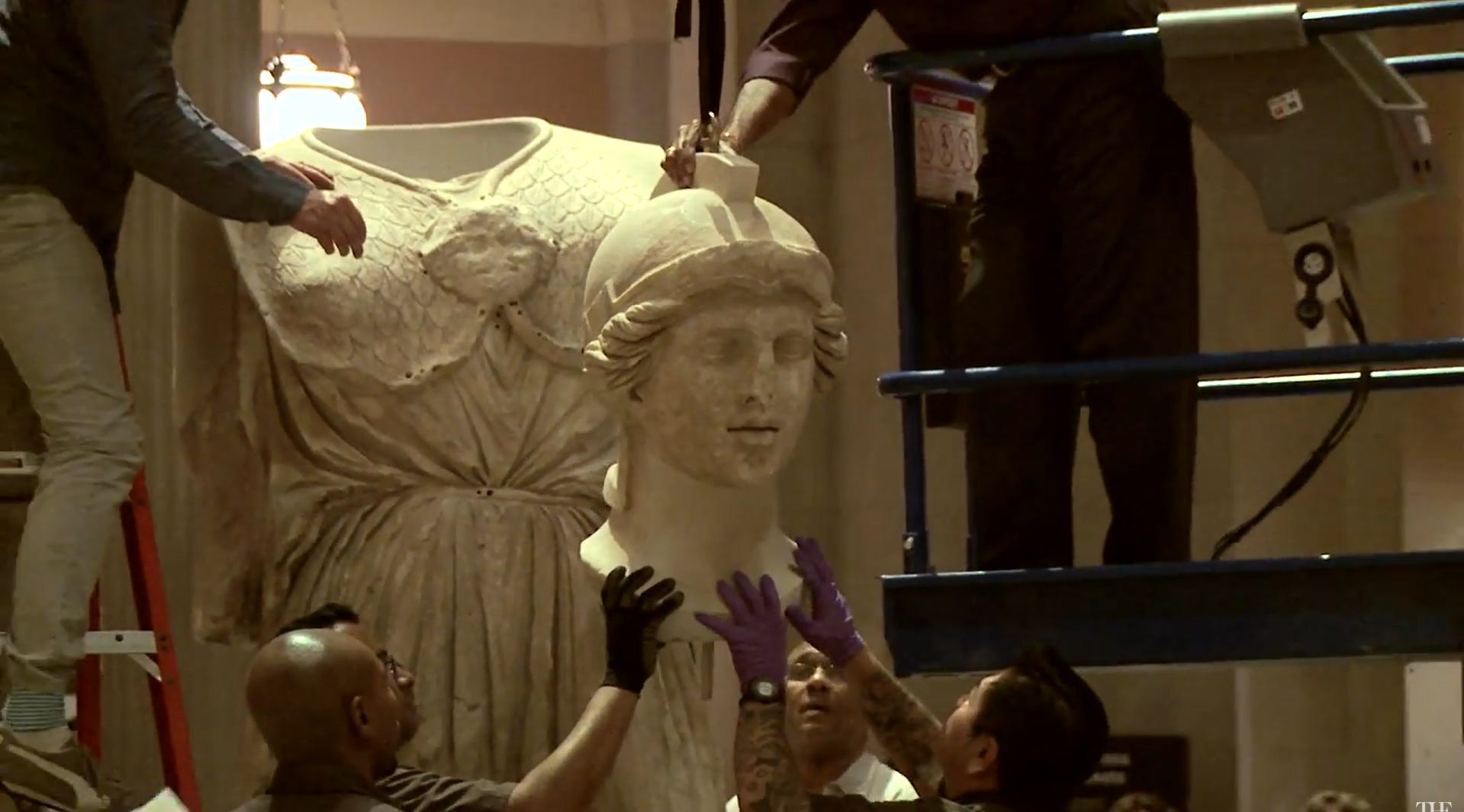
Another example of this is the Statue of Athena Parthenos, which was on loan to the MET from Berlin’s Pergamon Museum. Here, the head arrived separately from the body and was pieced together on site.
I want to walk through a specific example, because the abstract becomes interesting when it’s attached to an actual object.
What better example to use than the ultimate large-scale sculptor, Richard Serra?
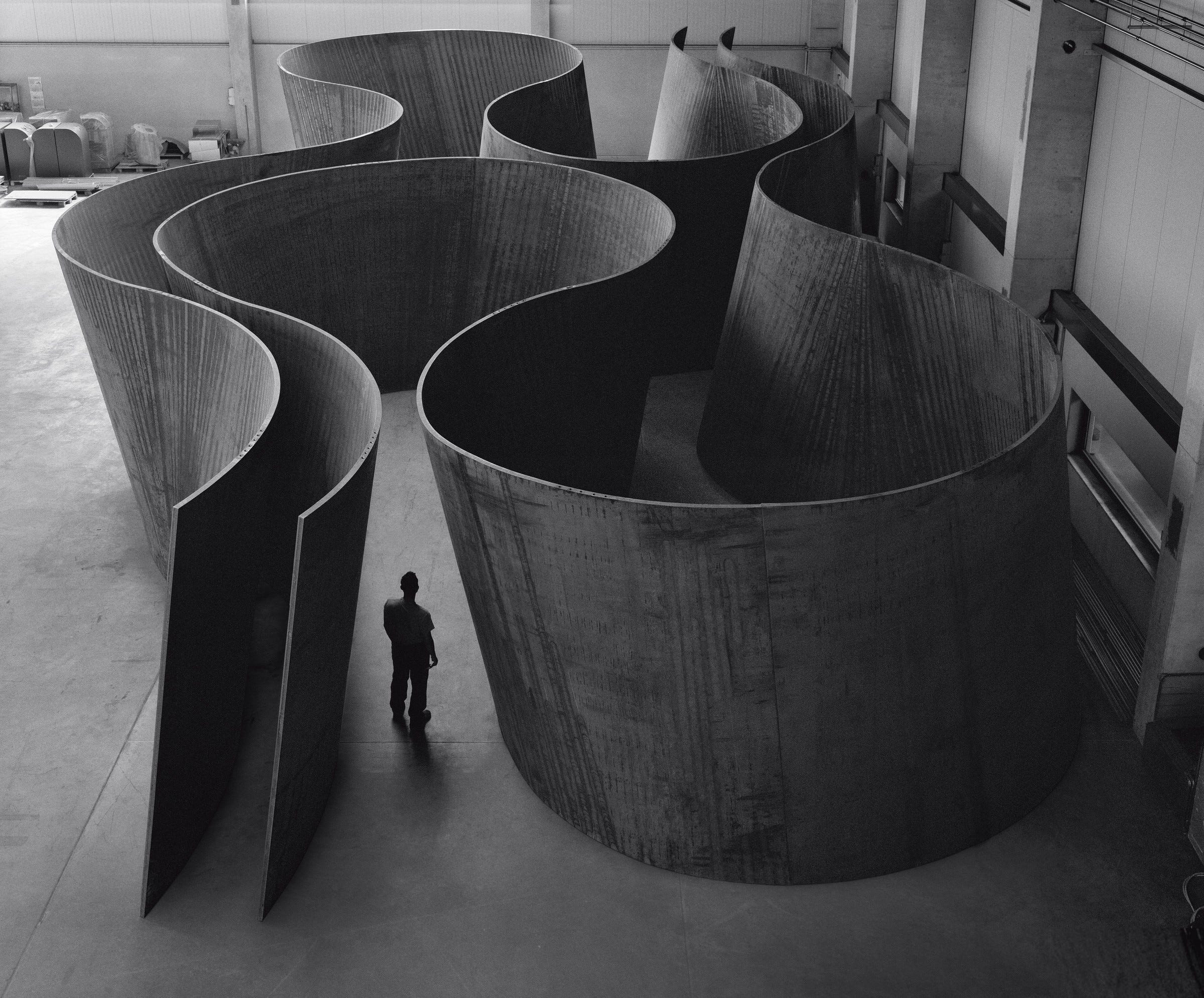
Serra’s sculptures are among the most installation-intensive works in contemporary art. The pieces are massive, some weighing upward of 500,000 pounds. His pieces are so large that they create their own atmosphere.
You don’t look at a Serra. You move through it.
The Cor-ten steel that he uses works in our favor during transport. The material is built to weather - it’s actually part of its appeal. So the pieces can be strapped directly to flatbed trucks and left open to the elements. No climate-controlled crates, no special wrapping. They can travel exposed.
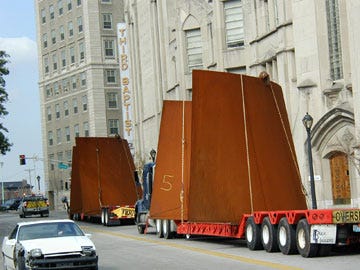
I get excited when I see someone with a mattress strapped to the top of their car. Can you imagine seeing a Richard Serra?!
ANYWAY, there is one asterisk to this open-air transport method: road salt. In cold climates, the salt used to treat icy roads can corrode the steel in ways that aren’t very nice. So let’s say that a Serra piece has to travel through New York City in February, two days after a storm. The sculptures would need additional protection. The material is tough, but it’s not invincible.
For the SFMOMA installation, the process started long before the piece reached the building. First, after a conservation review, construction cranes loaded the sculptures onto flatbeds. They crossed the city that way, exposed, enormous, occupying traffic lanes.
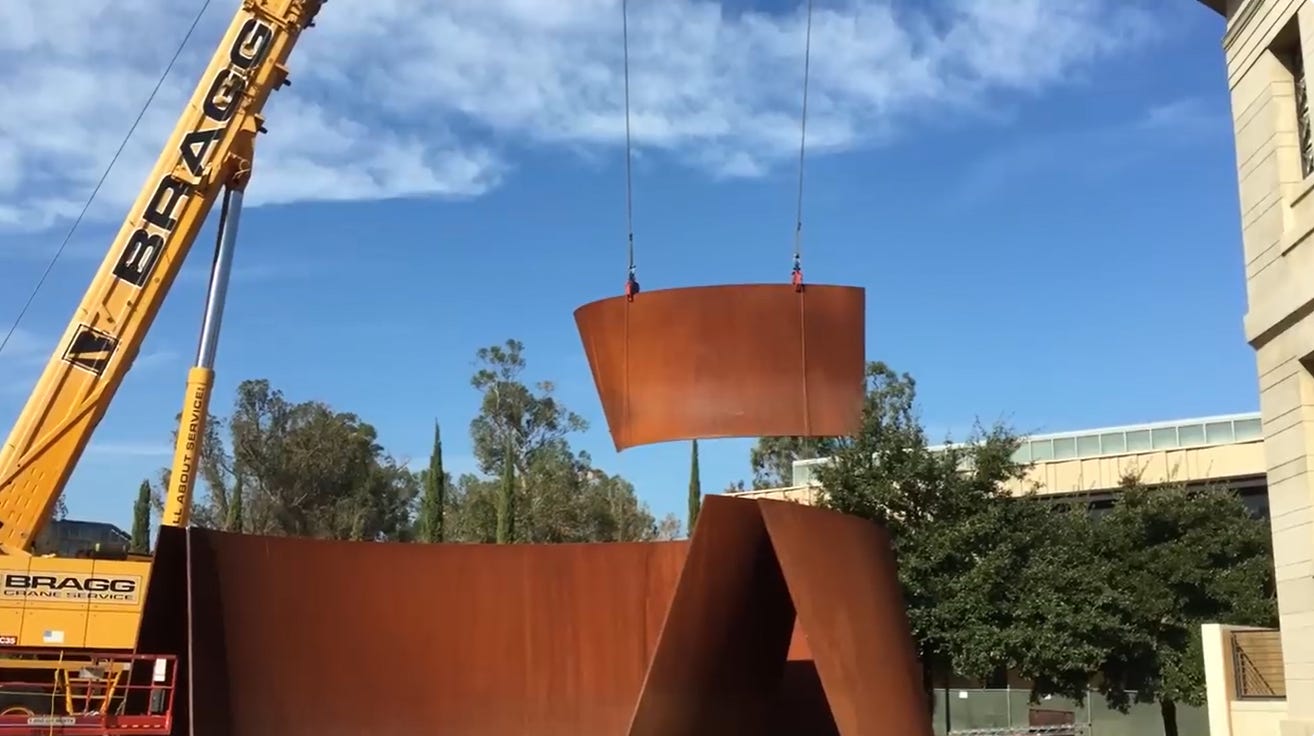
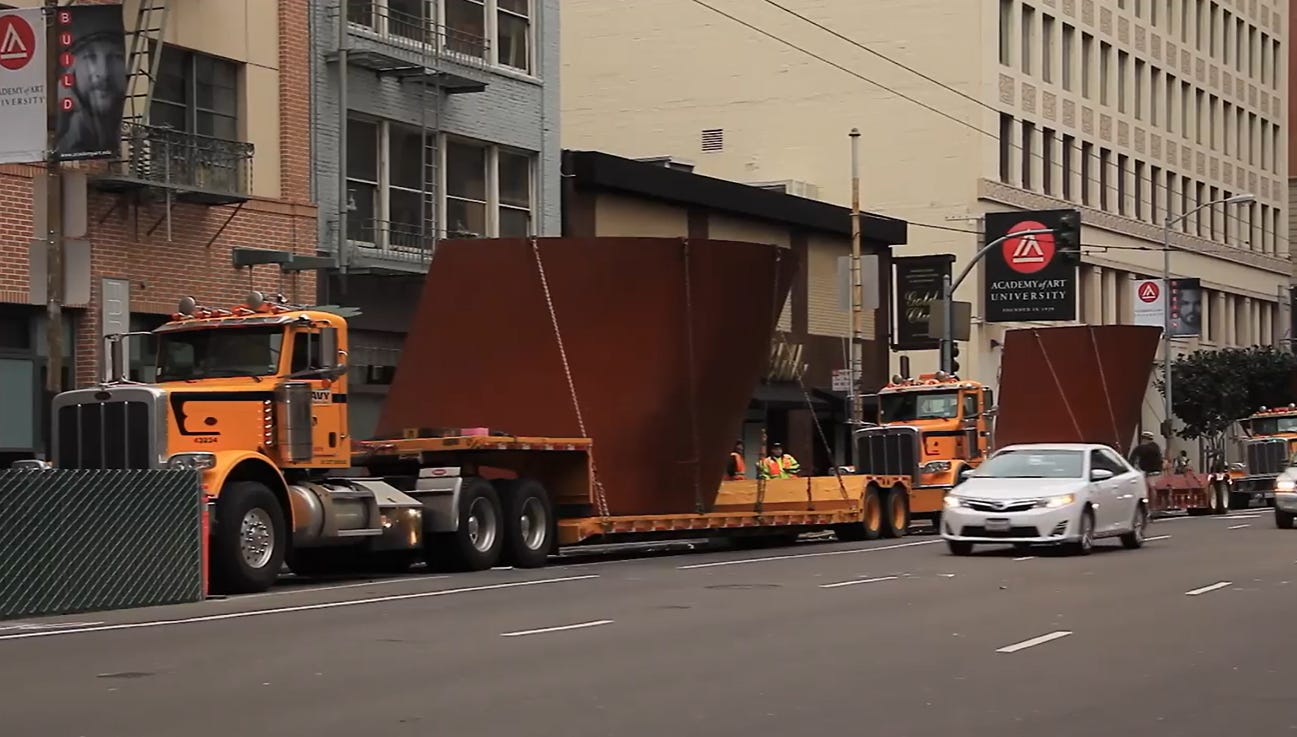
Once they arrived at the museum’s loading area, industrial-scale gantries took over.
Then came the particularly tricky part: sequence. The pieces had to go in back to front. Last position first, front position last. Get it wrong, and you’ve boxed yourself in. The installation is a puzzle, and if you’ve boxed yourself in, you’ve failed.
The only way out is to take something back out, which, at 500,000 pounds, is not a casual decision.
It sucks.
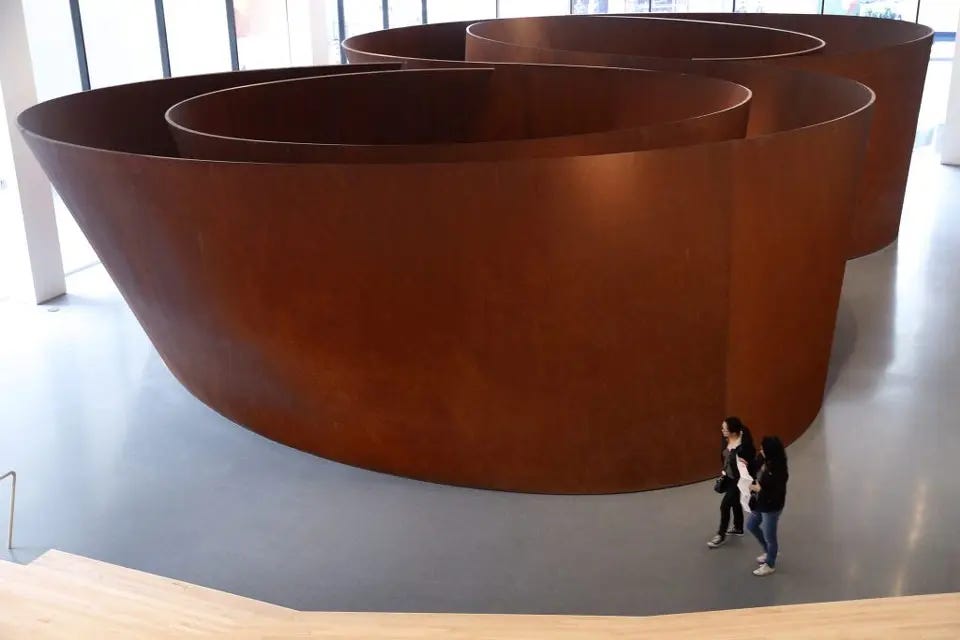
This kind of installation is discussed, diagrammed, and rehearsed in planning meetings for months before anyone touches the work. Every variable is accounted for in advance because on install day, there’s one chance to get it right.
Sometimes the work is just so big that the building has to be built around it.
The work comes first. The building comes second.
When I visited the Cast Courts at the Victoria and Albert Museum (V&A) in London last year, my eyes, like many, were instantly drawn to Trajan’s Column. How the h*ll did they get this in here?
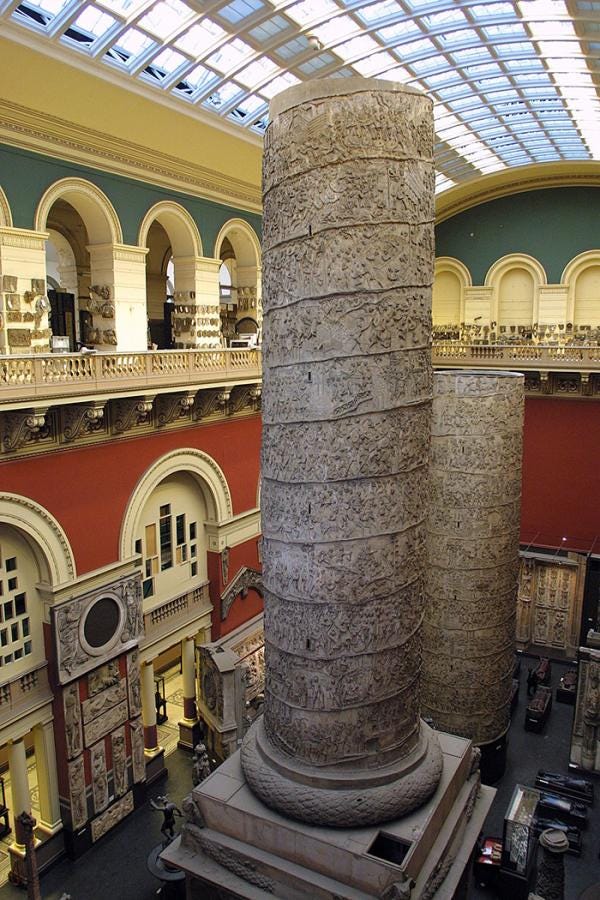
Turns out the V&A hired a military engineer to design the Cast Courts specifically to house the collection’s largest casts: the Trajan column in two parts, and wide enough to fit the 17-meter-wide copy of the Portico de la Gloria.
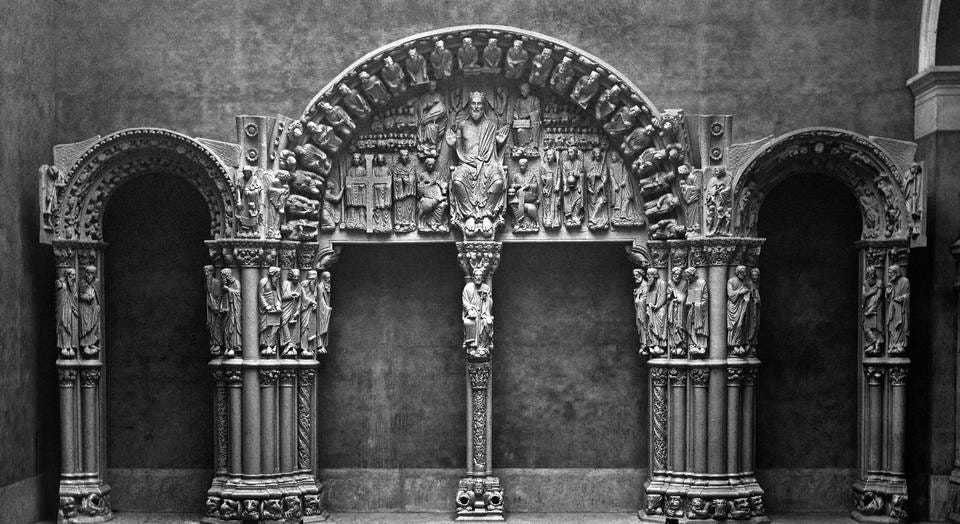
Another example is the U-505, a German submarine captured by the U.S. Navy in 1944, on permanent display at the Griffin Museum of Science and Industry in Chicago. It is 251 feet long. It is not going in or out of any door. An entire wing of the museum was constructed around it.
The submarine didn’t come to the museum. The museum came to the submarine.
In my Anatomy of an Exhibition essay, I wrote about how much invisible work goes into putting a show together. To me, large-scale sculpture is the least invisible version of it all.
When I stand in front of large or heavy sculptures, I think less about the curatorial logic (although this is still very important!) and more about the physical one. The people who assessed the weight, planned the path, built the crate, drove the truck, operated the crane, operated the gantry, placed the straps, lowered a 2,000lb sculpture within a ½” of its position, and bolted it into its final place.
Let’s all raise a glass to the art handlers, shall we?

The next time you’re standing in front of something that has no logical business being inside a building, I hope you’ll ask the question I can’t stop asking.
How did it get in here?
The answer is always the same. More carefully than you’d think.
As always, thank you so much for reading.
Best,
Alya
No posts
Comments
Nothing yet. Say the first thing.
Sign in to join the conversation.