

Dear reader
Rest assured this is no bog standard idea. Bogged down might be where James Cropper Plc (ticker CRPR) might be seen to be on a short-term drop.

So is 361p a good entry price? Can we make double-digit or triple-digit returns?…….. Or zero returns? Let’s log the growth in lieu of other views, and assure ourselves this idea isn’t one that could go down the toilet. Don’t want to come a cropper now, do we, eh?
Consternation around a short term revenue drop at CRPR won’t be for the first time. In 1H26 CRPR made a similar announcement that led to a £2.5m revenue drop in its Paper business in 2H26 so a 9% impact to its 2H26 result (to 31/3/26).


We should probably introduce CRPR and the various references to Paper. Does it produce loo rolls? Or is it a bit more upmarket than that?
CRPR is a venerable UK Paper Mill of the early Victorian era reinvented for the 21st.

Up to 750 gsm paper, embossing, feltmarks, patterns, imagine the silky box that a £1,000 iphone comes in. Yep CRPR does high-end paper products and packaging, particularly coloured-products. Loo roll - if were to produce those - would probably be 10-ply Loo Rolls sold by Harrods (darling).
CRPR through its Colourform™ proprietary thermoformed, plastic-free moulded fibre packaging solution directly targets luxury cosmetics, spirits, and consumer electronics looking to replace single-use plastic inserts and outer shells with 100% recyclable mono-materials. Because these are bespoke, branded solutions, they carry significantly higher pricing power and gross margins than standard paper grades.

CRPR’s proprietary Cupcycling™ technology upcycles single-use takeaway coffee cups into luxury paper and packaging. Corporate brands and luxury retailers pay a premium for circular packaging credentials to meet strict Scope 3 and ISO14001 compliance standards, giving CRPR a distinct advantage in commercial tendering.

Paper and Packaging (“P&P”) is the larger but less profitable part of CRPR - in fact until recently it was the loss making part of CRPR. Over the past year or so, a large guillotine has (metaphorically) been applied to reduce costs, to optimise and stabilise… and it’s worked. Special forces are at work…… more on that later.
CRPR’s strategy is about overlapping skills and core competencies between this P&P segment and its Advanced Materials business (more on that later) but also to drive asset utilisation. Paper mills have high fixed overhead costs. Volume matters. Its Paper & Packaging segment provides that, even if a proportion of its output is commodity production (aka Peak 1) alongside the higher-value Core (aka Peak 2) and aspirations to grow the Technical (aka Peak 3).
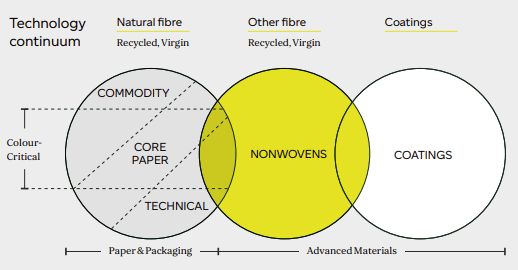
CRPR has leaned in to working with recycled materials and sustainable materials with good circularity - driven by regulation, ISO14001 and ESG expectations of buyers and consumers for its Paper & Packaging segment.
CRPR is a beneficiary to the ESG drive to replace plastic with paper products - particularly within packaging. Have you noticed your Amazon delivery no longer has those ‘orrible foam baubles? Used to. Now it’s corrugated paper, right?
So demand for paper is robust and rising. The installation of a new pulper in 2026 allows all three mill paper machines to run simultaneously. This eliminates an operational bottleneck and provides parallel running to service large jobs more efficiently.
Composites are non-woven materials used for shielding, aerospace, defence, automotive and sporting goods.
Energy solutions is coatings and substrates for wind turbines, BESS, and the Hydrogen economy.
These markets are growing rapidly and few companies have the skills to do what CRPR does.
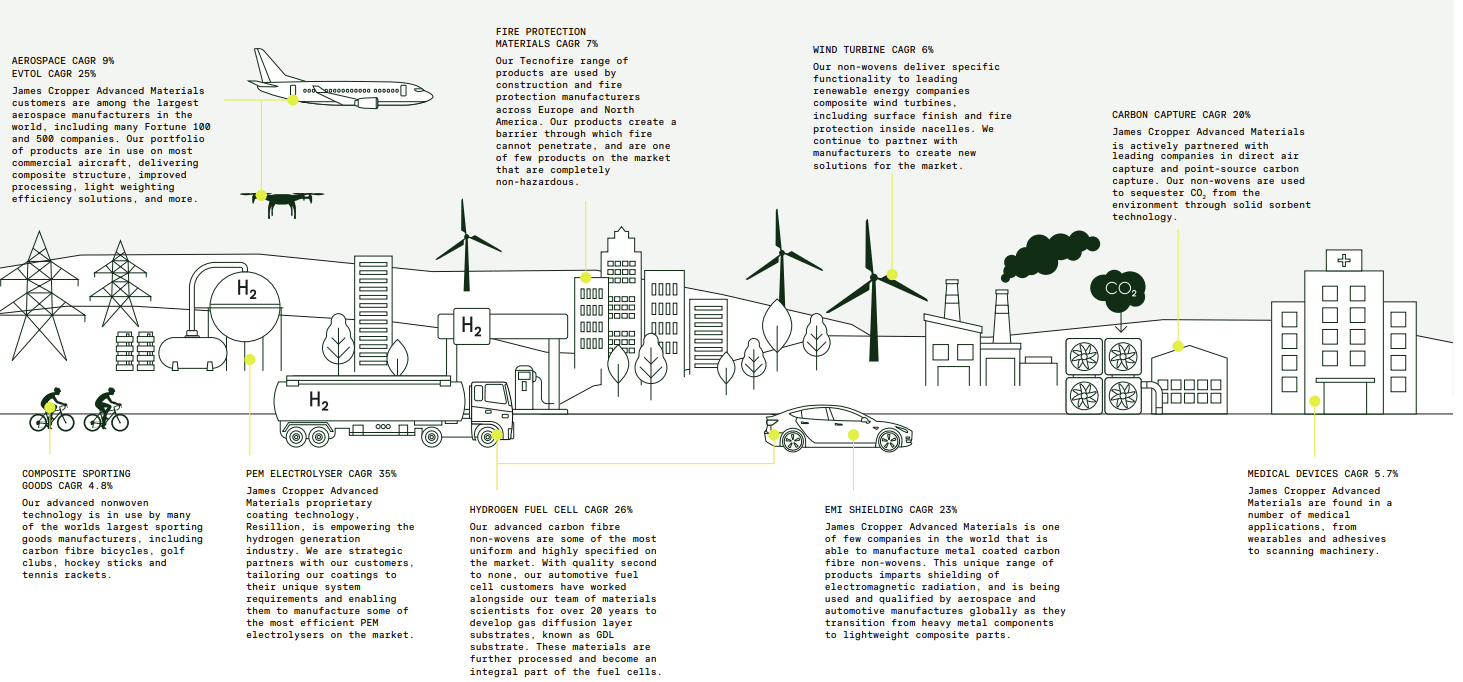
These markets are rapidly growing although in fits and starts. There might be a fit in the short run for Hydrogen Production Side.
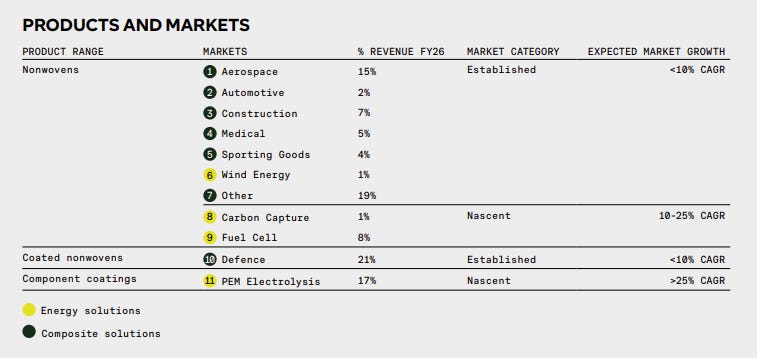
…. Well it’s a good thing that CRPR plays both sides. CRPR is hedged across both sides of the hydrogen economy:
Production Side (Electrolysers): Resillion™ coatings for Bipolar Plates and Porous Transport Layers (currently facing a lumpy project queue).
Consumption Side (Fuel Cells): Carbon fiber GDL substrates and catalysts (providing a steady, 30-year legacy baseline).
Degradation significantly increases operating costs over an electrolyser’s 10-year lifespan. PEM is a type of electrolyser. It takes unwanted power (e.g. from surplus renewables) and turns it into Hydrogen Fuel.
CRPR’s Resillion™ lowers degradation rates to ~3.9 μV/h (beating the US Department of Energy benchmark of 4.8 μV/h), saving customers >$0.43m in operating costs per 5MW system over 80,000 hours (10 years).
CRPR say growth of its Resillion is >25% CAGR.
The IEA tells us the worldwide installed capacity of Electrolyser production is 7GW. Capacity growth is growing far faster than the 25% that CRPR say demand is growing. To be fair CRPR say “more than 25%”. But look below it’s much more.
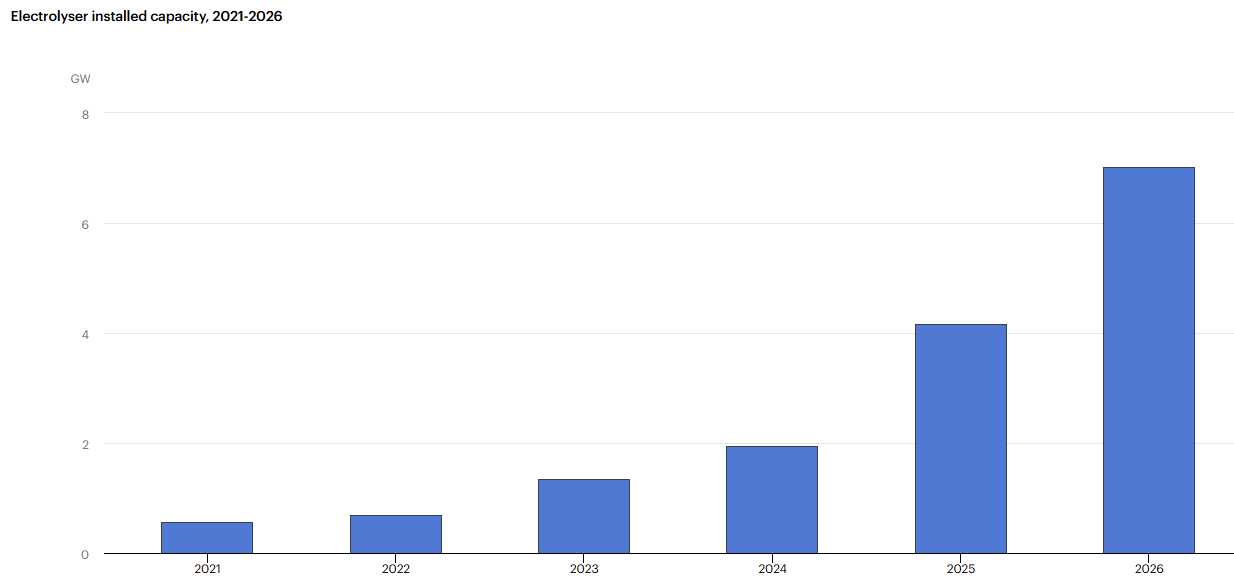
Bobby Bosch opens its 1GW PEM factory later in 2026. Siemens 1GW PEM factory is expanding to 3GW. Even ITM Power has doubled from 0.1GW to 0.2GW. Capacity to produce electrolysers far exceeds demand growth for electrolysers, currently.
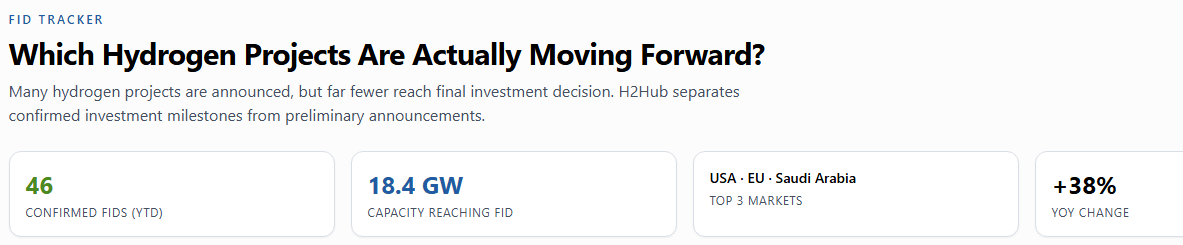
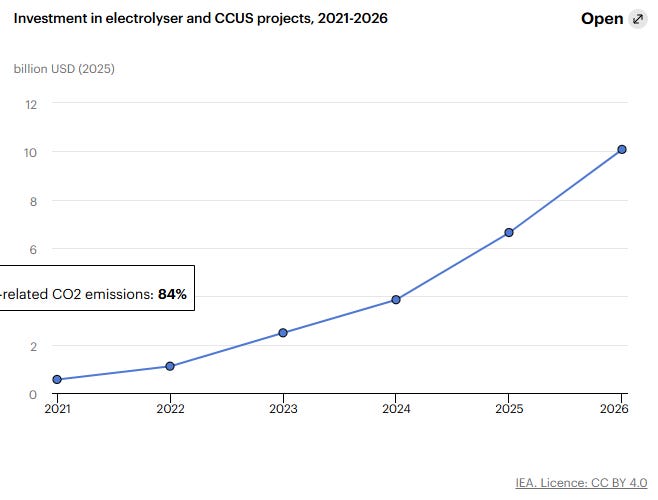
But investment isn’t zero. Investment is growing and hit $10bn this year up over 50% from $6.4bn the year before.
Yeah yeah yeah mutter detractors. So what?
So what if CRPR gets its PEM customers outta the CRPR? What if CRPR has a USP that its competitors - Bekaert, Impact and Von Ardenne - can’t match? CRPR is the only one that has Resillion - the stuff that saves its customers $0.43m over ten years right?
What then? Will they choose moderate degradation of Voltage or very low? Will they choose the lowest TCO or not?
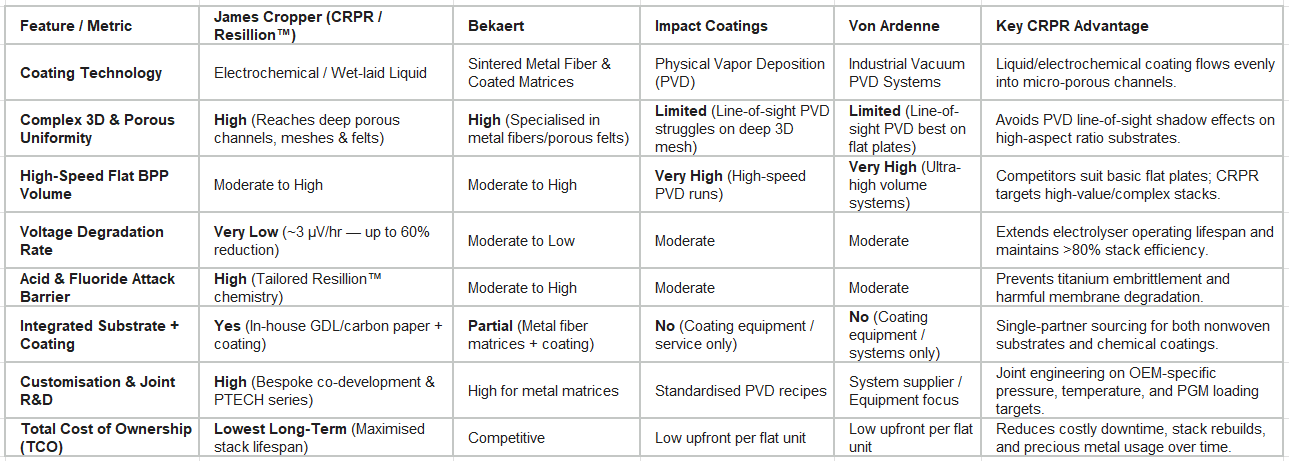
The added cost of paying more for CRPR to get you out of the CRPR vs the risk of expensive repairs (perhaps at an offshore wind farm) going offline through degraded anodes and cathodes is a no brainer.
But did you also spot it’s not just about lumpy Electrolyser demand either.
I said CRPR is play-hedged across both sides of the hydrogen economy:
Production Side (Electrolysers): Resillion™ coatings for Bipolar Plates and Porous Transport Layers (currently facing a lumpy project queue).
Consumption Side (Fuel Cells):
(providing a steady, 30-year legacy baseline).
Sucker-puncher Bobby Bosch and other Electrolyser Manufacturers might be weeping over their lumpy green hydrogen electrolyser project timelines, CRPR’s fuel cell business keeps ticking over at 20%+ CAGR regardless. Detractors have not understood that the electrolyser tech is only part of the story and pure high-margin upside optionality sitting on top.
Fuel Cells are used in Mobility across:
A. Heavy-Duty Transportation & Commercial Fleets (The Primary Growth Driver)
Class 8 Long-Haul Trucks & Buses: OEMs like Hyundai, Daimler Truck, Volvo, and Toyota (with its Gen 3 fuel cell stack) are actively deploying heavy-duty fuel cell vehicles. Because battery weight restricts payload on 500+ mile long-haul trucking routes, hydrogen fuel cells remain the primary zero-emission path for heavy freight.
Asian Transit & Municipal Fleets: China, Japan, and South Korea dominate current volume orders for GDL materials, having deployed thousands of fuel cell buses and commercial delivery vehicles.
B. Stationary & Backup Power (Data Centers, Telecom, Hospitals)
Grid Bottleneck Relief: Uninterruptible Power Supply (UPS) systems and off-grid power generation rely heavily on PEM fuel cells. Companies like Bloom Energy and Ballard Power supply data centers and critical facilities needing behind-the-meter power.
C. Aerospace & Defense (High-Margin Niche)
Specialty nonwovens and GDL substrates are utilised in high-altitude unmanned aerial vehicles (UAVs), submarine AIP (air-independent propulsion) systems, and specialized aerospace power units where weight efficiency is essential.
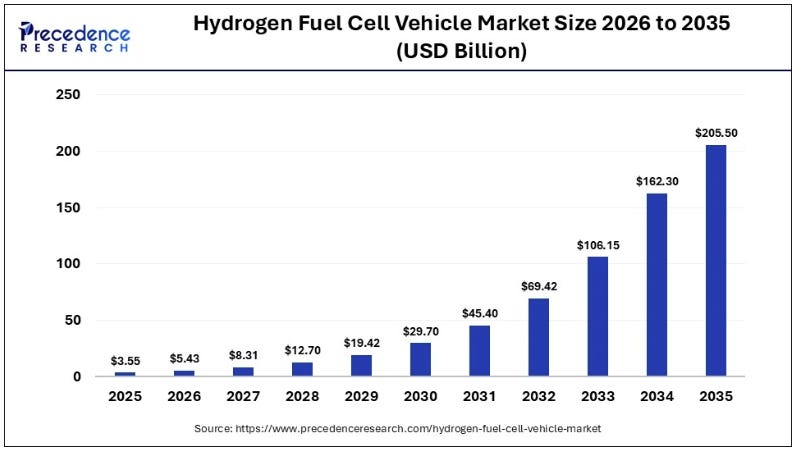
Global GDL Market Valuation~$1.6bn – $2.0bn
Projected CAGR (2026–2035) 28%–30% per year
Fuel Cell Vehicles are forecast to REALLY grow.
35+ Years of Nonwoven Fiber Engineering Expertise:
While many suppliers adapted standard papermaking techniques for carbon, CRPR leveraged over three decades of nonwoven carbon fiber development (since 1988). They use a specialised wet-laid nonwoven process that aligns individual carbon fibers with extraordinary precision.
Exceptional Thickness Uniformity & Compressibility:
Cell stack assembly subjects GDLs to intense mechanical pressure. CRPR substrates offer controlled compressibility. They flex without crushing the porous network, ensuring uniform contact pressure across the entire Membrane Electrode Assembly (MEA) and avoiding pinholes or short circuits.
Optimised Pore Network for Dual-Phase Water Management:
The primary cause of PEM fuel cell failure/performance drop is either flooding (water clogging the pores) or drying out. CRPR designs its carbon fiber matrices with a customisable pore size distribution, making it ideal for receiving hydrophobic (PTFE) treatments and Microporous Layer (MPL) coatings smoothly.
Ultra-Low Areal Weights with High Mechanical Strength:
Their carbon nonwovens are available in lightweight grades down to 17 g/m² while maintaining high tensile strength (up to 90 N/15mm for thicker variants). This offers stack designers significant volume and weight savings for automotive and heavy-duty transport applications.
Superior Chemical and Corrosion Resistance:
Formulated to withstand harsh acidic environments (especially on the cathode side where liquid water and oxygen interact), preventing carbon corrosion over tens of thousands of operating hours
There is a similar logic for other products serving markets such as aerospace and defence. Reliability, reduced manufacturing complexity and product performance are key. Failure is not an option in aerospace. Not even for Boeing. The lightness of wet laid nonwovens and consistency can provide an edge as an advanced material.
Take CRPR’s newly launched VECTIS™ platform and UNIMAT™ products for example. A massive commercial unlock - let me explain why.
Historically, the structural composites industry faced a major dilemma:
Continuous Carbon Fibre / UD Tapes (High Performance, High Cost): Strong in a single direction, but stiff, difficult to mold around complex shapes, expensive, and non-circular and difficult to recycle.
Standard Nonwovens / Short Fibres (Low Performance, Low Cost): Easy to shape and mold around complex parts, but weak because the short fibers point in random directions.
The VECTIS™ Breakthrough:
CRPR engineered a way to take discontinuous/short fibres (including recycled carbon fibre and post-industrial waste) and align them to ~95% directional orientation on standard nonwoven manufacturing lines at industrial scale (up to 1,200mm widths).
Through their UNIMAT™ mats, they now provide the strength and stiffness of premium directional composites alongside the complex, formable flexibility and lower cost of recycled nonwovens.
Boom!
The Aerospace & Defence Pathway
Partnership with Hexcel & ECCA: CRPR partnered directly with Hexcel (a global leader in aerospace composites) via the European Composites Circular Alliance (ECCA) to develop UNIMAT for structural aerospace parts.
Economic Drivers: Fuel accounts for over 90% of an aircraft’s lifetime emissions and up to 30% of airline operating costs. Replacing heavier or virgin-carbon parts with high-performance recycled carbon nonwovens reduces airframe weight while satisfying strict ESG/circular economy quotas for next-gen commercial fleets and for Advanced Air Mobility (AAM / eVTOLs).
Scalable High-Volume Markets: Automotive & Sporting Goods
Formability for Mass Automotive: Traditional composite prepregs wrinkle when stamped into complex automotive geometry. UNIMAT’s conformability allows rapid compression molding, stamping, and Resin Transfer Molding (RTM) without wrinkling, opening high-volume automotive production lines.
Circular Supply Chain Solution: Auto OEMs face strict EU regulations on end-of-life vehicle recycling. VECTIS allows them to recycle carbon composite scrap back into structural vehicle components rather than sending it to land-fill or low-grade fillers.
VECTIS isn’t just an experimental R&D win—it solves the multi-decade challenge of industrialising aligned discontinuous fibres. By launching UNIMAT commercially alongside premier partners like Hexcel, James Cropper has created a bridge to capture high-margin growth across the multi-billion dollar structural composites, aerospace, and eVTOL markets.
Nowhere is Vectis in the price. Qualification and adoption will take time so I’m not presenting this as an imminent fillip, but you are buying into a disruptive technology that solves a real engineering problem.
Revenue appears fairly pedestrian but underneath the surface we see a growing advanced materials business. I believe it’s going to grow faster in FY27 despite their cautious update.
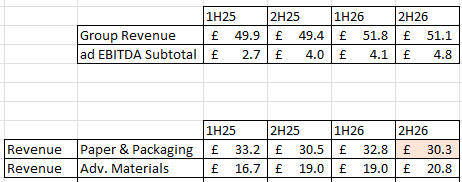
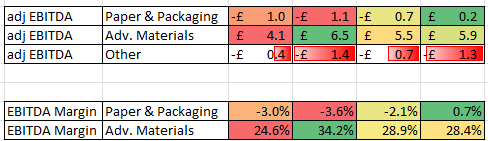
And a Paper & Packaging business that has cut fixed costs and improved its margins. Moving to a 5-day shift pattern and fixing the pulper bottleneck pushed P&P back to positive EBITDA in H2 FY26 (£0.2m).
Large cuts have been made since FY24 where you can CRPR was a larger business but a far less profitable one. I’ve calculated a cost of sale (and therefore a gross profit) assuming that materials and direct labour are the components of cost of sale (COS) to understand gross profit.
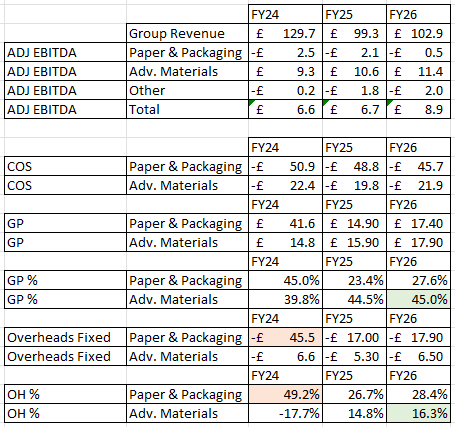
It is pleasing to see a growing (estimated) 45% GP margin for the AM segment and a 27.6% GP margin for the P&P segment. It appears something like a 60% reduction in fixed costs for P&P has been achieved in FY25/FY26, although input costs of energy and global pulp could present a challenge if inflation spikes again.
I do see this as another Hardide in the making. Traditional British company muddled along for years but has been innovating and will see contract wins over the coming year(s) or perhaps month(s).
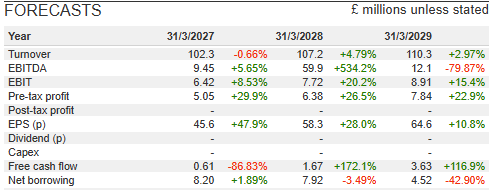
Of course being right might take longer than months, due to the short term outlook decline for hydrogen coatings, but I’d rather buy in at what I see as an advantageous price into a market that is growing at 50%.
If Advanced Materials expands top-line revenues by £8m (~20% CAGR) at a ~45% gross margin, approximately £3.6m in incremental pre-tax profit flows down to the bottom line.
Consensus Comparison: Achieving this performance would roughly triple conservative consensus broker estimates for FY27.
Earnings Multiple: This trajectory reduces the forward P/E from 11.7x to under 8x.
Balance Sheet Safety: Net debt has been reduced to £8.1m (<0.9x EBITDA) following a £7.1m bank loan repayment, supported by a £15m invoice factoring facility.

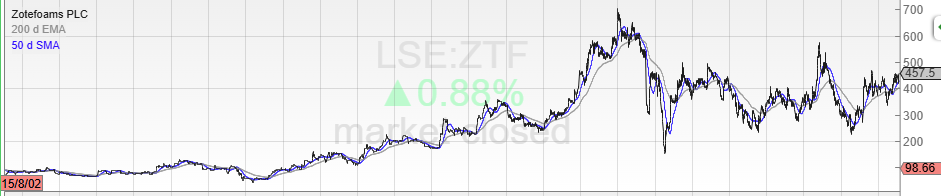
CEO David Stirling took the wheel 12 months ago after leading Zotefoams plc for 24 years. What he did before is just history.
He transformed Zotefoams from a localised foam manufacturer into a global technology powerhouse, landing an exclusive global supply deal with Nike. Applying that exact commercialisation playbook to James Cropper’s non-woven IP is Stirling’s opportunity to repeat his success here.
Why else would he have joined CRPR? His eye for a 10-ply loo roll? Don’t talk CRPR. And take his new leadership seriously - he has sass.
At a £34m Market Cap against a Net Asset Value of £24.4m, CRPR is significantly undervalued. You get a stabilised luxury paper business providing cash flow cover, led by a proven CEO, with high-margin Advanced Materials IP delivering 45% gross margins and 20%+ growth prospects (and the rest).
I’m relaxed about the short-term lumpy outlook in hydrogen coatings - at sub-5x EV/EBITDA, considering the IP and medium term commercial potential for that IP it’s a price well worth paying when you consider their IP.
Regards
The Oak Bloke.
Disclaimers:
This content is for educational and informational purposes only. It does not consider your personal circumstances and is not financial, investment, tax, legal, or professional advice. Nothing here is a recommendation, offer, or solicitation to buy, sell, or hold any investment. Investing involves risk, including the loss of capital. You are solely responsible for your own decisions
Micro cap and Nano cap holdings might have a higher risk and higher volatility than companies that are traditionally defined as “blue chip”
Comments
Nothing yet. Say the first thing.
Sign in to join the conversation.