

Dear reader
Fair Oaks (ticker LON:FAIR) is one of the OB picks from 2024 that continues to deliver Cash. FAIR is a collateralised loans manager where the underlying debtors are Corporate businesses like McAfee, Ineos and Exact plus hundreds of others you’ll probably have never heard of. To buy FAIR you need to prove you’re a sophisticated investor so spruce yourself up reader, if you choose to partake.
The fund achieves its target 12%–14% return primarily through the spread differential between its asset income and its financing costs:
Weighted Average Asset Yield: The portfolio’s underlying loans generate a spread about +3.5% over benchmark rates (SOFR/EURIBOR).
Cost of CLO Financing: The fund’s CLO structures borrow at an average weighted cost of EURIBOR/SOFR + 1.80%.
The Arbitrage: By locking in cheap, long-term non-recourse debt (1.80%), the fund captures a ~1.70% net interest margin on a leveraged base, which translates over the full cycle into an annualised yield on current market prices of around 30% across its CLO Subordinated (Equity) Notes, although there is a drop this month which requires explanation (see Section 2)
Three months ago in “Fair Oaks” I described progress to April. Where are we today?
Let’s look at what happened when geopolitical tensions boiled over in the Middle East and fears over AI and the SAAS-pocalypse hitting the US software sector sent retail investors scrambling for the exits. Are we out of the woods? (No pun intended)
In March, US software loans got absolutely hammered, trading down to a miserable average of $0.88 on the $1. Panicked investors saw ‘CLO’ and sold everything. Look at what it did to FAIR’s share price vs. its actual underlying value:
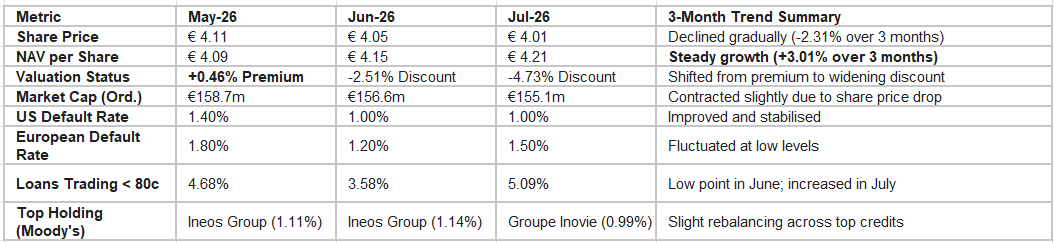
Share Price: Plunged an ugly -9.4% in March, dropping down to about €3.80. Today it is €4.01
Underlying NAV in March: Actually rose +0.30%!
Since then the NAV has risen a further +3% in the past two months to €4.209 per share. That’s 18% annualised.
May NAV: €4.086
June NAV: €4.154 (+1.67%)
July NAV: €4.209 (+1.32%)
Because of this rise in NAV the discount is now about 5%.
FAIR is focused on European CLOs (91%) with a legacy 9% of US assets.
Older Deals (Reinvestment Period Ended 2025–2026):
Deals like FOAKS 1X, 2X, 3X, and 4X have reached or passed their reinvestment end dates.
They yield massive cash flow (annualised yields on previous market price ranged up to 50.4% but are now in the high-20s to low-30s) because borrowers are actively paying down and returning capital.
The Risk: As these mature and pay down, the manager must redeploy capital into new transactions (like ALLEG 2025-1X or FOAKS 6X) to maintain the fund’s income generation.
Newer Deals (Reinvestment Period Through 2028–2030):
Deals like FOAKS 6X (2030) yield a lower cash distribution today (12.2%), but provide 4+ years of guaranteed reinvestment runway, investing into tomorrow’s maturation and massive cash flows.
FOAKS 7X was marked at 81.8% of par in July (much higher than the ~50% average of the older equity book). Because it is a sizeable position, adding it at that elevated mark lifted the overall equity weighted average from 50.5% → 54.8%.
FOAKS 7X arrived at the right time. Almost every other existing FOAKS deal saw its valuation decline in July:
FUND VALUATION (PERCENT OF PAR)
FOAKS 1X: 37.3% → 38.6% (small up)
FOAKS 2X: 27.2% → 26.4%
FOAKS 3X: 41.5% → 39.2%
FOAKS 4X: 54.1% → 51.1%
FOAKS 5X: 71.0% → 69.3%
FOAKS 6X: 77.3% → 76.1%
USD equity positions also softened slightly (ALLEG 2021-1A 37.0% → 34.0%; ALLEG 2025-1X 69.5% → 68.0%).
Without FOAKS 7X, the weighted average would almost certainly have been flat to down. These decreases are at least partly the natural decay of mature CLO equity — high cash distributions partly represent return of capital, so the positions gradually shrink.
However there’s another effect: The July equity yield is down - a lot - to 17.6%.
May: 31.8%
June: 31.3%
July: 17.6%
Ouch?
The FOAKS 7X CLO is no longer a warehouse but is now a CLO stuck at 0% yield until Jan 2027. This nil points is dragging the average yield down. The much newer FOAKS 5X and 6X are also dragging down the average.
Cash Yield breakdown:
FOAKS 1X: 29.5%
FOAKS 2X: 32.9%
FOAKS 3X: 32.9%
FOAKS 4X: 33.2%
FOAKS 5X: 15.0%
FOAKS 6X: 12.2%
FOAKS 7X: 0%
The Master Fund received €6.4m cash in the latest quarter versus €7.7m in the prior quarter. The report itself attributes this drop to seasonality and the ongoing pressure on excess spread from loan repricing. When existing loans in the CLO portfolios get refinanced or amended at tighter (lower) spreads, the CLO earns less interest income than before. That reduces the “excess spread” — the leftover cash that flows down to the equity tranche after the CLO has paid its own financing costs and expenses.
CLO equity only receives cash after the senior debt has been paid. If defaults rise far enough, interest is diverted away from the equity to protect the senior notes.
Across May–July the average OC test cushion on the equity positions stayed in a tight 4.3–4.5% range (and a similar level on the mezzanine notes). At current default rates of roughly 0.9–1.5%, this still provides meaningful headroom before distributions would be at risk. That’s a good outcome considering 2026 hasn’t been the easiest of years.
Currency: ~91% euro-denominated. The old currency mismatch has been largely eliminated.
Sector focus: The largest exposures remain Services: Business, Healthcare & Pharmaceuticals, and High Tech Industries — relatively defensive areas that have helped keep defaults low.
These non-cyclical sectors reduce exposure to consumer discretionary slumps, helping keep defaults low even during broader macroeconomic slowdowns.
Show me the money. FAIR can.
With an annualised inception-to-date NAV return of ~8.9%, the structural clean-up complete (Realisation Shares redeemed, single Ordinary share class, currency alignment improved), a fresh long-reinvestment engine in FOAKS 7X, and a discount that still offers a modest margin of safety, FAIR has navigated a sticky patch in 1H26 and emerged in decent shape.
The portfolio continues to generate attractive cash distributions, even if the precise yield on market price fluctuates with marks and the mix of old versus new deals.
The structural repair is done. The currency mismatch is largely gone. It is looking more than FAIR Euro-nough.
Regards
The Oak Bloke.
Disclaimers:
Disclaimers:
This content is for educational and informational purposes only. It does not consider your personal circumstances and is not financial, investment, tax, legal, or professional advice. Nothing here is a recommendation, offer, or solicitation to buy, sell, or hold any investment. Investing involves risk, including the loss of capital. You are solely responsible for your own decisions
Micro cap and Nano cap holdings might have a higher risk and higher volatility than companies that are traditionally defined as “blue chip”
Comments
Nothing yet. Say the first thing.
Sign in to join the conversation.