

Dear reader,
Diversified released their 1H26 results.
$70m of debt reduction in 1Q26 was good to see. But a further $163m of debt reduction was achieved in 2Q26 bringing 1H26 to a total of $233m of debt retirement. That brings the ratio of debt to TTM adj.EBITDA to just 2.45X down from 2.9X.
DEC now has $678m of liquidity (cash plus borrowing headroom) despite aggressive use of liquidity in acquiring a series of acquisitions, including Camino.
The effect of Camino is to increase net debt from $2.76bn to $2.83bn as at 30/06/26.
Debt reductions are in addition to the $93m of shares bought back in 2026. Over $300m of buybacks since IPO. Currently 70.76m shares in issue.
Buybacks are in addition to the $43m dividends YTD too.
So Debt Reduction (increase of EV), buybacks and dividends represents $369m of value beneficial to shareholders in six months. Returns of roughly 40% of the market cap of $904m….. in six months!
-
Some of that cash flow is thanks to land sales. After achieving $101m of land sales in 1Q26 did anyone expect DEC to top that in 2Q26? If they did they were rather circumspect. The news that $25m more land sales in 2Q26 and $147m for 9 kboepd of producing well so $273m of asset sales in 1H26 is incredibly exciting. Nowhere in the price. Further land sales are forecast to slow to around $9m in 2H26.
Those asset sales equate to about 50% of the $0.55bn cost of acquiring Canvas.
Of course it was not just disposal of leasehold land it was disposal of producing wells too. But considering past acquisitions have been at an average 3X EV/EBITDA disposing of assets at 8.5X EV/EBITDA in Arkansas and 10X in Barnett seems an extremely accretive deal. Buy stuff that earns $0.33 per dollar, sell stuff that earns $0.10 per dollar - right?
DEC is launching its first-ever operated drilling campaign ($145m capex committed total over 2026–27; $35–50m in 2026) in Oklahoma via a one-rig program led by COO Rick Gideon. By 2027, this—combined with non-op programs—could make DEC fully organic/decline-neutral, removing its dependency on continuous acquisitions.
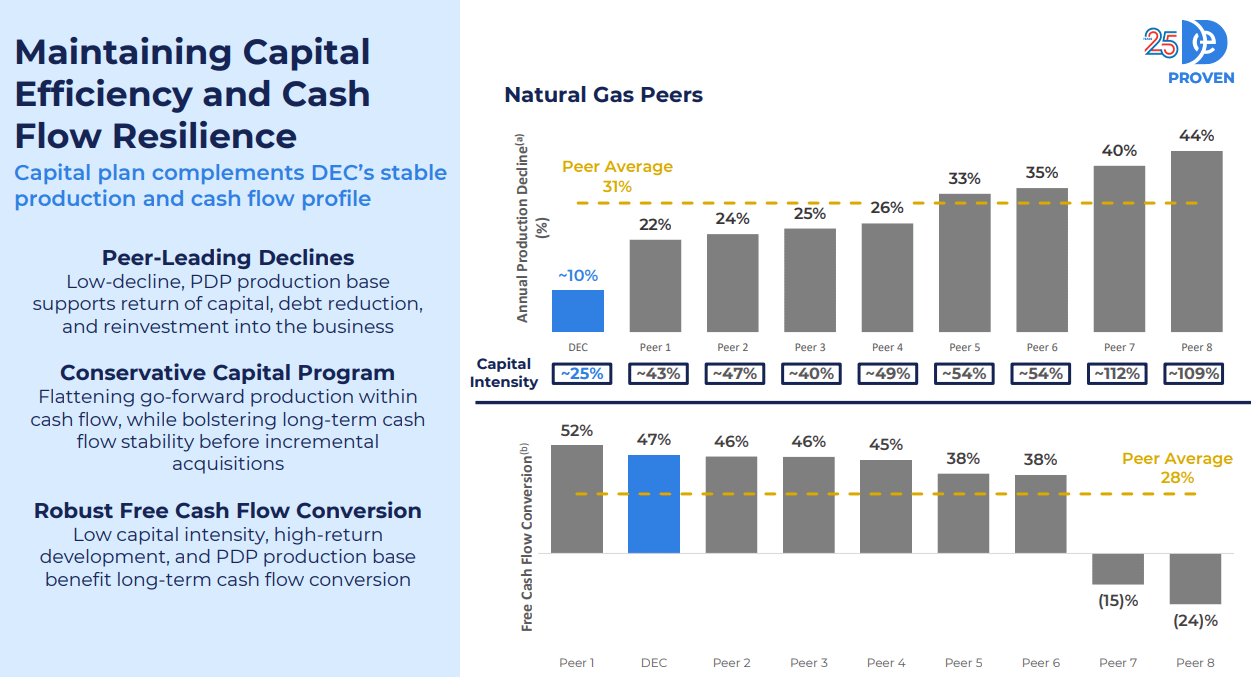
209 Kboepd average production and -25 kboepd gross decline is 12.5%. But non-operated development is expected to offset half of that putting declines at 6.2%. They describe themselves as a ~10% decline (perhaps meaning for Nat Gas alone?). DEC the hypermiler continues to lead the race as the Tortoise capable of “staying awake” for decades to come vs the Hares facing vast declines and steeply heading back towards sleepiness…. who shall win the race? The race for longevity is already won for the Tortoise - mark my words - once new well productivity declines according to Hubbert’s Peak the Hares will be in trouble….. it’s a matter of time.
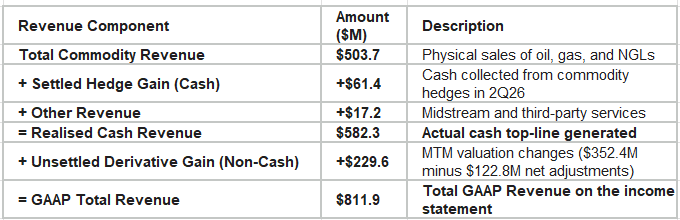
$565.1m of product sales including settled hedges at 209 kboepd equals 19.02mm BOE which equals an average $29.71 per BOE.
Given the 71% Nat Gas, 15% NGL and 14% Oil split that implies $16.80 per BOE of Nat Gas, $48.50 for NGLs and $75 for Oil to arrive at a blended $29.71 per BOE. That means Nat Gas contributed about 40% of the cash despite being 71% of product. This is actually a big improvement on 2025 when it contributed 35% at $15.30 per BOE in 2Q25 vs $16.80 in 2Q26.
The drop is actually in NGLs $74 per BOE dropped to $48.50 in 2Q26 and Oil from $82 in 2Q25 to $75 in 2Q26.
Production at 209 kboepd is much higher than the 192 kboepd achieved a year back meaning adjusted EBITDA ignoring the effect of land sales (which was substantial in 2Q25)

An average $23.28 per BOE achieved was slightly down from last year (-$0.18) but Operating Costs per static on a per BOE basis at -$12.54 per BOE which was achieved despite a 9% jump in employees, administrative costs and professional fees from -$1.38 to -$1.50 per BOE. A corresponding $0.12 reduction was achieved in transport and lease operating expenses. In fact given that tax was $0.24 per BOE higher an underlying $0.36 per BOE reduction in operating expense excluding production taxes was achieved.
Guidance was uplifted mid-point FY26 EBITDA by 3.7% to $985m and FCF up by 2.3% to $440m, specifically to integrate the recent Sheridan and Camino acquisitions while accounting for the ~9 kboepd Barnett/Arkansas divestments.
Liquids as a share of production increases to 29% from 28% and production is forecast at 200kboepd by end of 2026 vs 204 kboepd today.
Capital Expenditures are estimated at: $225M to $255M
Operated Development: $35M–$50M
Non-Op JV Partnerships: $115M–$125M (e.g., Mewbourne, Continental)
Maintenance/Other: $75M–$80M
Adjusted EBITDA forecast at: $960M to $1,010M vs $526.9m YTD implying a $433.1m+ 2H26 adjusted EBITDA result.
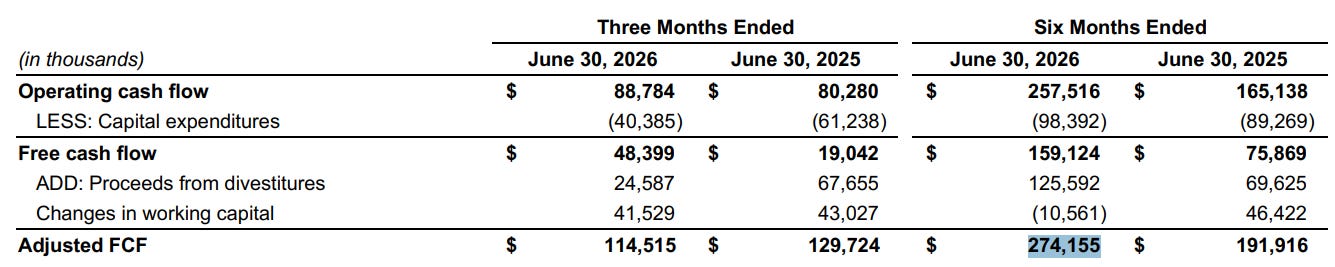
Adjusted Free Cash Flow forecast for 2026 at: ~$440M vs $274.2m achieved 1H26 implies a $165.8m+ 2H26 adjusted FCF result. Of course adjusted means includes cash proceeds from land and property ($125.6m). This means operating cash flow was $48.4m in 2Q26 and $159.1m in 1H26.
Finally a Leverage Target: 2.0x to 2.5x which give leverage is already within those bounds means at worst +$50m net debt ($2.88bn vs $2.83bn reported at 30/06/26) or at best -$520m less net debt by year end i.e. $2.31bn net debt vs $2.83bn
We don’t yet have the full interim financial results but from what I can see it’s yet another solid performance where once you strip out the noise of unsettled hedges you see a continued strong trajectory with strong shareholder returns.
Regards
The Oak Bloke
Disclaimers:
This content is for educational and informational purposes only. It does not consider your personal circumstances and is not financial, investment, tax, legal, or professional advice. Nothing here is a recommendation, offer, or solicitation to buy, sell, or hold any investment. Investing involves risk, including the loss of capital. You are solely responsible for your own decisions
Micro cap and Nano cap holdings might have a higher risk and higher volatility than companies that are traditionally defined as “blue chip”
Comments
Nothing yet. Say the first thing.
Sign in to join the conversation.