

Dear reader
Let’s revisit the Oak Bloke 2024, 2025 and 2026 portfolios as they stood Friday 7th August.
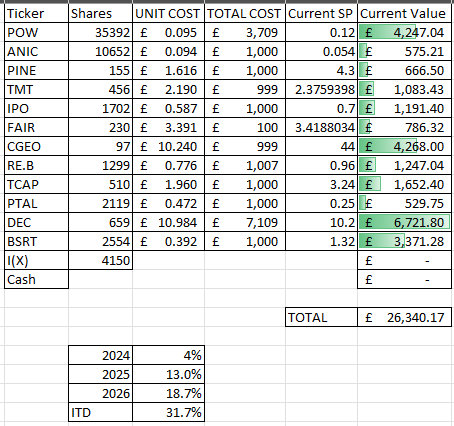
The 2024 cadre move into a 18.7% gain in 2026 and 31.7% overall despite the adverse effect of DGI9 blah blah blah negative negative.
Despite this negative 31.7% was delivered over 31 months. That’s a 1% gain per month, despite four severe setbacks. Will my stacking onto POW and DEC deliver results going forwards? I’m pretty excited.
IP Group was the leading contributor in the past week up 13% to “only” 35% discount to its latest NAV perhaps rising following a collapsed takeover from the minority shareholder RailPen who pulled out of its miserly offer.
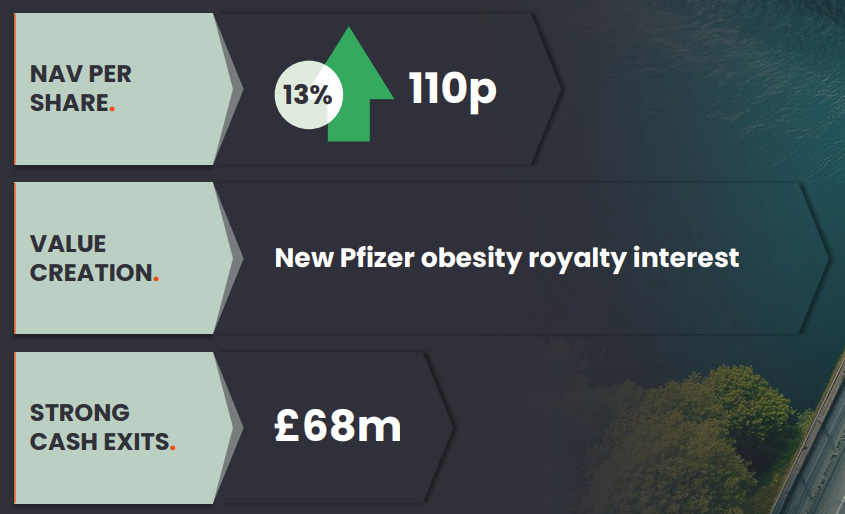
CGEO following was up 11%. Little surprise when it is delivering 18% increase to NAV in the past 3 months!! Superb stock.
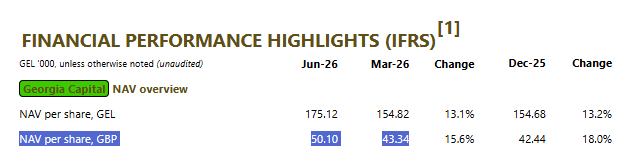
Even DEC delivered 4% following its 1H26 results.
My YTD loss on the 2025 is erased and a 53.57% gain is nearly restored. Just 0.1% left to recover.
The heavy bet on SEIT is nearly at break even. UUUU has sharply recovered +23% following Trump’s urging to “do magnets”. But also the growing voices speaking to Uranium. UUUU is going to be a huge beneficiary since it is the only one which can extract Uranium and REE from HMS. Mkango was up 13% too.
MAFL was up 15% and Thor +12% too.
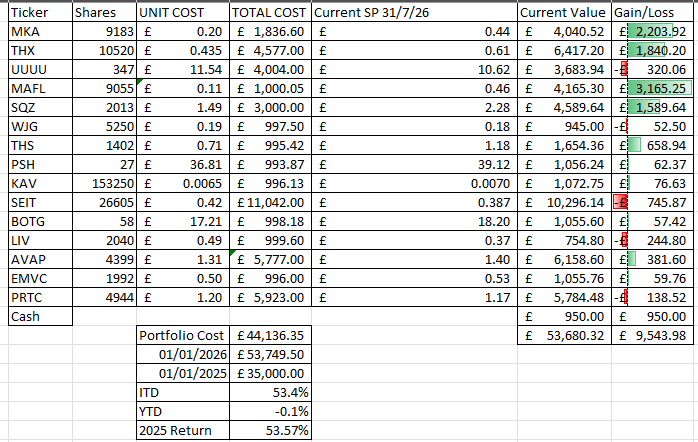
Moving to the OB picks for 26 a 32.8% gain is +3% since the last update.
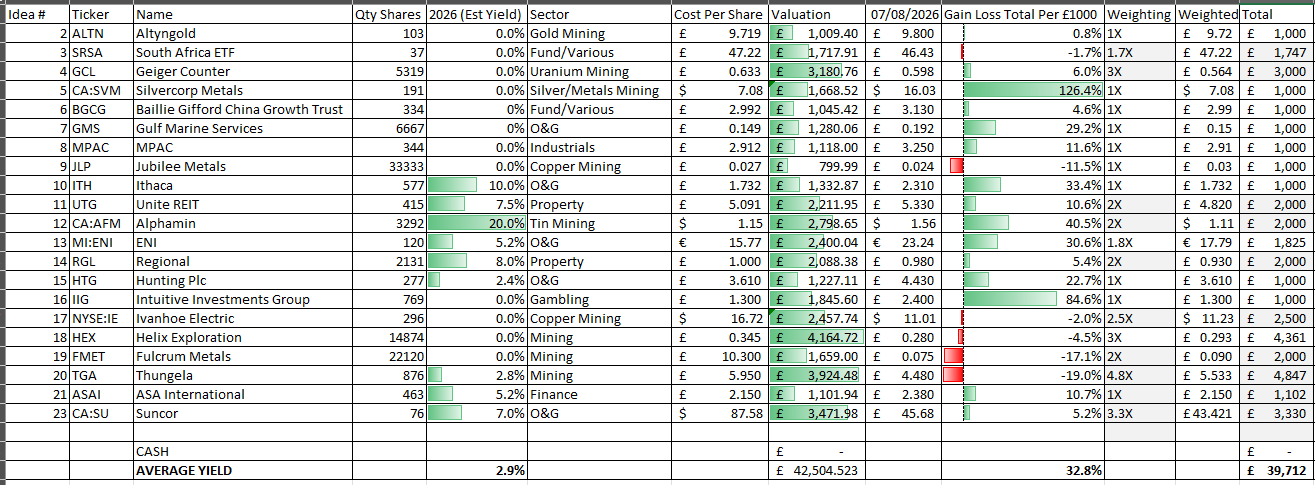
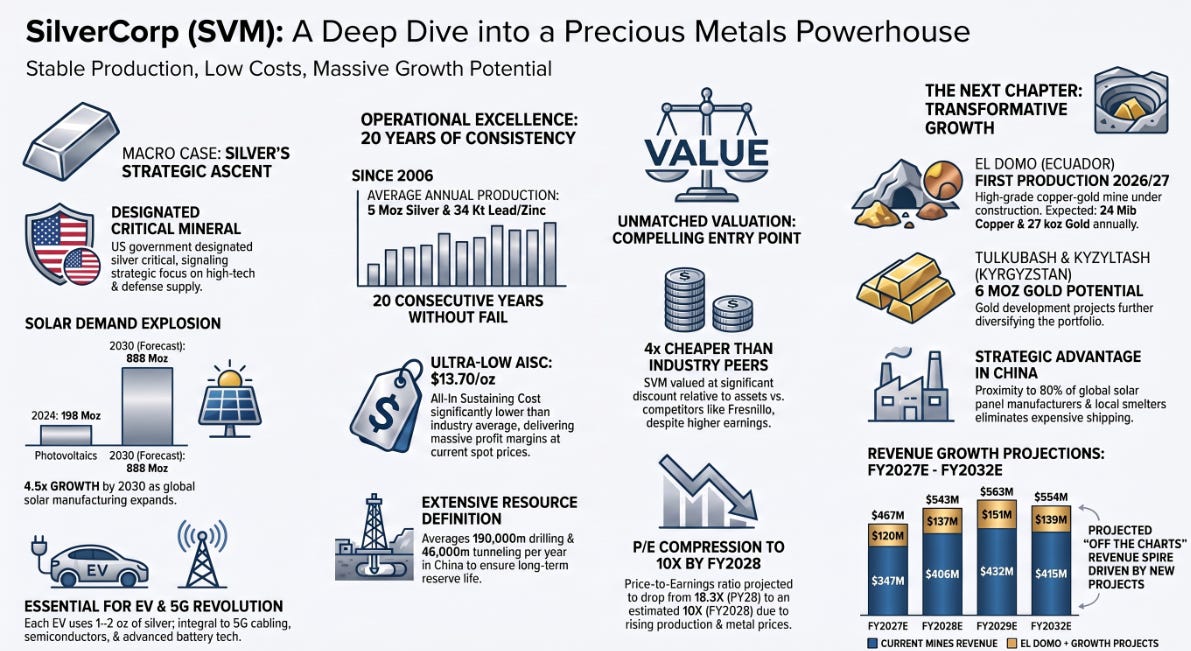
Large gains seen at Silvercorp. A big congratulations to readers who read the 19th July article and agreed it was at a compelling point. Silver is only at $63 an ounce. If you believe that the deficit and its strategic importance in electrification, solar, EVs, 5G and data centres let alone its read across from Gold matters then it has barely begun its move back to its 2026 highs.
Ivanhoe Electric is up 20% and doubling down recently was a good move. The NPV of its Santa Cruz mine alone more than covers its marcap as covered in the article “Clonkers”, let alone its tech potential to help with Copper delineation.
Altyn Gold is also up 20% this week but remains on a very low PE as covered earlier this week in “Double or Fold”
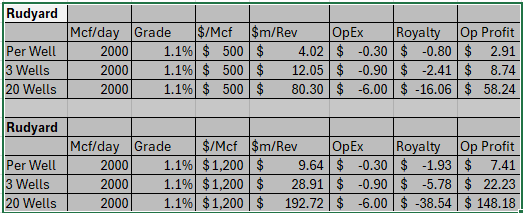
Helix was another conviction where I doubled down swapping Sausage Rolls for lighter fayre - like those Weight Loss people do. My lighter fayre was Helix who announced further progress at its Rudyard Wells and at Keyes its liquefaction plant.
A second filling completed 14 days after the first suggests that 11.4 MCF is being filled per day (to reach 160 MCF capacity after 14 days) which in turn suggests 1000 Mcf/day of raw 1.1% gas so that’s 50% of one well’s capacity of 2000 mcf/day. That suggests there’s a 500% increase yet to come but at $1,200 per MCF (if that’s the price achieved) that’s a $3.7m per annum operating profit….. and it will grow to $22.2m once all three wells are operating at full capacity.
CEO Sears did say they were pacing the wells slowly at first.
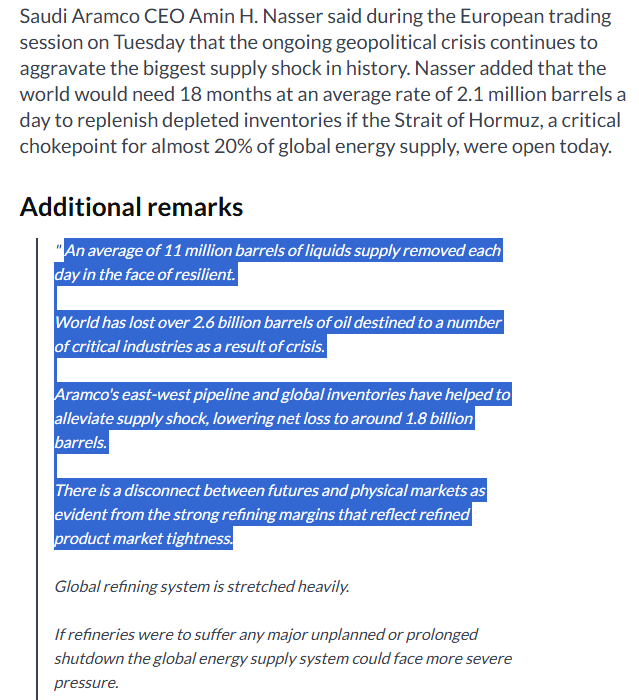
When the CEO of Saudi Aramco confirms a net loss of 1.8bn barrels and confirms that the Oil futures (paper) market is “disconnected” from the real world you have to pay attention.
Suncor was down 11% last week despite a knockout 2Q26 performance. What a surprise. A share you can buy for US$62 that delivered $4.52 per share operating cash flow in the past 3 months. That’s a 30% cash yield.
Net Debt reduced by a third in the three months to 30th June from $6.84bn to $4.48bn.

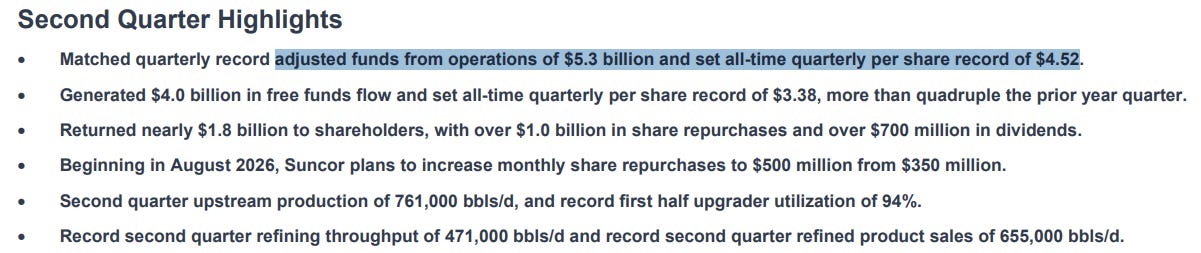
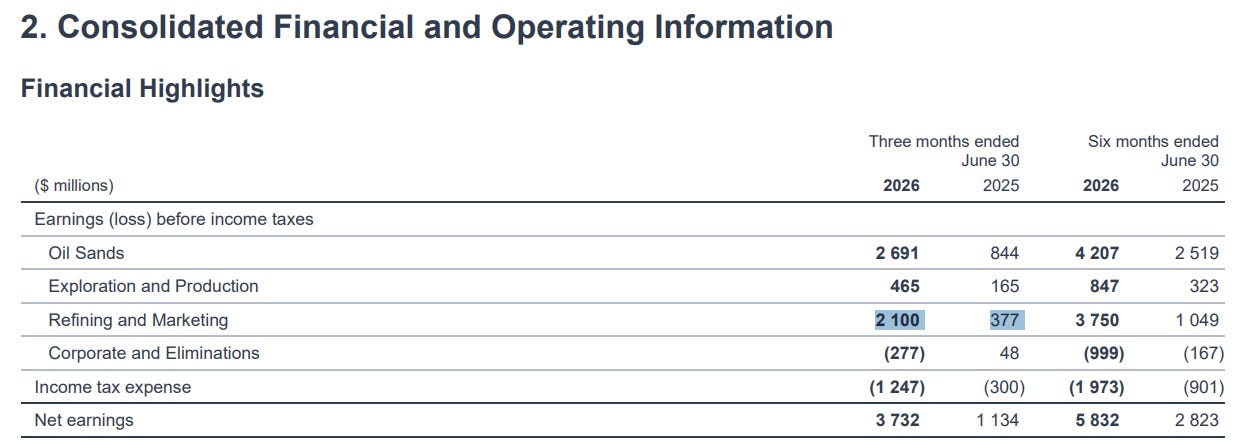
Crude Oil income rose but the 500% increase to Refining and Marketing earnings is the real eye catcher.
Stock commentators decided to provide a review of Unite UTG. Here’s what they had to say and here’s my response.
Declining Share Price:Unite has lost over half of its value over the last five years. Much of this decline followed their acquisition of Empiric Student Housing in the summer of 2025
→ This is inaccurate. ~70% of 5-year drop occurred prior to the summer 2025 announcement and the real driver here was BoE interest rate hikes, rising borrowing costs and yield expansion
Activist Interest: The widening discount on Unite shares has attracted the attention of activist investor Saba, which has declared a 5.1% position in the company
→ This is accurate. But no attempt is made to consider why Saba are buying UTG and what upside they see - it is portrayed as a negative only.
Weak Financial Results: Recent half-year results show earnings falling by 8%, with flat forecasts and rent growth. Furthermore, rising yields have caused valuations and development portfolio values to decrease.
→ This is partially accurate but lacks interpretation.
EPS fell by 8% but 10% EPS dilution occurred due to Empiric acquisition (which was reduced to about 4% dilution net of buybacks) and only 5 months of Empiric income was included in those earnings. So net of those extraordinary factors underlying earnings were actually resilient and close to a zero drop in underlying EPS.
→ Lacks interpretation: Rent Growth is guided to 1%-2% so isn’t flat although in real terms could be portrayed as such. Again lacks interpretation since lower occupancy explains the lower rentals where underlying rental growth is stronger than 1%-2% but is suffering from a blip in occupancy (but clearly improving from that blip) as well as a drag effect from disposals.
International Student Drop-off:
A significant factor behind the poor performance is the drop in international student numbers. While this began with Brexit impacting EU student numbers, recent declines in Chinese and Indian student arrivals have further hurt demand and achievable rents
→ Inaccurate: Commentator uses out of date info. Uses 2024/2025 data to explain the 2025/2026 results and overlooks CY2025 Home Office data that Study Visas are +4% to 406.8k people, or UCAS data for 2025/2026 that international applications are +5.1%. The projection is for 690k so is an increase on the prior year and not a “drop off”. The commentator also fails to consider the effect from the UK rejoining the Erasmus+ programme from 1st July 2027.
It is furthermore worth pointing out that the decline in EU students since 2020 was due to the fact that in 2020/2021 they were eligible for UK State Loans for the Tuition Fees, and their Fees were capped at the same as Home fees. So these were international students who got to pay a home price (due to EU rules).
It gets worse.
60% of tuition loans were not repaid and of the £5.8bn of loans issued £1.5bn has been repaid and the NAO estimate £0.7bn will be collected in the future, so UK taxpayers effectively “gave” £3.6bn of subsidies to EU students in the period 2006 to 2021 - let alone that Universities were forced to sell places to EU international students at “home” prices. Imagine if that £3.6bn had been directed at Universities to support their research instead? You’d have nearly doubled the £0.3bn directed at Higher Education Innovation Funding (HEIF) each year since 2006.
The commentator also neglects to point out that based on his numbers that the number of Non-EU Students since 2020/2021 have grown by nearly 40%…. so there’s no drop off there either is there? Education is actually a highly successful UK invisible export. And UTG is a beneficiary to that trend isn’t it?
Portfolio Restructuring:Unite is responding by narrowing its focus. They are looking to sell properties and reduce their presence from 29 cities to 20 to focus on top-tier university locations
→ Accurate. No attempt is made to consider the implications of focusing on these top-tier locations.
Capital Allocation: The company is aiming to increase occupancy and university nominations (fixed-rental agreements) to 60%.
→ Accurate
Market Environment: Commentator notes that the current investment market for student accommodation is at a low point, making it a challenging environment for Unite to sell its assets.
→ Highly Inaccurate. Commentator gives their own opinion and provides no evidence to their view. Knight Frank showed PBSA investment rebounding in 1Q26 to the highest level in 10 years so at a high point not at a low point - but let’s leave that aside.
UTG has a ~£9.2bn GAV. 6% is development and land bank. Commercial and Retail - shops etc is 2%. Other is 2%. So ~£8.28bn is actually beds. 72k beds works back to £115k per bed average.
Consider the economics of building PBSA. UTG recently completed Hawthorne House in Stratford with 719 beds. The site cost £73m to acquire and the development was £185m. That’s a build cost of £257k per bed.
And the commentator is arguing that selling a bed at £115k is “challenging”?
Where that £115k is flattered by the MUCH HIGHER values of London and the South East and Top-20 Cities. These are places like Warwick, Bath, ok not all London and the South East but these are pricey areas nonetheless.
We don’t know precisely but taking the Hawthorne £257k example would a £60k per bed NAV for the bottom-9 cities be a reasonable assumption?
Bearing in mind that ignoring the site acquisition cost (expensive in Stratford London for sure) the development cost per bed excluding land was £155.7k wasn’t it? (£112m / 719 beds)
So in Nottingham - let’s say - can you sell a bed for £60k?
It gets worse UTG is at a 42% discount at 535p per share. So I think we are really saying can UTG sell that bed in Nottingham for more than £34,800?!!! (£60k less 42%)
If you can’t then there’s something deeply wrong with you. And you absolutely can NOT describe the process of selling that bed for that price a challenge can you?
The challenge is more to not to laugh at the naivety of calling it a challenge.
Intuitive Investments was down too although this should catch back up as the scheme to merge with AC8 proceeds in the coming week (by the 13th August)
Here’s to a successful week ahead.
Regards
The Oak Bloke
Disclaimers:
This content is for educational and informational purposes only. It does not consider your personal circumstances and is not financial, investment, tax, legal, or professional advice. Nothing here is a recommendation, offer, or solicitation to buy, sell, or hold any investment. Investing involves risk, including the loss of capital. You are solely responsible for your own decisions
Micro cap and Nano cap holdings might have a higher risk and higher volatility than companies that are traditionally defined as “blue chip”
Comments
Nothing yet. Say the first thing.
Sign in to join the conversation.