
We’re getting close to welcoming a new baby, which naturally means that our unresolved household tasks have achieved urgent status in my mind. One such project has been to make soap using potash!
The girls and I enjoy making bar soaps using caustic soda (sodium hydroxide/ lye) and olive oil.1 I recommend! But if you want to go all-out, below is how we made soap circa the Bronze Age: extracting our own potash (to make what will be a potassium-based soap), rendering tallow, and using fire as a heat source. (We did cheat with a blender). A satisfying, “easy,” albeit more time-consuming endeavor that is worth attempting for no other reason than to have the experience of doing it! Activities such as these can help kids to understand the world as interesting and shapeable.
They’re also a great excuse to pick up a copy of Caveman Chemistry by K. Dunn, full of relatively accessible chemical explanations and instructions for making anything from bronze from metal ores, to celluloid from cotton. The author is committed, and his enthusiasm is infectious.
Please note that I’m not an expert soap maker, am rather relaxed with my technique (hey, Bronze age people weren’t calculating mols either!), and learnt a max of undergrad organic chemistry many years ago. If you have refinements to the below, please share! My approach to this recipe was to not overthink it or expect much from the result: optimizing for the joy of the process seemed most appropriate. If you want to make a soap with a reliably lovely composition, use a recipe that uses modern forms of the ingredients i.e. more predictable ratios :).
Patience! Plan for a solid half day (about an hour of actual labour).
Wood ashes to make potash2 - i.e. the hydroxide source. Ash from burnt hard wood is said to yield more potassium, although K. Dunn reminds us that chemical composition varies greatly and unreliably in all trees and soils, so I’d say stick with the relaxed an attitude of anything goes. Ours would have been a mix of hard and softwood. Make sure your ashes have never been wet (as they will have leached all of the good stuff). We used about two pots of ashes to produce 1.5 cups of sufficiently concentrated potash, which can be matched with about double the amount of fat. I explain more of the chemistry below, but essentially potash is largely made of potassium carbonate. This produces the necessary hydroxide once dissolved in water.
Water. We used rainwater, our house water supply. If you wanted to be less Bronze-agey and more chemist-y, you could use distilled (pure) water. Or check out how hard/soft your water is and whether you need to worry about e.g. calcium. Or not!
Heat source. You’ll need to evaporate some water from your potash, melt your fat, and use heat for the saponification (mixing) process. Using an outside heat source is ideal, because the process omits noxious fumes. Go on - do it over a fire!
Non-reactive implements: stainless steel, glass, plastic, silicone, or wooden versions of pots, stirrers, measuring cups, containers, etc. Optional - a stick blender (speeds up the saponification process).
Fat source. For maximum ancient mode, we used home-rendered tallow.3 The internet suggests that you can use liquid oils, but I’ve not explored that.
A way of testing whether your final product is too basic for use. pH strips, your tongue (those sacred, ancient ways….). You won’t need these for a number of weeks, so don’t let the absence of these prevent you from getting started.
Protection from gases and liquids: ventilation, goggles, gloves, mask. (Some in our household are more relaxed about such things than others ;) ).
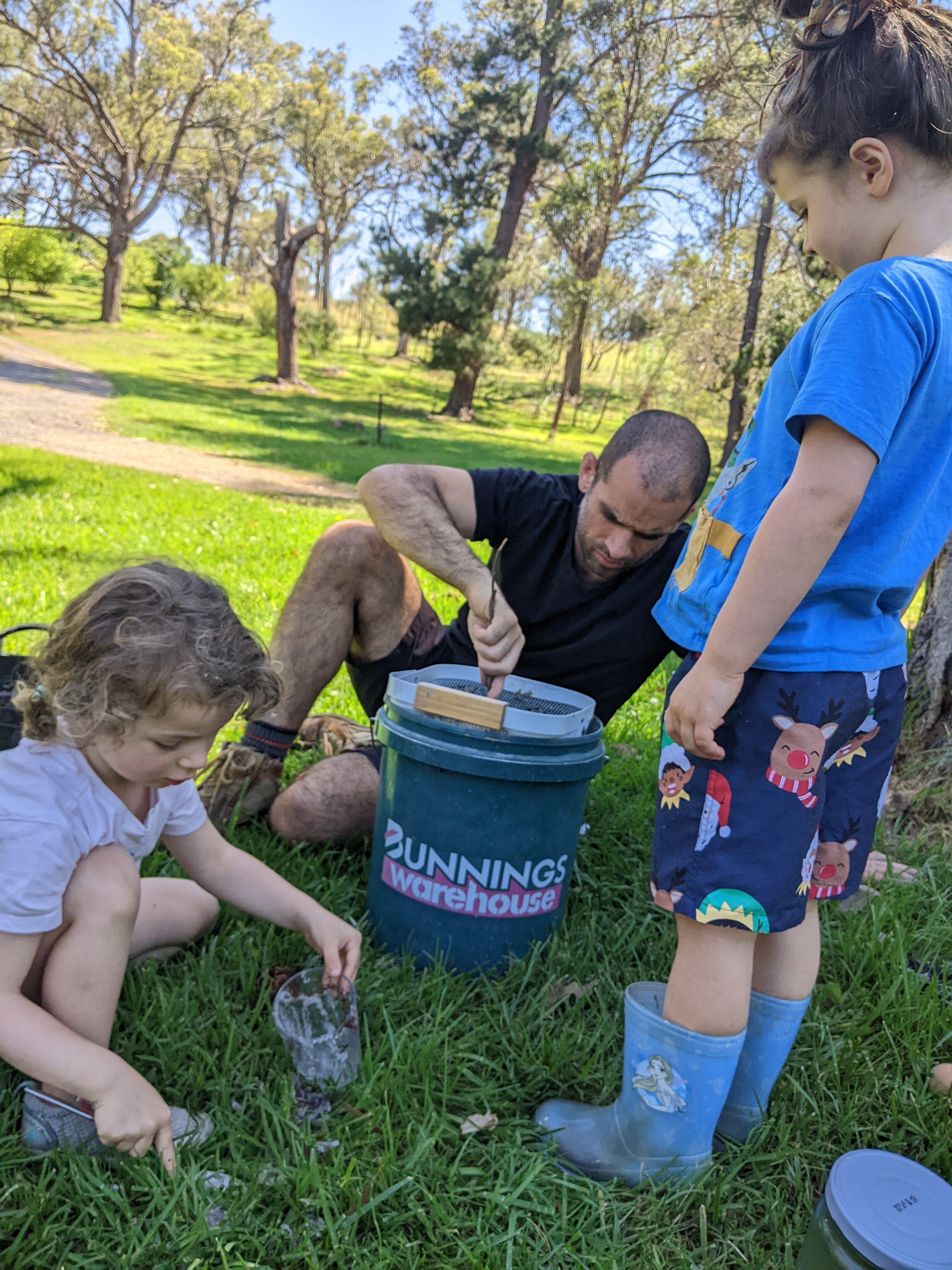
Extract your potash. Mix your ashes with water. You can do this the day-of, or anytime before hand, as we did, and leave it sit in a glass jar. You want to first get as much potash (dissolved salts) from the ashes as you can, and later we’ll evaporate it down to achieve sufficient concentration. The potassium salts will dissolve readily in water (you’ll have others in there, too), and you can accelerate the process by heating the mixture, repeatedly straining it back and forth, or stirring it. Or be lazy and let it sit for multiple days. Oz did this step by straining the mixture back and forth. You’ll need to remove the floating charcoal.

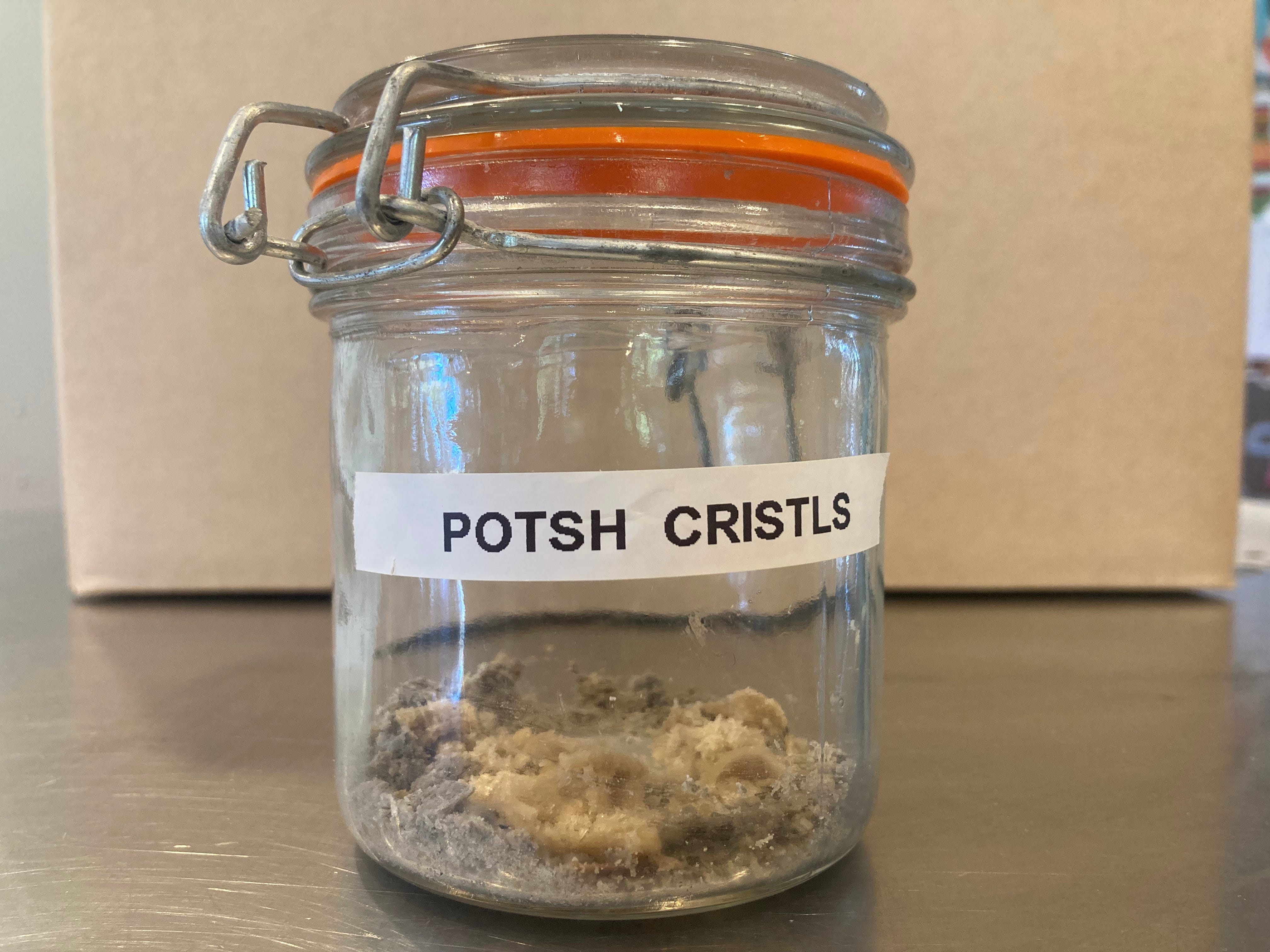
The kids mimicked the process in a safer way: they were tasked with straining a NaCl solution mixed with bark. I later found this gem in our chemistry box: a little pot of potsh cristls, made a while ago by Oz and our eldest in homage to Caveman Chemistry. They followed the above process and evaporated off all of the water. I added these to our solution to increase its concentration aka save evaporation time - bonus!

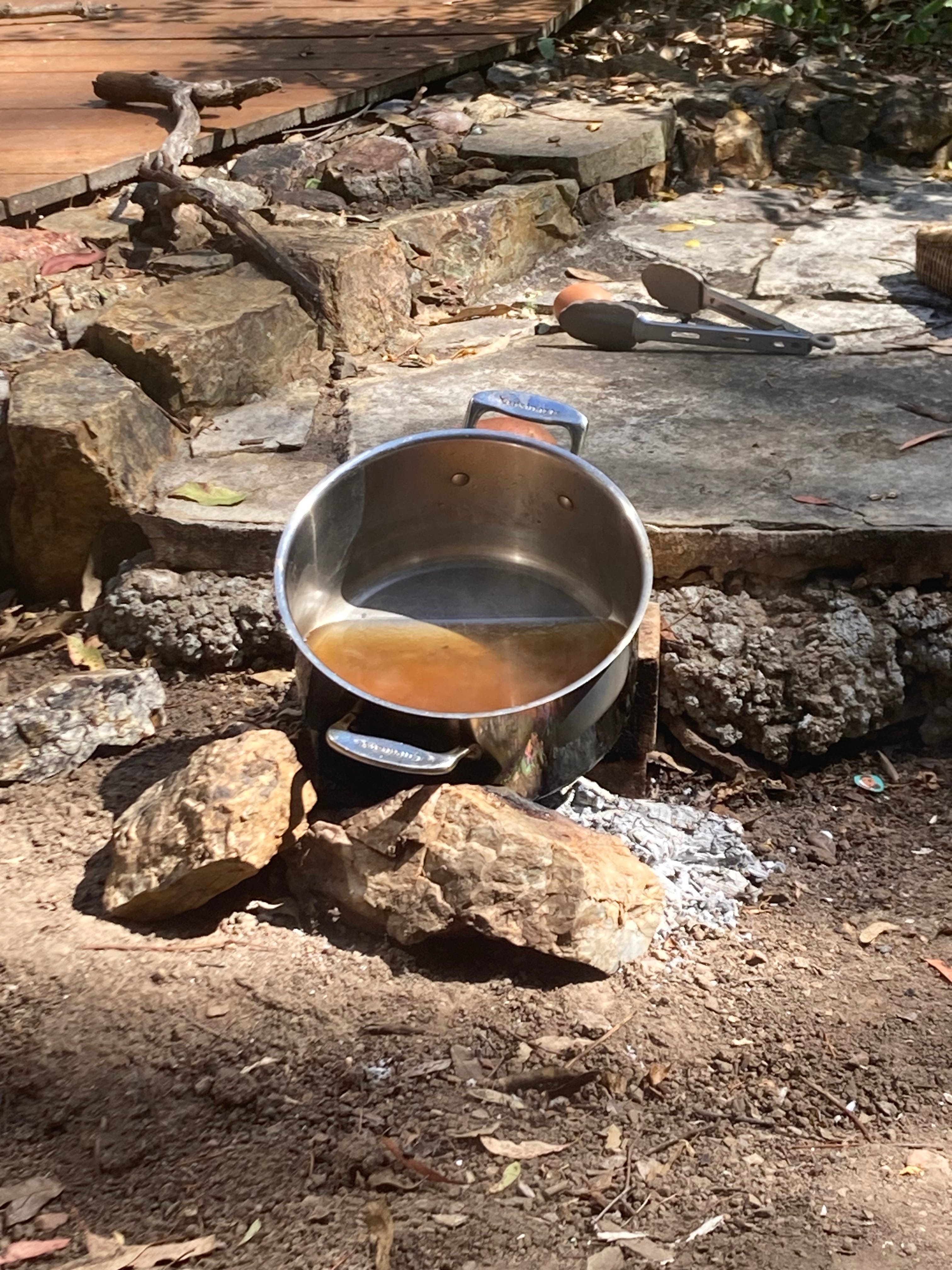
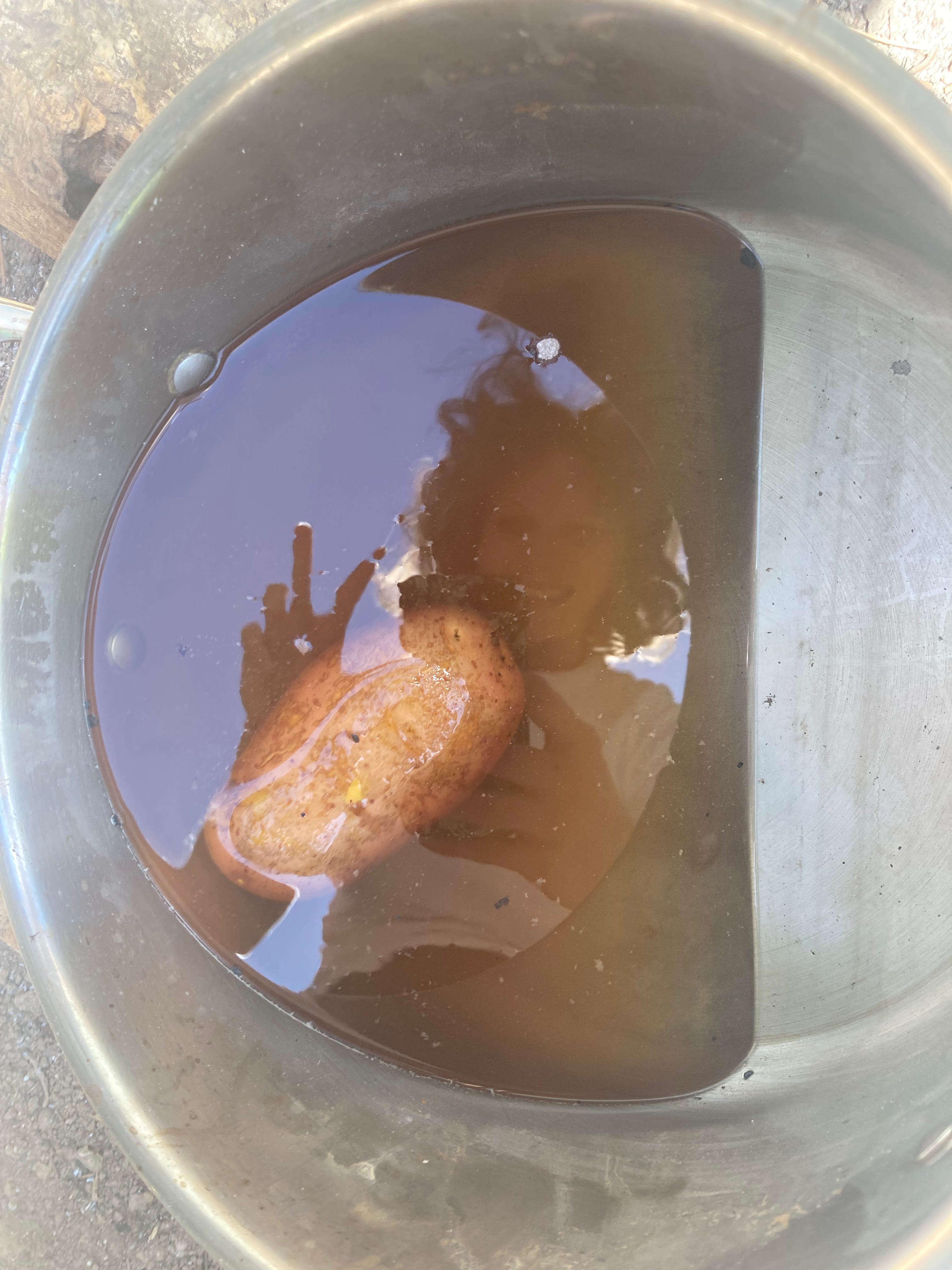
This “should” be white but it has residues. Concentrate your potash. Heat the solution to concentrate it enough that: a potato will float (~1/5 of its surface exposed), and it’ll look like a tasty IPA. Or, whip out your trusty hydrometer.
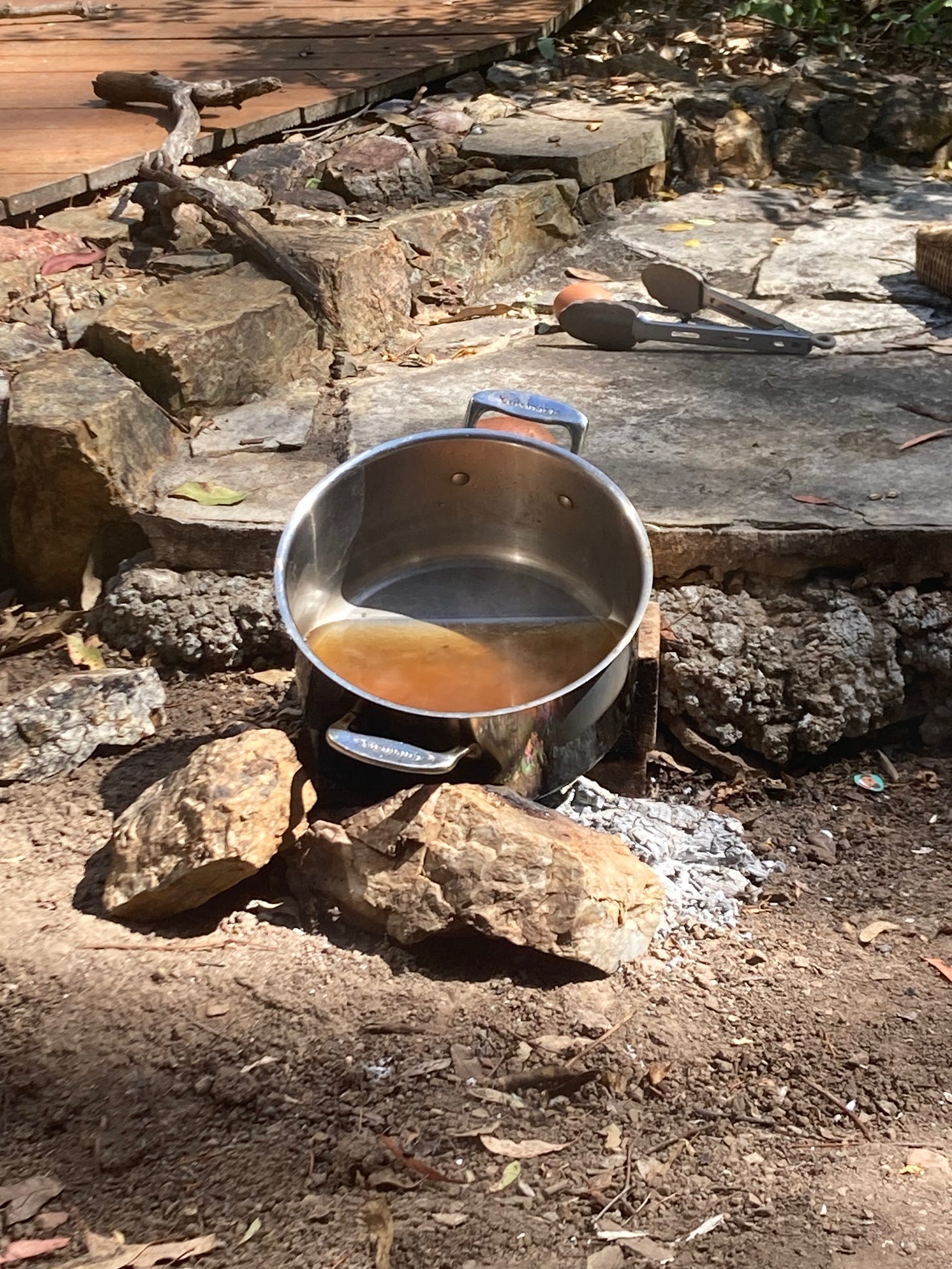
Who needs Amazon Prime. 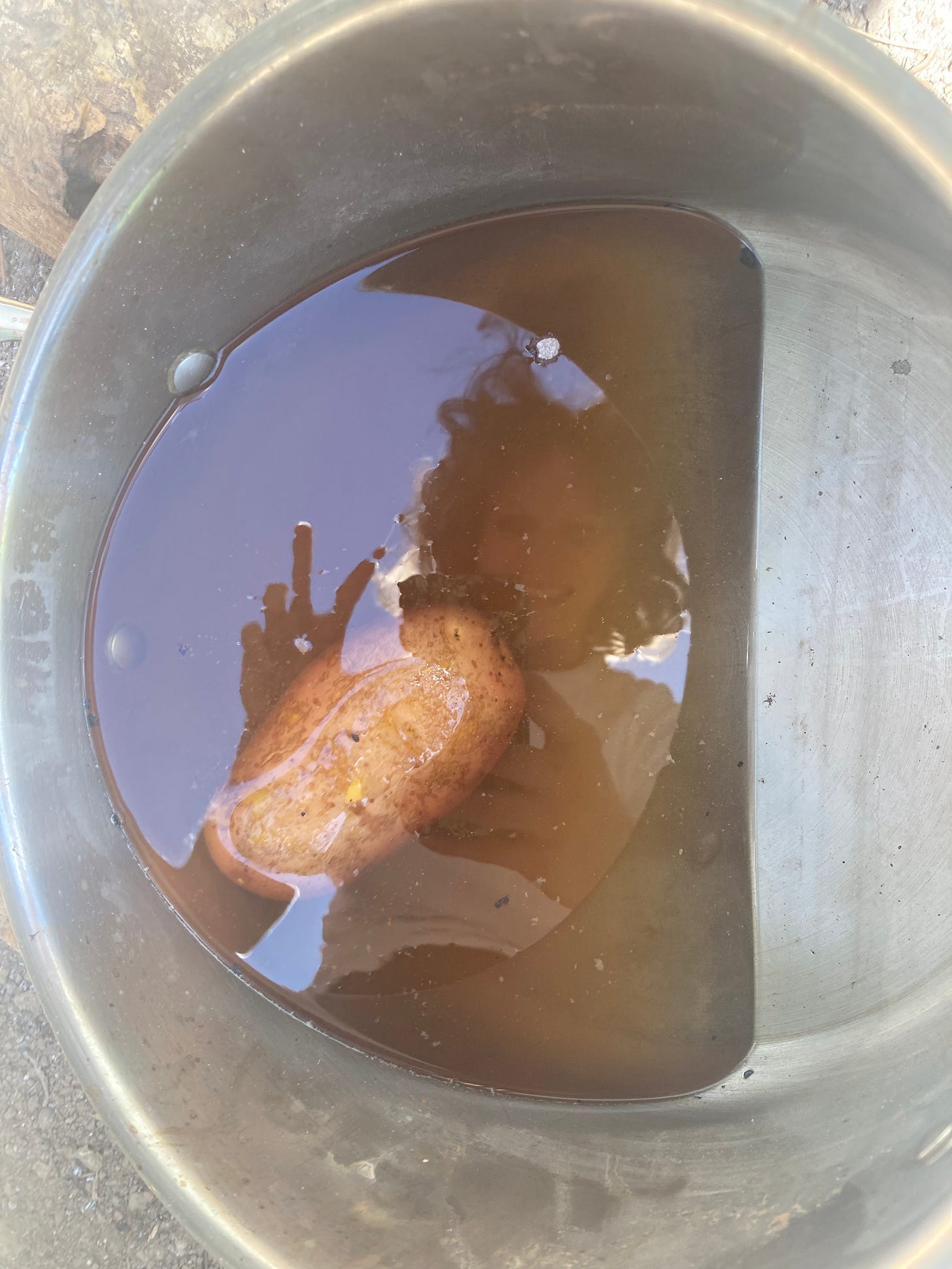
Look mum: a floating potato! This pic makes the solution appear paler than it was. Bonus step: I added about half a tablespoon of table salt (i.e. sodium, NaCl, non-iodized) to help harden the soap. Potassium soaps makes for a softer soap than the sodium versions, because the potassium soap salts are more water-soluble (hold onto water better). Adding the table salt (sodium) displaces the potassium, making the soap harder (less water-soluble). It could be fun to experiment with various NaCl concentrations, or even better - try using sea water to dissolve the potash (I think I’ll actually do this!). If I had my time again I’d have added more / actually made an effort to calculate a good quantity, because so far ours is looking like it’ll be softer than I’d like.4 Our three year old chemist has since added some extra salt to one of her soaps - we’ll see what happens there! Reportedly in the olden days where lye (sodium hydroxide) and natron (sodium carbonate) were unavailable for making hard soap, they’d add just add table salt to the potash soap to make it hard (again, sodium displaces the potassium).
Melt your fat (if not already using oil).
Mix your fat with the potash solution on very low heat. And so begins the saponification process!
We used a ratio of 1 cup fat: 3/8 cup solution. A good soap-maker or chemist would be way more precise here; I am neither of those. Even if I were, nature will impose its unpredictability on you anyway, because the triglyceride composition in your fat will vary, especially for fats like tallow, making its response to your potash less predictable. You want to err on the side of having more fat and less potash, because if the soap is too basic (from the potash salts), it will burn your skin.
It seems ~70C is a good goal here, but I was working mainly off vibes by this point :)5 I didn’t bother to mix these over a low heat, but rather relied on the fact our pot had been sitting in the hot summer sun + the rocks/brick I’d used to assembly our fire pit had retained enough heat to keep our potash toasty. Seemed to do the trick.
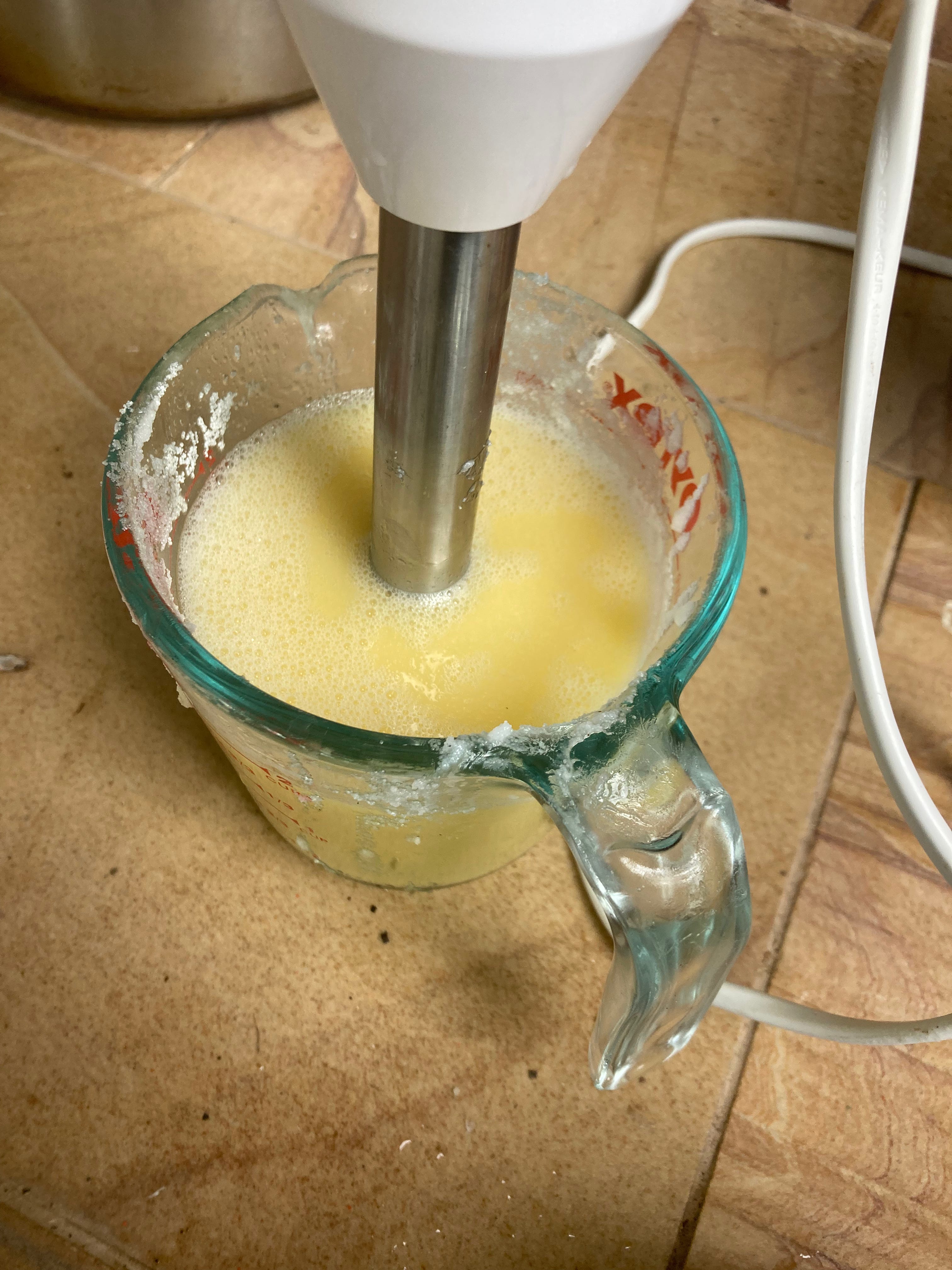
Mix manually (slow), or with a stick blender.

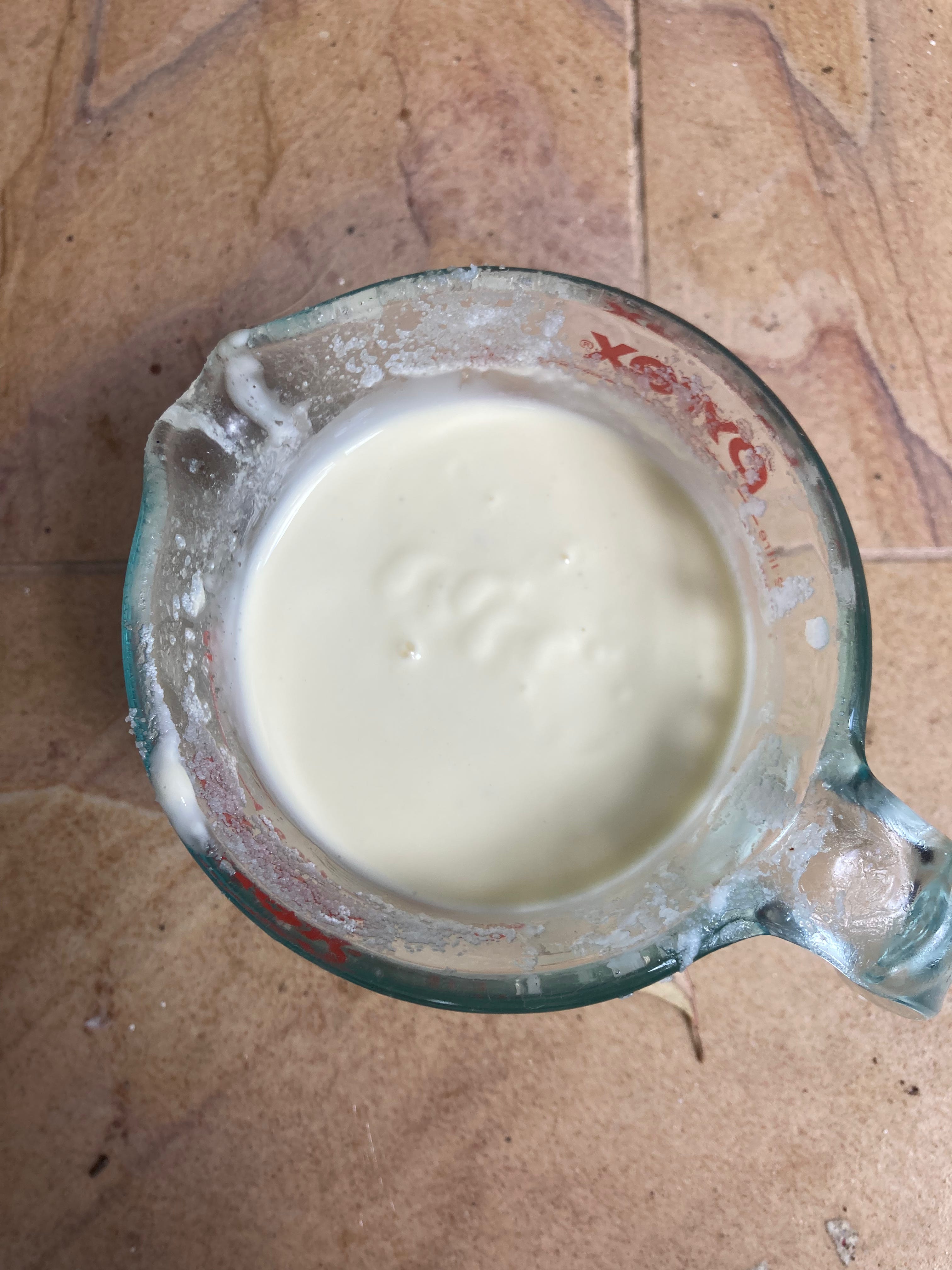
All hail electricity. It’ll turn a nice creamy color. You want to get it to a point that it develops a “trace” - i.e. the utensil you use to stir will start leaving a path behind it. Think a nice cake batter or thick custard.
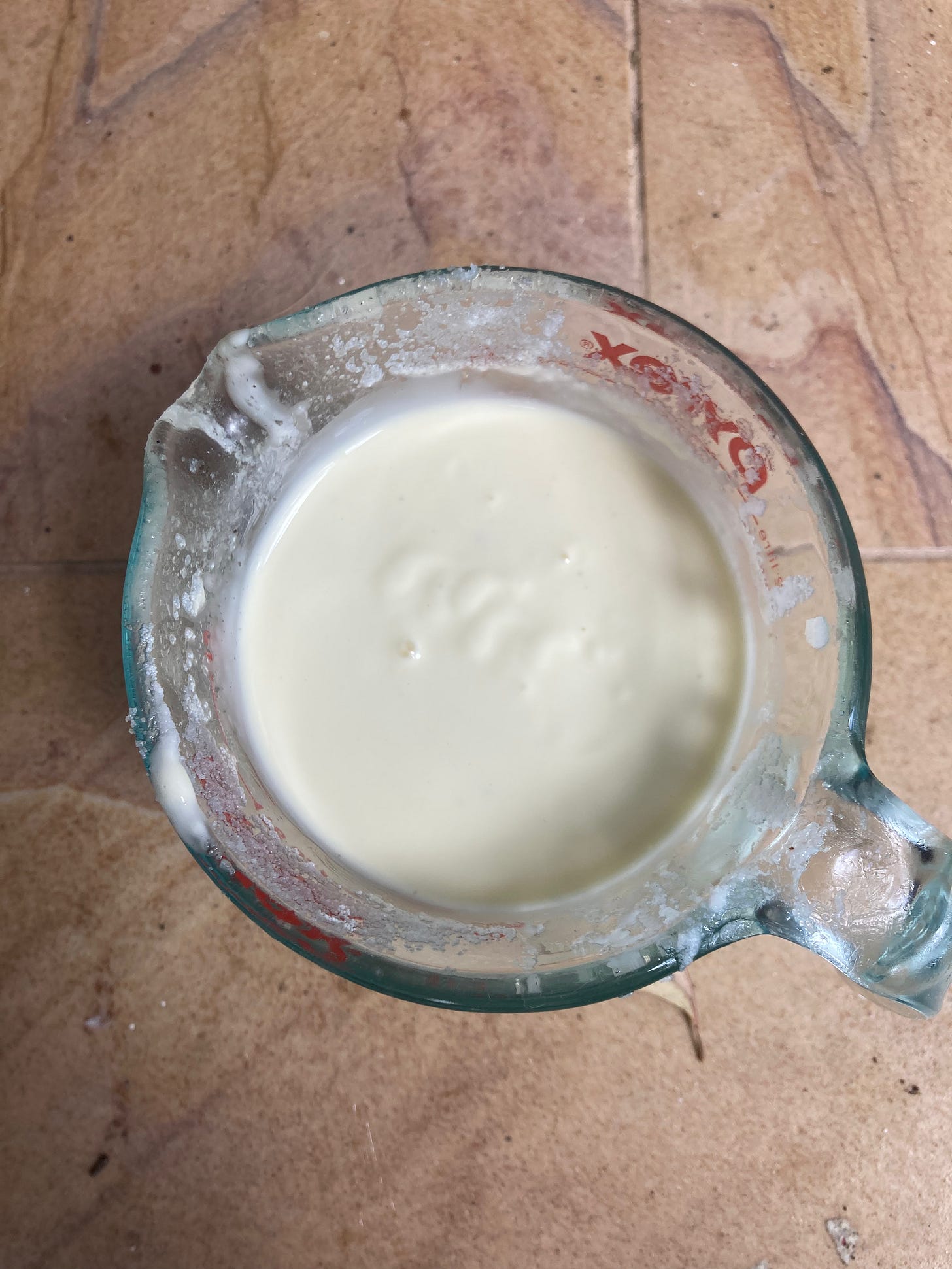
A video would be better here, but can you see how the mixture is thick enough to support the disruption I created in the centre? Instead of meekly slipping back into the shape of the container, these daring molecules are beginning to hold their own. Go guys, go!
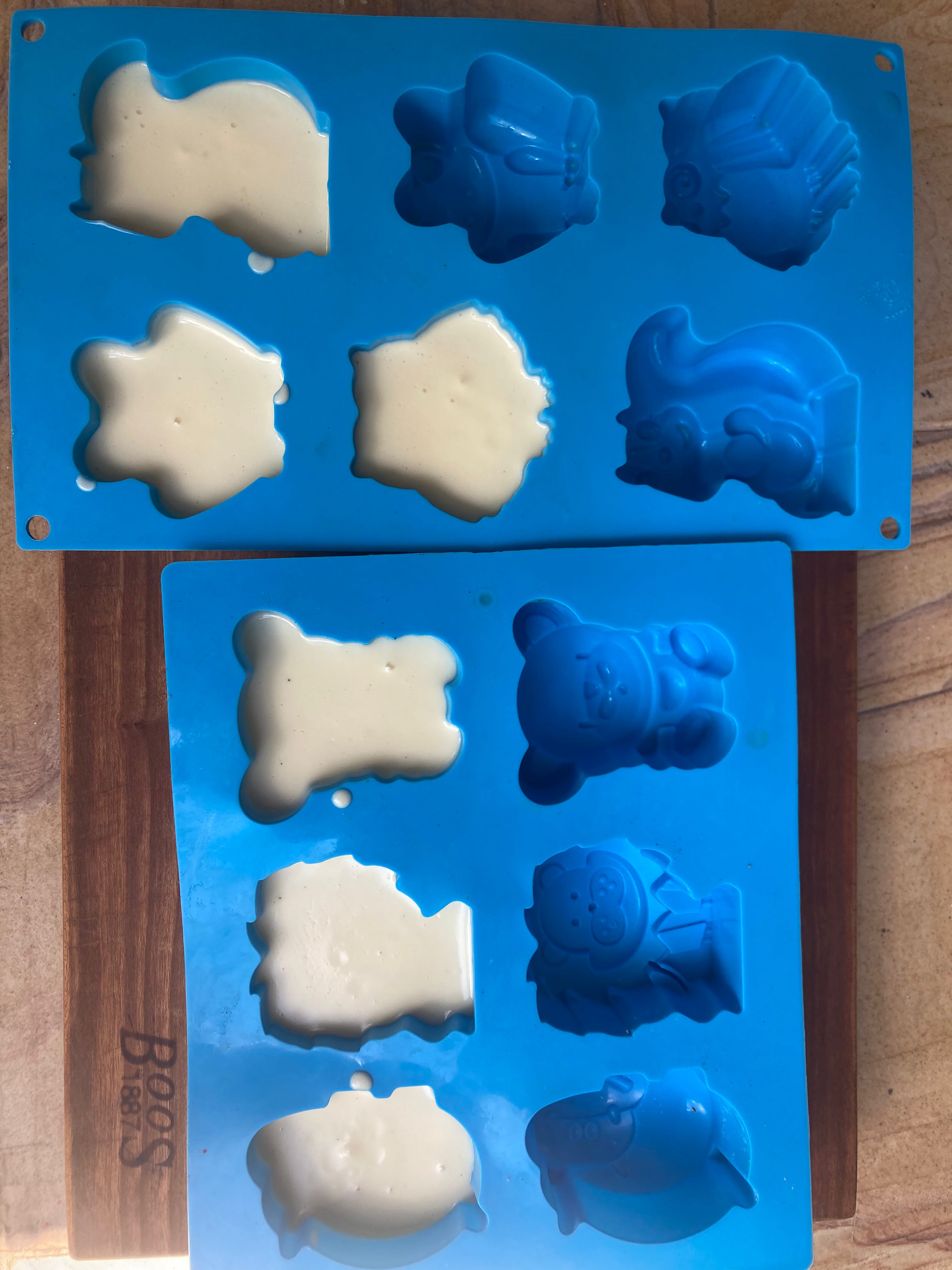
Pour into a non-reactive mould/jar (remember: it’ll be more liquid if it doesn’t have much sodium).

We use silicone animal moulds because they are cuuuute. Curing (i.e. leaving it to sit). You essentially want to make sure all of the basic part (hydroxide) has been used up so that it doesn’t damage your skin, and also get the fat parts into their new form so they can be used as soap. If I hadn’t added the table salt, I’d be working under the assumption that this would turn out as a liquidy soap, which doesn’t need much curing time at all. But since I was trying to get a harder soap, I followed the curing process of a hard bar soap, and will hope for the best!
Regardless of whether it’s a liquid or bar soap, let it sit for a couple of days to finish (the vast majority) of the saponification process. Keep it covered.6
Bar soap: After that, you should be able to remove the soap from your moulds and then leave to cure on e.g. a plate, uncovered for 1-2 months.7 For the first couple of weeks, water evaporation will contribute to the hardening process. After that, the hardening will come from the fatty acid salts continuing to rearrange themselves into less water-soluble, “crystal” structures. Leaving it for a while will give you a better lather (won’t go to mush) and potentially be nicer on your skin (less basic, if all of the hydroxide wasn’t gobbled up already).
Liquid soap: doesn’t need the evaporation time or the time to develop its crystalline structures, so should be good to go! It could be on the more basic side if it’s not curing for as long… test!
Test the pH (you want 8-10 for your skin’s sake) before use.
Ash is a variable mixture of non-flammable minerals, including potassium and sodium salts. When you mix ash in water, only the substance potash dissolves (mostly potassium carbonate), and charcoal will float to the top. You can boil the water off to create a crystalline potash residue. This is very basic (alkaline, pH>7) and isn’t good for your tissues!
When the potassium carbonate dissolves in water, it creates potassium hydroxide, which is what we want for soap. The hydroxide is what makes it basic, and is also what breaks down your fats into glycerol and soap molecules (fatty acid salts).
Here’s what potassium carbonate does when you mix it with water - i.e. how it creates an excess of hydroxide ions (OH-) in solution.
First it breaks up into potassium and carbonate:
\(\[ \text{K}_2\text{CO}_3 \rightarrow 2\text{K}^+ + \text{CO}_3^{2-} \] \)
Then it creates extra hydroxide (OH-) ions in the solution, by either:
Interacting directly with water molecules:
\(\[ \text{H}_2\text{O} + \text{CO}_3^{2-} \rightarrow \text{HCO}_3^{-} + \text{OH}^- \]\)
or by
Interacting with free hydrogen ions (which naturally exist in small quantities within a pure water; i.e. some water molecules fall apart into hydrogen cations and hydroxide anions). The effect is to remove free H+ ions from the solution, thereby increasing the relative ratio of their associated free OH- ions (i.e. the carbonate joins with the hydrogen, and the potassium and hydroxide are left to live their best life together):
\(\[ \text{H}^+ + \text{CO}_3^{2-} \rightarrow \text{HCO}_3^- \]\)
Is what we call the hydrolysis reaction used to make soap; essentially the process of making fats able to mix with water.
The potash gives your fats (in triglyceride form) hydroxide (OH-), which allows them to interact with water. (Fats don’t normally have any OH- groups, so they’re water insoluble).
Saponification: triglyceride (fat) + potassium hydroxide (or other) → glycerol + soap molecules
The glycerol is an important byproduct; it’s a type of alcohol that retains moisture, contributing to the soap’s moisturizing properties. And if instead of luxe bath soap you’re in more of an explosives or plastic-making mood, Caveman Chemistry has some great ideas for you.
When you use soap with water to clean a fatty substance, the soap is acting to break up that fatty substance into tiny parts to form an emulsion (tiny fat droplets suspended in water). Soap can do this because the soap molecules (fatty acid salts) interact with both the water and the fatty substance. One end of the fatty acid salt is soluble in water, and the other end is soluble in fat, causing your fatty substance to break into small droplets, creating an “emulsion” in the water, which can be rinsed away, leaving a clean surface.
Elly’s Everyday Soap Making YouTube channel has some really great, beginner-friendly recipes that in our experience are pretty fool-proof, quick, and simple.
I only recently learnt that “potassium” is derived from the term “pot ash”: wood ashes soaked in water, which elicits water-soluble salts including those of potassium. Thanks for your ever-curious mind, Oz!
You can render your own tallow by collecting (unadulterated) fat from cooking and simmering it for a while over low heat. Super easy. In looking for a recipe link for you, I had a choice between the “prairie homestead” theme or the “meat grill man” theme; I chose the latter.
Adding too much sodium will negatively impact the lather, since it’s going to make it less water soluble.
And the reality of juggling this process with parenting two littles.
We used gladwrap to prevent the potassium absorbing water from our wet-weather air; some people on the internet use paper towel.
If you are like us and live in the countryside, I suggest keeping these away from rodents (eeep).
No posts
Comments
Nothing yet. Say the first thing.
Sign in to join the conversation.