
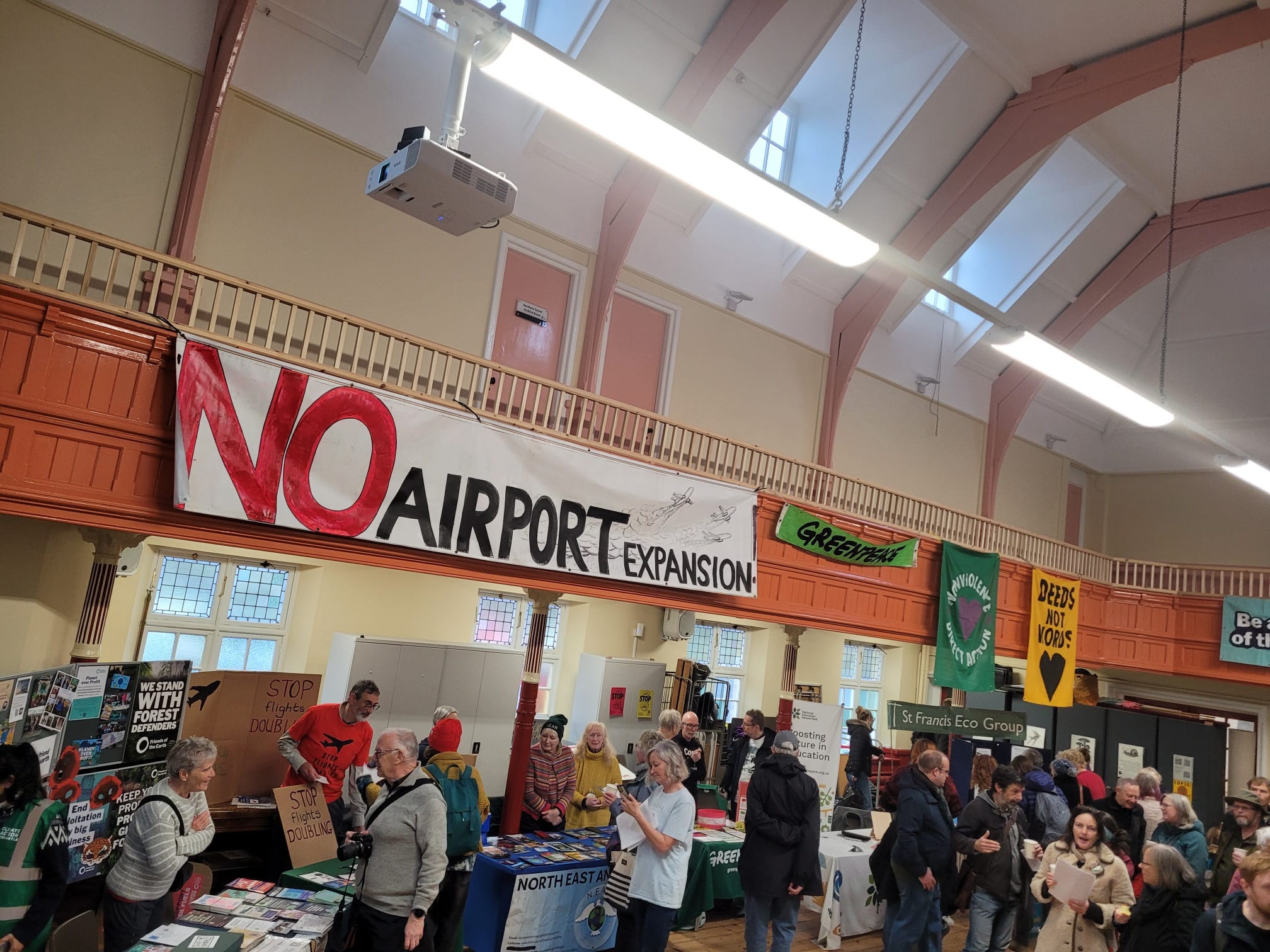
Newcastle Airport’s recently published Masterplan 2040 proposes a huge expansion to nine million passengers will grow the regional economy and create jobs. But these claims have been dismissed as “smoke and mirrors” by campaigners, who highlight expert analysis that predicts the opposite.
Newcastle Airport say its 2040 Masterplan was shaped by its biggest-ever public consultation, with more than 600 responses from local residents, businesses and stakeholders.
A spokesman said: “It sets out a clear vision for the future of the Airport, with the potential to serve up to 9 million passengers a year, support 5,000 on‑site jobs and contribute up to £1.9bn to the North East economy.”
Campaigners see things very differently and so are calling on seven local councils, as majority shareholders in the airport company, to demand independently validated evidence on two counts:
that increased flights would sustainably boost the region’s economy;
that an increase will not help derail the UK’s legal commitments to decarbonise.
Roger Haydon, spokesman for the Stop Flights Doubling steering group, said: “The Government’s cross-party Environmental Audit Committee reported in October 2025 that no evidence was provided that any benefit from UK airport expansion and related economic growth, if achieved, would outweigh the costs and losses. And it’s the same story with Newcastle Airport’s plans: a lot of assumptions and assertions without sound evidence – smoke and mirrors.
“National and local economies are stalling world-wide, with greater volatility due to accelerating climate change – the current jet fuel shortage is a reminder of how vulnerable aviation is to geopolitical turmoil.”
During the consultation on the Masterplan, concerns raised included increased noise intrusion for local residents, increased traffic congestion, increased air pollution, and the impact of new developments and increased emissions on wildlife.
In response to The Northern Eco’s request for comment, the airport spokesman said that sustainability was at the heart of its plan and pointing to initiatives such as expanding an on‑site solar farm, creating new woodland areas and transitioning to a fully electric vehicle fleet.
“They are all key steps towards us achieving Net Zero by 2035, something we are on track to deliver.
“The Airport’s economic and employment impact was independently assessed by global consultancy Arup, supported by interviews with key partners including airlines, universities and council bodies.
“These findings, presented as part of our Economic Impact Assessment report published last year, received strong backing from more than 40 regional business leaders.
“As the Airport continues to grow, we will continue to work closely and engage with local residents, businesses and stakeholders, while further strengthening our role as the North East’s international gateway.”
Climate Action Newcastle spokesperson Olwyn Hocking said: “We’ve found that economists, academics and aviation experts all expect an uncertain future for aviation and airports. We’d welcome a realistic Masterplan that faces up to aviation’s rising contribution to global carbon emissions, but not one that buries the emissions from Newcastle’s current flights on page 83 in small print. That’s in contrast to 27 mentions of “Net Zero”; the “Net Zero 2035” goal applies only to the airport hub, but its prominence suggests the airport thinks a huge increase in emissions from flights doesn’t matter!”
NO to more car parking, road changes, expanded facilities and a longer runway
Campaigners plan to oppose planning applications including for more car parking, road changes, expanded facilities and a longer runway for larger aircraft to more destinations.
Alethea Warrington, head of aviation at charity Possible, said of the Environmental Audit Committee report: “This is the final nail in the coffin for the government’s case for airport expansion. The government’s scrutiny committee has made it clearer than ever that airport growth is a bad option for Britain and that the government simply doesn’t have any economic evidence to justify the environmental devastation this would cause.”
Analysis of the Airport’s own current Flight Guide reveals that it primarily provides leisure flights, resulting in the net export of local spend from the regional economy, as inward tourism is at far lower levels. Campaigners say the airport must explain why an increase would not further harm the regional economy and jobs creation.
Comments
Nothing yet. Say the first thing.
Sign in to join the conversation.