
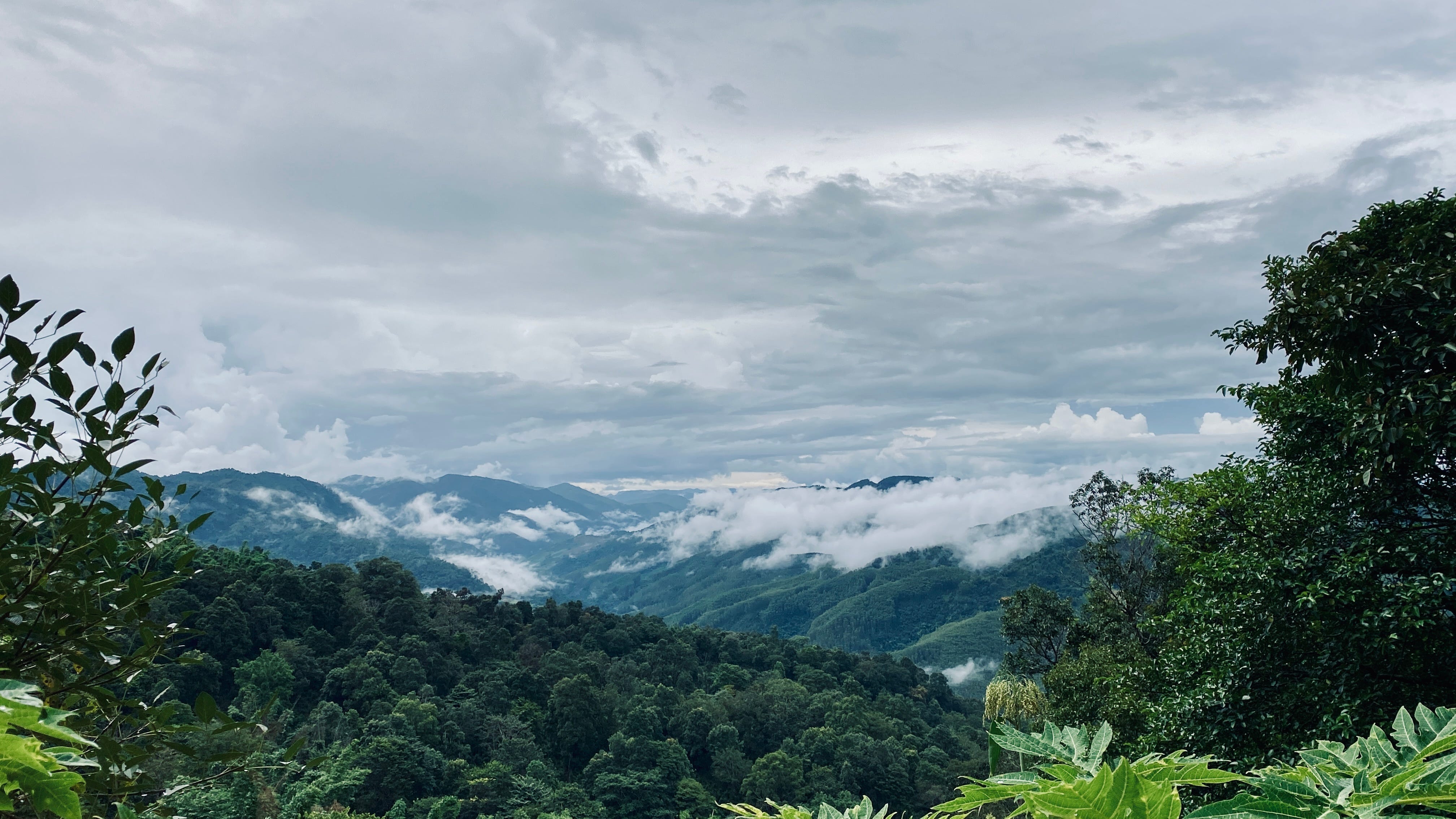
I’m on a five-hour train ride, heading south of Kunming, on a trip that sneakily whisked me away from the city before I had a chance to think and say no. The person I’ll be traveling with — whom I’ve only met once before, said that she’d arranged everything for the trip, and if I wanted to join I only had to bring myself and we’d share all the costs. I’d been wanting to go to 景迈山 ― Jingmaishan for a while, so it’s an offer I couldn’t refuse.
A cold is coming. I don’t usually get headaches, but now it’s threatening in the background, looming, ready to pounce. I fear cough with my whole being; once you catch it, it takes forever to get rid of, sticking to your throat and lungs like chewed gum on your hair. My throat is dry; my nose is wet — always a curious combination to me, as if the body errors all over the place. I know what it’s trying to say: Halt! Stop right there! Drop everything you do right now — and rest. Oh no, young lady. Rest is mandatory. That is an order — not a request.
I exchange messages with Adam during the solitary train ride, half the time waiting for the tunnels to be over. There are so many tunnels, one queuing after another. Black, bright, black, bright — Morse code of the Chinese railway system. The West highly disapproves — I’m sure, but the Chinese do what needs to be done. If a straight line needs to go through mountains, we make the line; we bore holes through hills and mountains.
Adam worries that my cold symptoms are caused by the ghosts.
“You were on that rail track late at night on the Ghost Festival. Do you think…?”
Appreciative as I am of the pure, genuine, however outrageous, concern, I also find the whole ghost argument infuriating. No — it is not ghost — I don’t believe in ghosts — don’t you talk about ghosts again, as I slam my virtual door in his face. If he thought the silly white-sheet that says boo really caused this breakdown of the body, then he got it coming. He proceeds to explain how the ghosts in his world are real and dark, to be feared and respected — not cartoon ghosts. I mentally wave away the barrage of imaginary voices as I drift in and out of exhausted sleep — the kind that’s disrupted by a mix of distorted memory and heartbreaks.
—
When they opened the body bag, chills ran down my body. It had come straight out of the fridge.
“Oh my god, it’s the same blanket,” Alex said.
“It’s the same blanket,” I parroted back to him, and to Adam. We were the first three on the scene. “Can’t believe this.”
I remembered the thickness, the beige colour, the red flower pattern, and the texture — a photographic memory from the week before. The same blanket Alex and Adam covered him with. That means the same position, the same clothes, same everything. Literally a death frozen in time.
As if we also shouldn’t have moved much, some of us filed in, in awkward steps like ducks, around the body in a messy circle; some people stayed at the back — thinking that there was little use staring at a cold, empty husk. Someone broke down crying — there’s always one, while the rest of us inclined to stay very still, subconsciously mirroring the frozen body. Later, they took the body bag back inside, and we had to wait for the body to thaw.
***
I never really like Tai chi and find it too slow, but when the bubbly Aurelie asks if I want to join her Tai chi-like exercise, I say, fine. The morning is heavy still as the cold and cough have one foot in the door, while I try my best to defend and hold the fort. Some morning exercise might do me good. Baduanjin shares the slow, flowing, meditative qualities of Tai chi, but simpler in structure: stretching, the drawing of the bow, the low stance, the thawing of the muscles and bones. She explains to me every single move as she does it, claims that this routine has saved her, that it has done wonders to her health and her skin — which is not an atypical claim. I’ve never met a society more obsessed about health than the Chinese: numerous ads on the lifts, the subway, bus stops — all about the next best thing to keep you young and healthy. In the past, there was said to be a Chinese emperor who was looking for the ultimate potion that prolonged life. Up and down the country, his men went, in search for this elusive elixir. Who knows whether they found it or not, but the end surely was the same? All good things must come to an end.
The next day we take a car with our female driver (quite rare still), from the base city — Xishuangbanna, to Jingmaishan. At the best of times, I get sleepy when I don’t drive — or even when I drive. But this time, it’s as if my whole purpose in coming here is to sleep, as my body is continuously pulled down by drowsiness. Normally I’m head of the group whenever I travel: with my family, with my mum, with my friends. This time I let Aurelie take the literal front seat as I take the back seat and follow. For once, I don’t even much care where we go.
I have the window half-opened when we get out of the city and the scenery becomes more leafy and green, feeling the breeze in between the half-sleep, half-awake state. Aurelie suggests that I close the window; and I wave her away. The Chinese are very scared of the wind, that it would go into your body and cause ‘coldness’. I wish people would stop warning me that the wind, or the ghosts, would enter and disrupt my body. It’s not those, I say. Can’t I just be tired?
We stop occasionally for sightseeing, for pictures, which is lovely and all, but the overriding feeling is relief when they say: the next stop is two, three, four hours away. Thank god. Just let me sleep. Just, let me… sleep…
I see orange behind my closed eyelids.
—
It was only two days ago that we burned the body.
“Oh no, oh no. I can’t,” Adam had freaked out days before. ”Seeing the body burned?” He had his thinking man pose on, imagining whether it’s something that he could possibly accept when the moment comes.
“Well, you don’t see it burned,” I said. “You’ll see him going into the incinerator.”
He frowned. “Still.”
They shoved the body in with a mechanical sound, followed by the clang of the metal gate closing. In China, cremation is a mandate; there is not enough land to bury everyone. They do this every day, around the clock; there are queues and waiting lists to be cremated. Body in, ashes out. The building itself was like a factory, all white, metal, and coldness; the room and the floor were bare, no decoration, no niceties — all procedures and routines. Constant humming echoed in the huge room with rows of incinerators. No emotion allowed, steeliness required.
They told us to come back in an hour. Some bodies take longer, but Bill was small. So our group packed ourselves into the cars and went to eat a quiet lunch at a restaurant nearby. The sudden rain surprised us as it poured like buckets from the sky, and we rushed with our pathetic umbrellas, hopping through puddles and streams of water that immediately pooled on the ground. The haunting scene of the incinerator still followed, like the smell of smoke sticking to your clothes. I was relieved my ears didn’t hear the fire, but my head heard it anyway — the muffled sound of the blazing red-orange.
***
The boiling water makes a hissing noise against the tea leaves and the earth-coloured cup, poured by the hostel staff in colourful local costume. The tea leaves expand in the steaming water and float up, looking like pieces of black coal, as if the coal from the hearth has jumped and made its way into the tea cup. I blow and sip on the tea, there’s a burnt taste that is not usually there when boiling water using an electric kettle.
We’re sitting around the fire outside under the gazebo, with a big black teapot on top of the hearth. Earlier in the day we’ve picked some tea leaves, roasted them on a hot wok with bare hands — no gloves, on the same hearth we sit around now, then left the roasted leaves drying in the sun. It’s a technique as old as the forest, started by the Blang and Dai peoples. When we take the tea leaves home, it will take a while for them to mature — a year or two. The older they are the more expensive they get, the more sophisticated the flavour. Apparently time does matter; always allow time to work its magic.
A French couple from Paris are sitting across from us — the woman works for maintenance of commercial flights, the man designs rockets to outer space. There’s something peculiar in meeting aeroengineer Parisians in a quiet old tea mountain in Yunnan, as if they have come from another planet and are checking how we earth people are living. Aurelie is extremely excited; she loves talking to foreigners. Their chatteriness is a hum, a calming white noise, allowing me to get lost in the fuzziness and earthiness of my tea.
—
When we came back from lunch, they came up with a trolley, and on its shelves, a few plastic trays of bones. It felt bizarrely intimate, to see someone’s bones, chalky white, the inside of their body that you never saw before — the body that has been fiercely fought for and preserved for eighty-three years, now in pieces on plastic trays, on a metal trolley.
The man with the white lab coat put all the bones into a 30–40 cm box,— with his bare hands — no gloves. He picked the big bones first;—I could see the shin bone — or is that the thigh bone — or the arm? — were they all mixed up?; then poured the small pieces and the white ashes into the box; then moved to the next tray, and the next—I lost count of the trays.
I could see the teeth — with the titanium jaw; it took me a few seconds to figure out what it was. Surprising how the teeth still looked like human teeth — with their unique shapes, semi-circular row of white smallness,—the canines—the front teeth—the wisdom teeth. I’d heard that when a body decomposes, the teeth are the last thing to stay. I never knew Bill had a constructed jaw, likely a remnant from his military days. The man crushed the teeth with his fingers — separated the white from the grey steel; then, after clearing it all up, he chucked the metal bit to the side.
这个不要啦哈。You don’t want this. For a split second I wondered whether it was a question or a statement?
The titanium jaw flew — as if in slow motion — and made a metal clanging noise on the metal table;—its echo sounded louder in my head than it really did—; then it sat there all alone.
We all stood very still, as if breathing would blow away the ashes, forced to mirror the man in the white lab coat: mechanical, emotionless, procedural.
I wondered whether it would go into the bin — the jaw that has sustained life for however many years and survived through the fire; used fully, then gone — one day life sustaining, the next, a piece of crap.
Only later did the upset arrive, like waves, about how the man treated our friend’s jaw. How dare he? Is that how you treat our friend? But it also felt a bit silly to make a fuss, when the rest of him was already pieces and ashes in a box.
***
The hostel staff asks Aurelie where I’m from and why I’m here (always these two questions). His Chinese is clunkier and edgier than the city people’s Chinese, and I find it harder to follow, so I let Aurelie answer. I understand quite a bit of the conversation, but at this moment, like what I occasionally do, I pretend not to understand and play the ignorant foreigner.
I discover that Aurelie is somewhat of a clean freak. She comes with just a single backpack on this trip, but out from that small backpack, small bottles of sanitiser, disinfectant, what have you; she even has extras to pass to me. Every single night she also establishes a routine of brewing proper Chinese tea — complete with a small tea brewing pot with its strainer, and two tiny tea cups, one for each of us. She brews expensive tea leaves, no teabag, of course, like a tea fanatic would; pours the extra tea into my thermos as provision for the next day. “The temperature will be perfect in the morning,” she says. Funny how she also disinfects the bathroom we share the way she washes tea — with hot water over every surface.
Aurelie says the tea we’re drinking at the hearth is special and rare; she has requested the hostel host for a specific type of tea. Perhaps it’s the fire, or the backdrop of the tea forest, or the faint stars in the black sky, perhaps it’s the otherworldliness of it all, but the tea does taste much better than any tea at home and feel warm in my throat and chest. If fire burns, does water heal? Though it seems you need both to complete the process.
—
We burned all Bill’s clothes in the giant fire at the lot next to the cremation building. A few friends had gone to his home, collected all his clothes, and packed them into suitcases. The flame was raging red inside the towering blackness of the boxy brick shed. It was surprising how fast the fire burned, swallowing everything in seconds like a hungry beast of a dragon. The two sacks of paper gold nuggets that I didn’t manage to burn with the weak lighter at the Ghost Festival a few days back were gone in a split of a second. The gold nuggets, which to me looked more like those Japanese paper cranes that carry wishes — every single one of them, plastic bag and all, disappeared, as if into a portal to another world. We went in one by one, brave like soldiers, getting as close as possible until we could no longer stand the heat on our face, then we flung the stuff into the centre of the fire with all our might — throwing and chucking, clothes flying in the air like colourful birds, withdrawing ourselves immediately after to avoid the waves of the fire. I saw Lee throwing Bill’s iconic black puffy jacket — I’d seen him so many times with that jacket, his trademark of the black jacket and the white hair, often with Lee by his side. At the end, all the suitcases went flying as well, the metal handle, the plastic, the polyester, the whole lot. All was gone. There was no trace of what was before. Just the fire, happy and crackly that it’s been fed.
***
The last day at Jingmaishan, it is raining on and off since morning. In the afternoon, the rain gets heavier. But we persist. Armed with umbrellas, we brace the rain, visiting temples and pagodas. There’s barely anyone around, everyone takes cover somewhere.
~
After the collection of the ashes, a few of us were tasked to go spread the ashes in the woods. Bill’s sister had no plan to fly the ashes back to the States as it’d be too costly. I think it’s apt that he stayed in China, as he had the past fifteen years. Why go back to a world that you’ve left behind? Not in life, not in death.
~
It’s chilly but not winter cold. In fact there’s warmth in the tropical rain, and a certain solitude, just you and the umbrella in this little bubble. A lot of noise gets drowned in the rain, and the world turns still and melancholic; the floor glistening like mirror and the drizzle is a hazy curtain, making all sights a little blurry and all colours muted.
~
Spreading ashes at an unassigned plot wasn’t exactly legal, so ideally only a few people went, to attract less attention. I volunteered to leave, while Adam and Lee went and saw it to the end. They went up to a hill, quite famous for illegal spreading of ashes, hiked the trail, and at one point made a sharp turn, went off the trail, into the woods, and spread the ashes there. An unmarked spot in the mountain.
~
Our last destination is an old Silk Road of the tea mountain — a two-kilometre cobblestone road, which on a sunny day would be a breeze, but the drizzle has now turned into proper rain. Just the two of us, silly enough to chug along the wet path in this weather. The ancient tea trees stand tall on both sides of the trail, like a welcoming committee in the long road to nowhere. I imagine the days gone past, scenes from another time and another world over a thousand years ago, and I do wish it would continue for another thousand and beyond, long after we all make our exit.
~
Adam gave me multiple GPS points to narrow down the closest approximate point by a hundred metres, even though they had made a deliberate decision to not mark where the ashes were spread. I had to insist that I didn’t need to know exactly where he was, just the rough location, so I could go too when I wanted to — to the mountain where Bill was and hear the whisper in the air. That’s all.
~
Occasionally people on motorbikes come from the other direction, driving toward where we come from, their passengers hanging precariously with large sacks at the back, and all of them tell us to go back.
“Where are you going? There’s nothing there.”
The Chinese have good intentions, and they constantly seem so concerned at our gullibility. But they always say “there’s nothing there”, leaving me unsure what exactly do they mean by “nothing” and “there”. What is there at anywhere? Either everything is a miracle, or nothing is a miracle.
Our shoes are doing okay at the beginning, start to get wet around the middle, and are completely soaked at the end. There are few things I hate more than wet shoes, but the wetness of everything else has taken my attention away from the shoes. The lower part of my pants is now wet too, my bag, my sleeves, the ends of my hair. Aurelie has a big smile on her face. “I feel so happy,” she said, and I smile back. I’ve forgotten how much I love rain and how it evokes a sense of vaguely remembering a beautiful memory in the past that you’ve forgotten — just the remnants of the feelings linger, but the details have dispersed and transformed into something else, like the mist in the air.
—
On the same day of the cremation, at night, we had a wake at a local restaurant, in celebration of a life. Around fifty people came, friends from different phases of Bill’s life. Some of them were from his early years, ten, fifteen years back, very close then, but as many relationships, that changed with time and distance. I always wondered why the universe has brought Adam and I to get close to Bill at the last phase of his life, really it was condensed to the last six months. As if we had a duty to be done, a lesson to be learned, to be present, and to witness the end of this man’s life who we’d come to grow really fond of.
There was plenty of laughing and catching up, the constellation of people who otherwise would not have met. Perhaps that’s his biggest legacy of all — people and connections. As people were snatching pizza slices at my table, I went inside to get a plate, and that’s when I saw Sha, a friend who I had not seen for a long time. Like most people, she only just heard about the news, and was teary at the table. I went to console her and told her the stories, and soon I was the one weeping while she soothed me down. I had stood with my back against the tables, didn’t really want everyone to see me bawling, though it’s of little use, as we were facing the till instead, which had the highest foot traffic. I took cover in the crowd, loud tears in the middle of the louder laughters, all the while holding the empty plate. Half an hour later, Sha led my exhausted self back to my table, and there sat in the middle of a small round table — three slices of pizza. A sea of people, and nobody touched them. I didn’t know most of these people and didn’t even order the pizzas, and as you all know, pizzas always go really fast. I sat down and savoured every bite of the bread base, the cheese, salami, arugula — grateful for the kindness of semi-strangers. Everyone gave me the grace of pretending not to see my puffy eyes, as we laughed together into the night.
***
The next morning is the day we’re to make the journey back home. I wake up early and sit down at the edge of the courtyard where the other side falls into a valley of forest, crowded by banana and banyan trees, and watch the gentle sky. Not a human sound — just the high-pitched chatteriness of birds and insects — like the world is waking up before everyone else; later broken by the humming hustle in the kitchen, preparing mixian for breakfast.
The mist rises from the valley, boasting the famous sea of clouds of Jingmaishan, like scenery from another world. How can smoke and mist look so similar and be so different in essence? One choking, one healing. I take a deep breath and find that I don’t have the cold or the cough anymore. The rain has not put more cold into me, and has washed it away instead. The mist has cleared up my throat and lungs.
I see Aurelie bouncing toward me, ready to puncture the daydream and lead me back to reality, back to the city and the civilisation. Soon the misty ancient tea mountain will feel like it’s only a dream.
“Ready!” I shout, before she has the chance to say anything.
Author’s note: This is my true account of a trip to Jingmaishan just two days after the cremation of my friend. A mysterious journey in the misty old tea mountain with a company that felt like they were both handed to me by the universe at exactly the right time.
The Crossing is part of the Between Worlds series. Each piece can be read independently, but if you’re so inclined to read the full series, they are:
Comments
Nothing yet. Say the first thing.
Sign in to join the conversation.