
Node Ahead 117: Every Bear Market Feels Different and Yet Every Bear Market Rhymes
Back in March, I wrote that bitcoin bottoms are a process, not an event.
It was not an especially glamorous argument, nor the kind of thesis that captures headlines. Most investors want to identify the definitive moment that marks the end of a bear market: a single capitulation day, a dramatic washout, or an unmistakable signal confirming that the worst is finally behind us. The instinct is understandable. Investors naturally seek certainty, and few things feel more valuable during a bear market than believing you know exactly where the bottom lies.
My argument was that bitcoin rarely works that way.
Major bottoms are seldom discovered in a single day. They are built over months. They emerge through a slow and often frustrating process in which excessive optimism is replaced by skepticism, speculation gives way to patience, and weak conviction gradually transfers to stronger hands.
Several months later, that framework appears more relevant than ever.
In November 2025, when bitcoin was still trading near $110,000, I published a piece called Line in the Sand. The central argument was straightforward: while most market participants remained focused on upside targets, the level that mattered most was $95,000. If bitcoin lost that support level, the market structure would change materially, opening the door to a decline toward the $45,000–$60,000 range.
Today, with bitcoin having traded into that projected downside range, it is worth revisiting both of those earlier arguments—not to celebrate a prediction, but because they point to a broader lesson that extends far beyond this cycle. That lesson is that bitcoin bear markets have historically followed a remarkably consistent pattern.
Every cycle feels unique while it is unfolding. Each arrives with its own catalysts, narratives, and explanations for why this time is different. Yet when viewed from sufficient distance, the similarities become difficult to ignore. The details change, but the underlying process tends to rhyme.
That raises a more important question than where bitcoin’s price will ultimately bottom. The real question is whether this bear market is following the same playbook we have seen before.
No cycle unfolds exactly the same way, and history never repeats perfectly. But the historical record suggests this cycle may be adhering more closely to the familiar script than many investors realize.
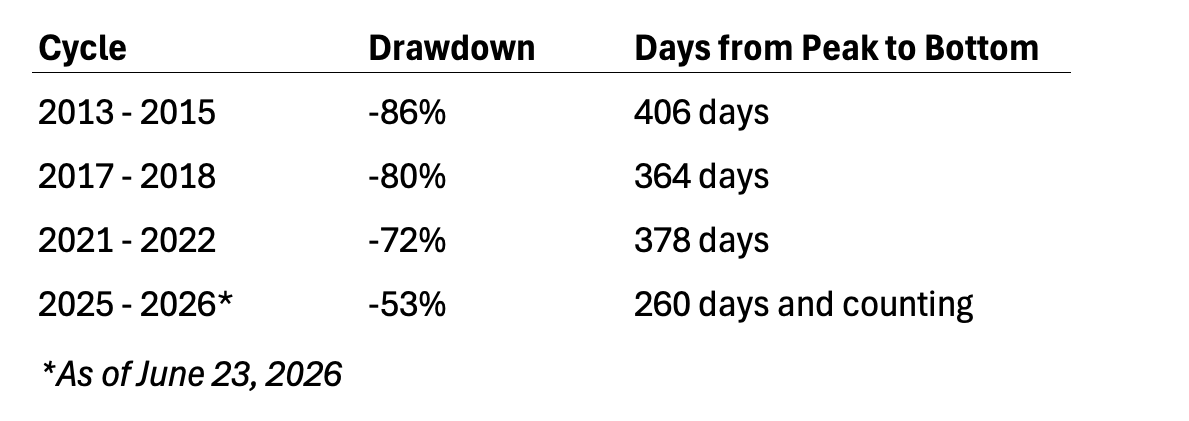
Bitcoin’s history is still too short to treat any cyclical pattern as a guarantee. Nevertheless, one trend stands out immediately: drawdowns have generally become less severe over time. If that progression continues, a decline of roughly 50% to 65% from the approximately $126,000 cycle peak would not be unreasonable. Such a move would imply a cyclical bottom somewhere in the $45,000–$60,000 range.
The case for a shallower decline is not based solely on historical precedent. It is also supported by meaningful changes in the market itself.
Bitcoin is maturing. Institutional ownership is significantly larger than in previous cycles. Spot bitcoin ETFs have introduced a new class of long-term holders. Market infrastructure is more robust, liquidity is deeper, and regulatory clarity has improved across several major jurisdictions. Taken together, these developments support the view that bitcoin’s bear markets may become less extreme as the asset matures. The current cycle’s relatively modest decline is consistent with that thesis.
Yet the depth of the decline may be less important than the consistency of the timing. Every completed bitcoin bear market has taken roughly one year to reach its ultimate bottom.
The 2014 bear market lasted approximately 406 days from peak to trough. The 2018 bear market lasted roughly 364 days. The 2022 bear market required approximately 378 days.
Different macroeconomic environments. Different regulatory backdrops. Different market structures. Different participants. Yet all three required roughly the same amount of time.
The sample size is small, but the consistency across cycles is noteworthy. More importantly, it provides a useful framework for understanding where we may be in the current cycle.
Markets need time to heal. They need time to exhaust sellers. Most importantly, they need time to drain the optimism that lingers long after a cycle peaks.
This is why bitcoin’s history is often more valuable as a framework than as a forecasting tool. Historical cycles cannot tell us exactly where the next bottom will occur, but they can help us understand where we are in the process. If the current cycle peaked in late 2025, the one-year mark would not arrive until approximately October 2026.
To be clear, this does not imply that bitcoin must bottom in October 2026 or that lower prices necessarily lie ahead. The recent low of $59,000 may ultimately mark the cycle bottom, but it remains entirely possible that bitcoin will trade lower in the months ahead.
The more important observation is that, if history is any guide, the current bear market is not unusually mature. Every completed bitcoin bear market has required roughly a year to fully run its course. Whether this cycle ultimately follows that pattern remains to be seen, but from a historical perspective, the current timeframe remains entirely consistent with prior cycles.
The significance of that consistency extends beyond the calendar itself. Time is one of the primary mechanisms through which bear markets reshape the composition of market participants.
As prices decline, ownership gradually shifts. Coins move from traders to investors, from participants focused on the next few weeks to participants focused on the next few years. While the composition of market participants evolves from cycle to cycle, the underlying psychology remains remarkably consistent.
Previous cycles were dominated by retail traders and early adopters. Today there are ETFs, hedge funds, corporations, and pension allocators. Yet regardless of who participates, bear markets still require the same transfer process. Short-term-oriented participants eventually sell to investors with longer time horizons.
The names change. The vehicles change. Human behavior does not.
This ownership transfer dynamic is also visible in the data. On-chain metrics have consistently shown that periods of market weakness are often characterized by long-term holders accumulating bitcoin while shorter-term, more speculative holders distribute their supply. The mechanism may differ from cycle to cycle, but the broader process remains remarkably consistent. Ultimately, bottoms form when the remaining sellers have exhausted themselves. That process unfolds gradually, which is why bottoms require time.
But ownership transfer is only part of the story. The second reason bottoms take so long is psychological.
Most investors imagine that market bottoms occur during moments of maximum fear. In reality, fear often arrives relatively early in the process. What arrives later—and is frequently more important—is apathy.
The progression tends to follow a familiar sequence: denial, fear, capitulation, and eventually something even more powerful—indifference.
People stop checking prices. Media coverage fades. Trading activity declines. Attention shifts elsewhere. The asset simply becomes uninteresting.
This phase is easy to underestimate because it feels uneventful. There is no dramatic headline, no memorable crash, and no obvious turning point. There is only a gradual loss of interest. Historically, however, that loss of interest has often been one of the clearest signs that a bottoming process is approaching completion.
It is difficult not to see elements of that dynamic today.
Google search interest in cryptocurrency has fallen dramatically from its 2025 peak and recently reached one-year lows despite bitcoin still trading several multiples above its 2022 bear-market bottom. Retail attention has faded even as prices remain elevated relative to just a few years ago. That divergence is notable because major bottoms are often formed not when prices are lowest, but when interest disappears.
At the same time, artificial intelligence has become the dominant narrative across both technology and capital markets. Venture funding into AI has followed. Media attention has followed. Investor enthusiasm has followed.
The shift is visible not only anecdotally but in market behavior. Capital and attention have increasingly migrated toward AI-related equities and technology investments while participation across crypto markets has weakened. Markets are always searching for the next compelling story. Right now, that story is AI.
Surviving a bear market is always difficult. It becomes even more challenging when another asset class is generating stronger returns, attracting more headlines, and absorbing much of the market’s attention.
Welcome to the apathy phase.
Markets rarely bottom when everyone is watching. They often bottom when nobody cares.
The truth is that I have no idea whether $59,000 was the ultimate bottom or whether bitcoin will trade materially lower. What I do know is that prices in the $60,000 range appear attractive from a long-term perspective, and that value likely improves further if bitcoin falls into the $50,000s.
As I argued back in March, there is limited edge in attempting to capture the absolute bottom tick. The difference between $19,000 and $15,500 in 2022 felt enormous in real time. In hindsight, it was largely irrelevant for investors with a multi-year horizon.
Waiting for a marginal undercut may provide psychological satisfaction, but it often offers limited incremental benefit relative to the opportunity cost of remaining underallocated during periods of attractive long-term value.
Data from James Check, one of the most respected on-chain bitcoin analysts, reinforces this point. His 200-Week Moving Average Quantile model measures where bitcoin is trading relative to its 200-week moving average. A reading of Q10 means that only 10% of historical trading days have seen bitcoin trade at a lower valuation relative to that long-term trend.
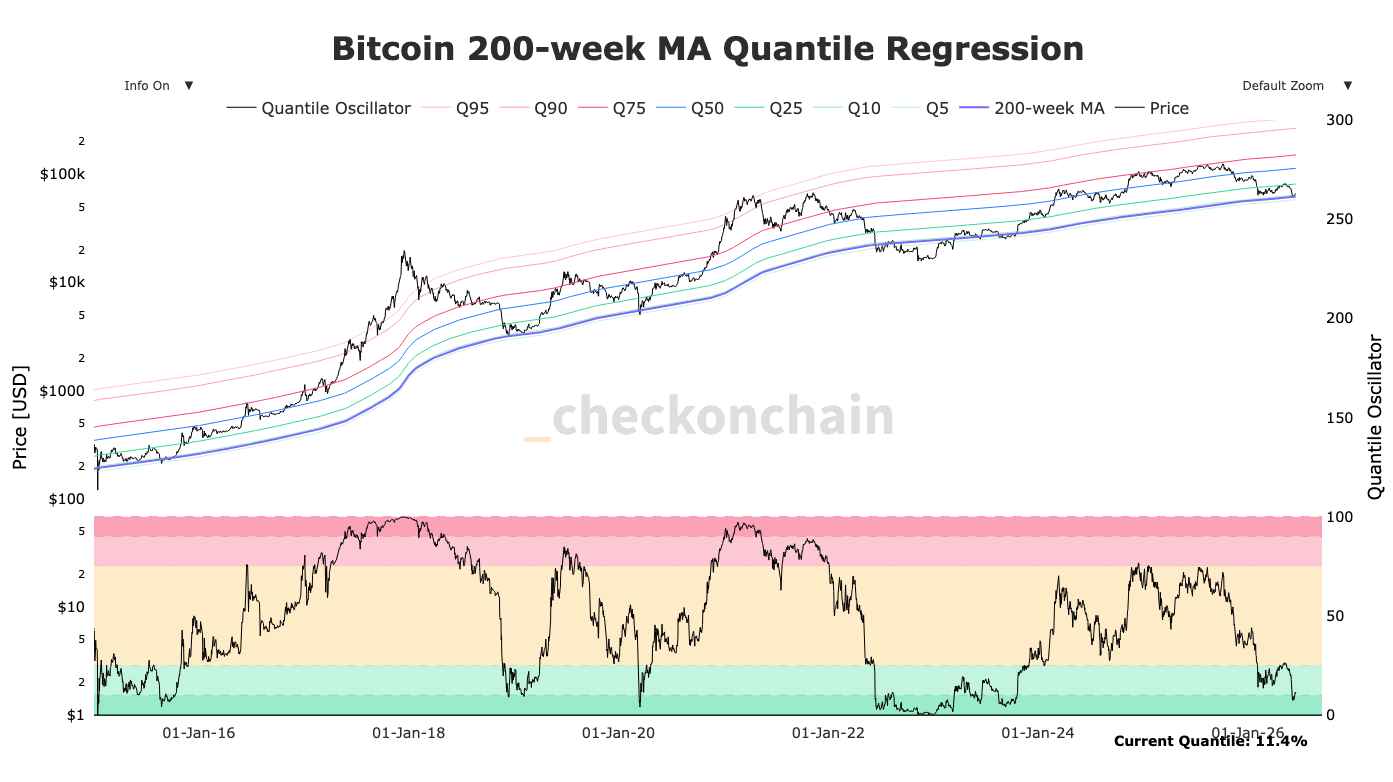
The recent move into the low $60,000 range produced a Q10 reading. In other words, bitcoin entered the lowest decile of all historical observations—a zone reached only during the deepest phases of prior bear markets.
Historically, Q10 readings have occurred near attractive long-term accumulation zones, even if they have not consistently identified the precise cycle low.
No indicator can identify a bottom with certainty. What this measure does suggest, however, is that we are operating in a region where the balance of risk and reward has historically become increasingly favorable for long-term investors.
Which is why, three years from now, I believe purchases made in the $60,000s are likely to be viewed favorably. Purchases in the $50,000s, if available, may look even better.
What will ultimately matter is not whether an investor captured the exact bottom tick, but whether they maintained the discipline and conviction to accumulate when the risk-reward profile was favorable.
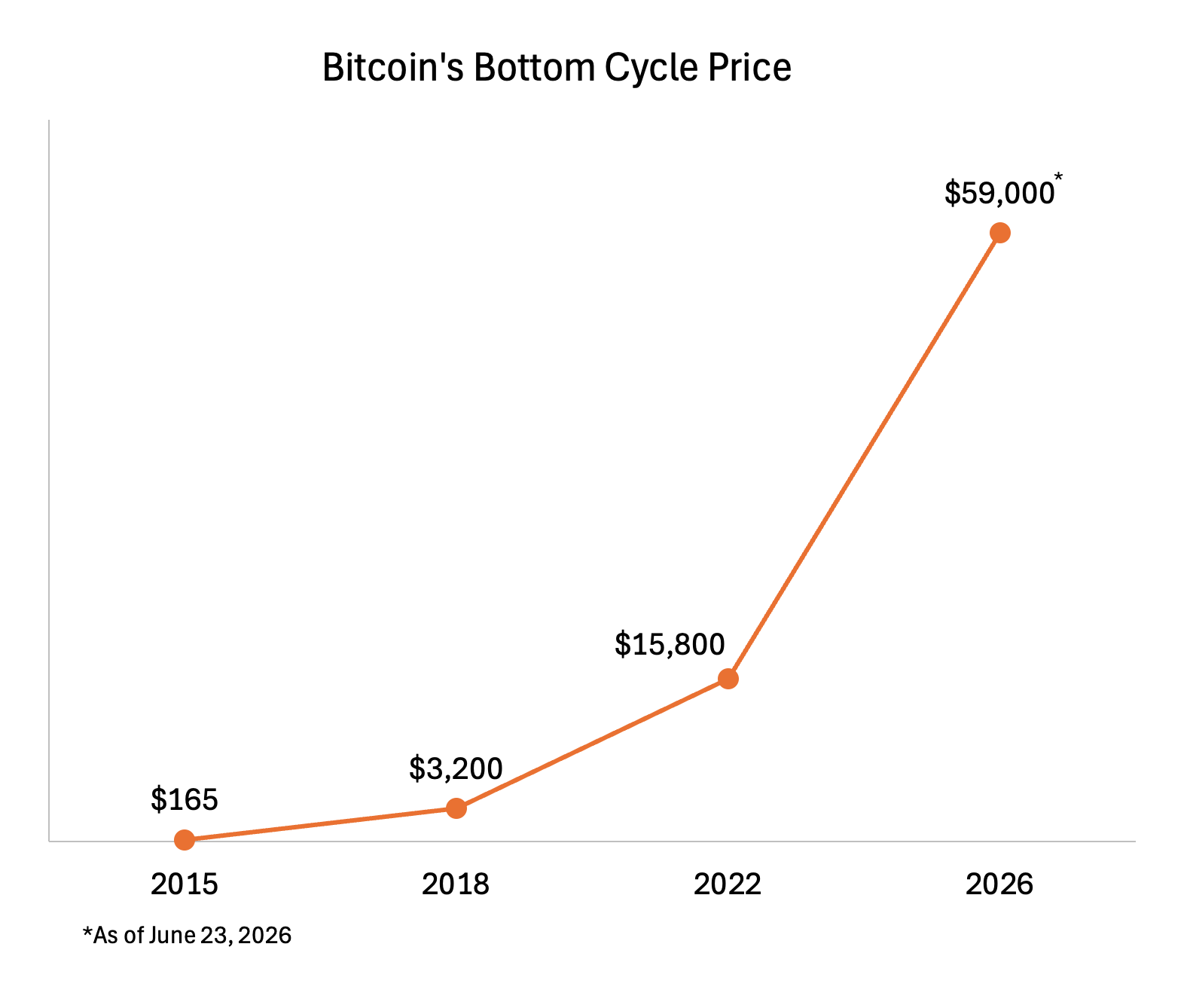
If the thought of buying today feels uncomfortable, it is worth remembering another recurring feature of bitcoin’s history. While every bear market has felt existential at the time, every cycle has ultimately established a bottom significantly higher than the one before it.
In 2015, many believed bitcoin would never recover from the collapse of Mt. Gox. In 2018, the bursting of the ICO bubble convinced many investors that cryptocurrency had been little more than a speculative mania. In 2022, the failures of Terra, Three Arrows Capital, Celsius, and FTX led many observers to conclude that the entire industry had been permanently discredited.
Each cycle destroyed confidence. Each cycle convinced a new group of investors that bitcoin’s best days were behind it.
And yet each cycle ultimately established a higher floor than the one before it.
Investors spend enormous amounts of time focusing on the highs. The highs generate excitement, headlines, and stories. But from a long-term perspective, the lows may matter far more.
The lows reveal where buyers consistently emerge. They reveal the level of conviction that survives after speculation has been stripped away.
That pattern does not guarantee future returns. It does not eliminate risk. And it certainly does not tell us where the current bear market will end. What it does suggest is that beneath the volatility, something more durable has been taking place.
Speculation comes and goes. Narratives come and go. Entire market cycles come and go. Yet the foundation of long-term ownership and conviction has continued to expand.
Ultimately, bitcoin’s historical cycles provide a framework, not a forecast.
History cannot tell us whether the ultimate low is already in. What it can provide is perspective. And that perspective currently suggests we are operating in a zone where the long-term risk-reward profile appears increasingly favorable. The investors who ultimately benefit most from bitcoin’s long-term growth are rarely the ones who identify the exact bottom. More often, they are the ones who remain rational while everyone else becomes emotional.
The goal should not be to buy the lowest price printed this cycle. The goal should be to accumulate when long-term value becomes increasingly attractive and sentiment becomes overwhelmingly pessimistic.
Every bitcoin bear market feels different while you are living through it. Each arrives with its own catalysts, crises, and explanations for why the old rules supposedly no longer apply. Yet the underlying process has remained remarkably consistent.
Bitcoin bear markets have historically taken roughly a year to complete. They have required extended periods of ownership transfer from traders to long-term holders. They have tended to conclude during periods of widespread apathy rather than moments of maximum panic. And despite feeling catastrophic in real time, each has ultimately established a higher floor than the cycle before it.
Whether the ultimate low ends up being $59,000 or something lower is a question that only hindsight can answer. The more important question is whether investors can maintain the discipline to act while fear, apathy, and uncertainty dominate the conversation.
Because if bitcoin’s history has taught us anything, it is that the greatest opportunities rarely feel comfortable when they appear.
Disclaimer: This is not investment advice. The content is for informational purposes only, you should not construe any such information or other material as legal, tax, investment, financial, or other advice. Nothing contained constitutes a solicitation, recommendation, endorsement, or offer to buy or sell any securities or other financial instruments in this or in any other jurisdiction in which such solicitation or offer would be unlawful under the securities laws of such jurisdiction. All Content is information of a general nature and does not address the circumstances of any particular individual or entity. Opinions expressed are solely my own.
No posts
Comments
Nothing yet. Say the first thing.
Sign in to join the conversation.