
As we have noted throughout the history of this newsletter, bitcoin has historically been one of the most liquidity-sensitive assets in global markets, responding strongly to shifts in monetary conditions and increasing currency debasement. Unlike sovereign currencies—whose supply expands elastically in response to fiscal deficits, policy intervention, or financial instability—bitcoin operates on a fixed, transparent, and immutable issuance schedule. This structural contrast with fiat systems helps explain why bitcoin has often performed well during periods of balance sheet expansion and accelerating money supply growth. In such environments, a programmatically scarce monetary asset with no sovereign liability makes bitcoin highly responsive to changes in liquidity expectations. While no asset provides a perfect read-through on monetary debasement, bitcoin has emerged as one of the clearest market proxies for the relationship between global liquidity expansion and demand for credibly scarce assets.
Focusing solely on debasement and liquidity expansion, however, overlooks a second and equally important dimension of bitcoin’s macro behavior. Beyond its predefined monetary policy, bitcoin exists outside the traditional financial system, offering holders portability across jurisdictions, resistance to seizure, independence from the banking system, and the ability to self-custody and settle transactions without permission. These characteristics shape its behavior during periods of geopolitical stress and financial instability—episodes driven by abrupt ruptures in confidence, disruptions in funding markets, or geopolitical shocks. In such moments, capital flows are neither orderly nor purely rational: they move first toward liquidity, and only later toward perceived safety.
This distinction is essential. In the immediate aftermath of a crisis—whether triggered by a banking failure, sovereign stress event, or geopolitical escalation—markets typically enter a phase of deleveraging. Margin calls spread across asset classes, funding liquidity tightens abruptly, and correlations between otherwise unrelated assets converge. In these conditions, valuation and long-term conviction become secondary. What matters most is the ability to raise cash quickly. Assets that are liquid, globally accessible, and continuously tradable tend to be sold first.
Bitcoin occupies a unique position within this framework. Because it trades 24 hours a day, seven days a week, it is often one of the first global assets to reprice when macro shocks occur, especially when those shocks happen outside traditional market hours. This constant liquidity is both a strength and a vulnerability. On one hand, it makes bitcoin a real-time barometer of global risk sentiment. On the other, it makes bitcoin especially exposed during sudden liquidity contractions. When panic hits, bitcoin often behaves less like a macro hedge and more like the most liquid risk asset available. That is why, during acute stress events, it frequently declines alongside equities and other high-beta assets, often with significant speed.
However, this first phase is mechanical rather than fundamental. It reflects liquidity stress, not a reassessment of bitcoin’s monetary properties, network fundamentals, or long-term adoption trajectory. Once leverage is flushed out and funding conditions stabilize, markets enter a second phase: post-crisis repricing.
This is where bitcoin’s behavior begins to diverge from traditional risk assets. Once the immediate liquidity stress subsides, investors start reassessing what the shock implies. Does it expose deeper fragility in the banking system? Does it increase sovereign borrowing needs? Does it accelerate monetary expansion or erode confidence in fiat institutions? In this environment, bitcoin increasingly trades not as a casualty of the liquidity event, but as a forward-looking hedge against monetary and geopolitical uncertainty.
It is in this second phase that bitcoin’s asymmetry becomes most visible. Gold often stabilizes, reflecting its role as a traditional safe haven. Equities may recover gradually depending on earnings expectations and economic growth. Bitcoin, however, often reprices more aggressively.
This dynamic is increasingly supported by institutional research. In its paper Bitcoin: A Unique Diversifier, BlackRock argues that bitcoin should be viewed as a structurally distinct asset, driven by fixed supply, adoption dynamics, and declining trust in fiat systems rather than by traditional equity or bond fundamentals. Importantly, BlackRock notes that bitcoin’s short-term correlation with equities is largely a liquidity phenomenon. During stress events, forced deleveraging leads to indiscriminate selling across risk assets. But over medium-term horizons—particularly in the 30 to 90 days following shocks—bitcoin has often outperformed both equities and gold.
This distinction between short-term behavior and medium-term repricing is central to understanding bitcoin’s role in crises. BlackRock’s analysis of historical stress periods shows that while bitcoin may underperform during the panic phase, it has frequently recovered more strongly once liquidity stabilizes. The implication is not that bitcoin avoids crisis drawdowns; it clearly does not. Rather, bitcoin tends to respond to crises in two distinct regimes: first as a liquid risk asset, and then as a monetary alternative that reasserts itself once systemic stress begins to normalize.
Recent market disruptions reinforce this conclusion. Episodes such as the yen carry trade unwind and the February 2025 tariff shock followed this same pattern as the examples laid out in Blackrock’s paper. In both cases, bitcoin initially declined alongside broader risk assets during the shock phase. Yet over the following 60 days, it outperformed both the S&P 500 and gold, reflecting a familiar rotation from forced liquidation to macro repricing.
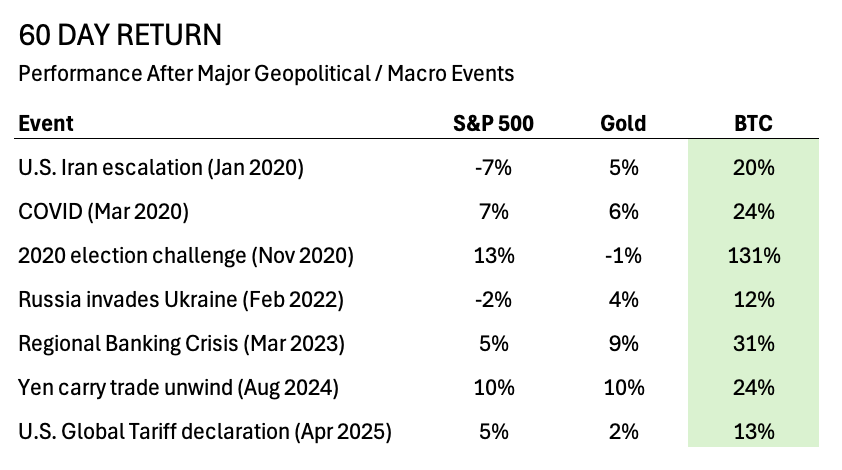
Independent research points to the same conclusion. Analysis published by Onramp across multiple crisis episodes—including the COVID liquidity shock, the Russia-Ukraine invasion, the 2023 regional banking crisis, and the 2024 yen unwind—shows a remarkably consistent pattern. Bitcoin often experiences sharper initial drawdowns than traditional safe havens but then rebounds more forcefully over the following one to three months. In all of these episodes, its 60-day performance exceeded both equities and gold, suggesting that its volatility masks a structurally stronger recovery profile.
What makes this pattern especially notable is its consistency across different kinds of shocks. Whether the trigger is a global pandemic, military conflict, domestic policy disruption, or banking sector fragility, the sequence remains broadly the same: an initial liquidity-driven selloff followed by rapid normalization and stronger relative recovery. This consistency reflects the way markets process uncertainty when a globally traded, fixed-supply monetary asset is part of the system.
This framework is also useful for interpreting recent geopolitical developments. The escalation of conflict involving Iran in February 2026 provided another real-time test of bitcoin’s crisis behavior. Following coordinated strikes on Iranian infrastructure, global markets entered a classic risk-off phase. Bitcoin sold off sharply alongside other high-beta assets, briefly falling near $60,000 as leveraged positions were unwound and demand for liquidity surged.
However, as conditions stabilized through March and April, the familiar pattern re-emerged. At the time of writing, bitcoin has rebounded roughly 33% from its lows, materially outperforming both gold and equities over the same period. Gold is down -6%, while equities are up around 6% amid persistent macro uncertainty. The same pattern seen in previous crises has once again played out: bitcoin suffered the sharpest initial liquidation but then staged the strongest recovery as markets moved from panic to reassessment.
The key point is not that bitcoin avoids volatility—it clearly does not—but that its volatility is structurally asymmetric. Drawdowns due to crises tend to be liquidity-driven, while recoveries from them are often faster and more reflexive compared to other asset classes. This asymmetry becomes especially pronounced when crises intersect with broader concerns around fiscal sustainability, monetary expansion, or geopolitical fragmentation. In those environments, bitcoin’s fixed supply and lack of counterparty risk become increasingly valuable to investors once the initial liquidity panic passes.
Taken together, the evidence from institutional research, independent macro analysis, and recent crisis episodes points to a consistent conclusion: bitcoin is best understood as a dual-regime asset in times of crisis. In the first regime—acute stress—it behaves like a liquid risk asset, often sold alongside equities as investors scramble for dollars. In the second regime—post-crisis normalization—it behaves increasingly like a macro hedge, benefiting from renewed liquidity and heightened awareness of monetary and geopolitical risk.
This duality is what makes bitcoin’s behavior so often misunderstood. Observers who focus only on the initial drawdown conclude that bitcoin is merely a high-beta risk asset. But those who observe the full cycle—from shock through recovery—see a different pattern: one in which bitcoin often emerges as one of the strongest-performing assets after markets reprice monetary and geopolitical uncertainty. In that sense, bitcoin should not be judged solely by how it behaves during stress, but by how it behaves after.
Over multiple cycles, this distinction becomes increasingly clear. Crisis creates forced liquidity demand. Forced liquidity temporarily drives correlations toward one. But once liquidity returns, fundamentals reassert themselves. In that second phase, bitcoin’s fixed supply, global accessibility, and independence from sovereign balance sheets begin to matter again. And it is in that phase that bitcoin has repeatedly delivered strong relative performance.
Disclaimer: This is not investment advice. The content is for informational purposes only, you should not construe any such information or other material as legal, tax, investment, financial, or other advice. Nothing contained constitutes a solicitation, recommendation, endorsement, or offer to buy or sell any securities or other financial instruments in this or in any other jurisdiction in which such solicitation or offer would be unlawful under the securities laws of such jurisdiction. All Content is information of a general nature and does not address the circumstances of any particular individual or entity. Opinions expressed are solely my own.
No posts
Comments
Nothing yet. Say the first thing.
Sign in to join the conversation.