
welcome to your weekly unplannable dose of brainsparks, the nexialist
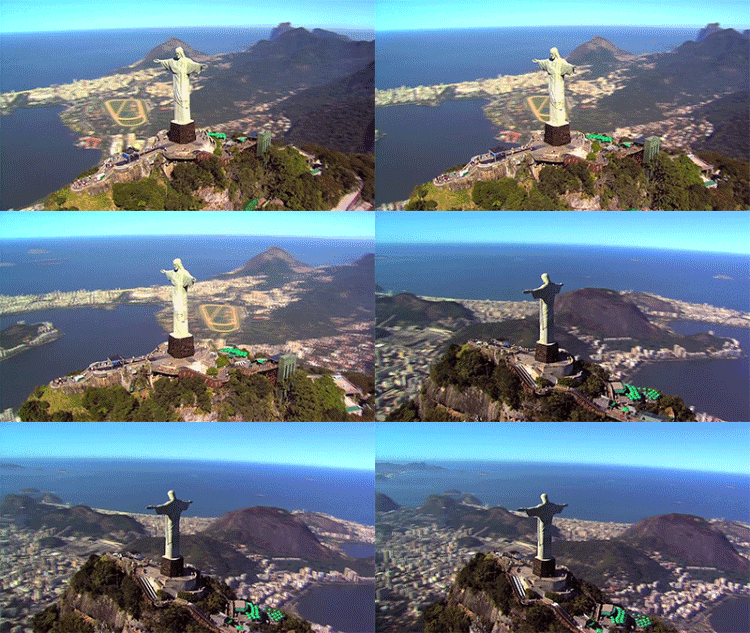
hey, you! i hope this message finds you well. this week, i write to you from rio de janeiro, where i haven’t been for around 7 years. i will tell you more about the experience at the brasil futures forum in a second, but before i just want to take a moment to say how beautiful and lively this city is, i’ve been so taken by the mix of lush nature and metropolis, it’s quite fascinating. i’ll leave you to it, since rio is calling me. enjoy! 🫀✨
⏮️ time-machine: best brainsparks this week over the past years:
race to the bottom of human dignity, self-destructing reality, magic realism for designers, tanzlinden, ácido brasil (tn#240), duelo, imaginal disk, lucifers, amsterdam archive, interrobang (tn#188), past lives & in-yun, implicate order & math tiling, quantum entanglement visualized, how tech changes the way we speak, power to peasants, digital feudalism (tn#136), electronic body music, post-punk (tn#84), the brazilianization of the world, being black in brazil, greengo dictionary, the guarani language, pão de queijo (tn#35)
this past weekend i’ve been immersed at the brasil futures forum event together with envisioning and i’m still digesting everything that happened. saturday and sunday different territories and institutions around the city were having their programs, and on monday we spent the day at the iconic museum of tomorrow with a rich program across different rooms and auditorium (the program website was completely vibe-coded by Michell Zappa, and you can read his report from event here).
firstly, it was so nice to spend time with the envisioning team irl: we’re 5 people only and have been working together for years, but as a remote company we don’t get to be all together that often. all of us are brazilian, and almost all of us live in europe, which gives us a specific angle to look at brazil.
one of the phrases i found myself thinking and saying to the team along these days: they don’t have this in europe (in portuguese: isso não tem na europa). it’s a twist on the brazilian fashion/make-up bloggers’ meme that need to show how their products are not available in brazil: they were either imported or bought on a trip. the way the event happened could only happen in brazil, the people, the conversations, the affection, the celebratory vibe, the space for emotions and for being yourself, the space to hold contradictions, the make-do attitude. congrats to lu bazanella, isa maria, wellington, eduardo and everyone else involved, the event felt like a love-letter to brazil.
disclaimer: i can’t even say i’m writing this because i’m high on the carioca sun/vitamin d, because the weather’s been cloudy and rainy/drizzly. but here is why i think bff was a hit and the world needs to pay attention:
futures from brazil/latam: the main pillar of bff was very clear throughout the event: brazil/latin-america need to own our futures, take it into our own hands and not simply copy/absorb what is being chosen by other hegemonic nations. the views of territory, community, ancestrality, indigenous thinking and environment were central to the event, not an afterthought. our cultural wealth is like no other and we need to appropriate that (@alabadaue).
get together & celebrate: the whole event felt like an intentional celebration and like a true community. this made me feel comfortable to say hi to people i had never met before and it just felt authentic to start conversations, not like a “regular” networking event. despite the event discussing a serious topic, joy and excitement were always present.
diversity core: i know this word has been emptied and disputed, but i found myself having goosebumps and teary eyes when i would look around and notice the real (not tokenized) presence of women, poc, indigenous people, different accents, youth and elders not only amongst the guests but on the stages. it felt like the diversity was so intentional and central, and that needs to be a cornerstone in futures work.
territory: “what does the territory want from this event?” this was a question isa shared during the organization and curatorship of the event. it was impressive how local social organizations that do the daily work in the territory in rio and around the museum were present, sharing the contradictions of futures work in such an unequal society.
beyond discourse: the people on stage were actually doers, who are putting the work to build better futures in the most diverse ways: social groups, political actors, artists, leaders, researchers, heritage workers, futurists, communicators, museum organizations,etc.
holding contradictions: it was clear that in some panels people sometimes had different views, and the way the discussions were held was respectful and understanding. even the difficult questions around tech x human, ai x art, futures x ancestry, there was so much power in understanding nuance and holding contradictions.
make-do attitude: because we’ve been involved for a few months, we noticed how the event came together because people envisioned the event and put in the effort. there were very few sponsors, and it was built on people’s will and make-do attitude, which is so endemic to brazil.
unplannable: during the event, i heard someone using the word implanejável (unplannable) and i was thinking how this is essential to futures work. there needs to be room for spontaneity, change and adaptation, and . as someone who lives in the super-planned dutch society and have adapted to that, i caught myself wishing to be more spontaneous.
brainsparks: brasil futures forum (tn#291), amazonize the world (tn#153), brazilianization of the world (tn#35), protopia futures (tn#27), ancestral future (tn#112), américa invertida (tn#140)
i had forgotten about this word and during the event it was used quite a few times: before brazil was named as so after the invasion, indigenous people called the region a different name — more specifically the eastern coastal area:
Pindorama (from Tupi pindó-rama: “region of palm trees”) is a term designating the ancestral lands of the Tupi-Guarani peoples—specifically the eastern region of South America known today as the Brazilian coast.
Archaeologists believe the term originated during ancient migrations, when the Tupi-Guarani moved to the Brazilian coast—the eastern region of South America.Various Tupi-Guarani groups inhabited the region prior to the arrival of the Portuguese.
In addition to meaning “land free from evils,” another etymological interpretation defines the word as “region of palm trees.”
Today, it is the name used by peoples of the Peruvian Andes and the Pampas to refer to Brazil. Many Indigenous people and activists in Brazil also refer to the territory officially recognized as Brazil by the name Pindorama.
brainsparks: literal countries names (tn#137), why amazon? (tn#137), 5000 years of coexistence (tn#170), reindigenisation x decolonisation (tn#140), el dorado (tn#78),ancestral future (tn#112), thinking for troubled times (tn#32), natural intelligence (tn#168), immigration in brazil (tn#151)
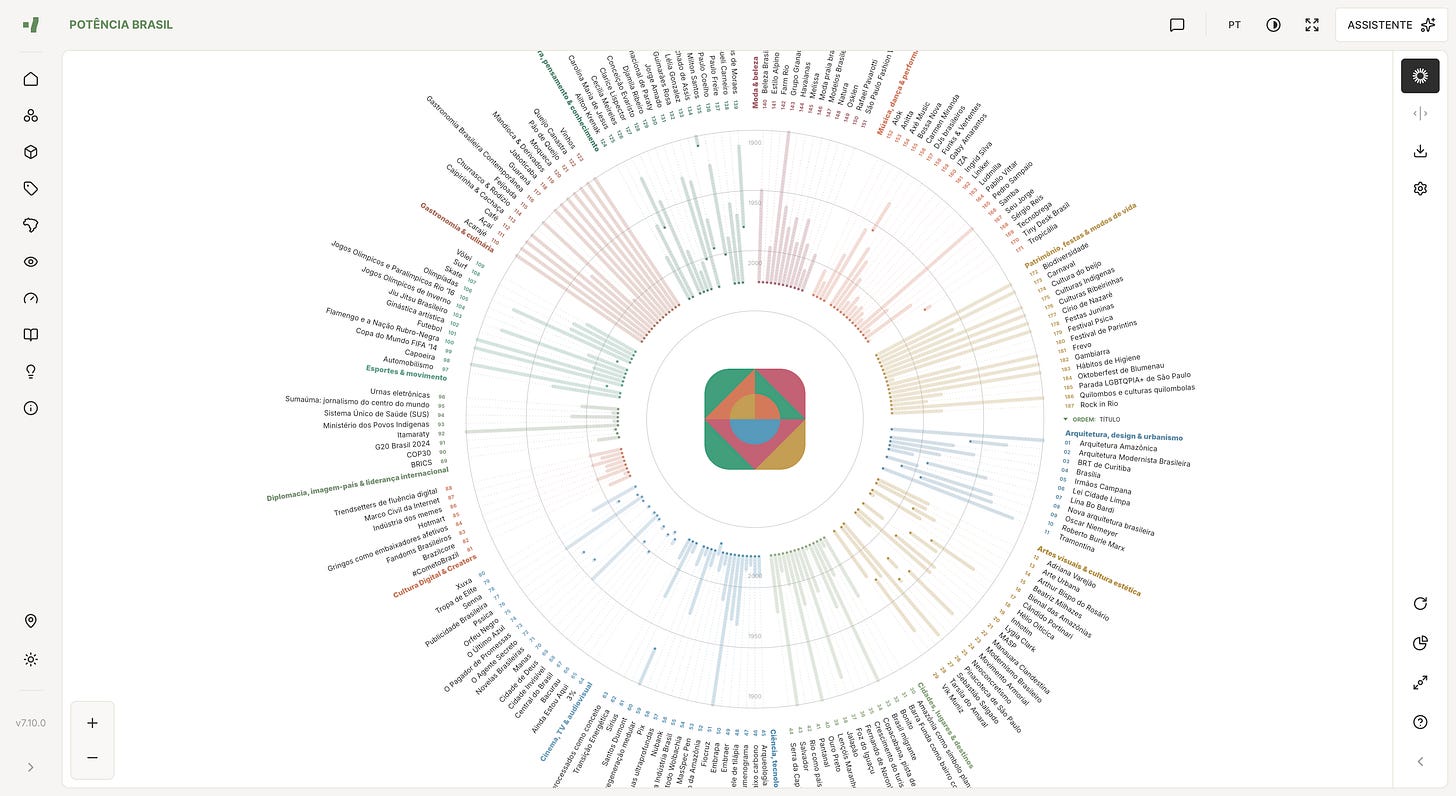
one of the activities envisioning held at the bff was a vibe-coding workshop at casa firjan, and we also soft-launched potência brasil so people could use this database of 180+ cultural references from brazil to create something.
this is still a preview, but i’ve been leading this research for the past months at envisioning and i wanted to share it with you as well, as many of these references have been shared here before. you can navigate in portuguese and english (soon in spanish, i hope), in 13 different areas, and check the duratiion and the projection of a certain cultural object/reference, from a specific artist, to a cultural movement, or a brand or institution. you can read about the learnings and metrics on the left side bar.
this interface is envisioning’s platform, which we usually use to map emerging tech or signals of change, but here we used it to map cultural manifestations, which is quite an exciting experiment. there’s also an assistant in the upper right corner so you can ask questions. you can also take a swipe-test to test your brazilian cultural knowledge (this quiz was also vibe-coded!).
brainsparks: encyclopedia — circle of knowledge (tn#177), tech radar (tn#177), centaur mindset (tn#106), tropicália (tn#8)
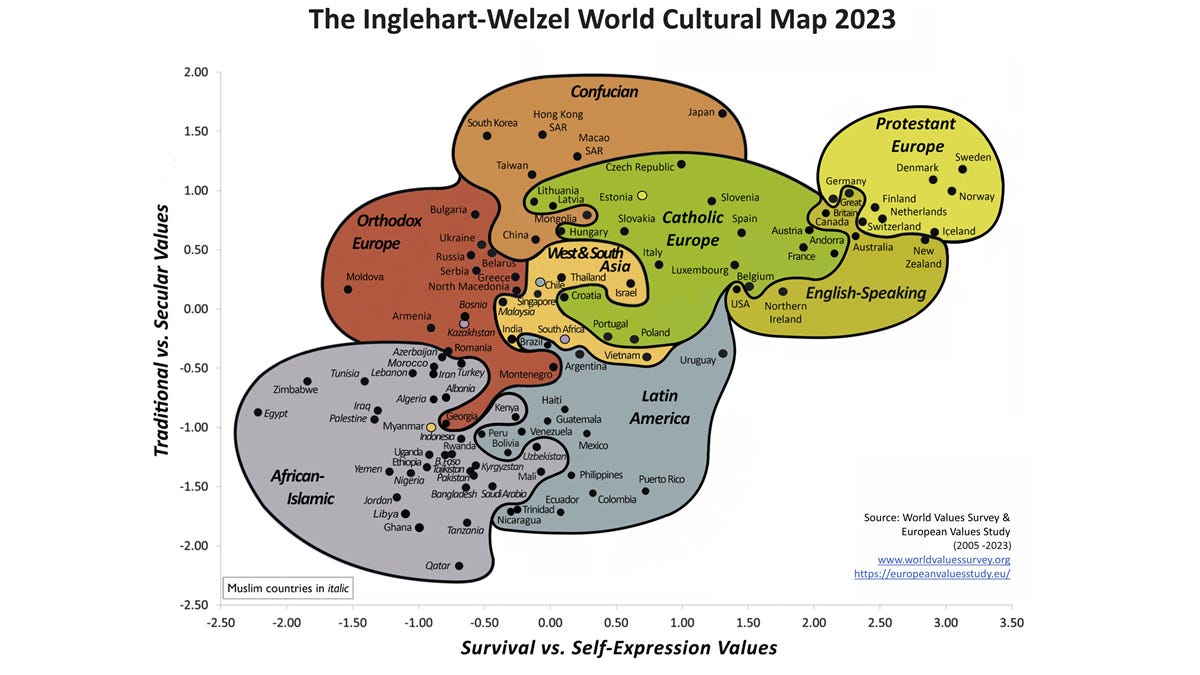
why had i not seen this before?? in one of the presentations that i could not attend (and someone sent this via whatsapp), they mentioned how most ai-training over-represents the “tiny” english-speaking section, leaving most of the other cultures underrepresented, which exacerbates those values and biases in the ai systems we use everyday.
The Inglehart–Welzel cultural map of the world is a scatter plot created by political scientists Ronald Inglehart and Christian Welzel based on the World Values Survey and European Values Study. An early version of the map was created in 1997, and several revised versions have been released since.
The map depicts closely linked cultural values that vary between societies in two predominant dimensions: traditional versus secular-rational values on the vertical y-axis and survival versus self-expression values on the horizontal x-axis. Moving upward on this map reflects the shift from traditional values to secular-rational ones and moving rightward reflects the shift from survival values to self-expression values. According to the authors: “These two dimensions explain more than 70 percent of the cross-national variance in a factor analysis of ten indicators—and each of these dimensions is strongly correlated with scores of other important orientations.”
brainsparks: bronfenbrenner’s bioecological model (tn#85), shifting values (tn#2), how to study culture (tn#232)

i learned about organic museums, which are being opened more often in brazil and latam. instead of waiting for institutional museums to notice local cultures, local leaders turn their houses or local spaces into museums “transforming living spaces into territories of living memory.” and they have been teaching larger museums how to be more in tune with the territory and communities around them, also shifting the roles of museums. in this talk we heard from museo interactivo mirador in santiago/chile, regeneracultura and sesilab.
brainsparks: museum-worthy (tn#167)
🫀✨thank you for reading The Nexialist. This post is public, so feel free to share these brainsparks 🧠✨
I truly believe innovation comes from bringing improbable areas together, and that’s why I called this project The Nexialist. Some sectors are known to be self-referencing and hermetic. Sometimes, teams are on autopilot mode, focused on the daily grind, which hinders innovation. As a Nexialist, I like to burst these bubbles, bringing references from different areas, and maintaining teams inspired and connected to the Zeitgeist.
I offer inspiration sessions called Brainsparks, creative desk research (Zeitgeist Boost), Plug’n’Play deals for workshops and sprints, and other bespoke formats. If you want to know more about this, send me an e-mail with your challenge(s) and we can figure something out together. Check out my website and some work I’ve done below:
Comments
Nothing yet. Say the first thing.
Sign in to join the conversation.