
welcome to your weekly brain-shimmy, the nexialist
hey, you! i hope this message finds you well. this weekend, it’s world pride is in amsterdam. i know the event can be criticized for its commercial focus, but after the attack last weekend at berlin pride, it’s a proof prides need to keep happening all over the world. i will be celebrating for the first time in one of the boats, and i’m so excited. i will leave you to this week’s nexialist which was a bit of a rabbit hole. enjoy! 🫀✨
⏮️ time-machine: best brainsparks this week over the past years:
neo-medievalism, tarot through the ages, failures of globalization, apocalypse in the tropics, digital plastic, hide & seek (tn#236), olympic outrage, underground cities, recession pop is back, creative manifesto, tribbing & tribadism, how big? (tn#184), second brain, neurorights, personal machines and portable worlds, humancore (tn#132), renaissance, what will replace religion?, the earthquake that changed history, masters of crowds, the vanishing designer (tn#81), scenius aka communal genius, tropicália, brazilian jester, wwii dataviz, mtv premiere, mistress violet (tn#31)
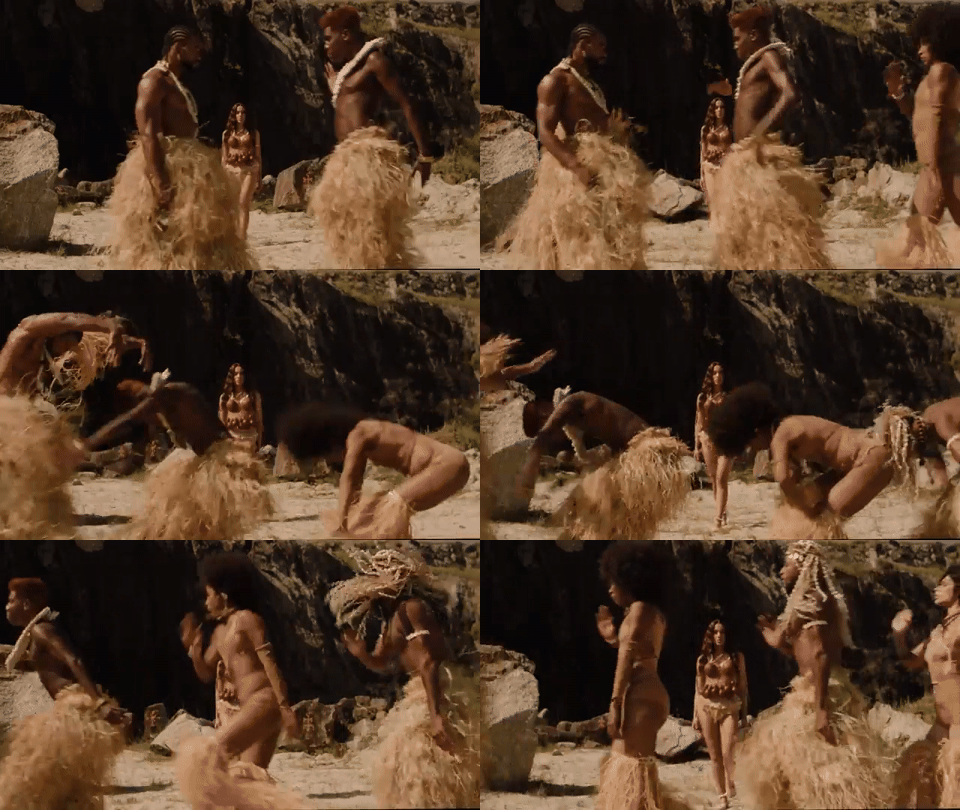
after 3 months of releasing equilibrivm (tn#275) anitta gifted the world with a sequel, and i’m so proud to show her off here. i do know we’ve always had artists showcasing the diversity and beauty of brazilian spirituality in their art, but to see an artist of this caliber releasing something like this gives me goosebumps. i don’t even follow the faiths she is representing, but i was getting chills and crying while watching it. the amount of afro-brazilian and indigenous elements, represent brazil’s syncretism (tn#44) in such a beautiful light — and i probably don’t get half of them.
you can see the visual research is so rich, the lyrics, the collabs and the different brazilian rhythms, anitta’s artistry is undeniable. as much as this a “new era” it feels authentic. we are walking through her spiritual learnings with her. one of the themes i saw in few songs is to get off our screens, take it slow, have moments introspection. this is how this work moves the zeitgeist forward.
haters online were complaining she used ai, and the artists that participated proceded to share their artisanal intelligence (tn#149) and ancestral intelligence videos, from the design of the outfits, sets and other visuals used in the video. it was all made by humans.
brainsparks: rock doido (tn#241), amazonize the world (tn#153), funk generation (tn#171), carranca (tn#238), luedji luna (tn#97), caju (tn#187), fetish, glamour & grammar (tn#75), syncretism (tn#44), appreciation or… (tn#20), more-than-human aesthetics (tn#200), profane (tn#170), artistry + world building (tn#192)
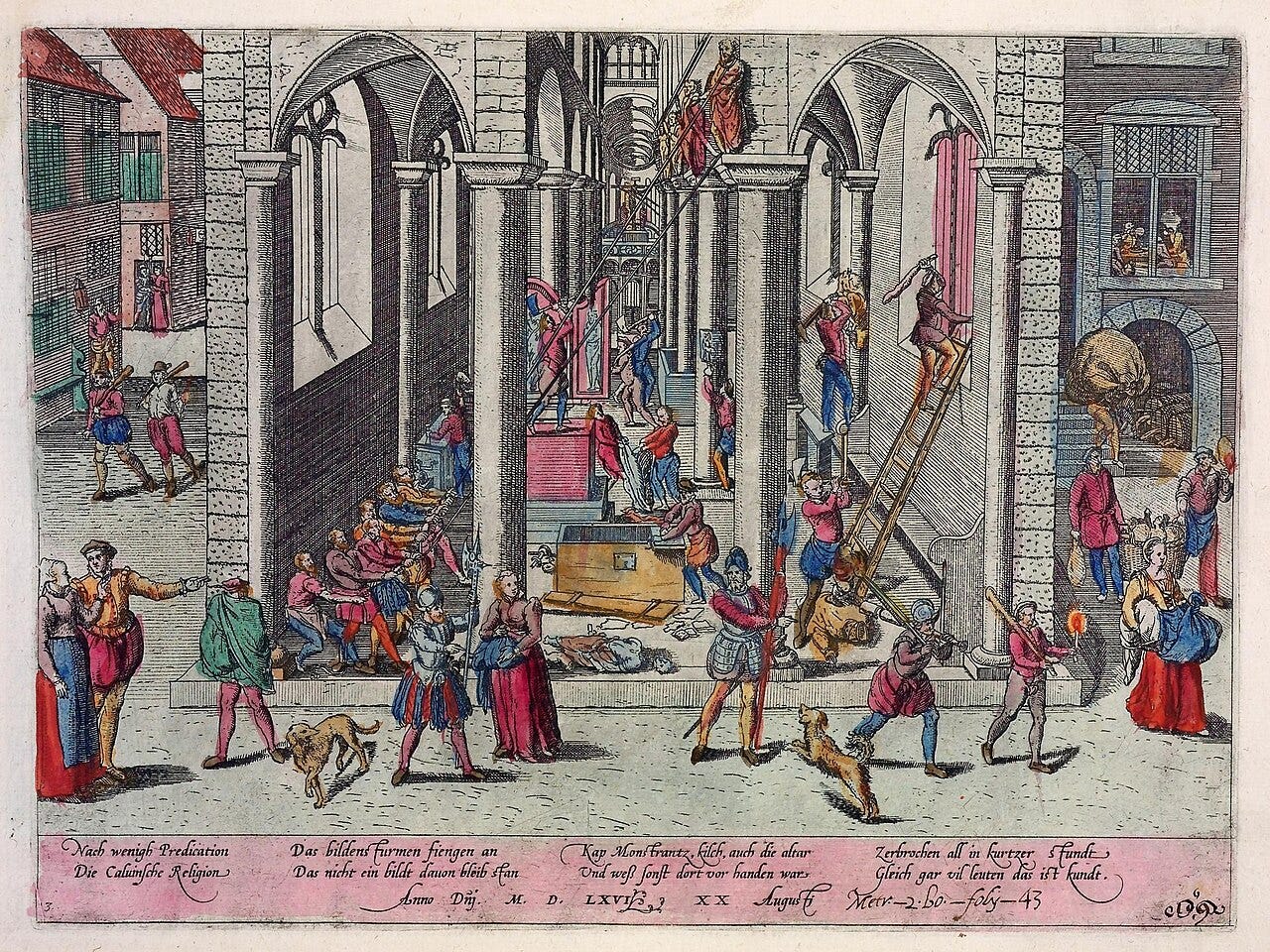
seeing anitta highlighting all these beautiful religious/spiritual brazilian symbology reminded me of something i’d read about here in amsterdam but never looked into, so i’m bringing this rabbit hole for you as well.
beeldenstorm: outbreaks of destruction of religious images that occurred in Europe in the 16th century, known in English as the Great Iconoclasm or Iconoclastic Fury. During these spates of iconoclasm, Catholic art and many forms of church fittings and decoration were destroyed in unofficial or mob actions by Calvinist Protestant crowds as part of the Protestant Reformation. Most of the destruction was of art in churches and public places.
i remember learning about this, but so briefly, in school. imagine how much art and heritage was lost in the name of power disputes. yet another case of cosmophobia (tn#135): “this monotheist regime in which there is only one way of existence, inherent of colonialism.” it also made me think of phillistinism (tn#85): “the attitudes, habits, and characteristics of a person who deprecates art and beauty, spirituality and intellect. As a derogatory term philistine describes a person who is narrow-minded and hostile to the life of the mind, whose materialistic worldview and tastes indicate an indifference to cultural and aesthetic values.”
it’s also a reminder that even if syncretism can be reclaimed as beautiful, what took place in brazil and many other invaded countries, happened as a way to keep their faiths alive during oppressive and violent rule, substituting/mixing religious symbols/rituals. btw, this kind of religious intolerance and violence still takes place in brazil and i think that’s what makes it even more powerful what anitta is creating.
brainsparks: cosmophobia (tn#135), syncretism (tn#44)
yes, you’re in the rabbit hole with me. hold my hand. and don’t genuflect.
i grew up 7th day adventist, so there was not a lot of imagery in church, and no saints, not even jesus’ mother (i know, boring) — and i remember hearing the explanation was the second of the ten commandments: do not make worship statues or images as gods. the catholic church conveniently forgot that for many years.
the beeldenstorm happenned in the 1500s, but centuries before there was another dispute against religious images: the byzantine iconoclasm, from 726 to 842 ad.
following major military threats and losses to arab muslim armies, byzantine emperors like leo iii wondered why their empire was shrinking and thought maybe it was “divine punishment for idolatry”. or that was the perfect excuse: emperors wanted to limit the immense wealth and political influence held by monasteries and monks who created and defended these sacred objects.
this culminated at the second council of nicaea which made all these mental gymnastics on why they could still venerate images and break the second commandment:
The Council determined that the honorary veneration (timētikē proskynēsis) of icons was permitted, and that the true adoration (alēthinē latreia) was reserved for God alone. It further stated that honor given to an icon passes through to its subject and therefore is not idolatrous as the iconoclasts believed.
it’s just fascinating how our image-obsessed culture started so long ago. it’s also a window into how early humans understood power is built with images and stories. now we have ai-powered jesus and godgpt (tn#232).
brainsparks: ARTificial (tn#123), the earthquake that changed history (tn#81), truth windows (tn#165), what will replace religion? (tn#81), crypto as ritual and religion (tn#58), smartphones and rosaries (tn#44), an apocalyptic meditation on doomscrolling (tn#145), digital esoterism (tn#116)

then i arrived at bruno latour’s concept of iconoclash, which i was not familiar with. i still haven’t read this book, but it’s still worth mentioning. the book was written in 2002 with peter weibel, and it seems so relevant to bring this concept in an age of synthetic imagery, maybe a hyper-iconophile culture.
This book offers new insights from new perspectives from the front of the image wars governing the actual world in the field of politics, religion, art, and science. The general drama that is being set in the book is the sort of double bind in which we are put by two contradictory injunctions: “If only we could do without images!” and “We cannot do without images!”. The first injunction is an appeal to get rid of all images, to become an iconoclast; the second is an appeal to respect images as our only possible mediation, to become an iconophile. The quandary of the many artists, saints, scientists, militants who populate the chapters of this book is that they are taken in between those two contradictory urges; this is what we call an iconclash, that is, a deep uncertainty on the power, sanctity, and violence of images. This uncertainty is what is explored by crossing the boundary between four domains of iconoclasm and iconophily that are rarely brought together, namely the world of scientists and their instruments, that of artists and their works of art, the realm of the devout and their faiths, and the domain of politics and their many representatives. Some images attract our rage, spite, and suspicion; others, on the contrary, are deemed beyond dispute; still others leave us indifferent.
brainsparks: post-branding (tn#178), the vanishing designer (tn#81), death of a fantastic machine (tn#231), when images matter more than reality (tn#155), deep doubt era (tn#193), super industry of the imaginary (tn#28), a blurry jpeg of the web (tn#111), engines for the imagination (tn#85), synthetic media (tn#18), synthetic porn (tn#242)
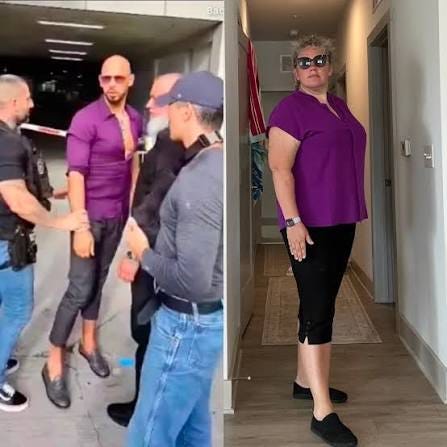
again, artlust articulating so well some recent cultural moments and connecting the dots: white jesus, the uproar over lupita nyong’o playing helen of troy and andrew tate’s masculinity all stemming from the same colonial wound. it’s worth the read.
Being scared that your framework for beauty is not the same as the rest of the world is hilarious and kind of weak. The online furor over Lupita Nyong’o’s casting and the fools who claim to have any understanding of the ancient Greek world, having literally never read the Odyssey, entered a museum, or read a myth, speaks to the shallowness of thought that fuels the reactive masculinity of online bros. Nolan’s casting has sparked an online war, only proving that Helen, as Lupita, could start one.
i haven’t watched nolan’s odyssey yet, but recently i found a phrase by horace about with this idea that rome conquered greece militarily, but greece “conquered” rome culturally, profoundly shaping roman art, philosophy, literature, education, religion, and architecture. this echoes the syncretic vibe i was talking about before.
Captive Greece captured her savage conqueror and brought the arts to rustic Latium. — Graecia capta ferum victorem cepit et artes intulit agresti Latio. - Horace’s Epistles, Book 2, Epistle 1.
brainsparks: philistinism (tn#85), olympic outrage (tn#184), cosmophobia (tn#135), cultural vacuums (tn#254)

talking about icons, banknotes/coins imagery have been used as way to assert power for centuries. it is a tool of soft power and shows what a country/region chooses to celebrate. Last week, the European Central Bank unveiled the finalists for the new euro banknotes, inviting people to vote. it gave me too many feelings, even if Amsterdam is basically cashless at this point.
first, why would they copycat brazilian money (tn#3) adding wildlife to the notes — i was feeling possessive about that idea, until i realized several countries include animals in their banknotes. i also think it’s somehow considered greenwashing to put animals in the notes when capitalism is the very system destroying wildlife. maybe i’m missing smth.
Showcasing species on currency is an opportunity to foster national pride and raise awareness of each nation’s unique fauna. But for threatened species, there is no guarantee this will ultimately lead to their protection.
then when voting, i realized i liked much more the ones that included the birds + brutalist/modernist buildings, and not the ones with important people.
brainsparks: wine animals (tn#223), brazilian money (tn#3), the cult of ugly aesthetics (tn#134), how did the world get so ugly? (tn#247)
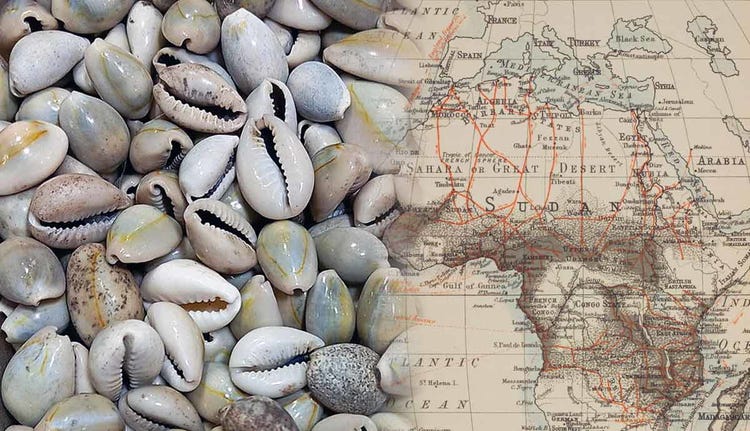
in the end, adding wildlife to our money is going back to the start of a global economy. cowrie shells became the first global money — its latin name is monetaria moneta. you can see them in anitta’s video, as they’re also used in accessories, and búzios rituals.
In an age of paper money, metal coins, and cards as common means of exchange, the concept of shells as currency may sound inefficient. However, cowrie shells were impossible to forge, were not easily broken, could not be melted down into something else, and were always of a similar size, shape, and weight. Besides currency, they could be easily incorporated into any ritual, ceremonial, or everyday object. This was especially the case in many regions throughout East, Central, and West Africa.
brainsparks: crypto as ritual and religion (tn#58), tulip mania (tn#275), how europe stole africa (tn#102)
talking about brutalist buildings, i had to include this here. victoria monét’s video is so stunning with the choreography, the voguing, the outfits matched with the lighting and angles of the salk institute in la jolla, california. so chic.
brainsparks: brutalist (tn#280)
🫀✨thank you for reading The Nexialist. This post is public, so feel free to share these brainsparks 🧠✨
I truly believe innovation comes from bringing improbable areas together, and that’s why I called this project The Nexialist. Some sectors are known to be self-referencing and hermetic. Sometimes, teams are on autopilot mode, focused on the daily grind, which hinders innovation. As a Nexialist, I like to burst these bubbles, bringing references from different areas, and maintaining teams inspired and connected to the Zeitgeist.
I offer inspiration sessions called Brainsparks, creative desk research (Zeitgeist Boost), Plug’n’Play deals for workshops and sprints, and other bespoke formats. If you want to know more about this, send me an e-mail with your challenge(s) and we can figure something out together. Check out my website and some work I’ve done below:
Comments
Nothing yet. Say the first thing.
Sign in to join the conversation.