
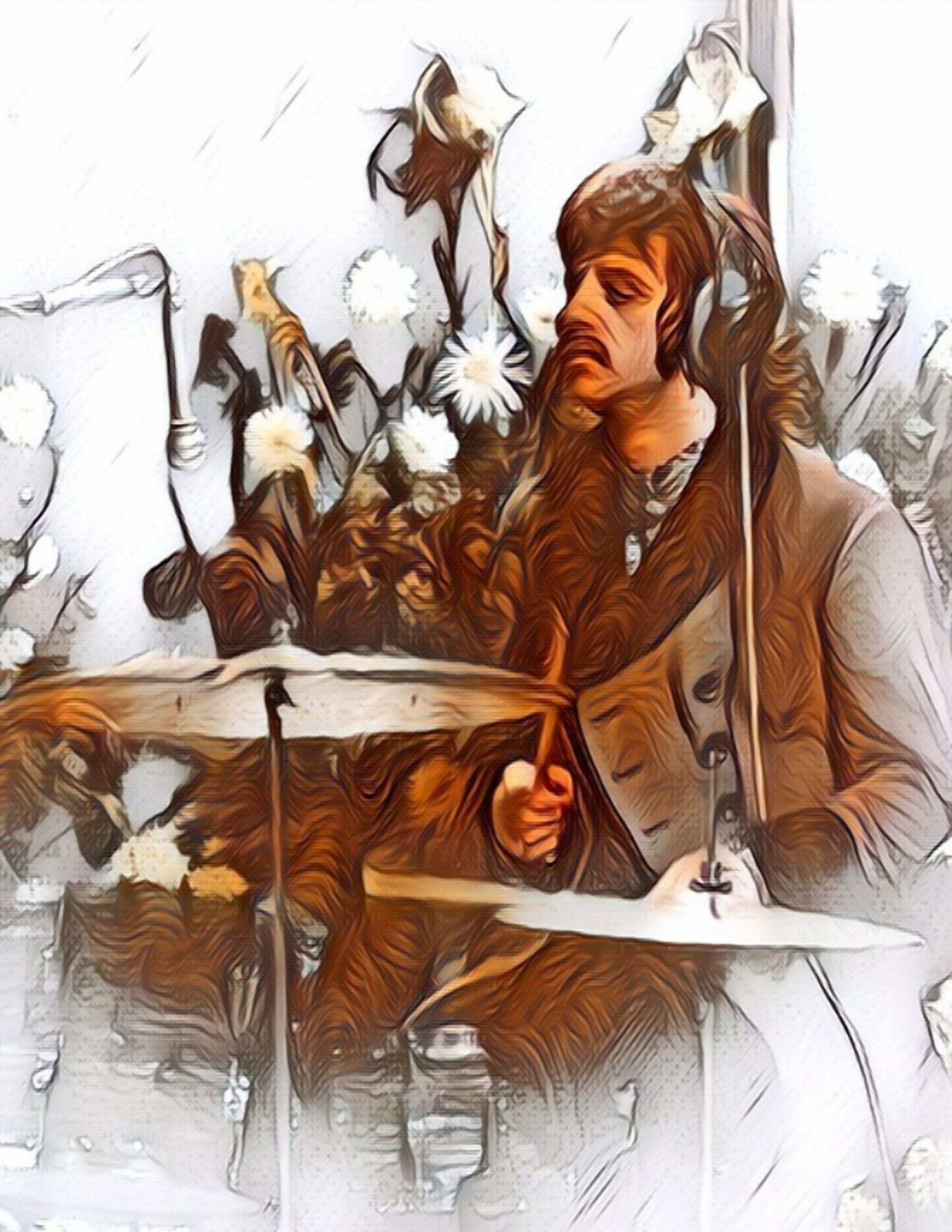
Studio Two, Abbey Road, Friday the 23rd of August, 1968. Somewhere in the room there is a drum stool with nobody on it, and this absence is the loudest thing in the building. Ringo Starr has, as of the previous evening, resigned from the most famous group on the planet and taken himself off to the Mediterranean to sulk on Peter Sellers’ yacht, which is exactly the sort of sentence you can only write about the Beatles and have it come out true. The remaining three are not mourning. They are working. They are, in fact, putting the finishing gloss on a giddy, chrome-plated slice of rock ‘n’ roll pastiche called “Back in the U.S.S.R.”, and the black comedy of the enterprise is so total that you almost want to look away.
Get 20% off a group subscription
Because two nights earlier — while a fluffed tom-tom fill and Paul’s tongue were busy driving the drummer out the door — a quarter of a million Warsaw Pact troops had poured across the borders of Czechoslovakia. Soviet tanks were sitting outside the radio station in Prague. Alexander Dubček, the man who’d dared to imagine socialism with a human face, was being bundled onto an aeroplane to Moscow to be interrogated into submission. And here, in a suburb of north London, a millionaire from Speke was overdubbing balalaika-flavoured harmonies onto a number that opens with a jet screaming down out of the sky and a bloke crooning about how happy he is to be home behind the Iron Curtain. You couldn’t make it up. Nobody would let you.
Let us be forensic about what actually occurred in that room, because the details are gorgeous. The basic track had been cut the night before — Paul on drums (of course), John on the six-string Fender Bass VI, George on electric guitar, the three of them bashing out five takes of a song none of them needed a fourth man to finish. On the 23rd they built the thing up. McCartney added piano. Harrison sat down at the abandoned kit and played more drums, in the process wiping Lennon’s bass part clean off track three, which tells you something about the pecking order that week. Another guitar went on. Then the whole lot was squashed down into a reduction mix — take six — so there’d be room to keep piling on. Paul sang his lead with John and George huddled round the microphone doing the Beach Boys “ooh-ooh” bit behind him, three grown men imitating California surf harmonies during the collapse of European détente. And then, the pièce de résistance: onto the fourth track went a McCartney bass overdub, a Harrison six-string bass, and — I promise you this is documented — John Lennon hitting a snare drum. The engineer, note, was Ken Scott, not Geoff Emerick, because Emerick had already flung down his headphones and walked out of these sessions in July, unable to stomach the atmosphere. The producer, George Martin, was present but increasingly resembled a man supervising a divorce. A mono mix was struck. Someone dubbed on the sound of a real jet aeroplane. Fade up. Fade out. Done.
Now hold that image — the flowers not yet on Ringo’s kit, the jet engine howling out of the monitors — and walk out of Abbey Road and onto any street in Britain that Friday morning, and pick up a newspaper.
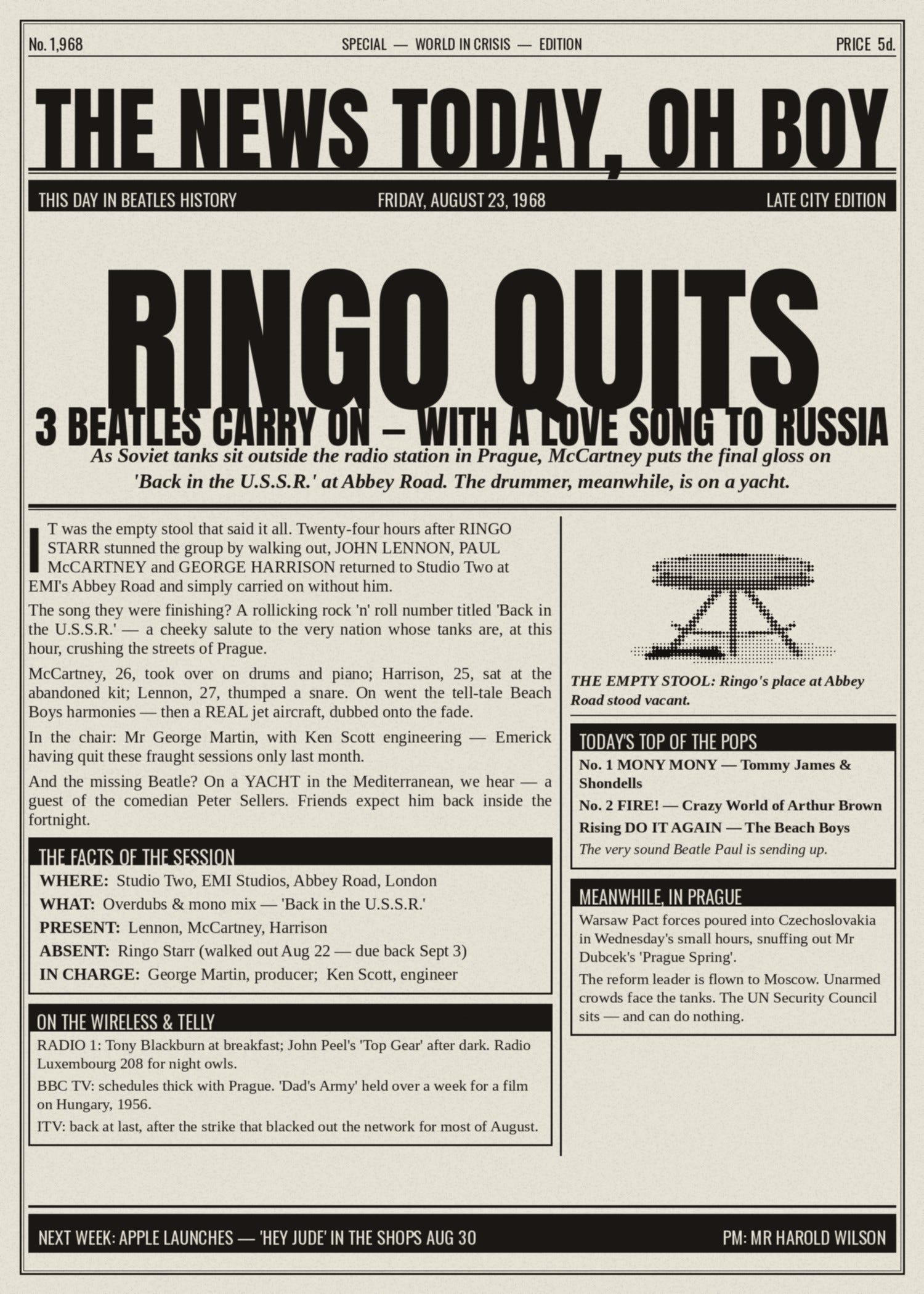
You would not have found the Beatles in it. You’d have found Prague. Every front page in the country was black with it: the tanks, the burning barricades, the students hurling themselves in front of armour, the desperate clandestine broadcasts from radio transmitters the invaders hadn’t yet found. The UN Security Council was in emergency session, achieving precisely what the UN Security Council always achieves when the aggressor holds a veto, which is nothing. Harold Wilson’s government issued its condemnations from the sidelines, impotent and glum, which was rather the house style of the Wilson years by then — the pound still limping after the previous November’s devaluation, the country broke and irritable. Away from Czechoslovakia the other running sore was Biafra, where the images of starving children coming out of the Nigerian civil war were beginning their long work on the British conscience. It was not, all in all, a cheerful August. And into this — this exact week — Paul McCartney was airbrushing a satirical postcard from Moscow, chirping that the Ukraine girls really knock him out. The Americans would later accuse the band of communist sympathies over the song, which is funny, because the actual communists had just demonstrated live on the evening news precisely what they thought of anybody’s freedom.
The television schedules caught the collision too, if you knew where to look. Two days before, on the Wednesday, the BBC had quietly yanked the fourth episode of a brand-new and rather nervy sitcom about the Home Guard — a little thing called Dad’s Army, only a month old and not yet a national treasure — and slotted in a documentary about the 1956 Hungarian uprising instead, presumably on the grounds that comedy about repelling a foreign invasion sat awkwardly beside footage of an actual one. Captain Mainwaring’s platoon was held over a week. Meanwhile ITV was only just staggering back onto the air after its own farce: the great technicians’ strike that had followed the franchise reshuffle, which had blacked out the commercial network for most of the month and reduced it to a management-run “Emergency National Service” — the same repeats and cartoons piped out nationwide with no regional variation, executives sweating over the machines. The strikers had trooped back on the 19th. So a Beatles fan settling down that Friday night was watching a BBC still thick with Prague bulletins and an ITV clearing its throat and pretending nothing had happened. Over at the Proms, incidentally, the crowd had booed and heckled the visiting USSR State Symphony Orchestra two nights running — the only front on which the British public got to vent directly at the invaders, by tutting at some blameless violinists.
Start writing today. Use the button below to create a Substack of your own
And the radio? The radio was, as ever, in its own weather system entirely. Barely eleven months old, Radio 1 was still finding its feet, but Tony Blackburn’s breakfast show was already the sound of the nation brushing its teeth, and what Blackburn was cheerfully spinning that fortnight was a top of the charts caught in a delirious tug-of-war between two of the daftest records imaginable. Arthur Brown — the self-styled God of Hellfire, a man who performed with his head literally on fire — had ridden “Fire!” to number one, only for Tommy James and the Shondells to shove him aside with the gibberish-glorious “Mony Mony,” the two of them swapping the summit like a pair of drunks fighting over a lamppost. On the chart current that week “Mony Mony” was back on top with “Fire!” breathing down its neck. Below them: Herb Alpert going soft with “This Guy’s in Love with You,” Tom Jones bellowing “Help Yourself,” Dusty Springfield counting to ten, the Bee Gees climbing with “I’ve Gotta Get a Message to You.” And there, at number four and rising fast, sat the exquisite punchline — “Do It Again” by the Beach Boys. The very band McCartney was busy parodying in Studio Two was ascending the British charts in real time while he did it. Somewhere Mike Love, who’d handed Paul the “Moscow girls” gag out in Rishikesh a few months earlier, was presumably grinning. For the heads and the insomniacs there was John Peel’s Top Gear playing the stuff daytime wouldn’t touch, and after dark the ghostly crackle of Radio Luxembourg on 208, the pirates having been legislated out of existence the previous summer.
How the Beatles had arrived at this strange, splintered Friday is a story of a spring that promised transcendence and delivered acrimony. They’d gone to Rishikesh to sit at the feet of the Maharishi and come home with a suitcase of songs and their faith in gurus somewhat dented. They’d launched Apple — the boutique, the label, the shambolic utopian money-bonfire — with genuine idealism and no accountant worth the name. In May they’d gathered at George’s Esher bungalow and taped acoustic demos of everything, “Back in the U.S.S.R.” among them, all of it sounding warm and companionable, the sound of four friends. Then they’d walked into EMI at the end of that month to make the record and the friendship had started coming apart on tape. Emerick gone. Yoko installed permanently in the studio, to Paul and George’s visible discomfort. Songs recorded in separate rooms. And now Ringo, the one everybody loved, the one who was supposed to be immovable, telling them he felt like an outsider and walking into the night.
Here's a joke that wrote itself in August 1968: as Paul McCartney sat in Studio Two sending up the Beach Boys, the Beach Boys' own "Do It Again" was climbing the British charts right underneath him. We map the whole strange Friday — the empty drum stool, the tanks in Prague, the jet on the fade — against what Britain was actually humming. Full readers get the lot. Join The News Today, Oh Boy.
What came next you can measure in days and in years. In days: at the end of the very month, on the 30th, “Hey Jude” — seven minutes of it, an outrageous length for a single, recorded over at Trident — would be unleashed on Britain as the debut release of Apple Records, the first shot in the label’s grand “Our First Four” salvo that also launched a Welsh folk singer called Mary Hopkin with a McCartney-produced weepie. It would sit at number one for weeks. On the 3rd of September, Ringo would come back, sheepish and forgiven, to find Mal Evans had smothered his drum kit in flowers and hung up a “Welcome Back” sign, and the four of them would carry on stitching together the sprawling white double album that wouldn’t reach the shops until late November. In years, the fracture that opened over a tom-tom fill on the 22nd of August would widen and widen — through the rooftop and the lawsuits and the rest of it — but nobody in Studio Two on the 23rd was thinking in years. They were thinking about whether the jet engine came in loud enough on the fade.
No posts
Comments
Nothing yet. Say the first thing.
Sign in to join the conversation.