
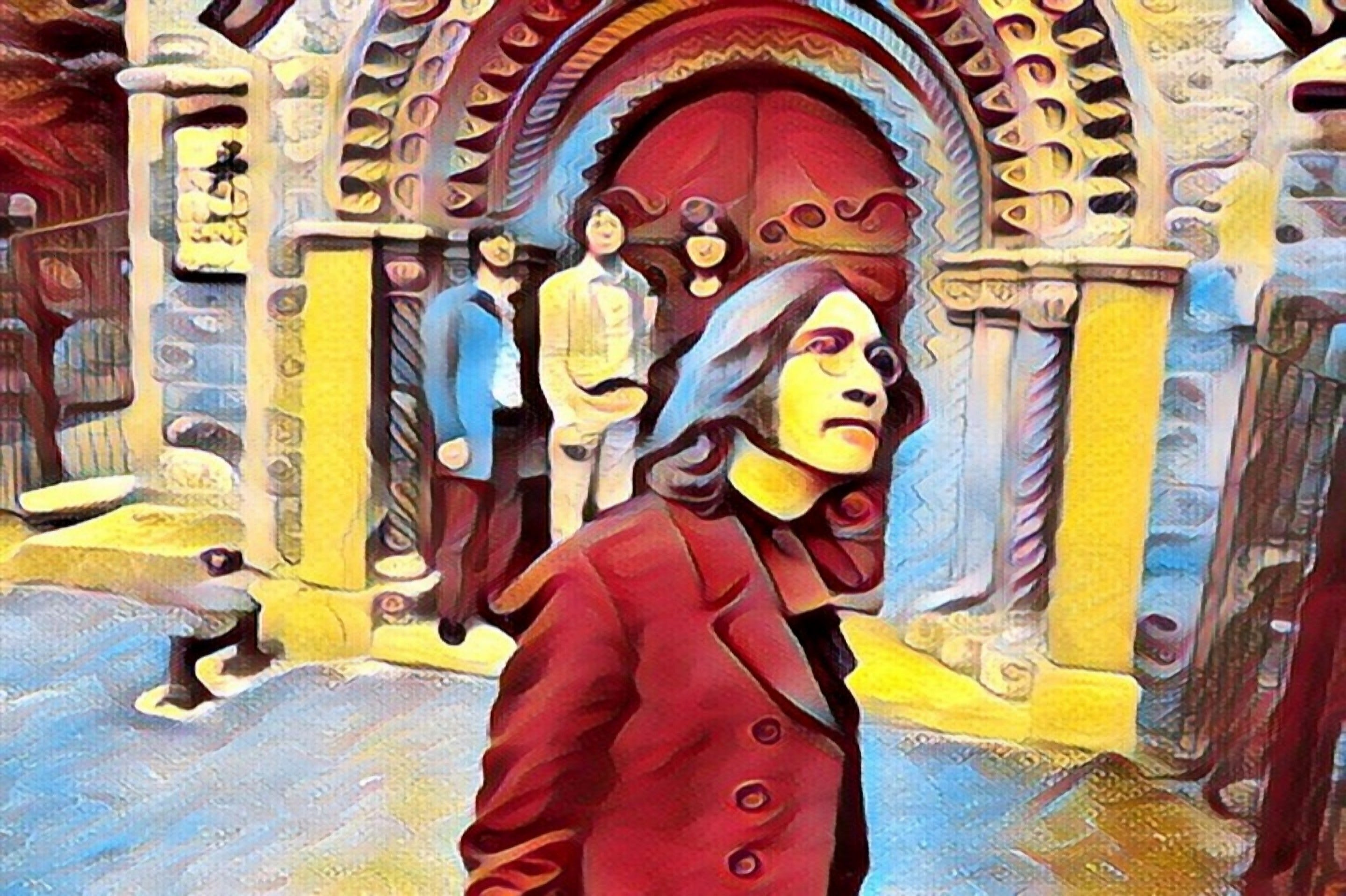
Lennon admitted, twelve years after the fact, that handing Paul the walrus in ‘Glass Onion’ was an act of guilt: he’d got Yoko, Paul (in his telling) had nothing, and he was already halfway out of the door.
His claim that he “was gonna quit” telescopes a whole year of quiet drift into a single line — the formal “I want a divorce” wouldn’t arrive until almost exactly twelve months later.
A song written for the express purpose of punishing people who read too much into Beatles lyrics went on to become Exhibit A in the daftest over-reading of the entire catalogue: Paul Is Dead.
Picture the room. It is the evening of 12 September 1968, Studio Two at Abbey Road, and John Lennon steps up to double-track a vocal onto a two-minute-seventeen trifle called ‘Glass Onion’. Ringo’s drum kit is, in a manner of speaking, still shedding petals. Barely a week earlier the drummer had slunk back from a fortnight’s sulk on Peter Sellers’ yacht off Sardinia — where, in a lovely bit of cosmic timing, he’d been busy writing ‘Octopus’s Garden’ about the joys of not being in a band — to find his kit buried under a florist’s worth of blooms and a banner reading “Welcome Back Ringo,” arranged by Mal Evans and a contrite George Harrison. Geoff Emerick, the engineer who’d made ‘Pepper’ shimmer, had thrown down his cans back in July and walked out of the sessions for good. George Martin, the only adult in the building, had taken himself off on holiday and left the faders to a 21-year-old assistant named Chris Thomas.
Get 20% off a group subscription
This, then, was the condition of the most beloved band on the planet in the autumn of 1968: two walkouts, an absent producer, a stand-in barely old enough to sign for the tea, and a fug of tension you could have bottled and sold as aftershave. Ken Scott was engineering. Nobody was speaking to anybody more than strictly necessary.
And into this John tosses off a little musical practical joke. ‘Glass Onion’ exists for one reason and one reason only: to wind up the anoraks. It is a song about people who take Beatles songs too seriously, stuffed deliberately with references to earlier Beatles songs — ‘Strawberry Fields Forever’, ‘The Fool on the Hill’, ‘Lady Madonna’, ‘Fixing a Hole’ — precisely so that some poor soul in a duffel coat would sit up all night trying to crack the code. There is no code. That’s the code. It is a hall of mirrors with nothing at the far end but Lennon’s smirk.
But then, right in the middle of the mischief, he does something that is not a joke at all. He lets the cat out of the bag, as Mal Evans put it in the Beatles Monthly that November. He announces, at long last, the true identity of the walrus. It was Paul.
Four words. And for the better part of sixty years we have been getting them completely wrong.
We know what those four words meant because, in the last autumn of his life, John told us. In September 1980, holed up in New York putting the finishing touches to ‘Double Fantasy’, he sat with the writer David Sheff for what would become his final long interview — thirty-odd hours of tape for Playboy, published that January, two days after he was shot. Sheff had flown over in the August; the song-by-song reminiscences came in the September. When they reached ‘Glass Onion’, John was breezy, then suddenly wasn’t.
Start writing today. Use the button below to create a Substack of your own
It was just a throwaway, he said — a bit of poetry, à la ‘I Am the Walrus’, à la everything he’d ever written. He’d thrown in the line about the walrus being Paul “just to confuse everybody a bit more.” Fine. Standard-issue Lennon deflection. And then, in the same breath, with a laugh that Sheff described as bleak, out it came: he’d done it because he felt slightly guilty. He’d got Yoko, he said, and Paul had got nothing. And he was going to quit.
Read that again, because it is one of the strangest sentences John Lennon ever spoke about the Beatles, and it is usually skated straight past. The most notorious throwaway on the White Album — the line the conspiracy brigade would spend decades treating as a death certificate — was, on the author’s own testimony, a guilt offering. A parting gift. A man about to walk out on the most successful creative marriage in popular music, handing his partner a keepsake on the way to the door and feeling rotten about it.
The guilt has a shape, and it is worth pulling apart, because it tells you almost everything about where John’s head was in that autumn. He had, by his own reckoning, everything. Six months earlier, in May, he and Yoko had sat up all night making the tape loops that became ‘Two Virgins’ and, at dawn, become lovers. By November he’d have that record out — nude cover and all — and his divorce from Cynthia finalised. He had found, as he saw it, his other half, his soulmate, his way out. He was, for the first time in years, ecstatically, disruptively happy.
And happiness, in a Catholic-by-osmosis Liverpudlian who’d lost his mother twice over, does not arrive clean. It arrives with an invoice. If John had got everything, then somebody, in his private moral arithmetic, had to have got nothing. And he cast Paul in the role.
Here is where the revisionist has to cough politely and consult the record, because the idea of Paul McCartney as some abandoned Cinderella figure in the autumn of 1968 does not survive thirty seconds of contact with the facts.
Yes, it had been a bruising year for Paul’s love life. The engagement to Jane Asher — announced with great fanfare on Christmas Day 1967 — had come apart in the July, Jane confirming the split live on the BBC’s Dee Time with the sort of composure that suggested she’d had quite enough of Cavendish Avenue. So on paper, in that precise window, Paul was a newly single man. You can see how John, squinting through the rose-tinted fug of his own new romance, might have looked across the studio and seen a bloke with a broken engagement and no obvious replacement and thought: poor sod, he’s got nothing, and I’ve got the world.
Except Paul had rather a lot. He had, that very summer, written ‘Hey Jude’ — a song of such open-hearted generosity that it was, in its origins, a message of comfort to John’s own son Julian, adrift in the wreckage of his parents’ marriage. Chew on that for a moment. While John is busy pitying Paul for having nothing, Paul is quietly writing the tenderest thing either of them would ever record, and writing it for John’s child. If that’s nothing, one would like to see something.
He also had, waiting in the wings, an American photographer named Linda Eastman, whom he’d first clocked in a London club the previous spring and would marry the following March. The “nothing” John so generously bestowed on his songwriting partner was, within six months, a wife and a family and the beginnings of the most stable domestic life any of the four would manage.
So the guilt is real, but the premise is a fiction — a fiction John needed. This is the thing people miss about Lennon’s confessions: they are gorgeously, ruthlessly self-serving even when they sound like self-flagellation. To feel guilty about being happy, he first had to invent a Paul who was miserable, a Paul with nothing, a Paul left holding the band while John sailed off into his new life. The guilt wasn’t really about Paul at all. It was about John needing his own departure to cost somebody something, so that it would mean something. You don’t get to be the one who leaves unless there’s somebody left behind. And John, more than any man alive, needed to be the one who leaves.

Available for iOS and Android
This is the question that ought to stop you, because it is the load-bearing wall of the whole confession, and it is the one the Playboy quote quietly cheats on.
“I was gonna quit,” John says, of a song recorded in September 1968. But John Lennon did not tell the Beatles he was leaving in September 1968. He told them in September 1969 — almost exactly a year later — at a meeting in the Apple offices on Savile Row that was meant to be a celebration. Allen Klein had just wrung a fat new royalty rate out of EMI and Capitol; there were contracts to sign and champagne, presumably, on ice. And John, unable to hold it in a second longer, looked round the room at Paul and Ringo — George wasn’t even there, off visiting his mum — and said the words he’d later compare to telling Cynthia he wanted out. “I want a divorce.” Klein, ever the operator, advised them all to keep it quiet while he tidied up the business end, which is how the most famous break-up of the twentieth century stayed a secret for seven months, until Paul let the cat out of the bag with his solo album in April 1970 — a betrayal, in John’s eyes, chiefly because Paul had beaten him to the punchline.
So when the 1980 John says he “was gonna quit” while cutting ‘Glass Onion’, he is doing what memory does to all of us: he is smoothing a year of agonising, backsliding, on-again-off-again drift into a single clean line of intent. It is emotionally true and chronologically bent. He was not, in September 1968, packing his bags. He was, in September 1968, beginning to leave — which is a slower and far more human thing.
John built a song specifically to punish people who read too much into Beatles records. They read it as a death notice and held a candlelit vigil for a living man. If you've ever suspected the hidden meaning was the con all along, The News Today, Oh Boy is your publication — Beatles history with the mythology cross-examined and the anoraks gently mocked. Private Eye meets Melody Maker. Come and peel the onion.
And here’s the part the confession accidentally gets right. The evidence that John had one foot out of the door in 1968 is everywhere, if you know where to look, and none of it is a formal announcement. Look at the sessions themselves: Yoko installed at his side in the studio for the first time, the invisible fifth Beatle, present at the mixing desk and the microphone alike, an arrangement the other three found roughly as comfortable as a wasp at a christening. Look at ‘Revolution 9’, John’s eight-minute plunge into musique concrète, a track that has nothing whatever to do with a pop group and everything to do with a man building a new artistic life with a new partner — inside a Beatles album, but not really of it. Look at ‘Two Virgins’, a whole record made outside the group entirely. Look, if you must, at the heroin creeping in around the edges of that year. Every one of these is a man rehearsing his exit without quite admitting he’s learning the lines.
And look at the company his little walrus joke was keeping. That very summer the band had come nearer to collapse than anyone outside the building knew. Ringo had actually quit — really quit, sailed-off-to-Sardinia quit — over Paul’s fussing about his drumming on ‘Back in the U.S.S.R.’, with Paul cheerfully taking over the kit in his absence. Emerick had gone. Tempers were being lost over, of all things, Paul’s ‘Ob-La-Di, Ob-La-Da’, a song John reportedly loathed with the heat of a thousand suns. The following January, at Twickenham, it would be George’s turn to storm off — during the Get Back sessions, mind, not these ones, a distinction the careless routinely fumble — muttering that he’d see the others round the clubs. Everybody was leaving in 1968 and 1969. They just kept coming back. All except one.
So: had John “said” he was going to quit as early as ‘Glass Onion’? No. Was he going to quit? Yes, in the way a tide is going to come in — invisibly, then all at once. The 1980 quote is not a lie. It is a man remembering the exact moment he first knew, and mistaking it for the moment he first said. There is no other contemporaneous statement of intent from 1968, no diary entry, no announcement, because that isn’t how leaving works. You feel it in your chest a year before it reaches your mouth.
Which brings us to the oddest, most revealing thing John said in that whole Playboy exchange, and the phrase that ought to be carved over the door of any serious study of the man. Having explained the guilt, he adds that the walrus “has now become in meaning, ‘I am the one.’”
I am the one.
Now, ‘I Am the Walrus’ — the 1967 original, the Magical Mystery Tour fever dream — was never about being “the one.” John pinched the walrus from Lewis Carroll’s ‘The Walrus and the Carpenter’, that grim little parable from Through the Looking-Glass in which the walrus weeps copious tears over the oysters even as he gobbles the lot. John would admit, ruefully, that he’d only later cottoned on to the fact that the walrus is the villain of the piece — he’d gone and cast himself as the bad guy by accident, all because the word sounded good and scanned nicely. It could just as easily, he shrugged to Sheff, have been “I am the fox terrier.” It was, he insisted, only a bit of poetry.
But by 1968 the poetry had curdled into something heavier. “I am the one” is a claim of primacy — the leader, the important one, the guiding spirit, the Beatle who mattered. This from the man who, two years earlier, had casually informed an interviewer that the band was more popular than Jesus and watched the American Bible Belt set fire to his records over it. The messianic streak in John was never far below the surface; give him a walrus and he’ll turn it into a throne.
And then — this is the genius of it, the little twist that makes ‘Glass Onion’ worth all this ink — he gives the throne away. The walrus was Paul. If the walrus means “I am the one,” then handing the walrus to Paul is John abdicating. It’s a coronation and an apology folded into the same four words. You be the one now. You be the important one, the one who carries it, the one they look to. I’m off. It is, depending on how charitable you’re feeling, the most generous thing John ever did for Paul or the most passive-aggressive — because remember, the walrus is also the villain, the one who weeps and devours. Hand a man that costume and you might be crowning him or you might be leaving him to take the blame. With Lennon, it was invariably both at once.
He would complete the manoeuvre two years on. On ‘God’, the great scorched-earth renunciation that closes his first proper solo album, he lines up every myth he’d ever been sold — and been — and knocks them down one by one, the walrus among them, before declaring himself, at the finish, plain John again. The mask comes off. He had been the walrus. Now he was just a bloke called John who used to be in a band. The handover begun in that guilty September of 1968, when he passed the costume to Paul, is finished: John has taken himself out of the myth entirely, and left the others inside it.
And now for the part that would have John howling with laughter if it weren’t so perfectly, cosmically apt.
‘Glass Onion’ — a song written, let us not forget, for the sole purpose of mocking people who hunt for hidden meanings in Beatles records — became the single most over-interpreted track the Beatles ever released. The very people John built the song to ridicule took his walrus joke, turned it upside down, and constructed from it the most baroque conspiracy in the history of popular music.
By the autumn of 1969, thanks to a Detroit disc jockey and a student newspaper and the general availability of too much time, the theory that Paul McCartney had died in a car crash in 1966 and been replaced by a lookalike was sweeping American campuses. And what was among the choicest pieces of “evidence”? Why, the walrus, of course. The faithful had heard — somewhere, from someone — that “walrus” was Greek for corpse. (It isn’t. It’s Scandinavian in origin, and even the notion that the beast symbolises death in some Nordic tradition has precisely no scholarship behind it, but never let a fact spoil a good funeral.) On the Magical Mystery Tour sleeve, they noted, one figure in the animal costumes stands slightly apart, dressed in black — mourning black. And here on ‘Glass Onion’ was John himself, apparently confirming it in song: the walrus was Paul. The walrus was death. Therefore Paul was dead. QED, hand me my anorak.
Consider the exquisite irony. John writes a song specifically to punish the code-hunters. He plants a deliberately meaningless line to lead them up the garden path. And they follow it — straight into a graveyard, where they hold a candlelit vigil for a man who was, at that very moment, alive and well and living in Scotland, growing a beard and being called dead on the radio. John was properly furious about it too, when the American press rang him for a comment. It was, he snapped, the most stupid rumour he’d ever heard — the same lot, he reckoned, who’d blown up his remark about Jesus.
He had built a trap for the over-readers and they had over-read the trap itself. There is no purer demonstration of what John understood and the fans never would: that sometimes a walrus is just a word that scans. That sometimes a man throws in a line because he feels guilty and sad and is trying to say sorry to his best friend without using any of the words for it. That the meaning, when there is one, is almost never the meaning you’d find by playing the record backwards.
So peel it, since the song dares you to. Under the joke, a confession. Under the confession, a guilt. Under the guilt, a lie John needed to tell himself — that Paul had nothing — so that his own leaving would carry the proper weight. And under that, the truest thing of all: a man who had already, in his heart, left a band he would not publicly leave for another year, saying goodbye to his partner the only way he knew how, which was sideways, in code, wrapped in a joke, disguised as an insult, buried three tracks into a double album amid the wreckage of the worst summer they’d ever had.
The walrus wasn’t a corpse. It was a love letter with the address smudged. And the fact that everyone spent the next half-century reading it as a death notice is, when you think about it, the most Lennon thing that ever happened to a Lennon song — a man’s clumsy, guilty tenderness mistaken, by people who thought they were clever, for the announcement of a murder.
He’d have hated that they got it wrong. He’d have loved that they got it so wrong. Both at once, naturally. He was, after all, the one.
This is a reader-supported publication. If you’d rather your Beatles history came with the mythology surgically removed — the walkouts dated correctly, the confessions cross-examined, the death cults given the eyebrow they deserve — the full archive is a paid subscription away. One in three of these lands behind the paywall; subscribers get the lot. Come and read the rest of the onion.
No posts
Comments
Nothing yet. Say the first thing.
Sign in to join the conversation.