

DISCIPLINARY PROCEDURES of THE NEW SCHOOL
In our article from April 28th, “How My Daughter Came To Think Like a Free Citizen”, and in the discussion of conflict resolution1, a very important structure comes up, the Judicial Committee. Many have called it the heart of The New School.
As Mr. Detwiler said in “How My Daughter Came to Think Like a Free Citizen”,
“...child(ren) can learn the wisdom of the American founders because they’ve tried government, and know what works – and what doesn’t work. They don’t just know it from words. They know it from experience.”
This applies to American jurisprudence as well.
We are a society guided, in part, by the rule of law.2 Everyone at The New School is bound by our laws as promulgated in our LawBook. Our Judicial Committee, like the American judicial system in the larger society, resolves conflicts between members of the community and levels the playing field so there can be justice for all.3
JUDICIAL COMMITTEE
The Judicial Committee or “JC” is composed of two Judicial Clerks (two students elected by the School Meeting) three regular student members (chosen by lot, one each from three age range cohorts), three alternates per cohort, and one staff member. Everyone serves on the Judicial Committee at least once during the school year, in the same way we adults are required to serve on a jury when called. JC members and alternates serve for two weeks at a time, and Judicial Clerks serve for three months.
Sometimes someone has broken a school law and doesn’t listen to those who remind them of what they should be doing according to our laws. If the problem has not been been resolved after talking with the offending person, School Meeting members can ask the JC to help resolve the difficulty by “writing up” the offending person and taking them to JC.
“Writing up” means filing a written complaint against someone for breaking one of our laws or for violating the LawBook Preamble. Complaint forms are kept in a readily accessible folder, and the completed form is placed in the JC file box in the Big Room.
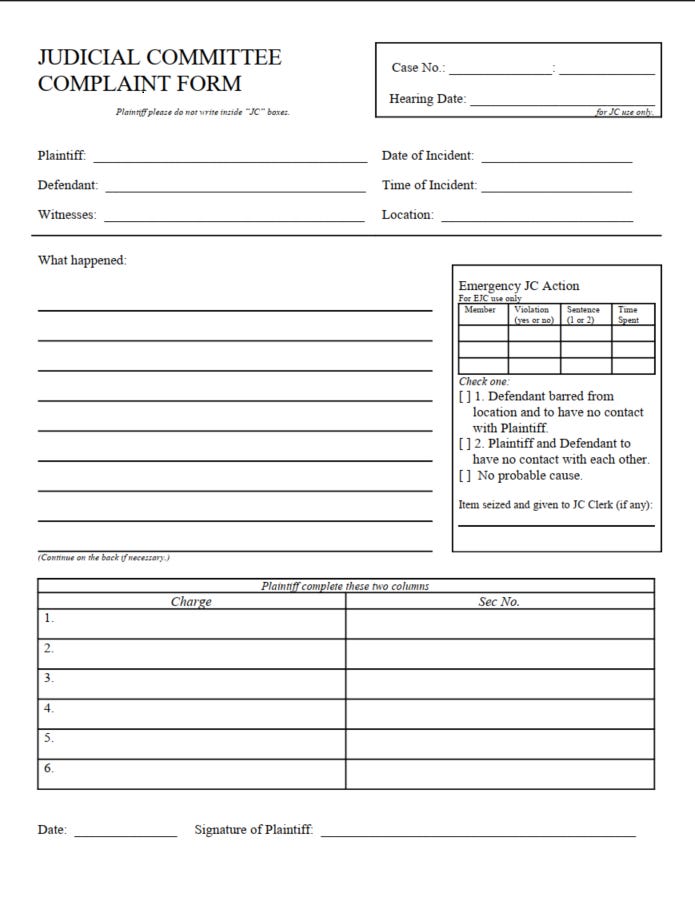
The JC hears cases every day at 11:00 AM in the Big Room when there are cases to be heard (Sometimes there aren’t any; sometimes there are a lot!). The evening before a hearing, the JC Clerk makes a list of the people needed for hearings the next day. This lets people know they must be ready to appear before the JC at 11:00 AM. Appearing before the JC takes precedence over whatever else a student may have scheduled that day.
The Judicial Committee bases their decisions on the LawBook, the testimony of the witnesses, and the past history of the parties involved as recorded in the Judicial Record. Past history does not mean one person’s personal experience with another, but only what is found in the judicial record. This last is an important aspect of being a part of the Judicial Committee. JC members must set aside their personal opinions of the plaintiff and defendant during a case; they have no bearing on a person’s guilt or innocence in any particular case. It’s one of the meanings of “Justice is blind,”4 a truism in American jurisprudence and in the exercise of the law at The New School.
When hearing a case, the JC can take one of several approaches. The Judicial Committee may mediate a case. Mediation means getting together the people involved in the complaint and seeing if something can be worked out. If nothing can be worked out, the case goes to trial. The JC hears the complaining witness’s arguments, the defendant’s defense, and the testimony of the witnesses. In the end, the JC votes on whether the defendant is guilty or not guilty and decides on a sentence if the defendant is guilty. At the best of times, the people involved in a case will have solved the problem themselves before the case comes before the JC. In this situation, the case is withdrawn. The JC can also decide whether or not a case is worth investigating. If the complaint seems frivolous, they may decide not to hear the case. At the end of a judicial session, the JC Clerk posts a record of that day’s proceedings on the bulletin board so we can all be aware of who needs help with what.
The JC is not meant for taking revenge or to unduly punish people; it is meant to help people remedy a wrong and, for the defendants, to learn to control their actions so as not to interfere with others. Sentences are never merely punitive nor are they used to embarrass a student or hold them up to ridicule. The sentences handed down by the JC are meant to help someone think about what happened and do better by fitting the punishment to the crime and the person.
The point of the Judicial Committee is to give the students the means to solve problems that concern them and to help those who break our laws change their behavior and be more aware of what it takes to be a member of The New School. Practicing the art of civic engagement at The New School, including doing justice, makes the students adept at practicing the same art as adults.
On Monday, we’ll see a case in point.
How My Daughter Came To Think Like a Free Citizen
·
Apr 28
This is an essay about a school that teaches children to understand the American system of government. It’s about how teenagers are learning – right now – to think like free citizens. At The New School, students learn about American liberty and responsibility, not primarily from books, but from experience --
How are conflicts resolved at The New School?
·
Apr 11

Sometimes I think conflicts are poorly resolved in the larger community because people value safety or quiet over freedom, playing ‘nice’ over really engaging with one another.
No posts
Comments
Nothing yet. Say the first thing.
Sign in to join the conversation.