
Listen to the latest episode of the News Block below.👇
The 30-year Treasury yield hit its highest level since 2007. The Treasury responded by doubling its long-end bond buybacks. Yields fell, the dollar fell, gold rallied, and Bitcoin had its biggest one-day gain since March.
The SEC proposed its first-ever formal crypto rule-making — and, for the first time in American history, a federal regulator green-lit a bank charter for a company owned by a sitting president’s family.
Strategy bought back another $132 million of preferred stock. Metaplanet planted a flag in America. MSCI threatened to throw both out of its indexes.
KPMG signed a clean audit opinion on Tether’s USDT issuer. The skeptics have a shorter list of questions than they used to — but the list isn’t empty.
Two data breaches in one week reminded Bitcoiners that privacy is security.
And Bitcoin just came out of one of the quietest stretches in its history.
Bitcoin surged as much as 7% on Wednesday — its biggest single-day move since March — trading near $69,000, the highest level since June 1. More than $1.4 billion in short positions were liquidated in roughly four hours (CoinDesk).
The trigger came from an unexpected place: the U.S. Treasury.
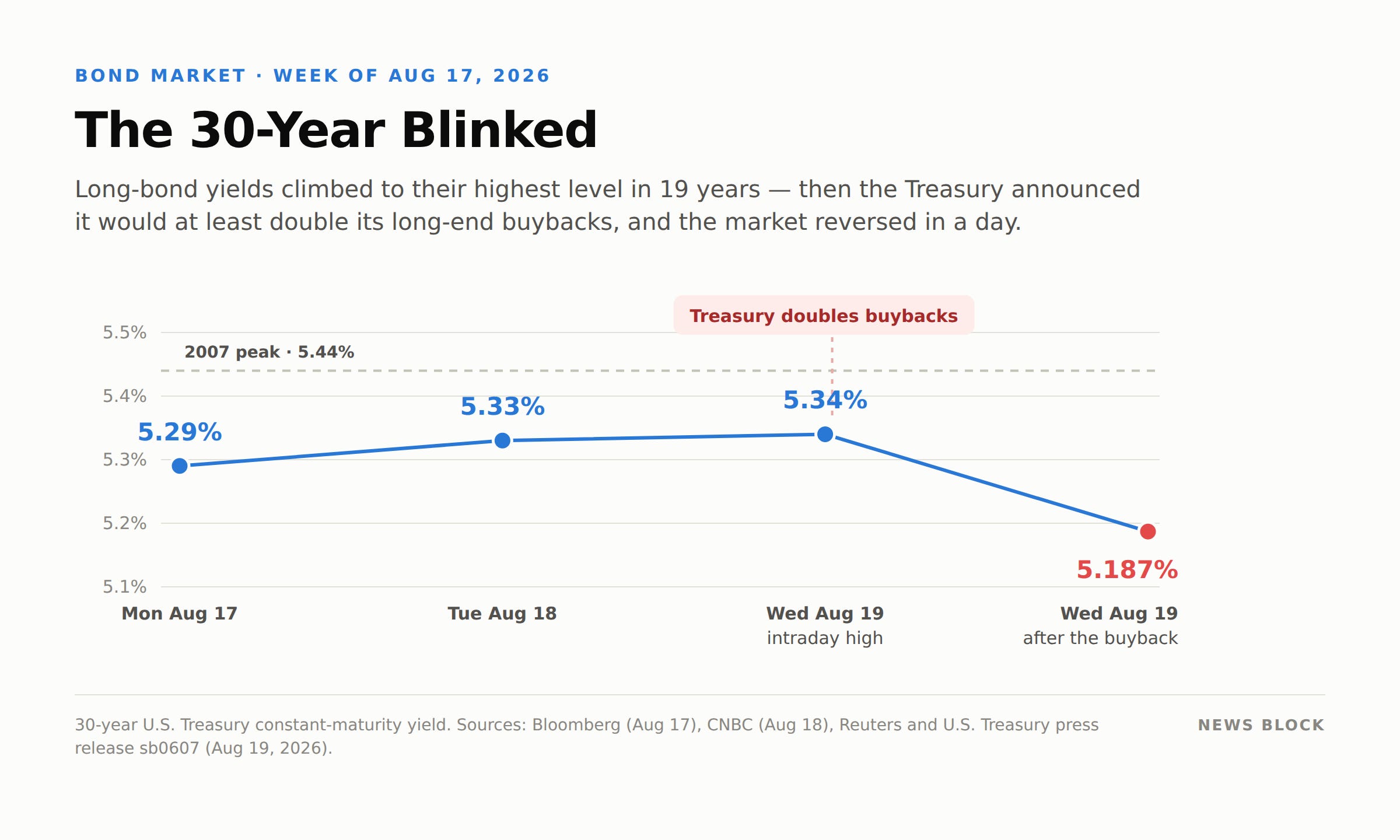
Long-term government borrowing costs had been climbing to levels that make Washington nervous. The 30-year Treasury yield hit 5.34% this week — its highest since 2007, closing in on that year’s 5.44% peak (Bloomberg, CNBC).
Translation: investors weren’t showing up to buy America’s long-term debt at the price the government wanted to pay.
So the Treasury made a surprise announcement. Beginning September 9, it will at least double the size of its buyback operations in the 10-to-20-year and 20-to-30-year sectors — from a maximum of $2 billion per operation to at least $4 billion (U.S. Treasury press release).
In plain English: the government is stepping in as a much bigger buyer of its own debt.
The reaction was immediate. The 30-year yield fell to 5.187%, its largest one-day drop since late June. The dollar index slid 0.76% to a two-and-a-half-month low. Gold rallied roughly 2.7% to about $4,528 an ounce, its highest since early June (CNBC, Barchart).
The Treasury insists this is about market liquidity, not propping up prices. The official language is that the increase “reflects Treasury’s desire to provide greater liquidity support in longer-dated nominal sectors.” Note also that the press release is institutional — it doesn’t carry Secretary Bessent’s name, though every headline did.
You don’t make a surprise move like this unless you’re worried. Especially when total public debt is now approaching $40 trillion (Reuters).
So let’s call this what it is. Borrowing costs got too high, and the government stepped in to buy its own debt. They’ll never call it money printing. But when debt gets too expensive, they don’t stop borrowing — they find a way to keep the debt machine running.
And that, in a nutshell, is why Bitcoin exists.
Three significant developments came out of Washington, and all three matter for different reasons.
On Tuesday the SEC proposed Regulation Crypto Assets — the agency’s first formal crypto rulemaking, rather than another enforcement action (SEC press release, proposing release).
The proposal creates two exemptions from full securities registration:
A startup exemption: up to $5 million over four years, with minimal disclosure.
A fundraising exemption: up to $75 million in any 12-month period, with public offering materials, financial statements, and ongoing reporting.
It also creates the piece everyone has been waiting on: a conditional safe harbor from the term “investment contract.” An issuer that certifies it has “completed or permanently ceased all essential managerial efforts” can have its token fall outside the investment-contract analysis entirely. Antifraud provisions stay in place regardless.
To be clear: this is about tokens, not Bitcoin. Bitcoin has never needed an off-ramp from securities law because it never had a promoter to escape.
Supporters say this finally ends regulation by enforcement. Critics worry it reopens the token casino with a federal blessing. Worth noting: the Commission currently has only three sitting members — Atkins, Peirce and Uyeda, all Republicans — and all three issued supporting statements. There was no dissent, because there is currently no one on the Commission positioned to file one. The comment period runs 60 days from Federal Register publication. For now, it is only a proposal.
On Friday, the OCC granted preliminary conditional approval for World Liberty Trust Company, N.A. — the Trump family’s crypto venture — to operate as a national trust bank (OCC Corporate Decision #1385).
To be precise about what this is: not a regular bank. No deposits, no lending. The OCC decision states plainly that stablecoins are not deposits under the FDI Act. What the charter allows is issuing and redeeming the company’s USD1 stablecoin, custodying digital assets in a fiduciary capacity, and managing reserve assets — under federal supervision. The conditions are real, too: $20 million in Tier 1 capital, 180 days of operating expenses in liquid assets, OCC pre-approval of executives, 12 months to raise the capital and 18 months to open.
And these charters aren’t actually unique. The OCC conditionally approved Ripple National Trust Bank, Circle, Paxos, BitGo and Fidelity Digital Assets back in December 2025 (Banking Dive), and Circle National Trust received final approval in July (CoinDesk).
What is unprecedented is the owner. Roughly 38% of the entity is held through an affiliate of Donald Trump and his family. No company owned by a sitting president’s family has ever been granted any kind of federal bank charter.
Senator Elizabeth Warren called it “the most brazen act of self-dealing our financial system has ever seen,” noting that the regulator that approved it ultimately answers to the President (CNN).
The White House response, from spokeswoman Anna Kelly: “President Trump’s assets are in a trust managed by his children. There are no conflicts of interest.”
On Wednesday afternoon, the administration hosted crypto and market-infrastructure executives at the Eisenhower Executive Office Building — Coinbase, Ripple, Gemini, Robinhood, Kalshi, Polymarket, a16z, Paradigm, plus CME Group, Nasdaq, Intercontinental Exchange (NYSE’s parent) and DTCC (The Block, CoinDesk).
One correction to the reporting you may have seen elsewhere: the meeting was chaired by CFTC Chair Michael Selig, with President Trump expected to attend and SEC Chair Paul Atkins present. It’s not the president’s meeting; it’s the CFTC’s, with the president in the room.
The backdrop everyone understands: the CLARITY Act. The Senate returns from recess on September 14, and Majority Leader Thune has already filed cloture — setting up a floor vote at 2:15 p.m. ET on Tuesday, September 15 on the motion to proceed (The Block).
That vote needs 60 votes. Republicans hold 53 seats. So at least seven Democrats have to come along — and the sticking points include ethics and divestment clauses aimed squarely at the president’s own crypto holdings. Which makes the timing of that OCC charter, one month out from the vote, something less than helpful for the bill.
The world’s biggest Bitcoin treasury companies had a loud week — and then got a reminder of how exposed they are.
Strategy repurchased 1,388,720 shares of STRC for $132.2 million last week (an average of about $95.20 a share) — its fourth and largest buyback under the $1 billion Digital Credit Securities Repurchase Program, with $653 million of authorization left (Strategy 8-K, Aug 17).
This one was funded by equity, not Bitcoin: the company sold 3,458,866 MSTR shares for $333.7 million net and held its Bitcoin position flat at 840,447 BTC.
The 8-K is explicit — “No bitcoin purchases or sales were made this week.”
That distinction matters, because the previous week’s buyback was funded by selling Bitcoin — 1,690 BTC at an average of ~$64k with the full $108.6 million going straight into the STRC repurchase.
Strategy’s USD reserve now stands at $4.8 billion, which the filing says exists “to support the payment of dividends on Strategy’s preferred stock and interest on its outstanding indebtedness.”
Going deeper: I just held my second retail investor Q&A with Strategy, where I brought your questions directly to the company. It’s streaming on Coin Stories now.
Japan’s Metaplanet — the third-largest publicly traded corporate Bitcoin holder at roughly 43,000 BTC — is expanding into the United States.
The company is seeding 2,100 BTC (about $132.1 million) plus $2.5 million in cash into Super League Enterprise (Nasdaq: SLE), which will be renamed Superplanet, Inc. and trade under the ticker SUPA. Metaplanet keeps 95.7% of common stock, locked up for five years. The deal is expected to close in Q4 (Metaplanet announcement, The Block).
CEO Simon Gerovich framed it this way:
“We’ve built one of the world’s largest Bitcoin treasuries from Japan. Superplanet is how we build in America, the deepest capital market in the world… It is one consolidated Bitcoin position, compounding through two listed platforms in Japan and in the U.S.”
Two listings, two currencies, one Bitcoin stack. Raise yen in Tokyo, raise dollars in New York, buy the same asset.
MSCI — one of the world’s largest index providers — is consulting on whether to exclude non-operating companies from its Global Investable Market Indexes (MSCI consultation document).
Pay attention to how the test is written, because it’s smarter than the version MSCI floated last year. It is asset-class agnostic — it never mentions digital assets. A company is eligible only if operating assets exceed 50% of total assets. Fail that, and you’re excluded if you trip at least four of five secondary ratios covering operating expenses, operating cash flow, non-operating fair-value swings, and financing cash flow.
MSCI named the companies it would delete from ACWI IMI: Strategy ($23.9 billion in free float), Yellow Cake plc (a uranium holder — $1.8 billion), and Metaplanet ($654 million). SharpLink and others are on a watchlist. That a uranium company is caught in the same net is the tell: this isn’t an anti-Bitcoin rule, it’s an anti-holding-company rule that happens to catch Bitcoin treasuries.
The consequence is mechanical. Trillions of dollars in index funds automatically own whatever sits in those indexes. JPMorgan has estimated roughly $2.8 billion in forced outflows from MSCI removal alone, and as much as $11.6 billion if other index providers follow (The Block).
Feedback closes September 30. A decision comes by October 16, with implementation no earlier than the November index review.
Strategy’s official response:

Strategy@Strategy
Digital assets are assets. Index providers should measure markets, not decide which assets companies are allowed to own. MSCI’s proposal puts it out of step with regulators, markets, and its own customers. Bitcoin doesn’t need MSCI. Neither does Strategy. $BTC $MSTR
12:00 PM · Aug 14, 2026 · 241K Views
176 Replies · 267 Reposts · 2.25K Likes
Worth remembering that MSCI floated a Bitcoin-specific version of this in October 2025 and declined to adopt it in January. Strategy rose 6% that day.
BlackRock has cut the minimum for in-kind exchanges of Bitcoin into IBIT shares from $25 million to $1 million — a 96% reduction. Robbie Mitchnick, BlackRock’s head of digital assets, disclosed it on Bloomberg TV on August 10 and signaled they want to push it lower still.
The mechanics matter: this runs through authorized participants — the large trading firms that service the ETF — not something you do from your phone. But any holder with a million dollars of Bitcoin can now make the swap. And because you’re exchanging rather than selling, it’s generally treated as a non-taxable event with cost basis carrying over — though it’s worth noting the IRS has never formally ruled on it.
That said — you know where I stand. I will always advocate for learning self-custody over handing your keys to an ETF.
Tether says it finally got audited. Yes, really.

Paolo Ardoino 🤖@paoloardoino
Wen Tether audit? nOw. Today Tether announces its first full financial audit for Tether International, conducted by KPMG U.S. which resulted in an unqualified clean opinion, marking the highest result possible. An unqualified opinion is the best possible audit opinion an

5:11 PM · Aug 13, 2026 · 619K Views
379 Replies · 372 Reposts · 2.97K Likes
Tether issues USDT, the world’s most-used stablecoin — a token designed to always be worth exactly one dollar. Roughly $180 billion circulates worldwide, much of it in countries with collapsing currencies, all resting on a single promise: that Tether actually holds the reserves backing every token.
KPMG U.S. audited Tether International, S.A. de C.V. — the entity that issues USDT — for the fiscal year ended December 31, 2025, and issued an unqualified opinion, the best grade an auditor can give (Tether, The Block, Bloomberg).
This is a real financial-statement audit, not a point-in-time attestation — balance sheet, income statement, changes in equity, cash flows. The audited figure shows $6.814 billion in excess reserves over liabilities.
And per Tether, KPMG physically counted and inspected every individual gold bar, rather than relying on custodian reports. After a decade of being told a real audit would expose a hole, that is a milestone.
Now the fine print, because there’s a lot of it.
The audit is dated. It covers the year ended December 31, 2025 — more than seven months ago. Tether’s own Q2 2026 attestation shows the excess-reserve buffer has since fallen roughly 40%, to $4.11 billion.
The scope stops at the subsidiary. The audit covers Tether International, not the group parent, Tether Holdings. In fairness, Tether International is the entity that actually issues USDT and carries the liability — so the gap is group-level consolidation, not the token’s backing. But it is a gap.
Nobody outside gets to read it. Tether is not publicly releasing the audited financial statements or the full KPMG report, citing its status as a private company. Everything above about scope and gold bars comes from Tether’s press release; KPMG has said nothing publicly.
Tether CEO Paolo Ardoino’s response to the critics, to The Block: “Honestly, I don’t care,” adding that Tether has “proved ourselves many times.”
A Big Four firm just put its name on Tether’s reserves. That’s real, and it’s more than the skeptics expected. The remaining questions are real too. You can decide how much weight to give each.
Your personal information is part of your Bitcoin security. This week proved it twice.

Trezor@Trezor
We have some difficult news to share. Unfortunately, one of our shipping providers has experienced a data breach that exposed sensitive order data. This affects new customers in the US, UK, Sweden, Colombia, Brazil, Italy, and Portugal who received an order within the 90 days
12:54 PM · Aug 13, 2026 · 6.93M Views
2.09K Replies · 2.25K Reposts · 8.31K Likes
Trezor disclosed that ShipMonk, its fulfilment provider for the U.S., U.K., Sweden, Colombia, Brazil, Italy and Portugal, was breached — exposing data on 13,689 customers. Of those, 11,742 had full exposure: name, email, phone number and shipping address. Another 1,947 had name, city and email exposed (Trezor).
Orders placed between May 10 and August 8 are affected. No devices, systems, private keys or wallet backups were compromised. No funds are at risk.
But understand what did leak: a list of hardware wallet owners, tied to where they live.
Trezor emailed every affected customer directly — if you didn’t get an email, you’re not on the list. Two things to do with this: be suspicious of any message claiming to be from Trezor, and going forward, ship hardware wallets to a P.O. box or a pickup point, not your home.
Hackers stole data from France’s tax authority, affecting roughly 678,000 individuals and businesses — names, dates of birth, home addresses, phone numbers, family circumstances, reference taxable income and withholding rates. A threat actor listed the database for sale on a hacking forum on August 12; the government began notifying victims on August 17 (The Record).
Why this matters for us: France has become the world capital of wrench attacks — violent robberies and kidnappings targeting crypto holders. CertiK’s Intel3D research counted 33 of 52 verified attacks worldwide in the first half of 2026 in France alone — 63% of global incidents and 85% of European ones, against roughly $124 million in exposure.
A searchable list of French households ranked by taxable income and mapped to home addresses is precisely what those criminals want.
The lesson is the same in both stories: protect your privacy as carefully as you protect your keys.
More than 40 Bitcoin companies and developer organizations — Coinbase, Block, Strategy, BitGo, Blockstream, Anchorage, Fidelity Digital Assets, Trezor, plus dev shops Brink, Chaincode Labs, Btrust and OpenSats — signed an open letter, coordinated by the Bitcoin Policy Institute, asking AI companies to give vetted security researchers access to their most capable models (CoinDesk).
The letter’s five asks: early access to cyber-capable models including pre-release versions; enough compute to run meaningful reviews; secure environments for examining undisclosed code; eligibility for independent maintainers, not just large firms; and direct lines to lab security teams.
The catalyst was Rob Hamilton, CEO of AnchorWatch and co-lead of the volunteer Bitcoin Red Team, which formed in the wake of the Coldcard exploit — a predictable random-number-generator flaw, traced to a single line of code from 2021, that let attackers brute-force seed phrases and drain north of $116 million without ever touching a device. Hamilton had completed OpenAI’s trusted cyber program and passed KYC, and was still blocked — the second time, within 19 minutes of starting to red-team Bitcoin infrastructure. He said he’d fall back to Chinese open-weight models instead: “It absolutely guts me as a patriotic American to have to do this.”
By August 8 the Red Team had scanned 501 projects and produced 7,958 findings, 1,280 of them high or critical — mostly on those Chinese open models.
Attackers already use frontier AI to hunt for weaknesses. Blocking the defenders only helps them. The letter is at btcpolicy.org/ailetter.
Bitcoin just came out of one of the calmest stretches in its entire history.
Fidelity Digital Assets posted a striking stat this week: Bitcoin’s volatility had fallen lower than roughly 98.5% of all days in its history. Spot trading volume, measured in coins, had dropped to its lowest level since 2019. For an asset famous for wild swings, the market had almost never been this quiet.
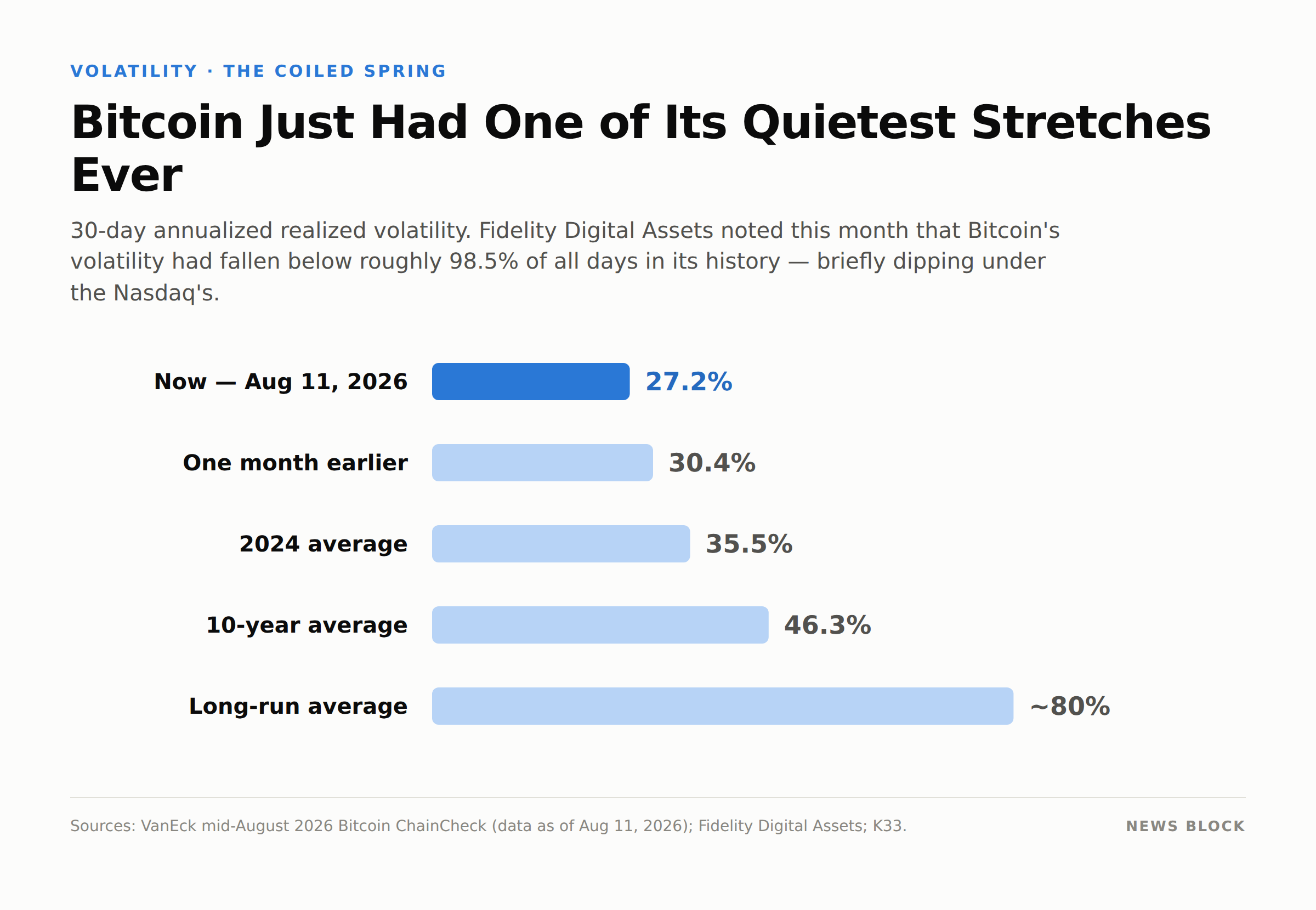
The hard numbers back it up. VanEck’s mid-August ChainCheck puts 30-day annualized realized volatility at 27.2%, down from 30.4% a month earlier — against a 10-year average near 46% and a long-run average closer to 80%. Bitcoin’s daily volatility had actually fallen below the Nasdaq’s (VanEck).
Quiet didn’t mean nothing was happening underneath. By Fidelity’s own Bitcoin Yardstick — a rough price-to-earnings analog that divides market cap by hash rate — Bitcoin had spent 203 consecutive days below one standard deviation, its undervalued zone (Fidelity Q3 2026 Signals Report).
Fidelity’s framing:
“Think of it like a coiled spring: The longer volatility remains compressed, the greater the potential for a meaningful move once it breaks.”
The key question was never whether volatility comes back. It’s what happens when it does.
This week, we got a preview.
- Nat
P.S. - Make sure to grab a copy of my new book, “Bitcoin is for Everyone.” I’ve written an approachable book on Bitcoin and the traditional financial system, perfect for your friends and family who are still learning about it.
You can order a limited number of signed copies and pay in Bitcoin or lightning (powered by Speed Wallet) on my website: shop.talkingbitcoin.com
If you enjoyed reading this post, you should consider subscribing to the News Block.

Disclaimer: This newsletter is for informational and entertainment purposes only and should not be considered financial, investment, tax, or legal advice. I am not a financial advisor. Always do your own research before making any investment decisions and consult a qualified professional for advice specific to your situation. Bitcoin, digital assets, and equities carry significant risk, including the potential loss of principal. Companies, products, and features mentioned in this newsletter may change without notice — including their offerings, availability, terms, financial condition, or regulatory status — and information shared here may become outdated, inaccurate, or incomplete over time. Guests share their own opinions, which do not necessarily reflect mine. Some links in this newsletter are affiliate or sponsor links, meaning I may earn a commission at no additional cost to you.
No posts
Comments
Nothing yet. Say the first thing.
Sign in to join the conversation.