
Listen to the latest episode of the News Block below.👇
Bitcoin just had its best week since March 2023. Up 22% in five days, from the low sixties to above $77,000 by Friday’s close, and then it kept going — clearing $80,000 on Monday for the first time since May 15, and topping out at $81,265 on Tuesday. What a run.
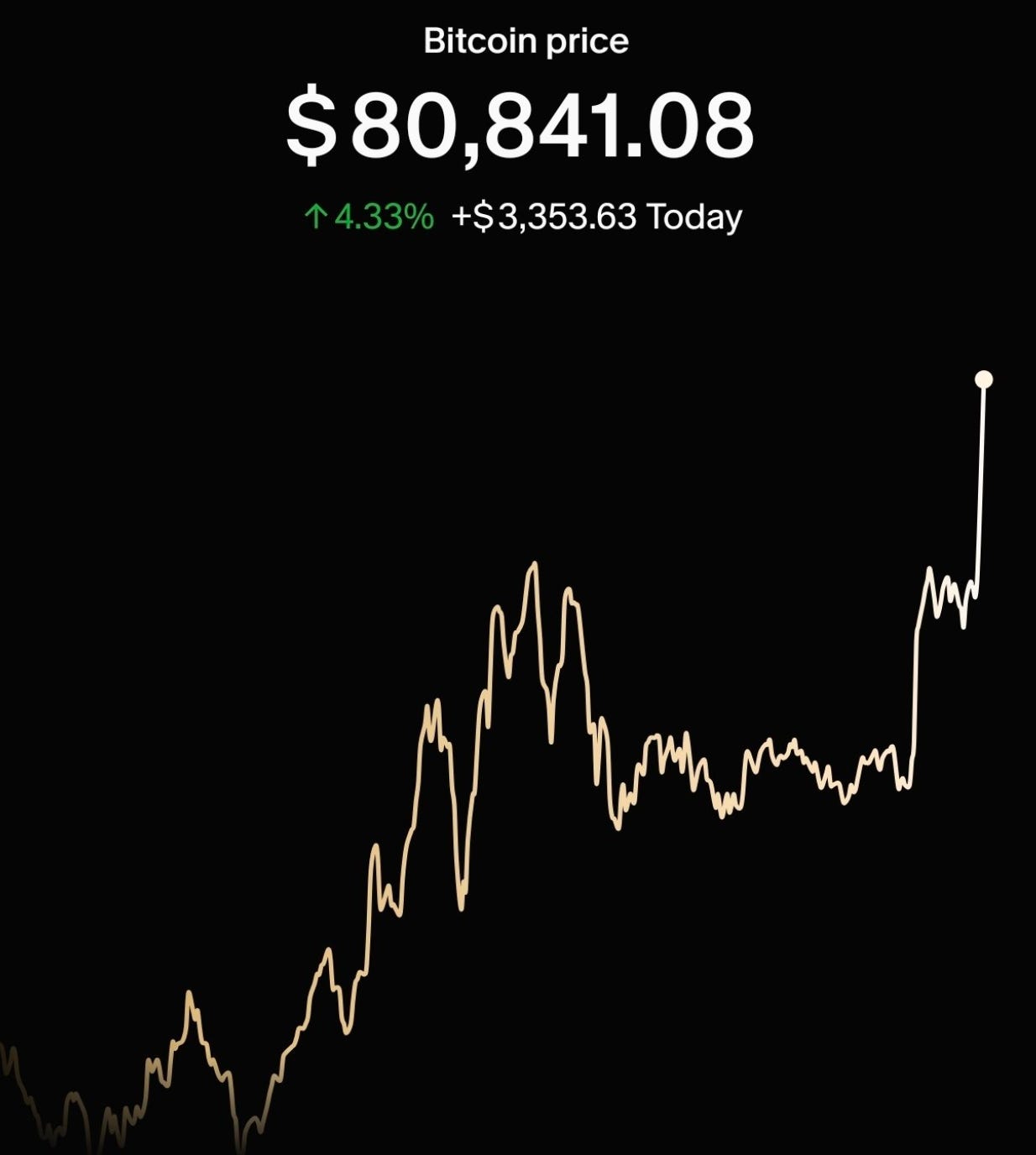
So what happened? A bunch of things hit at once.
The Treasury surprised markets by saying it would double some of its bond buybacks, and long-term yields came down. Washington gave crypto another boost, with the President turning up at a White House meeting with industry leaders. Bearish bets got obliterated — more than $4 billion in short positions were liquidated across the week, including a record $2.7 billion in a single day. And when short sellers get squeezed, they’re forced to buy, which pushes the price even higher.
Then the ETFs came roaring back. Nearly $2 billion flowed in for the week — $1.92 billion, the strongest week since October of last year — including the biggest single day of buying since May at $606 million on Thursday. Of that day, $503 million went straight into BlackRock’s fund. That’s 83% of it, into one product.
Now, some perspective. Bitcoin still isn’t back at the highs. It’s roughly 10% below where it started the year and about 37% below the all-time high of $126,198 set last October.
And Lucy Gazmararian of Token Bay Capital told CNBC she’s expecting “one final flush” before this bear market is really over.
September is historically Bitcoin’s worst performing month of the year, so she could be right. But remember what I told you right before this rally. Fidelity had just noted that Bitcoin’s volatility was lower than about 98.5% of all days in its history, and described the market as a coiled spring.

Fidelity Digital Assets@DigitalAssets
🆕 Update: BTC volatility is now lower than ~98.5% of all days in its history. Meanwhile, spot trading volume has fallen to its lowest level since 2019. Think of it like a coiled spring: The longer volatility remains compressed, the greater the potential for a meaningful move

Fidelity Digital Assets @DigitalAssets
BTC is barely moving, which could be one of the more important signals in the market right now. • 30-day realized volatility is hovering near multi-year lows. • Spot BTC ETP inflows have reaccelerated. • Valuation metrics remain constructive. These periods of compression
12:01 PM · Aug 19, 2026 · 21.3K Views
8 Replies · 25 Reposts · 266 Likes
Well. It finally moved. And this time, it moved up.
The News Block is powered exclusively by Ledn.

So what are these Treasury buybacks everyone keeps talking about? Because honestly, this is the story underneath everything else right now.
Here’s why it matters. Investors have been demanding a lot more interest to lend the U.S. government money for 30 years. The 30-year Treasury yield hit 5.34% this month, its highest since 2007. That’s when Bessent’s Treasury stepped in and announced it would at least double the size of its bond buybacks, from a $2 billion maximum per operation to at least $4 billion.
Okay. So what does a buyback actually do?
Government bonds get resold all the time, like any asset. But the trading concentrates in the newest ones. The older long-term bonds mostly sit untouched for years inside pension funds and insurance portfolios — they’re the overwhelming majority of the debt outstanding, but only about a third of daily trading volume. So when somebody needs to sell one in a hurry, buyers can be scarce. In a stressed market, that’s where trouble starts.
So the Treasury steps in as a buyer. It runs what’s essentially a reverse auction: holders offer up their old bonds, Treasury decides which offers to accept, and everything it buys gets retired — canceled, gone. Worth being precise here, because it often gets described as a guaranteed bid and it isn’t. Treasury sets a maximum per operation, not a minimum, and says outright that it may not buy anything at all in a given operation.
But the government has no spare money. It runs enormous deficits and borrows every week just to pay its bills, so the cash for these buybacks is borrowed too. And the debt has been drifting short. Bills — due back in weeks or months — now make up 22% of all marketable debt outstanding, above the 15 to 20% range Treasury’s own advisory committee has long recommended. Markets absorb bills happily, because they’re practically as good as cash.
Add it up. The hard-to-sell long-term debt shrinks, the easy short-term debt grows, and the total keeps rising. Long-term rates get some relief, but the pressure doesn’t disappear. It gets pushed into the future, because all that short-term debt has to be re-borrowed over and over, at whatever rates come next.
And here’s where this gets interesting.
Janet Yellen’s Treasury launched the modern buyback program, announced May 1, 2024 with the first operation that May 29 — while leaning heavily on short-term borrowing. Bessent was one of the loudest critics of that strategy, arguing it was politically motivated and aimed at juicing the pre-election economy.
One thing worth getting right, because it gets garbled constantly. The name for this — “activist Treasury issuance” — wasn’t Bessent’s. It came from a July 2024 paper by Stephen Miran and Nouriel Roubini, who argued Treasury was “dynamically managing financial conditions and through them, the economy, usurping core functions of the Federal Reserve.” They estimated the effect was worth about a full percentage point of Fed rate cuts. Yellen flatly denied it: “We have never, ever discussed anything of the sort. There is no such strategy.”

Stephen Miran@SteveMiran
🚨🚨 New from me, joint with @Nouriel 🚨🚨 ATI: Activist Treasury Issuance and the Tug-of-War over Monetary Policy How Treasury's issuance policies have stimulated markets and the economy and blocked the Fed's efforts to restrain growth and inflation tinyurl.com/ykmpps49 /1
2:02 PM · Jul 23, 2024 · 403K Views
49 Replies · 155 Reposts · 560 Likes
And Miran made a prediction. Once one party starts using this to stimulate the economy into election season, he wrote, “it may be used repeatedly by all future administrations.” He’d know. Miran went on to chair Trump’s Council of Economic Advisers and served a stretch on the Federal Reserve Board.
Well. That aged perfectly. Two years later, Bessent didn’t shut the program down. He doubled it. Fortune now calls him “the most interventionist Treasury secretary in financial markets in decades.”
And the relief didn’t even last. The 30-year fell to 5.19% on the announcement and was back at 5.27% two days later, the entire move erased. Yields have drifted back down since, as the risk rally ran. But a multibillion-dollar intervention bought about forty-eight hours.

Hedgeye@Hedgeye
🇺🇸 The 30-year yield to end the week right where it started Bessent’s buyback intervention was fully erased in a single day

5:38 PM · Aug 21, 2026 · 35.2K Views
23 Replies · 65 Reposts · 333 Likes
Meanwhile the government is $1.8 trillion in the hole just ten months into this fiscal year, $169 billion worse than the same point a year ago.
And this is the part I keep coming back to. Yellen used these tools. Bessent criticized that playbook, and now he’s running it himself, louder. Different administration, same underlying problem: the debt keeps getting bigger, and the tools keep getting more creative.
To me, that’s the Bitcoin story underneath all of this.
Stanley Druckenmiller just did something you don’t see every day. He publicly criticized the policy of his own former protégé, Treasury Secretary Scott Bessent.

Nick Timiraos@NickTimiraos
Stanley Druckenmiller renders an unfavorable opinion of Treasury Secretary Scott Bessent's use of buybacks to defend against higher yields in a market that is functioning normally. "I have spent five decades trading on a simple premise: Markets aggregate information no committee
10:58 PM · Aug 24, 2026 · 3M Views
393 Replies · 1.66K Reposts · 8.9K Likes
These two go back decades. Both were at George Soros’s fund during the legendary 1992 trade that broke the Bank of England — though it’s worth being accurate about the roles. Druckenmiller ran the money and put on the sterling short. Bessent was a young analyst in the London office whose research on Britain’s economic strain helped feed the thesis.
On Monday, Druckenmiller published a Wall Street Journal op-ed titled “Let the Bond Market Speak,” calling Bessent’s expanded buybacks “price management — and a mistake far larger than $4 billion suggests.”
His argument, in short: bond yields are a signal, and this Treasury is muffling it. “The long-term Treasury yield is the most important price in the world,” he wrote. “It is also the only fiscal disciplinarian the U.S. has left.” If the 30-year has to trade at 5.5% to clear, that isn’t a crisis — “It is an invoice.”
He also made the point that this isn’t really a liquidity operation at all. Buying back long bonds while funding the purchases with short-term bills shifts interest-rate risk off the public’s books — which he described as a small dose of quantitative easing, run out of the Treasury rather than the Fed, at a moment when inflation is still above target. His line about credibility: “You can’t buy your way out of a solvency conversation with liquidity tools.”
Then it got weird. Readers noticed the op-ed read like AI.
An AI-detection tool flagged it, economist Claudia Sahm posted that the argument was “classic Druck + Claude-isms,” and the whole thing took off. When Jeff Stein of NOTUS asked him about it, Druckenmiller just owned it:
“Of course I used AI. There’s a reason I moved from an English major to being an economics major. I’m not embarrassed by it. I write everything using AI now for the same reason I use a calculator when I do math problems.” He added: “My name is on the piece. It’s my message.”

Jeff Stein@jstein_notus
New - Billionaire Stanley Druckenmiller tells me "of course" he used AI to write op-ed on Bessent & bond market "There's a reason I moved from an English major to being an economics major," he says, "I'm not embarrassed by it" No response from WSJ
notus.org
Billionaire Stanley Druckenmiller’s WSJ Op-Ed Criticizing Bessent Was Written With AI

2:53 PM · Aug 25, 2026 · 2.15M Views
186 Replies · 397 Reposts · 3.25K Likes
The Journal stood by it. Editorial page editor Paul Gigot said AI “is a fact of modern life,” and that what matters is “whether what we publish from contributors reflects an author’s original argument” — adding that “nobody can doubt that his op-ed is his genuine opinion.”
The AI thing is a fun sideshow, and honestly a bigger media story than a markets one. But don’t let it bury the substance.
The man who taught Bessent the bond market is telling him the bond market can’t be managed — only answered. When the teacher disagrees with the student this publicly, pay attention.
Until next week, keep stacking!
- Nat
P.S. - Make sure to grab a copy of my new book, “Bitcoin is for Everyone.” I’ve written an approachable book on Bitcoin and the traditional financial system, perfect for your friends and family who are still learning about it.
You can order a limited number of signed copies and pay in Bitcoin or lightning (powered by Speed Wallet) on my website: shop.talkingbitcoin.com
If you enjoyed reading this post, you should consider subscribing to the News Block.
Disclaimer: This newsletter is for informational and entertainment purposes only and should not be considered financial, investment, tax, or legal advice. I am not a financial advisor. Always do your own research before making any investment decisions and consult a qualified professional for advice specific to your situation. Bitcoin, digital assets, and equities carry significant risk, including the potential loss of principal. Companies, products, and features mentioned in this newsletter may change without notice — including their offerings, availability, terms, financial condition, or regulatory status — and information shared here may become outdated, inaccurate, or incomplete over time. Guests share their own opinions, which do not necessarily reflect mine. Some links in this newsletter are affiliate or sponsor links, meaning I may earn a commission at no additional cost to you.
No posts
Comments
Nothing yet. Say the first thing.
Sign in to join the conversation.