
Listen to the latest episode of the News Block below.👇
Let’s start with the latest on the Coldcard hack — because while the numbers have gotten worse, the response from this community has been remarkable.
First, the update. Researchers now estimate roughly 1,800 Bitcoin — over $116 million — has been drained across multiple waves of attacks. If you haven’t yet moved funds from a seed generated on affected firmware (pretty much any ColdCard purchased from 2021 and on), please don’t wait. Updating the firmware alone doesn’t fix a seed that was created on the vulnerable software — you need a new seed entirely.
But here’s what should give every Bitcoiner a lot of hope.
The highly-technical volunteer group calling itself Bitcoin’s Red Team — led by developer Calle and Rob Hamilton of AnchorWatch, who you heard on my emergency episode. Their mission has been to make sure nothing like this is hiding anywhere else in the ecosystem.
Using cutting-edge AI models, 16 researchers audited more than 390 open-source Bitcoin projects in about 27 hours. They found nearly 5,000 security issues — including 85 critical vulnerabilities — and reported them privately to the developers who maintain those projects, so they can be fixed before attackers find them. The nonprofit OpenSats has been covering the computing costs.
No company ordered this. No government funded it. The community just did it.
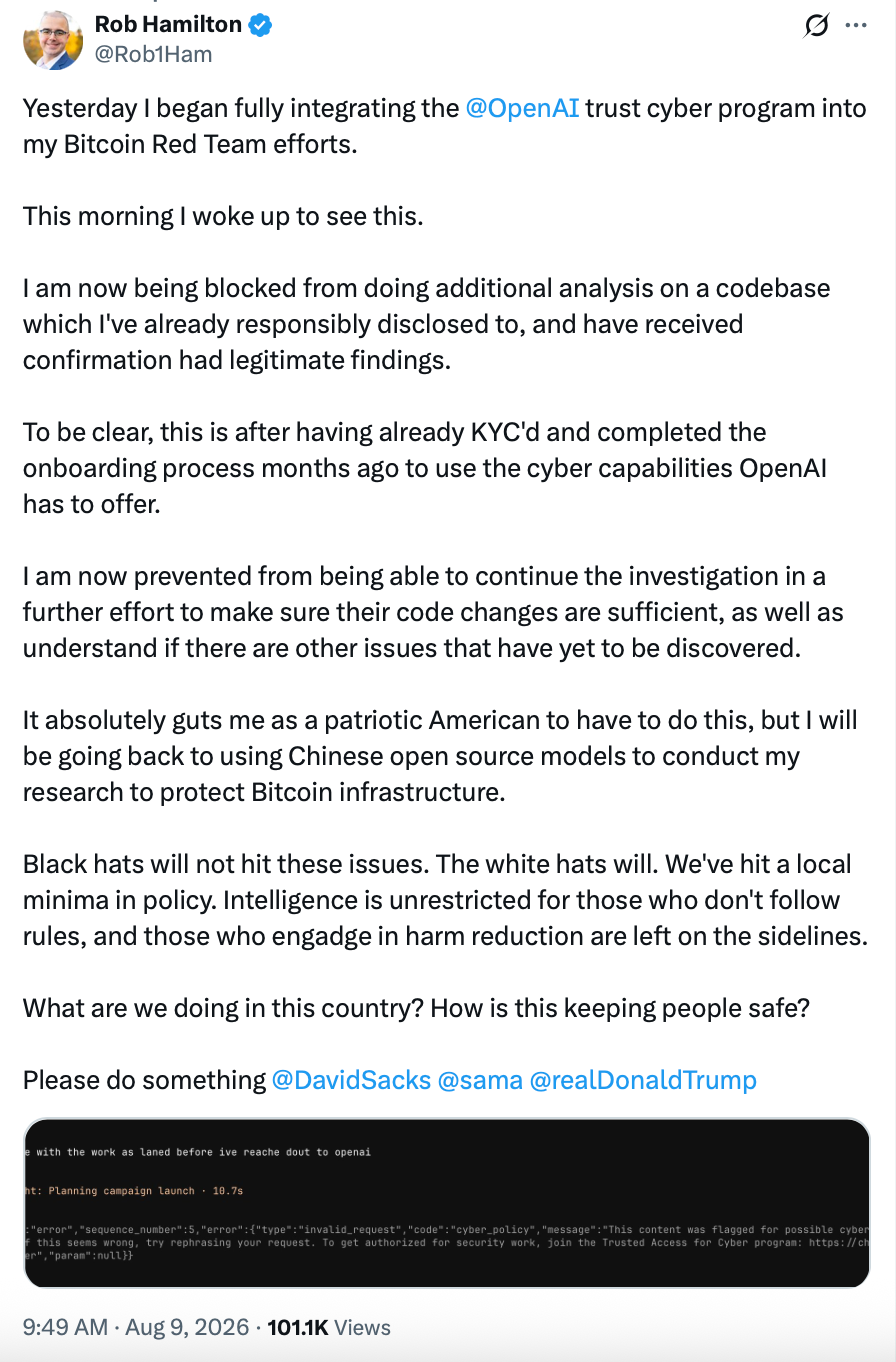
Although the work isn’t without obstacles. Just this weekend, Rob shared that OpenAI’s safety systems blocked him from continuing his analysis — even though he’d completed their vetting process for security researchers months ago. His frustration was blunt: attackers don’t follow the rules, so restrictions like these only slow down the defenders. He says he’s now forced to use Chinese open-source AI models to continue protecting Bitcoin infrastructure. I hope someone in Washington, D.C. is paying attention
Speaking of the community sorting things — let’s turn to a quick update on BIP-110.
BIP 110’s mandatory signaling period began Saturday. Nodes enforcing the proposal rejected non-signaling blocks and briefly formed a separate chain. That chain produced just two blocks before stalling, while Bitcoin’s main network continued uninterrupted and rapidly pulled ahead. No major exchanges recognized the alternative chain.
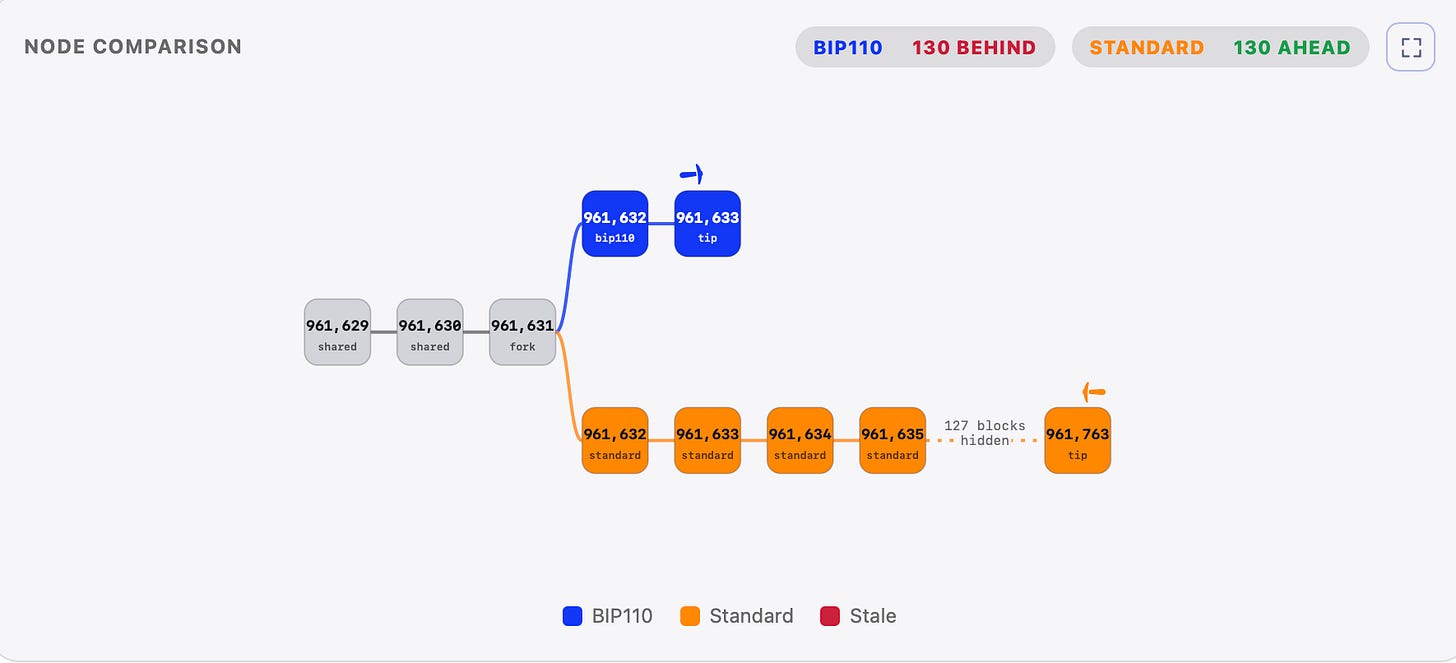
Bitcoin’s rules remain exactly where they were before the debate began.
Whatever your view on BIP 110, the outcome demonstrated something important about how Bitcoin works. Changing the rules requires overwhelming agreement across miners, node operators, developers, and the broader economic community. That bar wasn’t met. And that’s the system working as designed.
Now, some supporters insist the effort isn't over — arguing that node enforcement, not miner signaling, is what ultimately matters, and a few developers have even prepared contingency code that would change Bitcoin's mining algorithm entirely to keep their chain alive. Whether that goes anywhere remains to be seen.
If you want to understand the perspective of those who supported the proposal, I sat down with Matt Kratter of Bitcoin University for a full conversation. It’s streaming now wherever you get your podcasts.

I think hearing both sides of this debate matters, especially after months of people talking past each other online.
The News Block is powered exclusively by Ledn.
Ledn is the global leader in Bitcoin-backed loans, issuing over $11 billion in loans since 2018, and was the first to offer proof of reserves. With Ledn, you get custody loans, no credit checks, no monthly payments, and more.

Visit LEDN.io to learn more.
Now to the nation’s capitol where The CLARITY Act, the bill that would finally establish a comprehensive federal framework for digital assets in the United States, did not get a vote before the Senate left for its August recess.
Senate Majority Leader Thune confirmed the delay, blaming his Democrat colleagues for blocking it. He said: “We’re getting that queued up first thing when we come back.”
The Senate returns September 14. But the window is shrinking fast. The ethics provision — specifically, whether senior government officials and their families should be restricted from profiting off digital assets — remains unresolved. And prediction markets now put the odds of the CLARITY Act becoming law this year at just 15%. Down from over 70% in May.
After nearly a decade of regulation through enforcement, Congress had a real opportunity to establish lasting rules. Whether they still can depends on what happens in September — and whether midterm politics get in the way.
Michael Saylor had a great tweet about this development saying “Bitcoin doesn’t need CLARITY. America needs clarity.”

Which brings us to Russia — because the contrast couldn’t be sharper.
Russia just passed its first comprehensive crypto law and Putin signed it on August 4th.
The law legalizes crypto trading through licensed exchanges under the Bank of Russia — but bans domestic payments in crypto entirely. You can buy and sell Bitcoin in Russia now, but you can’t spend it at a store.
The catch for ordinary citizens: retail investors are capped at roughly $3,750 in annual crypto purchases. At that limit, a Russian citizen would need about 17 years to accumulate a single Bitcoin at current prices.
But here’s the part that tells you what this law is really about. Cross-border settlements in crypto — meaning international trade — have no cap at all. Russia seems to want to use digital assets to move money around. It just doesn’t want its own citizens using it freely.
The takeaway: Russia is regulating crypto to control it. The U.S. can’t even agree on a framework.
And finally, a story about the power of currencies — and who controls them.
Treasury Secretary Scott Bessent made headlines last week by helping engineer the first joint U.S.-Japan currency intervention in decades.
The Japanese yen had been collapsing — trading near its weakest levels since 1986. And here’s why America cares. Japan is the largest foreign holder of U.S. government debt — over $1 trillion in Treasuries. When the yen collapses, Japan’s playbook for defending it is selling dollars — which in practice means selling Treasuries. And if Japanese interest rates rise to protect the currency, Japanese investors have every reason to bring their money home instead of funding America’s deficits.
In other words, a yen crisis would become a Treasury market crisis. With nearly $40 trillion in national debt and trillions to refinance, that’s a risk Washington cannot afford.
So Bessent — who spent decades making billion-dollar currency bets for George Soros — used his old playbook in the new job. Bloomberg reported that he deliberately let reporters see his notepad at a meeting, with a to-do list that included buying as much as $10 billion in yen. The message to the market was loud and clear.
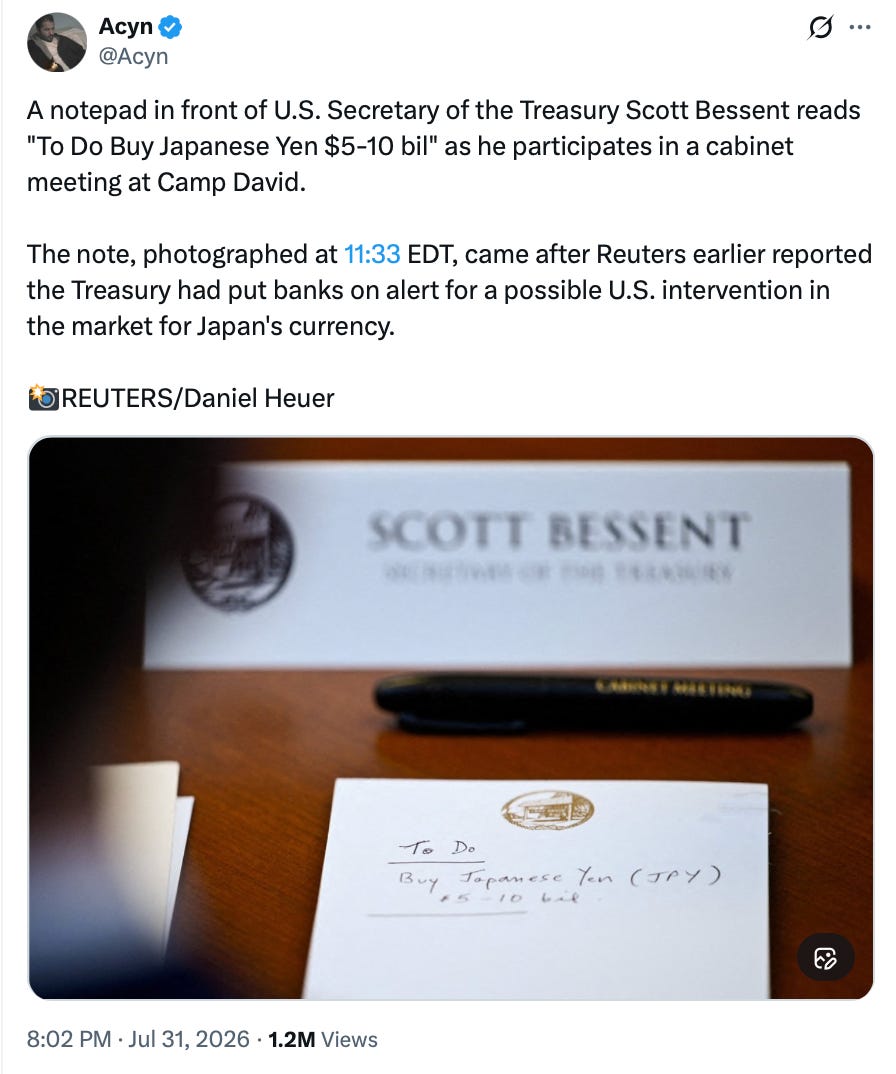
This wasn’t just about helping an ally. It was about protecting the biggest buyer of American debt — because the entire system depends on someone continuing to fund it.
Bitcoin doesn’t have a Treasury Secretary. Nobody can prop it up, push it down, or rewrite its monetary policy to serve a political agenda. In a world where governments are openly intervening in currency markets to keep the debt machine running, that neutrality is the feature.
Until next week, keep stacking.
- Nat
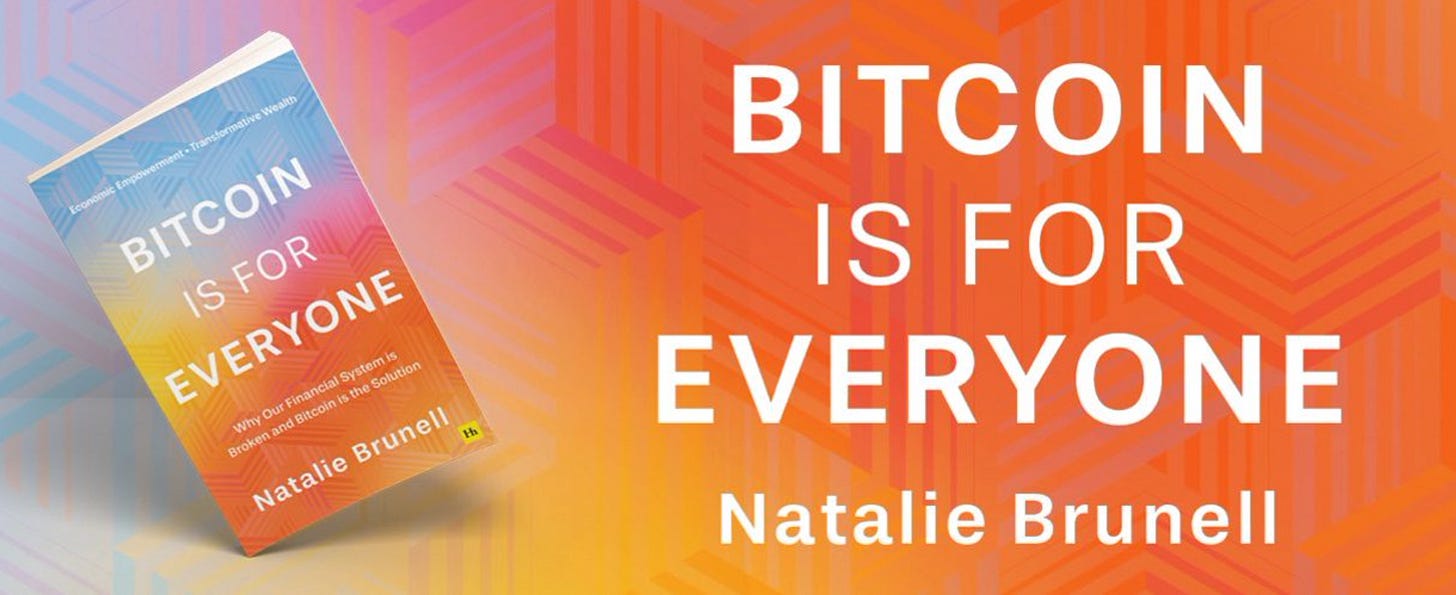
PS - Make sure to grab a copy of my new book, “Bitcoin is for Everyone.” I’ve written an approachable book on Bitcoin and the traditional financial system, perfect for your friends and family who are still learning about it.
You can order a limited number of signed copies and pay in Bitcoin or lightning (powered by Speed Wallet) on my website: shop.talkingbitcoin.com
If you enjoyed reading this post, you should consider subscribing to the News Block.

Disclaimer: This newsletter is for informational and entertainment purposes only and should not be considered financial, investment, tax, or legal advice. I am not a financial advisor. Always do your own research before making any investment decisions and consult a qualified professional for advice specific to your situation. Bitcoin, digital assets, and equities carry significant risk, including the potential loss of principal. Companies, products, and features mentioned in this newsletter may change without notice — including their offerings, availability, terms, financial condition, or regulatory status — and information shared here may become outdated, inaccurate, or incomplete over time. Guests share their own opinions, which do not necessarily reflect mine. Some links in this newsletter are affiliate or sponsor links, meaning I may earn a commission at no additional cost to you.
No posts
Comments
Nothing yet. Say the first thing.
Sign in to join the conversation.