
If you’ll permit me, I would like to wildly overthink Spider-Man: Brand New Day with you for a minute or two. Won’t that be fun? I think that will be fun. Okay, here we go.
This is the fourth Spider-Man movie starring Tom Holland as Spidey and Zendaya as “MJ” (she is not called Mary Jane in this version because she is Zendaya and Zendaya is too cool for that or something). In the third one, Spider-Man has to protect his identity and the universe by erasing everyone’s memory of him using a magical plot device cast by Doctor Strange. Not a spoiler: Brand New Day is about Spider-Man yearning to reconnect with MJ, who has forgotten him.
And it’s very touching! Part of this is down to Holland, who radiates charm and pathos. Part of it is the inherently poignant idea of being forgotten by your loved ones (see also: The Notebook, The Good Place, Hermione’s last act in Harry Potter). But Spider-Man screenwriters Chris McKenna and Erik Sommers have also understood something crucial about this trope. The tell is that they give MJ a bunch of lines about how Spider-Man violated her by electing to be forgotten, and how the MJ who loved Peter Parker is simply gone.
Here comes the over-thinking. In the last movie, we were led to conceive of Spider-Man’s tragic choice primarily as an act of self-sacrifice, erasing himself from the world. When Thanos famously snapped half the population out of existence in Avengers: Infinity War, it was Holland’s pitiful boyish face everyone remembered disintegrating into space dust. Spider-Man was very clearly going back to that emotional well.
But Brand New Day underscores that in erasing himself from his friends’ memory, Spider-Man is equally erasing them, reaching into their minds and taking away some part of their being. This actually makes for a much more compelling human drama than the inherently exploitative and irrational multiverse fantasy that has weighed down the Marvel franchise for so long.
It’s not really like the Thanos snap at all, once you play it out: Tom Holland’s Peter Parker hasn’t ceased to exist. He’s arguably the only character who does still exist in the same form. The one who’s really been scrubbed out in this scenario is MJ, along with all the other people who have lost that inner dimension of themselves which transected Peter’s own self. I think this is a more powerful choice because—bear with me—it is more in keeping with Medieval anthropology.
Recently my friend Mary Harrington put me on to The Book of Memory, a groundbreaking study of Medieval memory techniques from 1990 by Mary Carruthers. Mary (Harrington) told me it would blow the doors wide open on my understanding of the past, and she wasn’t kidding. Carruthers reveals how much of the stuff we file under “Weird Medieval Shenanigans”—the cat pics and snail guys in the margins of illuminated manuscripts, for example—are actually traces of a highly sophisticated methodology for retaining vast quantities of knowledge in the memory.
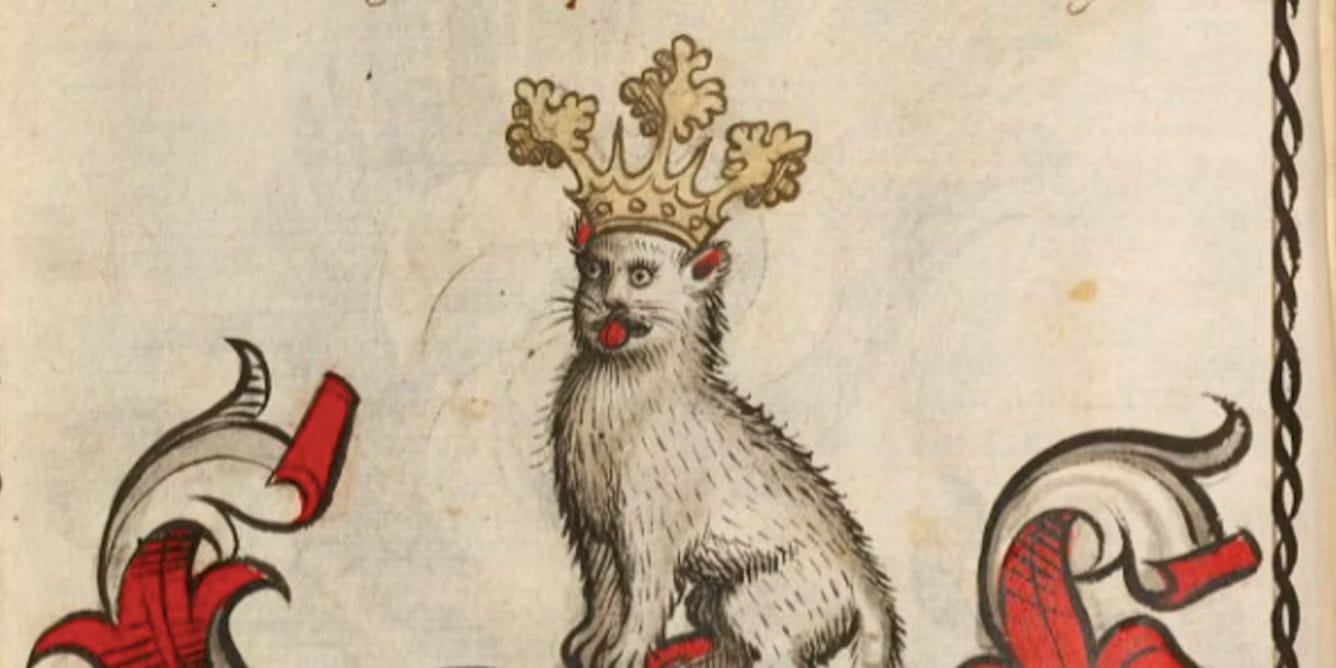
The Book of Memory opens with the observation that whereas moderns prize imagination as the chief attainment of the human mind, “ancient and medieval people reserved their awe for memory.” “See, in the measureless plains and vaults and caves of my memory,” writes St. Augustine in Confessions, “I run and fly back and forth, I penetrate as deeply as I can, I meet no boundary anywhere. So great is the power of memory, so great the power of life in man who lives though mortal.”
Two things stick out to me about this famous quote from Augustine after reading Carruthers. First, Augustine associates the memory with freedom. It doesn’t lock him into rote litanies, like our stereotyped image of a schoolboy droning through a passage he’s learned by heart. Instead, because Augustine has been trained to call up ideas he’s retained at will, he can be free to mix them creatively and draw on them for his own reflection, making his memory a source of novelty rather than doldrums.
Second, Augustine draws a very close association, almost an identity relation, between “the faculty of memory” and “the power of life.” It’s almost as if memory is life, or at least to be fully alive as a human being is to remember. Aristotle shows the truth of this right at the beginning of his Metaphysics, when he invites us to imagine what it would be like to have no memory at all: it wouldn’t actually be like much of anything, because there would be no persistent you to speak of. No two mental events would be linked, leaving just a succession of unrelated experiences that happened to be taking place one after another in the same brain.
Which means you aren’t just your brain at any given moment. Memory stitches together thoughts gone by into a continuous self, developing but enduring over time. This also explains why Plato was so worried about technology becoming a substitute for memory, housing facts and records outside of our living minds and gradually unpicking the threads that hold us together. Now that the digital revolution has created an archive of basically everything, leaving us weakened by default in the art of memory, we are pretty much in danger of falling to pieces.
We are also in danger of forgetting how to connect with each other, which is another thing the writers of Spider-Man: Brand New Day have implicitly grasped. MJ’s selfhood is assaulted when her memories of Peter are erased because her self is relational: it’s formed in tandem with his. She’s not just an isolated unit; her self is made of other selves. He can’t actually vanish from the scene without taking a chunk of her with him.
All of which is rather profound, though I am definitely reading too much into this routine superhero movie. But it does cause me to reflect that, unless we take active care to keep up the practice of human contact and refurbish the arts of memory, we may be left with No Way Home.
See? That was fun.
To hear Klavan Sr. and Klavan Jr. break down the whole Spider-Man franchise, be sure to watch the new Klavans on the Culture!
No posts
Comments
Nothing yet. Say the first thing.
Sign in to join the conversation.