
14 August 2026 | Full taxonomy with company URLs
You can get from Geneva to Zurich by train in less than three hours. Somewhere along that line sits almost every major part of the Swiss neurotechnology industry. Geneva has Campus Biotech, the Wyss Center, HUG and companies building cortical implants, soft electrodes and long-term brain monitoring. Lausanne gives you EPFL, CHUV, spinal cord work, neuroprosthetics and a fairly ridiculous amount of rehabilitation technology. Keep going and you hit Bern, Basel and eventually Zurich, where ETH sits underneath another cluster of sensing, diagnostics, stimulation and research hardware. In the United States those would be separate industries in separate states. Here they’re stops on the same train.
I hadn’t really appreciated that when I put the Europe map together earlier this year. I tagged twenty-eight companies as Swiss, decided that sounded about right and moved on. Unlike the UK piece, I haven’t spent the last couple of weeks wandering into Swiss labs and talking to founders, so this one has been much more desk-heavy: company sites, trial records, university spin-out pages, regulatory notices and an increasingly stupid number of tabs open at once. That also made it easier to be brutal about what actually belongs on the map.
The first thing that happened was that the list got smaller. Brain+ is Danish. NeuroRestore matters enormously to the Swiss story but it isn’t a company. Sonova owns Advanced Bionics, but that one is run out of California, so I’ve treated it as ownership rather than sneaking another logo into the count. Then the list got bigger. Once I stopped searching for “Swiss BCI companies” and started searching for the clinical problems these companies are trying to solve, names kept appearing that I had simply never seen written down together. BrainScape Medical. Luciole Medical. SensArs. MYNERVA. NeuroGyn. Skaaltec. Gondola. I somehow ended up back on twenty-eight core companies, which is either a coincidence or the least interesting number here because it isn’t the same twenty-eight. The wider working map has fifty-one names once the adjacent and borderline group is shown separately. For a country with roughly the population of London, that’s a lot of neurotechnology.
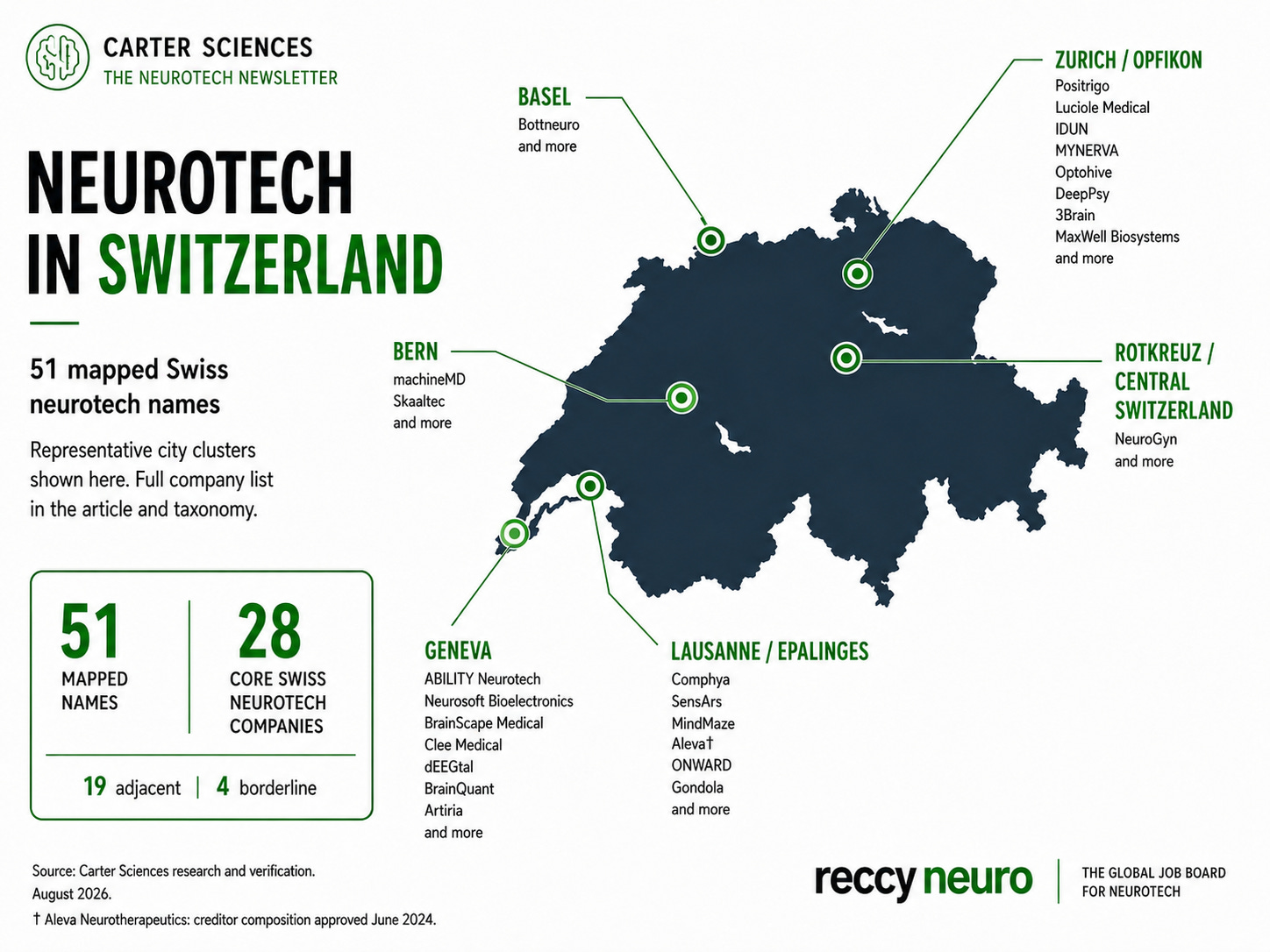
The company that properly made me realise I hadn’t looked hard enough was DeepPsy. It’s based in Zollikon and was founded by Mateo de Bardeci and psychiatrist Sebastian Olbrich around a fairly simple problem: depression treatment still involves a lot of trying something, waiting and seeing what happens. DeepPsy uses EEG and ECG biomarkers to give psychiatrists another piece of information before they choose a treatment. What caught me wasn’t the algorithm. It was the reimbursement. The service has been covered for eligible patients by Swiss basic health insurance since April 2025 and the company now reports more than a thousand patients and dozens of physicians using its reports. Plenty of neurotech companies can produce a promising signal. Getting a health system to pay for that signal is usually where the optimism goes to die.
I had never come across DeepPsy once before this map, and that changed how I searched the rest of the country. Searching by technology finds you the companies that already describe themselves the way you’re searching. Searching by clinical problem, bladder control, foot sensation, treatment selection in depression, finds the ones that don’t. Almost everything below came out of the second kind of search.
Every country map I build has a layer underneath it of businesses that were doing this before the current cycle made it interesting, and Switzerland’s layer is unusually solid. Hocoma has been building robotic gait and upper-limb rehabilitation systems for long enough that its machines are basically furniture in rehabilitation clinics across Europe. 3Brain and MaxWell Biosystems make high-density microelectrode arrays, so researchers around the world are recording neural activity on Swiss hardware whether or not they think of it that way. FinalSpark rents researchers remote access to living neurons, which I still find hard to describe without sounding like I’m making it up. And the Advanced Bionics point is worth making properly, because cochlear implants are the neural interface that became normal medicine decades ago while the rest of the industry was still arguing about what counted as a BCI. Switzerland didn’t discover the nervous system in 2022.
Then there’s Aleva Neurotherapeutics, which I had in the present tense until a week ago. Aleva got directSTIM, a directional deep brain stimulation system, CE marked out of Lausanne and sold it into European clinics against Medtronic, Abbott and Boston Scientific. Rotem Kopel at ABILITY told me she thought Aleva had wound down, and the Swiss commercial register bears her out, because the Lausanne court approved a composition agreement with its unsecured creditors in June 2024. A Swiss company raised north of sixty million dollars, got an implantable through CE marking, went at the three majors and then ran out of road. Most maps of this country still list Aleva as active and marketed. I’d rather show you the version where it isn’t, because it’s the clearest warning about the two things Switzerland is short of, which are growth-stage money and people who have taken a device like that to market before.
Comments
Nothing yet. Say the first thing.
Sign in to join the conversation.