
Written by Sophie Trandos, with Chay Carter’s market map.
It seems Australians have quietly infected neurotech. Chay can attest to this, because I more or less bullied him into hiring me, and letting me write the Australasia edition felt like a fairly natural hard launch for the Carter Sciences team doubling in size. He is pleased with the decision so far, but we will see. I grew up in Perth, have now left Australia twice, and came into this thinking I understood the place reasonably well. What I had not appreciated was just how much difficult neurotechnology gets its first proper start there before the company, the capital or the founder eventually heads overseas.
Most of the conversation is still framed as the United States versus Europe, with Asia now biting at their heels, while Australia and New Zealand tend to appear as the place somebody came from rather than the place an industry is being built. That framing turns out to be the answer rather than the setup. Australasia is not really trying to become the largest neurotech market in the world. It has found something more specific, probably more useful and very Australian: turning exceptionally difficult neuroscience into a device that actually works in a person, then more often than not waving it off to America once the hard early work is done.
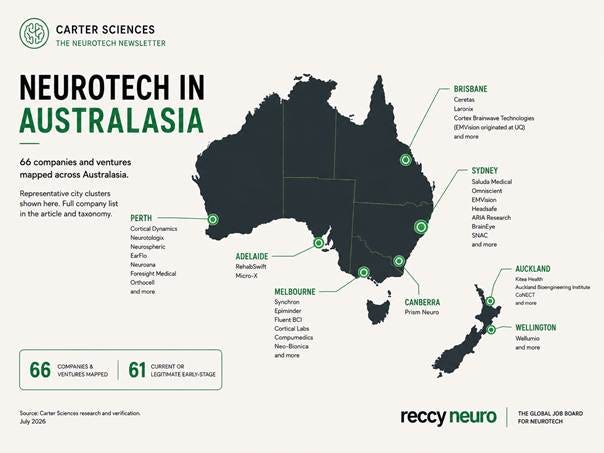
By the time Chay and I had everything in one place, the full map contained 66 companies and ventures. Sixty-one are current or legitimate early-stage businesses, while a small handful remain because the less tidy stories matter too. The exact total depends on where the line is drawn, because a retinal implant is obviously neurotech while a stroke scanner, digital cognitive test or company growing human brain models sits closer to the edge. However we counted it, the market was far broader than either of us expected. The place to start is still the cochlear implant, because it is not simply the oldest part of the story. It is the reason so much of what followed was possible.
The cochlear implant was the start, not the whole story
Professor Graeme Clark and his team developed the multichannel cochlear implant in Melbourne, Cochlear became one of the world’s great medical-device companies, and Clark founded the Bionics Institute in 1986. The famous part is the implant, which the Institute credits with giving hearing to more than a million people. The more important part for this story is what formed around it, because the work produced engineers who understood implanted electronics, surgeons who became comfortable placing devices around nerves, and institutions that had watched a laboratory idea turn into a global company. It feels a little like a vintage version of a startup ecosystem, except the product changed an entire field rather than helping somebody order lunch faster.
The Bionics Institute is the clearest evidence Cochlear was not a one-off. Its work has fed into Epiminder‘s epilepsy monitor, EarGenie‘s infant hearing technology, Bionic Vision Technologies‘ retinal implant and Neo-Bionica‘s manufacturing facility, alongside research in vagus-nerve stimulation, Parkinson’s and chronic pain. That is a proper family tree rather than a collection of unrelated projects that happened to share a city, and it gives Melbourne something most neurotech markets do not have: people who have already made the same difficult journey several times. Hearing is the lineage, while the modern branches now run through epilepsy, brain-computer interfaces, vision, pain and rehabilitation.
Melbourne is where it becomes a proper cluster
I was already of the opinion that Melbourne is the best city in Australia, and this research did very little to challenge my bias. Synchron is the obvious modern example. Its Stentrode reaches the brain through the blood vessels rather than open-brain surgery and lets people with severe paralysis control digital devices by reading activity near the motor cortex. It began in Melbourne, has raised more than 345 million US dollars and now does most of its commercial and fundraising work from the United States, while a new Australian trial announced in 2026 is testing the latest implant in people with motor neurone disease across Melbourne and Sydney. Around it sits Ultra Bionics, founded by Synchron co-founder Nicholas Opie, who stayed home to work on precisely aimed ultrasound intended to reach deep parts of the brain without leaving a device behind. It is early, but the pattern is already there: one company internationalises and the same people begin the next one in Melbourne.
Epiminder is the strongest of the near-commercial names. Its Minder system records brain activity continuously from an electrode array under the scalp, which solves the fairly obvious problem that epilepsy is difficult to understand from a brief clinic EEG and an unreliable patient diary. It came out of the Bionics Institute, the University of Melbourne, St Vincent’s Hospital and Cochlear, received FDA authorisation in April 2025 and then listed on the ASX, raising 125 million Australian dollars, with Cochlear still holding roughly a third and making the device. They do not simply rub shoulders. They are on the share register. The next branch is Fluent, founded in 2025 to build an interface placed under the scalp but outside the skull, intended to turn attempted speech into text. Its co-founder Dean Freestone previously co-founded Seer and worked on the programme behind Epiminder, so Fluent is taking people who have already built this kind of hardware and pointing them at communication.
Seer is the less comfortable part of the lineage. It built home video-EEG monitoring for epilepsy, entered voluntary administration and survived through restructuring, which makes it neither a clean failure nor the neat success story company histories prefer. Around those names the cluster becomes much broader. Bionic Vision Technologies takes the cochlear logic into sight with a retinal implant, Cortical Labs grows living neurons on silicon, Neurogen is building brain implants from living cells, and Compumedics has been exporting sleep and EEG systems from Melbourne for decades. None of those companies is doing quite the same thing, which is precisely why the cluster matters.
There is another layer beneath the better-known names too. Wavewise Analytics is developing continuous monitoring of blood flow and oxygen around stroke and serious brain injury, Redenlab measures changes in speech and swallowing across neurological disease, and Resonance Therapeutics is working on personalised brain stimulation for depression at home. HITIQ approaches concussion through instrumented mouthguards, while Tessara Therapeutics and Chromos Labs sit closer to infrastructure, building human brain models and tools to understand what those models are doing. This is the point where Melbourne stops looking like a few clever spinouts and starts looking like an actual technology base.
The company Chay had become most attached to was also the one with the fewest headlines, and once I understood what it did, I was with him. A founder can have excellent science, enthusiastic surgeons and a real patient problem, then discover there is nowhere nearby that can turn the prototype into a sealed, tested implant safe to leave inside a person. Packaging a tiny device, keeping fluid out and making the small batches needed for early human studies will never be the glamorous part of neurotech, but it can stop a company dead. Neo-Bionica was created by the Bionics Institute and the University of Melbourne to close that gap, working from St Vincent’s with the cleanrooms, packaging and testing that had previously been difficult to find locally. It is the unglamorous bit that decides whether the glamorous bit ever reaches a patient.
Why the first patients still come here
Australia’s real advantage sits in the awkward middle between a device working in a laboratory and somebody being brave enough to put it into a person. The early clinical-trial system is practical, hospitals know how to run these studies, and public funding can carry a technology far enough that private investors finally become interested. That is why companies with American headquarters still return to Melbourne and Sydney for their earliest human work. Australia is very good at getting a device into its first patient. Getting it to its ten-thousandth is still the part it tends to hand to somebody else, usually with a polite wave at the airport.
SUBSCRIBE TO KEEP READING
The rest of this piece covers Sydney, Brisbane, Perth, the smaller Australian clusters, New Zealand, the international founder diaspora and the full July 2026 taxonomy.
Comments
Nothing yet. Say the first thing.
Sign in to join the conversation.