
Welcome to the latest edition of Global Nature Beat. This edition includes:
Updates on biodiversity negotiations, Amazon rainforest, plastic treaty talks, global mangrove mapping, climate — and biodiversity — justice.
Features about the flawed Ocean Cleanup, canopy bridges and roadkill, AI and nature, UK aid for the Congo rainforest, climate journalism in Africa, and more.
Journal papers on opium versus biodiversity, aquatic deoxygenation, legal protection for Europe’s wildlife, palm oil and deforestation, the US roadless rule and water, nature and mental health, crime scripting and pangolin trafficking, invasive species and their impacts, blue carbon and more.
Plus, the usual mix of news from around the world, useful resources, jobs and opportunities for environmental journalists, and more.
Amazon: The area of the Brazilian Amazon that burned was smaller last year than it has been since records began in 1985, reports Rachel Flynn. This and the recently reported decline in Amazon deforestation are good news for the world’s biggest rainforest. But there is a challenge on the horizon. After two decades, the soy sector’s voluntary moratorium on sourcing soybeans from land deforested after 2008 is over. This will cause at least 1.4 million hectares of deforestation over the next decade, according to new research. The paper is behind a paywall but is summarised here by WWF, which proposes policy measures to halt the projected surge in deforestation.
Plastics: The stalled negotiations toward a global treaty on plastics had an injection of energy early in July, when informal talks took place in Kenya ahead of the resumption of formal negotiations in March 2027. However, journalists Emma Bryce, Benard Ogembo, Conor McGlone and Louise Krüger report on concerns that the closed-door informal sessions risk weakening transparency and ambition. Giulia Carlini and Cate Bonacini of the Center for International Environmental Law warn that a “no surprises” draft treaty text risks locking in weak, lowest‑denominator measures. They outline eight tests of whether negotiations are moving in the right direction to deliver an effective treaty. Meanwhile, the scale of the plastics crisis is becoming ever more apparent. In the past week, journalists have reported that microplastics are contaminating fish deep in the Amazon and sea salt in Indonesia, and that a billion tiny plastic ‘nurdles’ spilled into a UK river.
Legal duties: A year ago, the International Court of Justice (ICJ) issued a landmark opinion on the duty of states to act to address climate change. Reviewing what has happened since, Joie Chowdhury of the Center for International Environmental Law and colleagues write that the ICJ climate opinion is already reshaping global climate law, diplomacy and governance. The UN General Assembly endorsed the opinion in May. But as Aditi Shetye and colleagues at the World’s Youth for Climate Justice note in a new article, the hosts of the next two UN climate change conferences — Türkiye and Ethiopia — both abstained from the vote. Meanwhile, Andreas Buser wants to start the conversation about whether a similar ICJ advisory opinion on biodiversity could clarify that states have legal duties to halt nature loss.
Mangroves: The updated Global Mangrove Watch dataset shows that the extent of these coastal forests has greatly increased in Australia, India, Pakistan, Philippines and Senegal over the past 40 years, but has shrunk significantly in Indonesia, Myanmar, Malaysia, Nigeria and Cuba. The gains are nearly entirely offset by the losses, leaving a net global increase of just 47,000 hectares — a tiny amount, but better than an overall decline. The Global Mangrove Watch update, which launches officially on 26 July, maps its data to 30 metre resolution — see the press release. See also, a selection of the Mangrove Action Project’s annual photography awards winners, published on 24 July.
Biodiversity: National negotiators are in Nairobi, Kenya from 27 July to 12 August for talks in two subsidiary bodies of the UN Convention on Biological Diversity (CBD). In both meetings, negotiators will discuss a draft report on progress toward the goals and targets of the CBD’s Global Biodiversity Framework, and will develop the text of decisions for parties to adopt at their conference in Armenia in October. As a new report from the Dutch government concludes, collective ambition in national biodiversity targets is insufficient to match the global ambitions agreed under the CBD. The subsidiary bodies will also discuss a range of other issues — see the overview from the Earth Negotiations Bulletin, which will publish daily coverage of each meeting. See also the position papers from the International Union for the Conservation of Nature (here), and the World Wildlife Fund (here and here).
Can reason alone foster a way of living that respects ecological limits? Stéphan Barbe, Ossénatou Mamadou and Philip A. Davies argue that Indigenous philosophy can deepen sustainability science’s engagement with nature.
David Shiffman says the Ocean Cleanup’s celebrated tech kills marine life, can’t fix plastic pollution and has ignored scientists who warned that its approach is flawed.
Suzana Camargo reports that canopy bridges in one Brazilian municipality in the Amazon enabled 15,000 safe wildlife crossings and eliminated roadkill.
Tania Karas warns that AI governance is sidelining biodiversity and Indigenous rights, risking severe ecological harm.
Josh Gabbatiss reports that UK aid cuts have gutted promised Congo rainforest funding, undermining commitments made at the COP26 climate change conference.
Bongiwe Tutu writes about African newsrooms struggling to make climate reporting sustained and impactful, and the challenge of shifting from episodic, reactive reporting to deeper, more critical coverage that cuts across journalistic beats.
Mongabay, Scientific America and Project Multatuli produced a documentary about scientists and Indigenous partners capturing the soundscapes of a Bornean rainforest before it is replaced by Indonesia’s new capital city.
Opium eradication efforts in Laos are displacing illicit cultivation into protected areas and increasing hunting there — read the full paper.
The strengths and weaknesses of laws protecting wildlife in Britain and the EU — read the press release or the full paper.
Barriers and enablers for the inclusion of Indigenous Peoples and local communities in the Global Biodiversity Framework — read the full paper.
Aquatic deoxygenation is approaching an ‘unsafe space’, with Earth-system impacts that are likely to be irreversible in our lifetimes — read the press release or the full paper.
Declines in deforestation in the supply chains of Indonesia’s palm oil sector are not currently being driven by corporate commitments to zero-deforestation — read the press release or the full paper.
The ‘roadless rule’ on forest conservation that the Trump administration aims to repeal helps protect clean drinking water for 25 million people — read the press release or the full paper.
Both restored forest and birdsong promote psychological well-being — read the press release or the full paper.
Using community-based ‘crime scripting’ to understand pangolin scale trafficking and gain insights into crime prevention —read the full paper.
Walrus ivory is being illegally exported from the United States to Indonesia where artisans carve it with Native American or Hawaiian motifs and illegally send it back to be sold — read the full paper.
Wetlands are highly fragmented across 38 European countries, whose restoration needs vary greatly — read the press release or the full paper.
The closure of the Strait of Hormuz could cause a surge in biological invasions — read the full paper.
The environmental impacts of invasive species are more severe in the Global South — read the press release or the full paper.
More than 90 percent of the US$2.3 trillion a year that marine and coastal ecosystems generate in carbon removal value comes from the open ocean, far exceeding the contributions of mangroves, seagrasses and salt marshes — read the full paper.
A comprehensive assessment of Australia’s terrestrial invertebrate pet trade found nearly 600 species on sale, including endangered species — read the full paper.
An outbreak of an insect pest of sal trees in Madhya Pradesh, India has led officials to offer a bounty of two rupees per insect (US$1 per 50) and to seek permission to fell 150,000 trees.
Some good news for oystercatchers and Hawaiian stilts.
The UK’s first public-private nature fund has raised US$86m to restore landscapes.
Biodiversity conservation in the Philippines should no longer be treated as separate from public health, say Krizler C. Tanalgo and colleagues.
The UN Development Programme launched Forest Guardians Invest — to channel private finance directly to Indigenous-led forest conservation and bioeconomy initiatives.
Thimedi Hetti wrote about Mrinalini Rai — founder of Women4Biodiversity — and her decades-long fight to centre Indigenous women’s rights in global conservation.
Canada’s environment minister says cattle ranches in the province of Alberta could count towards the national target of conserving 30 percent of land by 2030.
Mexico will no longer permit mining in natural protected areas.
Fermín Koop wrote about governments embracing fossil fuel‑free zones in ecologically or culturally important areas as a concrete tool for phased extraction bans.
Rivers flowing into Ghana’s newly declared first marine protected area carry toxic pollutants and heavy sediment loads from upstream illegal mining, reports Emmanuel Gamson.
The Andean Court of Justice has taken up an unprecedented case against Peru over its alleged failures to combat illegal mining in the Amazon basin, reports Steven Grattan.
Damage to Chilean seamounts from bottom trawling is still visible more than 25 years later, says a new study from Oceana.
Ashley Yeong reports that Melanesian nations plan a vast ocean‑reserve corridor but key governance details remain unclear.
The second Global Nature Positive Summit concluded on 15 July, with participating organizations adopting the Kumamoto Declaration.
I interviewed Carly Cook, an expert on the alternatives to protected areas known as OECMs — other effective area-based conservation measures — which are increasingly important but poorly known outside of specialist circles.
“Homer was not writing about climate change. But his image of a lone survivor clinging to a tree while the forces of nature rage around him feels strikingly contemporary”. For my other newsletter — Planet Ficus — I explored why Homer chose a wild fig tree to save the hero of The Odyssey and why that choice still has something to teach us today. Read the story here.
I publish this newsletter as a free service to thousands of readers in more than 120 countries. If that is something you can support, please consider becoming a paying subscriber for less than £1 a week. If you can spare that, you will be helping me to keep Global Nature Beat going for those who cannot afford to pay.
The European Journalism Centre published the Climate Frontline Toolkit to help journalists prepare before, report during, and follow communities after climate hazards.
On 27 July, the Solutions Journalism Network has a webinar on how to create social media content to increase the reach and impact of solutions journalism — register here to attend the webinar and its follow-up session in August.
On 4 August, Covering Climate Now and the Solutions Journalism Network have a webinar on how to identify, measure and report the impacts of climate change journalism — register here.
Mun Keat Looi interviewed Siri Carpenter — editor of the new book The Best Science Stories and How They Work — about close reading and the craft of science journalism.
Fermín Koop suggests five questions that can improve media coverage of the energy transition in Latin America, to better reflect issues such as social justice, biodiversity, local communities and geopolitics.
See past editions for more tips and resources.
Journalists in Bangladesh can apply for The Climate Watch’s urban environment and climate media fellowship — deadline 26 July.
The Earth Journalism Network is hiring a Vietnam coordinator — no deadline listed.
The Texas Tribune is hiring an Immigration, Environment and Climate Editor — no deadline listed.
Climate Tracker Latin America has grants for journalists from Guatemala, Honduras, El Salvador, Mexico, Colombia, Peru, Bolivia and Brazil to report on the role of women in the face of the climate crisis — deadline 2 August.
The Climate Newsroom is a free, online training program for US journalists with or without experience covering climate change — apply by 7 August.
The Pulitzer Center invites reporters who cover climate for local news outlets to join a virtual workshop series on developing short-form video content for social media — deadline 14 August.
Santa Barbara News-Press is hiring a Climate, Environment & Water Reporter — no deadline listed.
Bonus content: There are 41 jobs, grants, fellowships and other opportunities listed here for Global Nature Beat’s paying supporters. Paid subscriptions are less than £1 per week.
17-28 August 2026: The 17th Conference of Parties to the UN Convention to Combat Desertification takes place in Ulaanbaatar, Mongolia.
11 September: BirdLife International will host its second Global Flyways Summit in Nairobi, Kenya.
Bonus content: The full calendar for Global Nature Beat’s supporters includes nature-related intergovernmental negotiations, scientific conferences, report launches, and other events up until 2029.
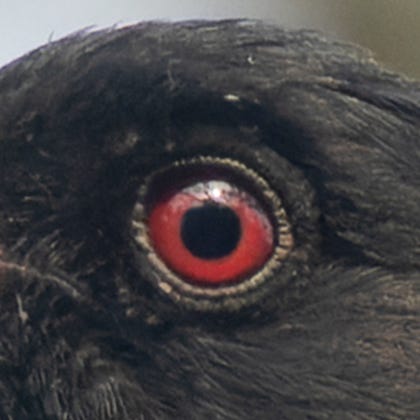
The eye belongs to a black-hooded oriole. Photo credit: Tisha Mukherjee — Wikimedia Commons.
Thanks for reading. For past editions, see the Archive. If you found it interesting or useful, please share and subscribe. If you want to get in contact, you can reach me at: thenaturebeat@substack.com.
Comments
Nothing yet. Say the first thing.
Sign in to join the conversation.