
A riddle for you.
What do these 40 words have in common?
Acorn
Adder
Almond
Ash
Beech
Blackberry
Bluebell
Bramble
Buttercup
Catkin
Conker (British term for buckeye)
Chestnut
Clover
Cowslip
Crocus
Cygnet
Dandelion
Fern
Hazel
Heather
Heron
Herring
Ivy
Kingfisher
Lark
Leopard
Lobster
Magpie
Minnow
Mistletoe
Moss
Mussel
Nectar
Newt
Otter
Ox
Oyster
Panther
Pasture
Willow
Living things would be a good answer, but sadly that is not what binds them in this instance. About eighteen years ago, the Oxford English Dictionary editorial team decided to remove these forty words from the Junior edition to make room for technological terms. Oxford said that the 40 deleted words remained in an edition of the dictionary for children seven and older, but they determined that those under seven were in great need of techno definitions like “chatroom" and “database”, rather than “dandelion" and “otter”.
Does a six-year-old really use and need the definitions of blog, broadband, bullet-point and voicemail? What stories are you reading these children? Little Miss Wifi? Or How Mr. Piggly Makes a Power-Point Presentation? I am not in favor of these natural words being deleted from the dictionary for any age group, but in terms of a choice it would seem that a thirteen year old is much more likely to need the definition of broadband or blog than a five or six year old.
As far as one of the responses from the publisher implying that now fewer children live in rural and semi-rural environments (which I would argue isn’t even true), even if all children lived in urban settings, I can tell you from being raised in Manhattan that nature bursts through, even in the largest cities. Greens emerge from the cracks in pavement, flowers grow around the trees dotting sidewalks, Central Park (and other urban parks) are filled with plants like dandelions, clover, ferns and moss—just a handful of the words omitted from the Junior Oxford Dictionary.
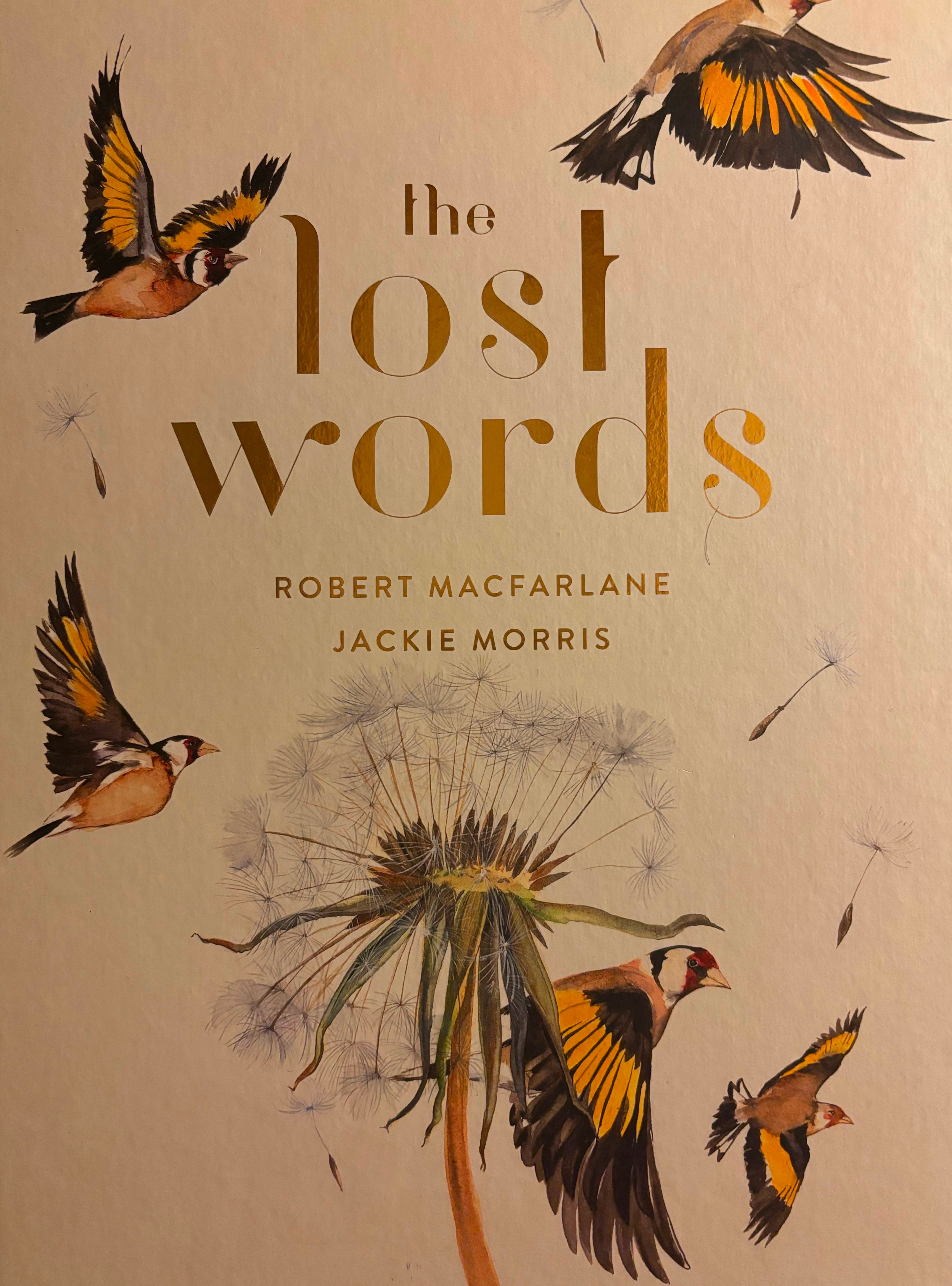
Fortunately, a group of authors, environmentalists and others, expressed their outrage about this omission of words, starting a much needed conversation about language and the interaction with our world. One of the results was a magnificent book, The Lost Words, written by Robert Macfarlane and Jackie Morris to conjure the power of some of the omitted words.
While The Lost Words has kept the issue alive, the conversation needs to stay front, center, and ongoing. As the media—social and news—is filled with what is considered “correct” language around human-centric issues of gender, sexuality and more, we are missing an essential topic of what attitudes and language we use for what water-scientist and author, Dr. Easkey Britton, calls our “more-than-human world.”
This entails far more than forty words being deleted from a children’s dictionary. This is about having our language and priorities reflect respect, appreciation and cooperation with the world and universe. Robin Wall Kimmerer beautifully expresses this in her seminal book, Braiding Sweetgrass. We are family, kin, not other or separate. In addition, we are utterly and completely dependent on this vast interconnected universe. All the myriad interactions, connections, and mechanisms that occur in every nano second (or less) in the depths of the soil, the abyss of the oceans, the vast sky and atmosphere, in the stars and heavens, as well as our bodies and that of our fellow creatures are wonders that affect the whole web of life. The dandelion, the stream, the acorn, the ocean, the otter, the almond and blackberry, the panther—all play out an infinite number of notes, as it were, in the symphony of the cosmos (whether they are listed in the dictionary or not).
Diminishing or omitting those words from references, is more than just bad judgement. It is an ominous portent of a fatal attitude. To raise children who do not know the words for living things and who not honor the reciprocal relationship with them stunts their understanding of life and handicaps them and the greater collective. We should be revering dandelions, not omitting them (literally and figuratively). We should be caring for all our water—from springs, wells, streams, rivers, oceans, and all the creatures that inhabit them—as if the water was our beloved grandmother, not a garbage dump.
As author Lucy Jones writes in Losing Eden, “We must move away from an extractive mindset, towards kindness, care and respect for other species.” And forming a new relationship with the Earth which “positions us not as conquerors, but co-tenants with wildlife and rivers and mountains and trees…” This must be reflected in our language and our actions. Further, we must learn that many plants and creatures we have been taught to fear or think are bad have gifts and benefits to us and the earth.
Children and all people need more exposure and experiences in the natural world, not less. Our minds and bodies benefit from immersion in the pulsing frequency of life—walking on sand and soil, submerging in water—both fresh and salt—feeling the sun on our skin, inhaling the aerosols of trees, flowers and plants. We should be fluent in the language and music of this world long before we learn the sterile techno world of disconnection.
Let’s embrace the “lost” words for ourselves and our children, and change our attitudes as well. These are not commodities to be written out of language or history. These are necessary for life. For thriving vitality. For joy and peace, for life on earth.
For more information:
Braiding Sweetgrass: Indigenous Wisdom, Scientific Knowledge and the Teachings of Plants, by Robin Wall Kimmerer
The Lost Words, by Robert Macfarlane and Jackie Morris
Resources about The Lost Words:
Ideas & Resources for The Lost Words
Explorers Guide to The Lost Words
Resource Guide for The Lost Words
Misunderstood Plant Tales, by Dorian Yates
Available now: Woad & Toad: A Misunderstood Plant Tale, by Dorian Yates
Upcoming: Dent-de-Lion: A Misunderstood Plant Tale, by Dorian Yates
Saltwater in the Blood: Surfing, Natural Cycles and the Sea’s Power to Heal, by Dr. Easkey Britton
Comments
Nothing yet. Say the first thing.
Sign in to join the conversation.