
In my last post on marginalia, we discussed Illuminated Lettering, its history and beauty, and Substack’s new drop caps. If you missed it, you might want to take a look.
We also focused on some specific examples of Illuminated Lettering. The Book of Kells incorporates large initial letters, fanciful drawings of people and animals, and Celtic knotwork. This form of marginalia is rooted in ancient history and features intricate woven patterns that symbolize the interconnectedness of all living things.

You already know that I was a little weirdo who learned calligraphy at the same time I was taught cursive and tried to teach my 3rd-grade classmates this elaborate handwriting for a quarter a lesson on the playground.
You also know that in my early 20s, I started trying my hand at illuminated lettering as an art form and a meditative practice.
What you probably don’t know is that in my late 20s, I ended up in Tempe, Arizona, with a 1/2 Italian, 1/2 Irish boyfriend from New York City who looked like he should have been planted in the kitchen of a pizzeria but instead worked as a bartender for an Irish pub.
The pub was unceremoniously stuck in a strip plaza with no foot traffic.
Sure, the crowds spilled out the door on St. Patrick’s Day or whenever Flogging Molly and the Dropkick Murphys played around the corner at the Marquee Theatre, but on ordinary Friday nights, the place was dead.
No amount of Cranberries or Pogues albums on the old jukebox was going to get anyone in there, except for maybe a Wednesday night dart tournament.
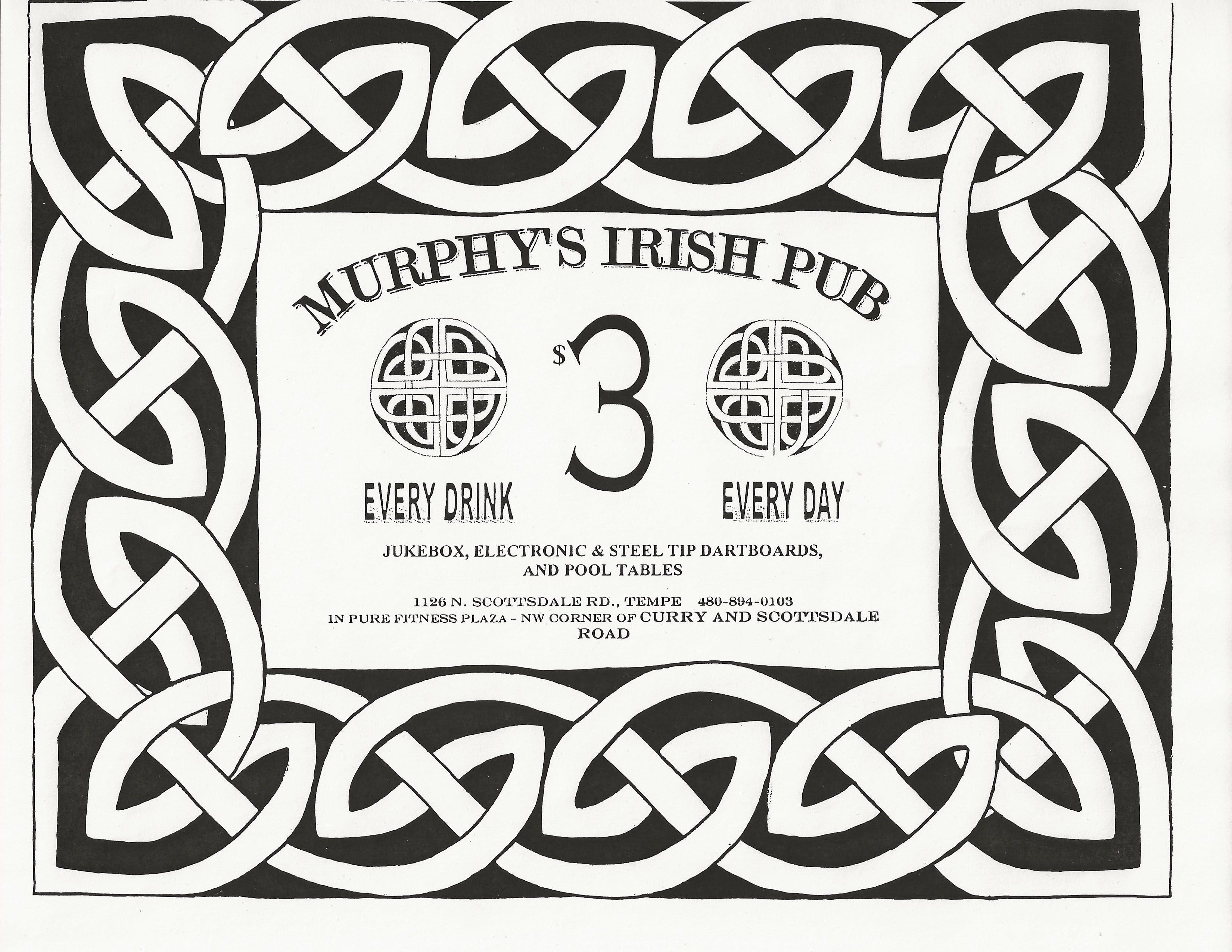
The owner wanted to put an ad in the local newspaper, so my boyfriend suggested the pub use my talents. Working full-time for an engineering firm I hated, I had abandoned my illuminated lettering years earlier. I just didn’t have the time to pull out gold leafing on the weekends while running errands and prepping my lunches for the week.
But a pencil and paper—I could handle that!
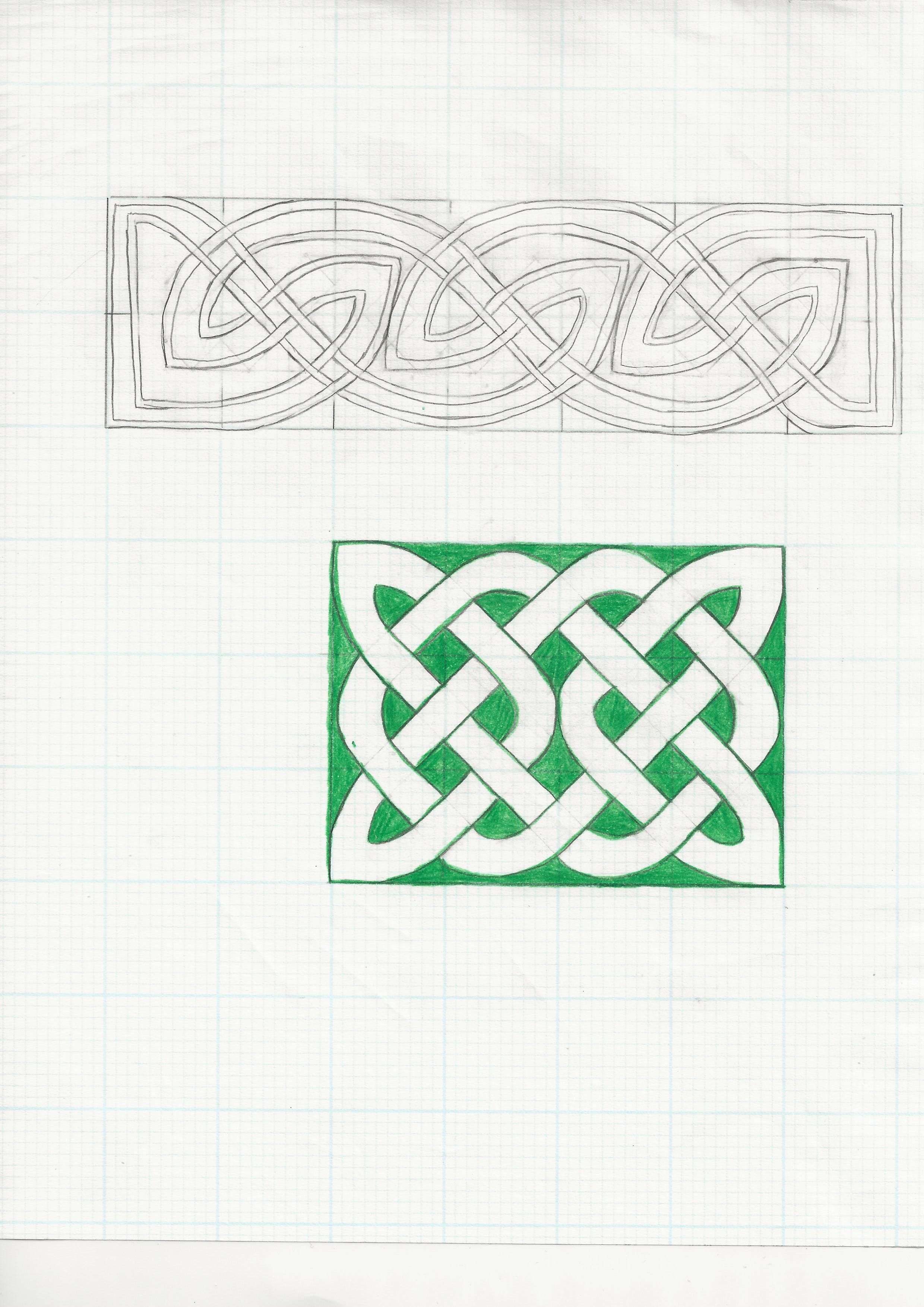
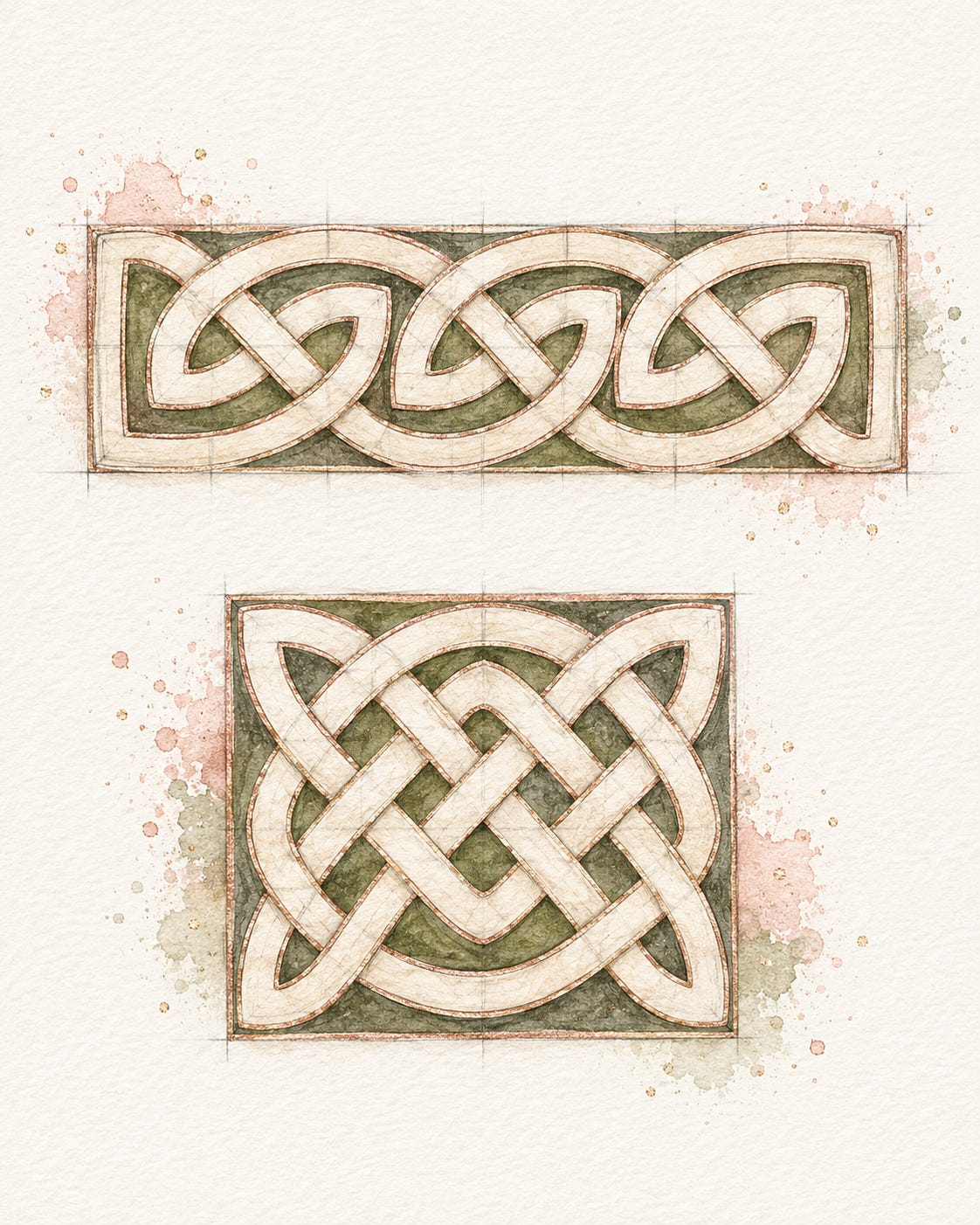
So, I started noodling with the structure of Celtic knotwork.
I was drawn to the geometry of laying down perfectly straight lines, many of which I would later erase, to work through the knotwork’s grid. This grid technique was as meditative as the lettering I’d previously mastered.
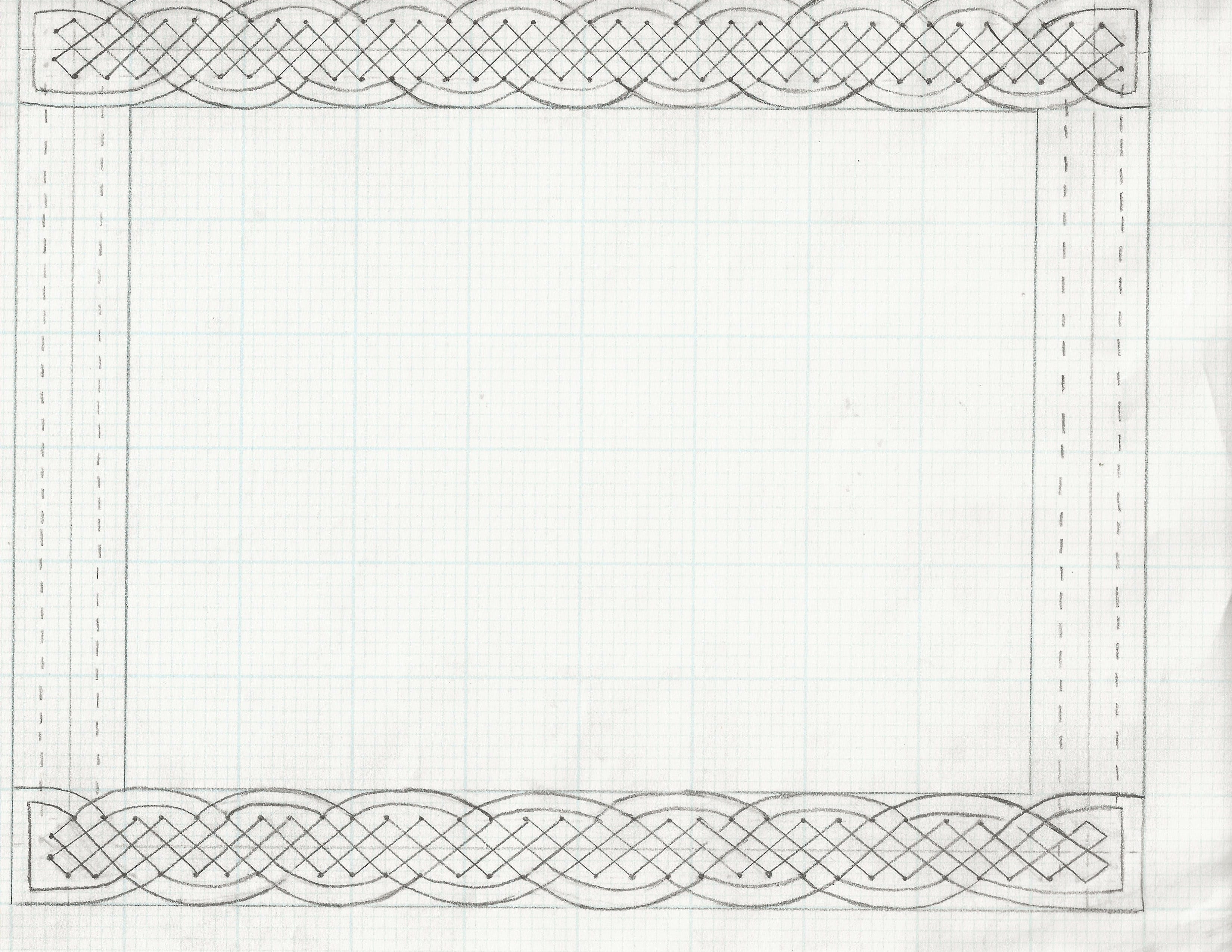
The pub included my knotwork in their small, nearly unnoticeable ad in the local paper. It was successful enough to bring in a trickle of new business, but the plaza eventually succumbed to an apartment complex that went up in its place.
I still think fondly of how that focused time drawing out the knotwork by hand taught me that my art had a purpose and a place. It gave me a reason to come home from my dreary job and make something real with my own hands.
But where does knotwork come from?
We can go back to the Book of Durrow, thought to have been created between 675 and 700 AD, which contains the four gospels of the New Testament.
In the video below, you’ll notice the drop caps with the giant first letter of the body of text, but here you get something even more. You’ll find detailed knotted patterns inside that main letter.
But knotwork isn’t found only in medieval biblical texts. It actually first appeared on stonework in pagan forms.
The even bigger mystery: Is this knotwork strictly Celtic?
As someone currently attempting to trace my family lineage, I’m not finding that this question can be answered straightforwardly. Instead, Viking, Celtic, Germanic, Anglo-Saxon, and even Roman history blended together into a stew on the British Isles. And much the same can be said for tracing the beginnings of knotwork. Its history is just as intricately entangled as the lines of its patterns.
But if you’re curious about it, this video speaks to the interweaving of that history.
In 2000, I took a trip to Ireland with my father and visited the Newgrange World Heritage Site, home to Neolithic monuments in Ireland’s Boyne Valley. Interestingly, these mounds, when viewed from above, bear a striking resemblance to the Etowah Indian Mounds here in Georgia.
The difference, however, is that at the entrance stone and inside the chamber of Newgrange, you find carvings of the distinctive triple-spiral pattern. These spiral patterns were thought to have been carved over 5,000 years ago and to predate the Celts by 2,500 years.
Despite not being clearly connected to one particular culture, the megalithic stone provides something far more important. Due to the way the stones were crafted, each winter solstice, a beam of sunlight breaks through an open area above the entrance at sunrise, casting light down to illuminate the chamber’s triple spiral.
And what could this spiral symbolize:
Cycles of Time: Life, death, and rebirth.
Cosmic Elements: Earth, water, and sky.
Spiritual Journeys: Mind, body, and spirit
So, while the true historical and cultural beginnings of knotwork may remain a mystery, these patterns have invaded the margins of many a manuscript for 1,300 years and stone work for much, much longer. Their appearance in texts as early as the 7th century, expounding upon the meanings found in those stone carvings, still speaks to us as truly timeless and human symbols.
Consider the interwoven patterns as a nod to the journeys we all must follow in life, which are intertwined with the journeys of so many others.
If you know any book lovers who’d like to know more about marginalia, send them this post:

If you need to be pointed in the right direction. Literally. The manicule is a symbol often found in the margins of old textbooks.
Follow the pointed hand to learn more. ☞
Marginalia
Manicules ☞
·
Jun 30
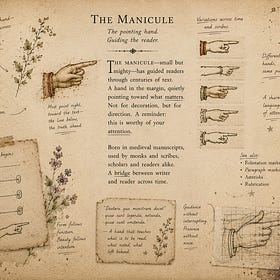
A manicule, for the uninitiated, is that little pointing hand that medieval and early modern readers drew in the margins of their books to flag a passage worth remembering.
Comments
Nothing yet. Say the first thing.
Sign in to join the conversation.