
This is part of Get Lost: The Accidental Curriculum of Roadside America, my ongoing series on the strange, kitschy, sacred, and occasionally fictional attractions scattered across the United States, and what they teach us about history and mythology. Read The Showman of the Springs here.
❦ This stop on the tour: Cherry Log, Georgia; Roswell, New Mexico; Jerome, Arizona (detour), and Point Pleasant, West Virginia.
Pull off the highway; the map won’t help you. Try not to worry if you lose time.

Last week, I introduced you to Newt Perry, the alligator wrestler who put Florida on the map and helped give underwater photography its rightful place in Hollywood with movies like Creature from the Black Lagoon.
The Creature, as you’ll recall, was a man named Ricou Browning in a $15,000 foam-rubber suit, swimming in the actual waters of Wakulla Springs.
But this week, we’re leaving Florida behind to look for creatures many swear are not just movie monsters but real beings in the US landscape.
A few months ago, on a quiet weekend, my family drove up to the small town of Cherry Log, Georgia, to visit a museum called Expedition: Bigfoot! The Sasquatch Museum.
It was early in the year, before we got back into our homeschool groove, and I wanted us to have a family adventure. That’s exactly the spirit of the Get Lost series. Your homeschool family doesn’t have to drive to the Smithsonian while filling out worksheets to make science and investigation real. Sometimes the real museum is in a metal building off Highway 515, run by people who take seriously what the rest of the world claims is fake.
Expedition: Bigfoot! is exactly that kind of place.
The museum is dedicated to cryptozoology—the study of animals whose existence has not been confirmed by mainstream science.
Just my cup of tea.
The big three, if you’re keeping score, are Bigfoot (North America), the Yeti (the Himalayas), and the Loch Ness Monster (Scotland). But there are dozens more, including: Mokele-Mbembe in the Congo. The Chupacabra in Latin America. The Yowie in Australia. And the Mothman in West Virginia.
What surprised me about Expedition: Bigfoot! was its earnestness. The staff is not winking at patrons from behind the counter and pointing to fake exhibits like they’re jokes. They present footprint casts, audio recordings, eyewitness reports, and the actual decades-long research record of people who have devoted serious time to investigating claims around Bigfoot.
They let us, the visitors, decide our own truths.
For homeschoolers, this works as a science project because it provides evidence, the gaps in that evidence, and the scientific method when applied to an open question.
That’s a full science curriculum.
The Bigfoot lore that’s most interesting and least prone to making cryptids a running punchline is the long tradition of stories in which Bigfoot helps.
In Indigenous North American traditions across many tribes, the figure variously called Sasquatch, Tsiatko, Stiyaha, Mesingw, and many other names is often a guardian of the forest. Not always benevolent toward humans, but not malicious by default either. More like a neighbor with rules.
In modern American folklore, the helper tradition shows up most powerfully in stories of lost children.
The most famous recent case: in January 2019, a three-year-old boy named Casey Hathaway wandered into the freezing North Carolina woods. He was missing for two nights in below-freezing temperatures. When searchers found him alive, he reportedly told his family that a bear had kept him company.
A bear.
In January’s below-freezing weather.
For the record: bears hibernate in January, and they do not generally appear out of hibernation to babysit toddlers.
Cryptozoology researchers and a fair number of folklore-minded folks who are not cryptozoologists note that this is not the first of such stories. The Bigfoot Field Researchers Organization keeps a running file of cases where lost children, especially small ones, are found alive after periods that should have killed them, and report having been kept warm and watched over by a large, hairy figure they called a “big monkey,” a “big dog,” or a “bear.”
The kindly, large creature watching over a lost child in the woods is one of the oldest and most universal stories our species tells. From the wolf who nursed Romulus and Remus, to the bear who raised the Inuit hero, to the lions who lay down with Daniel, we have always wanted to believe that the wilderness is not indifferent. If our children are lost without us, someone would be protectively keeping watch.
Bigfoot, in his most generous folkloric mode, is that someone.
My nine-year-old daughter Aurora has been exposed to Kate Bush thanks to her musical resurgence due to Stranger Things. My daughter’s never seen the TV show, but “Running up that Hill” has again become a staple on the radio, like it’s 1985. And that has led me to play all of Bush’s albums for her.
“Wild Man” is one of her favorite songs, the first single from Bush’s 2011 album 50 Words For Snow. A strange and beautiful pop song about a Yeti in the Himalayas.
The lyrics are written in the voice of a sympathetic narrator who has gone looking for the Wild Man there, has seen evidence of him, and is now trying to protect him from being found by other humans who would hunt and capture him.
“They will hunt you down,” Bush sings to the creature. “Then they will kill you.”
Aurora plays it on repeat and knows all the hard-to-pronounce names of the mountains in the lyrics. (Kangchenjunga. Lhakpa-La. Garo Hills. Tengboche Monastery.)
What Bush said about why she wrote the song should be the epigraph for every cryptid museum in America:
“In our contemporary world, things of mystery are even more precious than they were before the internet… I think it would be really terrible if that mystery was taken away from us, don’t you? It’s really important.”
It is really important.
We live in a culture that has Googled almost everything, with a world that has been mapped, satellite-photographed, biometrically cataloged, indexed, ranked, reviewed, and turned into a TripAdvisor entry.
The unknown is in retreat.
And in a culture like that, the cryptid is not a joke; he’s a sweet refuge.
The Bigfoot believer, the Mothman tourist, and the Yeti devotee are all, in their way, making the same argument as Kate Bush: some things should be allowed to remain hidden within woods that hold mystery, and some creatures should never be captured.
A few years ago, my family relocated from Arizona to Georgia in February.
I was wearing a heavy winter coat when we stopped for pasta at an Italian restaurant in Roswell, New Mexico.
Of course, I knew about Roswell’s history, but I was not prepared for how deeply the community there embraced its alien mythology.
I had imagined Roswell would be a town with one alien attraction, like a UFO museum, or maybe a souvenir shop or two, and would otherwise be a regular small American city.
Nope.
Everything is aliens in Roswell, New Mexico.
The streetlights have little alien faces. The McDonald’s is shaped like a flying saucer. The city's civic seal features an alien.
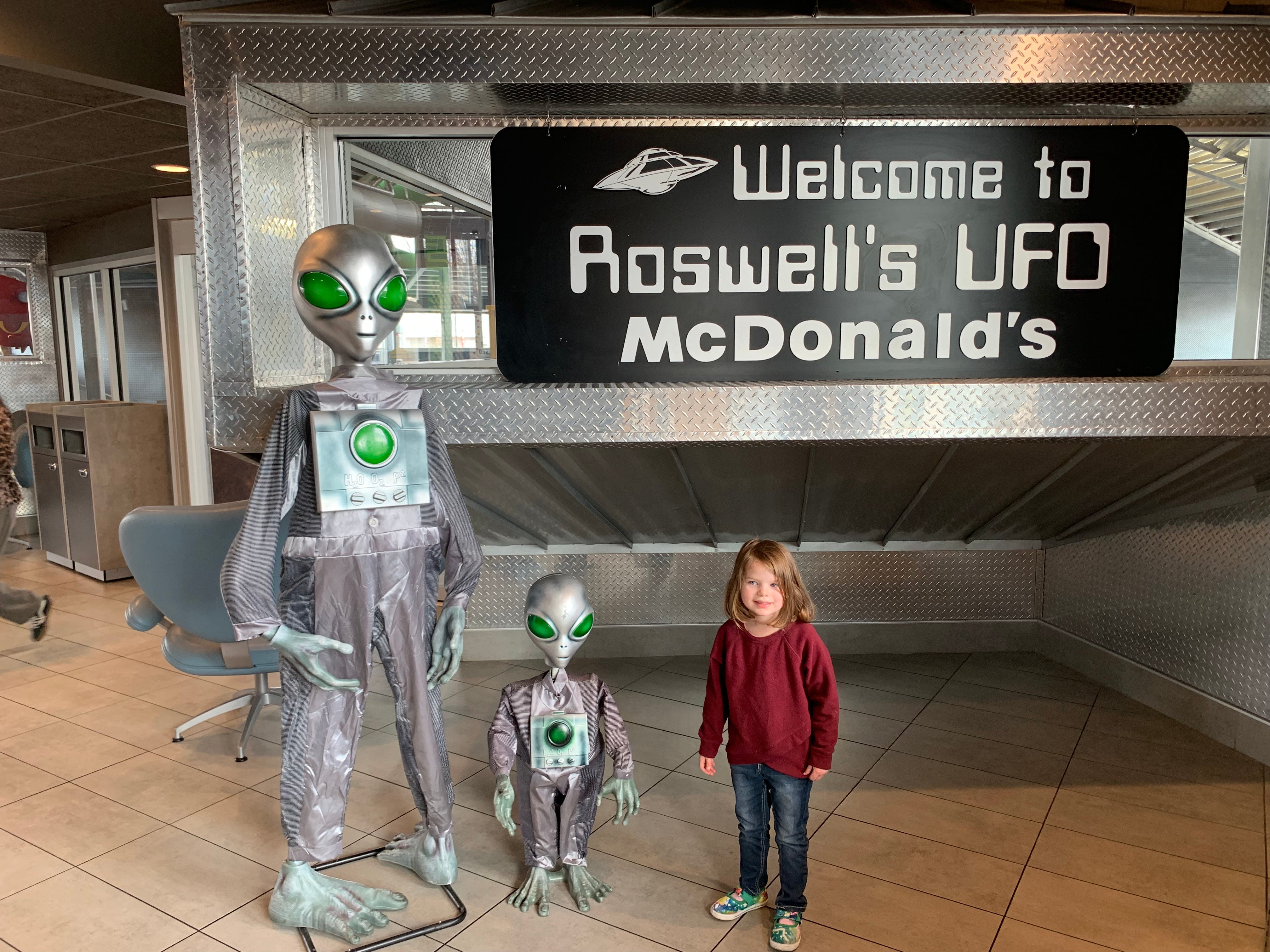
If you take Highway 285 north out of town, there is an installation of an entire extraterrestrial family stranded in a broken-down UFO on the side of the road, looking for a jump-start.
Somewhere around 1990, the entire town made an enormous collective decision to commit to the bit. But here is the wild thing: the famous 1947 incident that started all of this almost certainly was not aliens.
In June 1947, a rancher named Mac Brazel found unusual debris on his ranch about 75 miles outside Roswell. There were metallic sticks, foil reflectors, plastic, and a strange paper-like material. The U.S. Army Air Forces issued a press release announcing they had recovered a “flying disc.” The next day, they retracted their claim, saying it was a weather balloon.
The rumor died for thirty years.
Then, in 1978, a retired military officer who had been involved in the original investigation gave an interview claiming the debris was actually extraterrestrial. The story exploded.
In 1997, the U.S. military finally declassified the truth: the debris had belonged to Project Mogul, a top-secret Cold War atomic-espionage project involving 700-foot strings of neoprene balloons designed to detect Soviet nuclear tests. The reason the Army Air Forces had originally said “flying disc” and then quickly retracted was that the local officers genuinely did not know what they were looking at, and the project was so classified that even they hadn’t been briefed.
So not aliens. Atomic spy equipment, mistaken for a flying saucer, by people who weren’t allowed to know what they were really seeing.
But by 1997, none of that mattered.
By 1997, Roswell was an industry.
The International UFO Museum and Research Center was already there. The McDonald’s had already taken its spaceship form. The town’s economy had been restructured around the steady flow of pilgrims arriving to commune with the idea that something else had happened in 1947.
And the people of Roswell are so kind.
This is a thing I will never forget. We ate dinner at a small Italian restaurant in Roswell that February, and I left my big winter coat on the chair, but didn’t realize it until we were a state away.
When my husband called the restaurant because I was in a bit of a panic, the owner said yes, they had it, took my address, and shipped my coat to my new house.
A small business in a desert town that did not know me helped me get my coat back across the country in February. Did not charge me for the shipping and refused to let me pay them.
That is the Roswell I like to think of. Not the aliens. The owner of a local Italian eatery who is willing to take care of their patrons.
But the aliens are why the restaurant has tourists in February at all.
That is, in its way, also an alien story.
While we’re in the desert, let me mention one more strange place I love.
Jerome, Arizona, is a former copper mining town clinging to the side of Mingus Mountain. At its peak in the 1920s, it was one of the largest cities in Arizona. By the 1950s, the mines had closed, and the population had collapsed to almost nothing. Today, it is America’s largest ghost town, saved from total abandonment by an unlikely community of artists who moved in during the 1960s and 70s and decided this strange, vertical, half-empty town was worth salvaging.
The town’s most famous local oddity is the Sliding Jail, an old jailhouse that, due to decades of mine blasting altering the geology underneath it, has slowly slid 200 feet downhill from its original location.
A jail that ran for it.
But the part I want to mention is the lore. Jerome included a large number of miners who were Irish, Slavic, German, Italian, and Mexican. But some of the most notable miners during this period were of Cornish descent. And the Cornish brought with them a deep folklore of the Knockers (also called Tommy Knockers in American English).
Knockers are small, two-foot-tall, gnome-like beings — little people — who supposedly live deep in mine shafts. They dress in tiny miners’ outfits. Some traditions say they are the spirits of dead miners; others say they are an entirely separate folk who have always lived underground.
What Knockers do is knock on the walls of the mine before a cave-in.
The knocking is a warning. To tell humans that the world is not as stable as it looks. Or a way for the dead to look out for the living.
Miners who survived collapses often credited the Knockers with their survival. Miners would leave them food, small tokens, the crusts of their pasties. The folklore was so strong that some mines were eventually abandoned because their Knockers were perceived as malevolent and the men refused to keep working there.
I think about the Knockers a lot when I think about the cryptid impulse generally.
Because the figure is not frightening, not in its most generous form. The figure is looking out for us. The figure is a small, hidden, persistent reminder that we are not alone in our most vulnerable places, that the earth has voices, and that the wisdom of the dead is still trying to reach the ears of the living.
That is a theology dressed up as folklore.
Here is the stop on the tour we haven’t taken yet, but I’m eager to visit.
In November 1966, in a town called Point Pleasant, West Virginia, on the banks of the Ohio River, two young couples driving through an old World War II munitions site called the TNT Area reported seeing a creature.
It was about seven feet tall with red, glowing eyes and an enormous wing span. And it chased their car.
Over the next 13 months, more than 100 people in and around Point Pleasant reported sightings of what came to be known as the Mothman.
Then, on December 15, 1967, during the evening rush hour, the Silver Bridge connecting Point Pleasant to Gallipolis, Ohio, collapsed into the icy river below. A single eyebar failure. The bridge, the cars, and the people went straight down.
Forty-six people died.
The Mothman sightings stopped almost immediately.
The most enduring interpretation of the legend, popularized by the writer John Keel in his 1975 book The Mothman Prophecies and the 2002 Richard Gere film of the same name, is that the Mothman was not the cause of the disaster but a harbinger of it. A creature who appears before tragedy. A messenger from somewhere else, trying to warn the people.
In 2002, the town of Point Pleasant began the annual Mothman Festival.
The following year, sculptor Bob Roach unveiled a 12-foot stainless steel statue of the Mothman on Main Street. The Mothman Museum opened nearby. The town, like Roswell, has turned its tragedy and mystery into an identity. The 2026 festival runs September 19-20, with the museum open year-round.
My family has not been there, but we are so eager to go.
We saw advertising for the Mothman Museum and Festival at Expedition: Bigfoot! in Cherry Log, and I have been holding it in the back of my head ever since.
A town that lost forty-six people on a December evening in 1967 has spent fifty-eight years asking what it was that was trying to tell them something was coming. The museum treats the disaster with real gravity.
What do we get from these creatures?
What message is Bigfoot, the Mothman, the Roswell aliens, and the Knockers in the mines trying to convey to us, humans?
I think a few things.
We get to be wonder-struck without embarrassment. A grown adult cannot, in 2026, easily say they believe in fairies. They can absolutely say they think Bigfoot might be out there and get a knowing nod in return. The cryptid is a culturally acceptable container for adult wonder in a culture that has largely outgrown its tolerance for the rest of the mythological menagerie.
We get to imagine the wilderness is not indifferent. Whether it’s a Sasquatch keeping a toddler warm in the North Carolina woods or a Knocker tapping on a mine wall to warn of a collapse, the cryptid lets us believe that the most dangerous places have attendants. That something is watching out for us, even in the dark.
We get to share a story. In a fragmented modern culture where almost nothing is held in common, cryptids are still collective property. A Bigfoot believer in Oregon, a Bigfoot believer in Florida, and a Bigfoot believer in Pennsylvania share a real, if unusual, sense of fellowship. The Mothman Festival draws fifteen thousand people every September who would otherwise never sit at the same table.
We get to give small towns a reason to keep existing. Roswell, Point Pleasant, Cherry Log, and Jerome are not big cities. They are places whose industries have left or whose populations have dwindled. The cryptid economy is what kept some of them alive. Diamond Lil and Newt Perry would absolutely understand.
And we get to keep some mystery in a world rendered flat and flavorless. Kate Bush is right; the mystery is more precious now than ever.
The cryptid is the modern American version of the woods our ancestors couldn’t see into. It is the edge of the map. It is the place we have agreed, together, not to fully colonize with knowledge.
We need that.
Even when we know it isn’t entirely real.
Podcasts
Sasquatch Chronicles — long-form interviews with people who claim Bigfoot encounters. Approached earnestly; good for older kids and teens.
Bigfoot and Beyond with Cliff Barackman and James “Bobo” Fay (from the show Finding Bigfoot). Hosts treat the subject with affection and rigor.
Our Fake History, episodes on Bigfoot and on Mothman. Sebastian Major’s approach pairs perfectly with the framing I used in the Fountain of Youth piece.
MonsterTalk — a more skeptical, science-minded show on the same subjects. Pair with a believer-oriented podcast for actual critical thinking practice.
Books and TPT resources for kids
In Search of Sasquatch by Kelly Milner Halls — picture-book format introduction to cryptozoology. Good for ages 8–12.
TPT has solid Cryptozoology and Scientific Method lesson plans for grades 5–9, including Bigfoot-themed scientific method exercises that introduce concepts such as apophenia (the tendency to perceive patterns where none exist) and pareidolia (seeing faces in random visual data). These are real curriculum concepts that kids will use for the rest of their lives, and the cryptid frame makes them stick.
Bigfoot Field Researchers Organization (bfro.net) — the closest thing to a comprehensive sightings database. Use it the way you’d use any primary source: read it, examine it, and ask what kind of evidence it actually constitutes.
Music
“Wild Man” by Kate Bush. From 50 Words For Snow (2011). Have your kid memorize the names of the Himalayan mountains in the lyrics. They will retain them forever.
Places to put on your map
Expedition: Bigfoot! The Sasquatch Museum, 1934 Highway 515, Cherry Log, GA. A short drive from Atlanta. Worth a day trip.
International UFO Museum and Research Center, 114 N Main St, Roswell, NM. The flying saucer McDonald’s is a few blocks away.
Mothman Museum, 411 Main St, Point Pleasant, WV. Festival every September.
Jerome State Historic Park, Jerome, AZ. Go for the ghost town; stay for the Knocker lore.
When we left Roswell, Aurora had a green stuffed alien she had picked out at the UFO Museum gift shop. It is still her favorite stuffed animal.
He is a small fabric reminder that the map still has miles we can travel.
There are the stories I want my daughter to inherit. They are not factual in the way my aquifer infographic was factual. But they’re doing truth work of a different kind.
I have some things to attend to over the coming weeks that will reduce the time I have on Substack. When I’m back, I’ll be turning toward what I’m calling The Mystery Curriculum, a more sustained, deliberate exploration of how I teach my daughter to inhabit the unseen and the unverified parts of the world.
If the Get Lost series was about the strange places humans have made, the Mystery Curriculum will be about the strange place the world itself is and the ways we must learn how to look at it.
The map is open.
We’ll meet on the next page.
❦ If The Narrative Nest benefits you as a home educator, but you aren’t ready for a paid subscription, consider making a small donation to help me continue my work ❦

If you know a kid who loves Bigfoot or a homeschool parent looking for cryptozoology curriculum, send them this piece:
The Get Lost series is on a brief pause. The Mystery Curriculum will begin soon. Thank you, as always, for traveling along.
Comments
Nothing yet. Say the first thing.
Sign in to join the conversation.