
In Vivaldi’s Winter, a figure warms by the fire and crunches his way across the ice.
In Autumn, peasants celebrate the harvest and hunters chase their prey.
In Spring, shepherds dance to a bagpipe under a blue sky.
In each case, a person moves through a scene Vivaldi is painting.
Summer does something different.
There are vivid musical descriptions of summer’s heat, birds, and a storm, but the music also turns inward and settles on what one lonely shepherd fears, and what his body experiences.
That change, from painting a world to painting a human interior, is what makes this concerto unlike the other three. Once you are aware of the deeper meaning of the music, your understanding and enjoyment will be enhanced.
Composer: Antonio Lucio Vivaldi
Full title: Violin Concerto No. 2 in G minor, Op. 8, RV 315, “L’estate” (”Summer”), from Il cimento dell’armonia e dell’inventione (”The Contest Between Harmony and Invention”)
Nationality: Italian (Venetian)
Year composed: Composed roughly between 1718 and 1723, while Vivaldi was working in Mantua; published in 1725 in Amsterdam as part of Op. 8
Historical musical period: Baroque
Common name: Summer, the second concerto in The Four Seasons
Musical Morsel: When Vivaldi published Summer in 1725, he wasn't premiering a brand-new piece. In his dedication to Count Wenzel von Morzin, he explains that these concertos had already "long enjoyed the indulgence" of the count's favor, meaning Morzin had likely been hearing them for years before the rest of the world did.
Sotto dura stagion dal sole accesa
Langue l’huom, langue ‘l gregge, ed arde il Pino;
Scioglie il cucco la voce, e tosto intesa
Canta la tortorella e ‘l cardellino.
Zeffiro dolce spira, ma contesa
Muove Borea improvviso al suo vicino;
E piange il Pastorel, perché sospesa
Teme fiera borasca, e ‘l suo destino.Under the harsh season, scorched by the sun,
man languishes, the flock languishes, and the pine burns.
The cuckoo unleashes its voice, and as soon as it is heard,
the turtledove and the goldfinch sing.
A gentle breeze blows, but suddenly
the North Wind rises to challenge its neighbor.
And the little shepherd weeps, because overhead
he fears the fierce storm, and his fate.
As with Winter, Autumn, and Spring, Vivaldi paired this concerto with a sonnet. The lines above belong to Movement I, and everything in this movement traces back to them directly. If you’ve read my articles on the other 3 seasons (links at the end), you already know how closely Vivaldi ties his music to these words. Summer is no exception. What’s different is where the sonnet’s attention ends up by the time this movement closes.
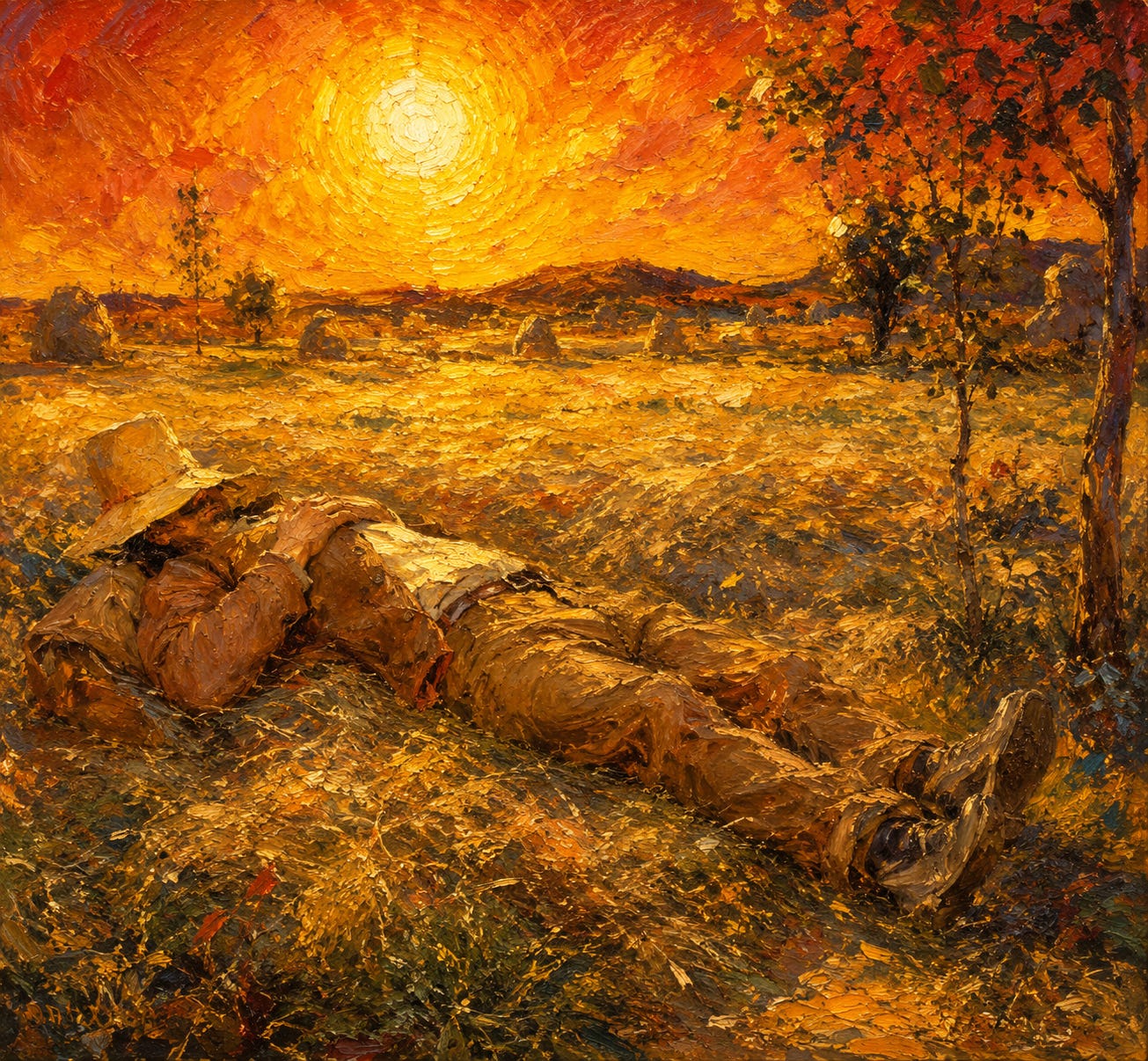
It begins with the season itself, not the shepherd yet. Before any named character enters the picture, everyone and everything is already worn down by the heat: man languishes, the flock languishes, the sun scorches, and even the pine tree burns. If you want an image to hold in your mind while you listen, Van Gogh’s The Harvest, painted in a single day under what he called the burning noonday sun outside Arles, captures something close to what Vivaldi is describing in sound: a landscape saturated with heat, work continuing anyway because it has to.
Musically, this opening is a ritornello, the recurring orchestral refrain that will return, shortened and varied, throughout the movement. The full ensemble enters together, all seven voices moving as one weighted body, and the melody keeps sagging downward rather than climbing. The short phrases “droop” and give up rather than assert themselves. It’s Vivaldi’s picture of paralysis, bodies too worn down by heat to do anything but languish.
Then the sonnet’s mood lifts, and so does the music. A solo violin steps forward with a bright, two-note call, the cuckoo’s voice, and a turtledove and goldfinch join in, trading birdsong back and forth. A gentle breeze moves through, warm and calm - but don’t get used it. For a little while, Summer sounds like the other three concertos in this series, nature simply being observed and enjoyed.
But that’s exactly when it turns.
The North Wind rises to challenge the breeze, and the music turns with it. Smooth lines are replaced by wide, unstable leaps. This is where the sonnet’s real subject finally appears: not birds and not wind, but a person. The little shepherd weeps, afraid of the coming storm and what it might mean for him. The dynamics drop to a hush, and then the full ensemble slams back in at forte with no warning. The wind makes good on its threat.
This is the hinge the rest of the piece depends on. Everything before this line is still Vivaldi painting a world. The shepherd’s fear is Vivaldi painting a person inside that world, and once that shift happens, it doesn’t reverse. The movement ends not in relief but in foreboding, setting up the far more literal storm still to come.
Many people who listen to this piece will interpret it in different ways. I would like to offer an analogy of my own, perhaps to enrich your thoughts about a deeper meaning in this music:
Heat is already wearing you down, and you’re stretched thin by something ongoing: a hard season at work, a strained relationship, a body that hasn't felt right in a while. You're not in crisis yet. You're worn down in a specific way: the grinding fatigue that settles in only after enduring something for too long. Then you look up and see the storm: the next thing coming, unmistakable, still a distance off but closing in. You know exactly what it is and exactly that you can't stop it. That's the shepherd. Picture the shepherd this way: already worn thin by the heat, watching a storm form on the horizon, with no shelter to run to and no way to make it pass any faster. I have been there, and I would venture to guess you have been there too.
N.B. - I purposefully use music vocabulary that you may not be familiar with in an effort to help you expand your understanding. You may want to look up some words. Don’t forget - I’m an educator through and through. 😊
0:00
-9:09
Toglie alle membra lasse il suo riposo
Il timore de’ Lampi, e tuoni fieri
E de mosche, e mosconi il stuol furioso!The fear of lightning and fierce thunder,
and the furious swarm of flies and horseflies (or gnats and flies),
robs his tired limbs of their rest.
This is the middle section of the same sonnet, and it’s the shortest with just three lines. Everything about this movement is smaller and tighter than Movement I. Where the opening movement had room to breathe, an orchestra’s worth of texture, a ritornello returning again and again, this one strips almost everything away.
There is no ritornello here at all, no recurring theme for the music to circle back to. Instead, the solo violin carries one long, drooping melodic line above a hushed accompaniment in the lower strings, the same kind of falling shape heard in Movement I, but now with nowhere to resolve. The whole movement stays in G minor without a single modulation, not even a brief lean toward a warmer key, which many slow movements of this era would offer as a moment of relief. Vivaldi withholds that relief on purpose. There is no harmonic escape here, just as there is none for the man the sonnet describes.
Four separate times, without warning, this fragile, quiet line is interrupted. The tempo suddenly doubles, the dynamic snaps from piano to forte in the lower strings, and just as suddenly it’s gone again. This is thunder, arriving as a jolt rather than a gradual swell, each interruption landing a little more abruptly than the last because the listener never gets the chance to fully settle before the next one hits. Underneath it all, some of the faster figuration in the accompanying voices is often heard as literal flies and horseflies, buzzing around a body too exhausted to fend them off. Instead of giving us a cadence or coda, Vivaldi just ends it with the flies still buzzing.
Interpretation:
You understand this situation well, even if you’ve never lain awake in a field like a shepherd. You finally get horizontal, finally close your eyes, and just as your body starts to loosen, something jolts you back: a noise downstairs, a thought you can’t put down, or an incoming text that lights up the room. You settle again. It happens again. Each time it’s smaller, but each time it costs you a little more, until you’re not really resting at all, just lying still between interruptions, waiting for the next one. That's the shepherd: a body and a mind trying to rest before the storm even arrives, but denied that rest again and again.
0:00
-5:56
Ah che pur troppo i suoi timor son veri.
Tuona e fulmina il ciel e grandinoso
Tronca il capo alle spiche e a’ grani alteri.Ah, his fears prove all too true.
The sky thunders and flashes lightning,
and hail cuts the heads from the proud standing grain.
This is the sonnet’s final section, and it doesn’t describe a new threat. It confirms an old one. The storm the shepherd feared in Movement I, the one he could see building on the horizon, has arrived exactly as he dreaded it would. There’s no more waiting now. Only weathering it.
Musically, this movement breaks from the pattern the first movement set up. Movement I built itself around a true ritornello, that recurring orchestral refrain returning again and again between the soloist’s episodes, each one tied to a different image from the sonnet. Movement III doesn’t work that way. It’s essentially one continuous storm rather than a structure built from a recurring theme, and it never gives the listener a clean, fully restated homecoming to hold onto. What it does have are a few ritornello-like gestures borrowed from that same vocabulary: the opening material briefly resurfaces around the movement’s midpoint, buried inside the ongoing chaos, and later the full ensemble returns with the character of the very opening measures, close to a true return but never quite settling into one. Even the music itself seems to be reaching for something familiar and stable to hold onto, and not quite finding it. Rather than varying a returning theme, Vivaldi keeps the storm moving forward, relentlessly, glancing backward only now and then.
Twice, the storm briefly parts. The full ensemble drops away almost entirely, leaving a single cello and a bare bass line under the soloist, marked “1 Solo” and “tasto solo” in the score, meaning even the harpsichordist plays only the bass line, no chords filling in above it. These are the barest, most exposed moments in the whole concerto, brief clearings that never last. Each time, the full ensemble slams back in at forte with no warning, and the storm resumes exactly where it left off.
It ends the way it began. The movement stays forte to its final bar, in the same anxious key that opened it, offering no relief or release of tension. G Minor holds all the way through, the same key of dread the piece opened in an entire concerto ago. The storm doesn’t pass. It simply reaches its final measure and stops, still raging, and closing precisely where it started.
Interpretation
Remember the storm you saw building on the horizon back in Movement I, while you were already worn down by the heat? This is what it feels like when that thing you saw coming finally arrives. You don’t get a warning anymore. You don’t get pauses to catch your breath, only two brief openings before it closes back in on you. And when it’s finally over, there's no lesson waiting on the other side, just the fact that it happened and you're still standing. Vivaldi is telling a human truth here. Some “storms” that you have to face don't resolve, and you just come out the other side of them, having endured.
0:00
-6:15
If you made it through the storm with the shepherd, thank you for spending this time with Vivaldi, and with me. Understanding what’s actually happening in a piece of music, from the heat and the fear to the thunder that never quite resolves, is what turns listening into something richer than background noise. That has always been the goal here: to help you hear this music the way it was actually meant to be heard.
If you’re new to this publication, the other three concertos in The Four Seasons are waiting for you:
Autumn: Introducing: Classical Music Video Listening Guide #1, Vivaldi’s “Autumn”
Winter: Unlocking Vivaldi’s Winter: A Chilling Masterpiece That Warms the Soul
Spring: Vivaldi’s Spring: How Nature Was Turned Into Music
And if this kind of close, patient attention to classical music is something you want more of, a paid subscription helps make it possible.
Researching and writing each of these guides, along with building the audios or videos that go with them, takes real time, and that work exists because I believe classical music isn’t a relic to be preserved behind glass. It’s part of our heritage, and heritage only survives if each generation learns it and hands it forward. Every subscriber makes that possible, and I’m grateful for every one of you willing to help carry it.
Thank you for reading, and for caring enough about beauty to give it your time.
Fondly,
~ The Music Goddess
Share Our Heritage of Classical Music

No posts
Comments
Nothing yet. Say the first thing.
Sign in to join the conversation.