

“They do not love that do not show their love.”
—William Shakespeare, The Two Gentlemen of Verona
There is a kind of heartbreak that arrives with no standing to grieve. A woman can know the contents of a man’s childhood, the exact register of his voice before he has had his coffee, the names of everyone who has ever disappointed him, and still not know whether she is, to him, anyone in particular. She occupies the interior of his life with the social rank of a stranger. When it ends, if a thing that was never defined can be said to end, there is no one to notify. It is hard to announce the collapse of a structure only one person could see.
The vocabulary for this keeps multiplying: the situationship, the talking stage, the undefined thing. That kind of proliferation is usually a sign that a culture is describing an experience faster than it can explain it. We have built an entire lexicon for relationships that provide the sensations of intimacy while withholding its commitments, and we have built it because the arrangement has become ordinary. What has not become ordinary is the honesty required to notice who is doing the building.
I came to this conclusion honestly late and reluctantly. On my most recent trip to Phoenix to see my family, I admitted the aha! moment I had found in my reflections to my sister that I had spent years avoiding: I was not a discerning dater in my twenties and it wasn’t any better in my early 30’s. I had a habit of overexplaining, I was an over-functioner and, when sufficiently interested, a private investigator of male ambiguity. I could build an entire emotional case from a good-morning text, a vulnerable conversation, and the fact that he had remembered something I said a few weeks earlier.
The problem was not that I initiated. I have never been one to actively initiate and also there is nothing inherently undignified about expressing interest, planning a date, or sending the first message. The problem was that I did not allow his response to become information. If he failed to reciprocate, I compensated. If he became inconsistent, I became more understanding. If he offered ambiguity, I supplied an explanation. I had no standard for how consistently a man needed to show up, no boundary around how much access he could receive, and no point at which insufficient effort disqualified him. I did not lack desirability. I lacked a threshold. Interest alone was enough to make me available.
I mistook this availability for openness. I called it being loving, patient, and easygoing. In reality, I was making myself compatible with whatever a man was willing to offer. I did not ask whether the arrangement met my standards because I had not yet learned that having standards meant being willing to lose anyone who could not meet them.
My particular mistake was believing that effort could create meaning. If I planned the evenings, sustained the conversation, asked the thoughtful questions, remembered the details, and made myself emotionally indispensable, perhaps the relationship would eventually become as significant to him as it already was to me. I was conducting a one-woman orchestra of intimacy and mistaking his presence in the audience for participation.
It is easy, in a room full of women, to arrive at the comfortable verdict that men have simply gotten worse at dating. I have delivered that verdict myself. But the fuller truth is less flattering to all of us. Women are fluent in our own emotions and famously intuitive about others’ and yet we routinely misread the men we are pursuing, particularly the ones who meet our standards. A man can be attractive, accomplished, and seemingly compatible; give us a thimble of attention, and we begin pouring an imagined marriage into a connection too small to hold it. A daily good-morning text becomes proof of devotion. We cast him as the father of our children before he has decided whether he wants to see us on a Saturday night.
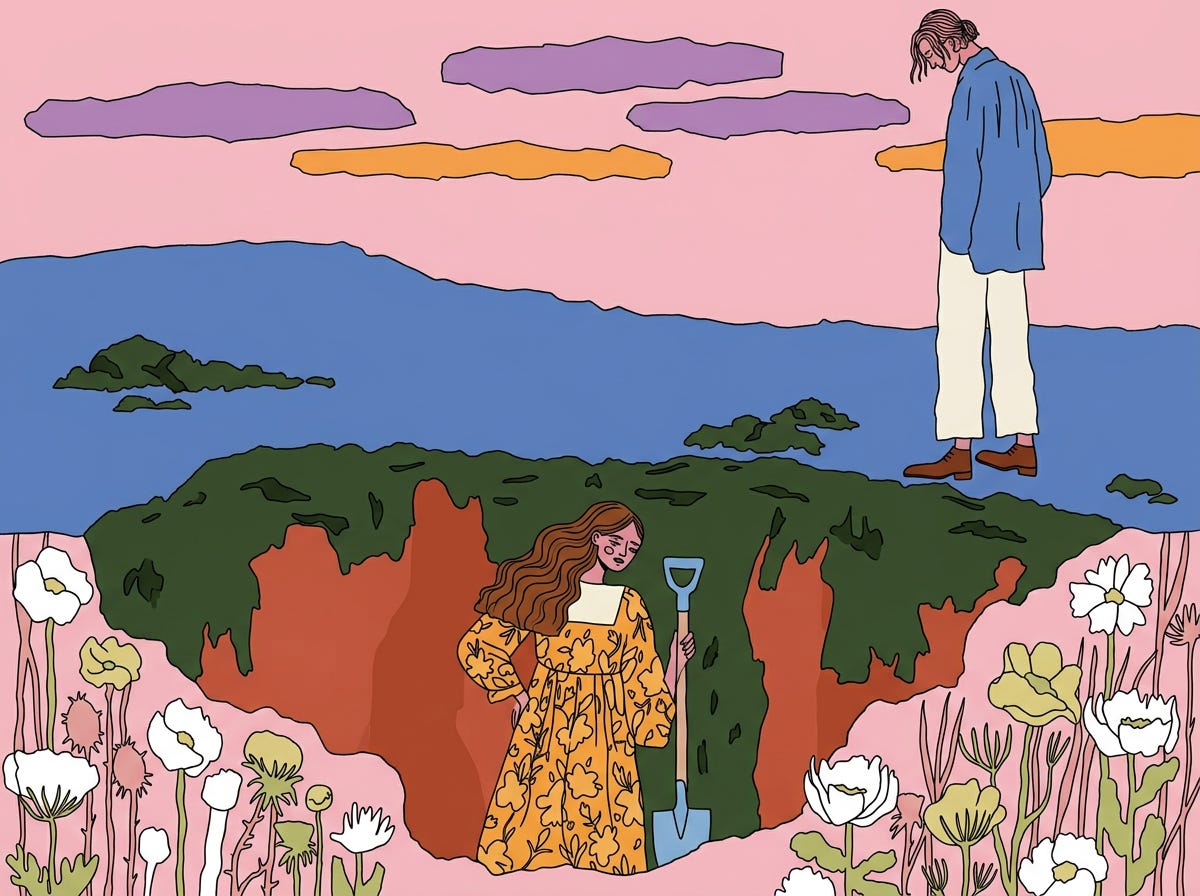
The problem is not that we feel too much. It is that we build too much, and too early, before discovering whether anyone is building beside us.

Modern relationships are increasingly formed in practice before they are acknowledged in language. Two people can develop the routines, access, and emotional dependence associated with a relationship while leaving its meaning and responsibilities unspecified. They may behave like a couple without ever making the mutual decision to become one. You made yourself exclusive before the relationship became mutual.
Consider everything a man who prefers ambiguity can receive without deciding anything at all. He can have constant communication: the good-morning text, the occasional call, and the running conversation that makes two people feel like a unit long before they become one. He can have physical intimacy without the conversation that would give it a name. He can have domestic and emotional access within a relationship that remains permanently and conveniently undefined. A woman may track his moods, absorb his stress, remember his sister’s birthday, and keep a toothbrush at his apartment without ever knowing what she means to him. You became emotionally dependable to someone who remained relationally undecided. You gave him the privileges of certainty while living with the anxiety of ambiguity. He can receive all of this within a culture that instructs women to be available but undemanding, present but never pressing, and “easy to be with” precisely to the degree that we decline to ask what any of it means.
Reality television has turned this contradiction into a recurring marriage plot. On shows such as Love Is Blind and Married at First Sight, the same asymmetry appears again and again. (Yes, I watch a lot of reality TV, it’s my guilty pleasure!) A man withdraws affection, avoids difficult conversations, disappears for days, or retreats to his own apartment, yet each act of disengagement arrives with an explanation: the accelerated timeline, unresolved family conflict, or some private difficulty he is not prepared to discuss. The woman often interprets these explanations more generously than she interprets his behavior. She keeps translating inconsistency into complexity. She uses the attention he offered at the beginning to construct a story capable of surviving his withdrawal in the present. In this story, he still loves her, still intends to marry her, and still wants the relationship as urgently as she does. He retains the status of a fiancé while performing little of the labor required to become a partner. The program presents the discrepancy as romantic suspense. What it actually reveals is how long the appearance of commitment can survive after the practice of it has disappeared.
The point is not that men are villains for benefiting from ambiguous arrangements. The point is that modern dating makes those arrangements so easy to sustain. One person can live as though a relationship exists while the other merely enjoys its atmosphere. Intimacy is being created, but commitment is never mutually established.
You can furnish an entire relationship that the other person only visits.
What follows is an examination of why we become attached to relationships we largely constructed ourselves, and how to stop offering intimacy before reciprocity, clarity, and trust have been established.
Comments
Nothing yet. Say the first thing.
Sign in to join the conversation.