Mike Thornton | The Multiplier · The Multiplier | Retirement Income with Options
The Multiplier is an educational approach to building retirement income by selling covered calls and cash-secured puts on quality stocks you own or want to own, alongside dividends and short-term Treasuries, with the goal of funding retirement spending from income rather than by selling down your principal.
If those two terms are new to you, here is the whole idea in plain English.
A covered call means you collect a cash fee today for agreeing to sell shares you already own at a higher price than today’s.
A cash-secured put means you collect a cash fee today for agreeing to buy a stock you want at a lower price than today’s.
Every obligation here is fully covered from the start. No margin, no borrowing, no naked positions. That is what makes selling options the conservative side of the options market, and it is a real distinction.
Why the skill of selling options matters for your retirement
Most retirees have one plan: save enough, then sell shares slowly to live on. That plan worked when bonds paid 5% and lifespans were shorter. It does not work as well now.
Selling options gives you a second income stream from the same portfolio.
If you’re new to this approach, I explain the reasoning in detail here:
Every Sunday, I publish the same type of review.
What we closed and how much income was actually locked in. What we rolled, and whether it was done for credit or debit, and why. What we held, and what we’re watching going into the next week.
Because if you strip it down, selling options comes down to three decisions you repeat over and over: hold, close, or roll.
Learning when to do each using rules is skill we learn here.
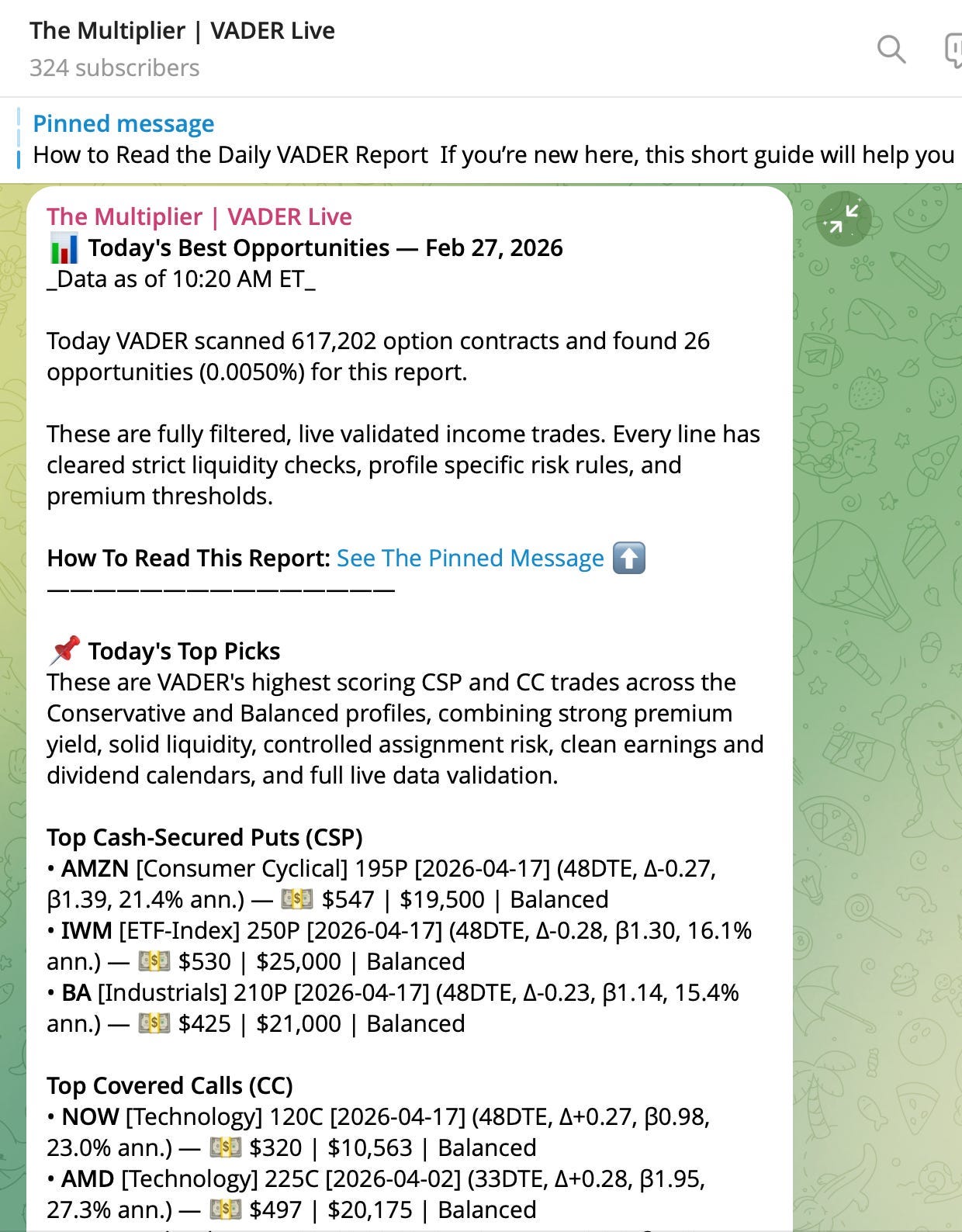
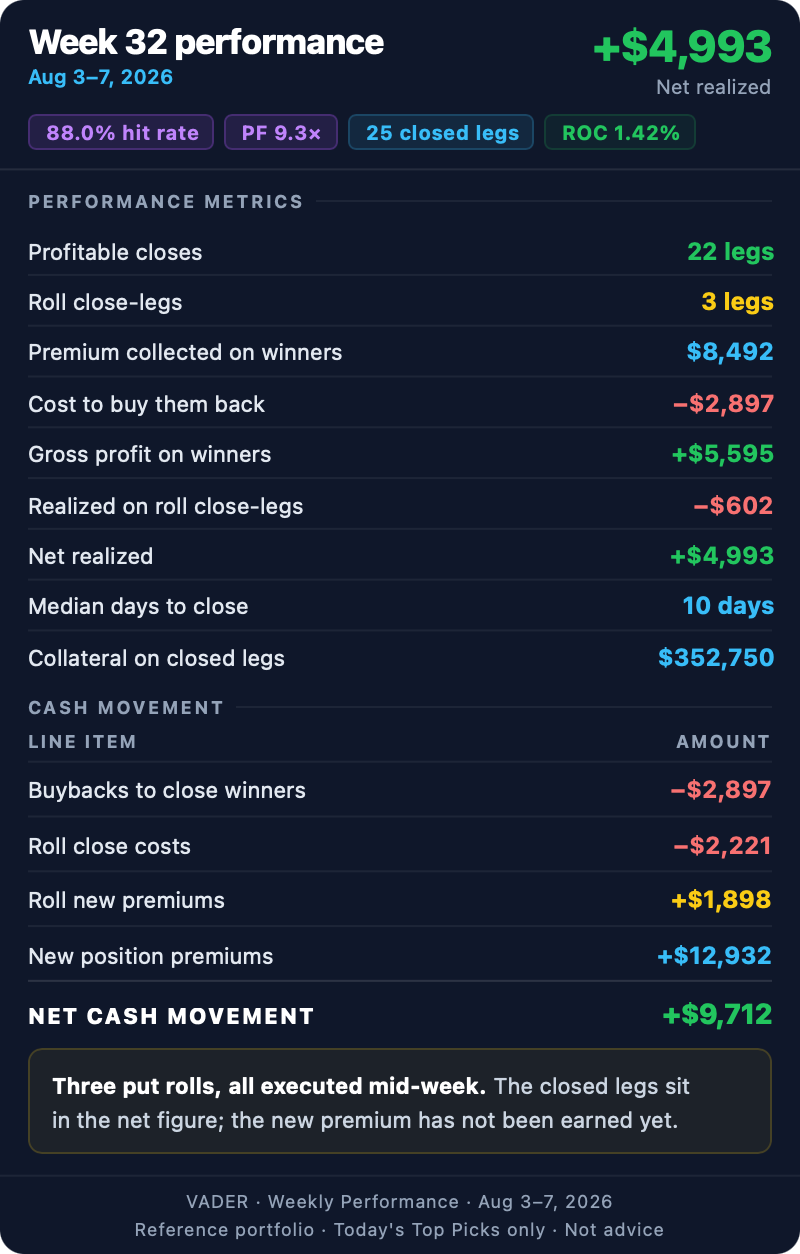
This week, the system generated $4,993 in realized profit from 25 closed positions - all picked by VADER, my proprietary algorithm that scans 500,000+ option contracts daily and surfaces only the top 0.005% of income setups.
Premium members receive those setups in real time, Monday through Friday, in the private Telegram channel.
This is what it looks like:
And then on Sunday, we review the results of VADER trades, explain the decisions, and map out what to do next with open positions.
There is no risk in giving it a try. Join today and use the full system for 60 days.
You can cancel the subscription anytime.
If at any point during those 60 days you decide it’s not right for you, email ‘refund’ to mike@themultiplier.co. I’ll process it within 24 hours, no questions asked. You keep everything you’ve learned.
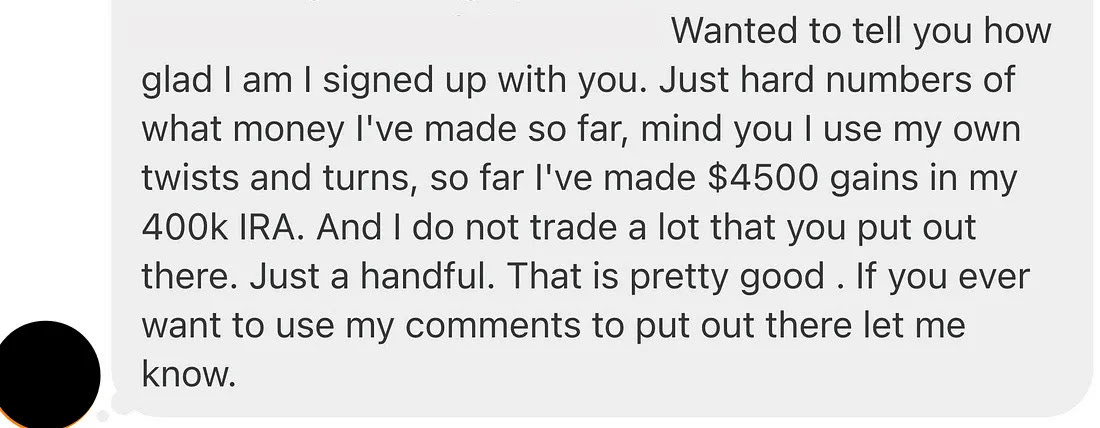
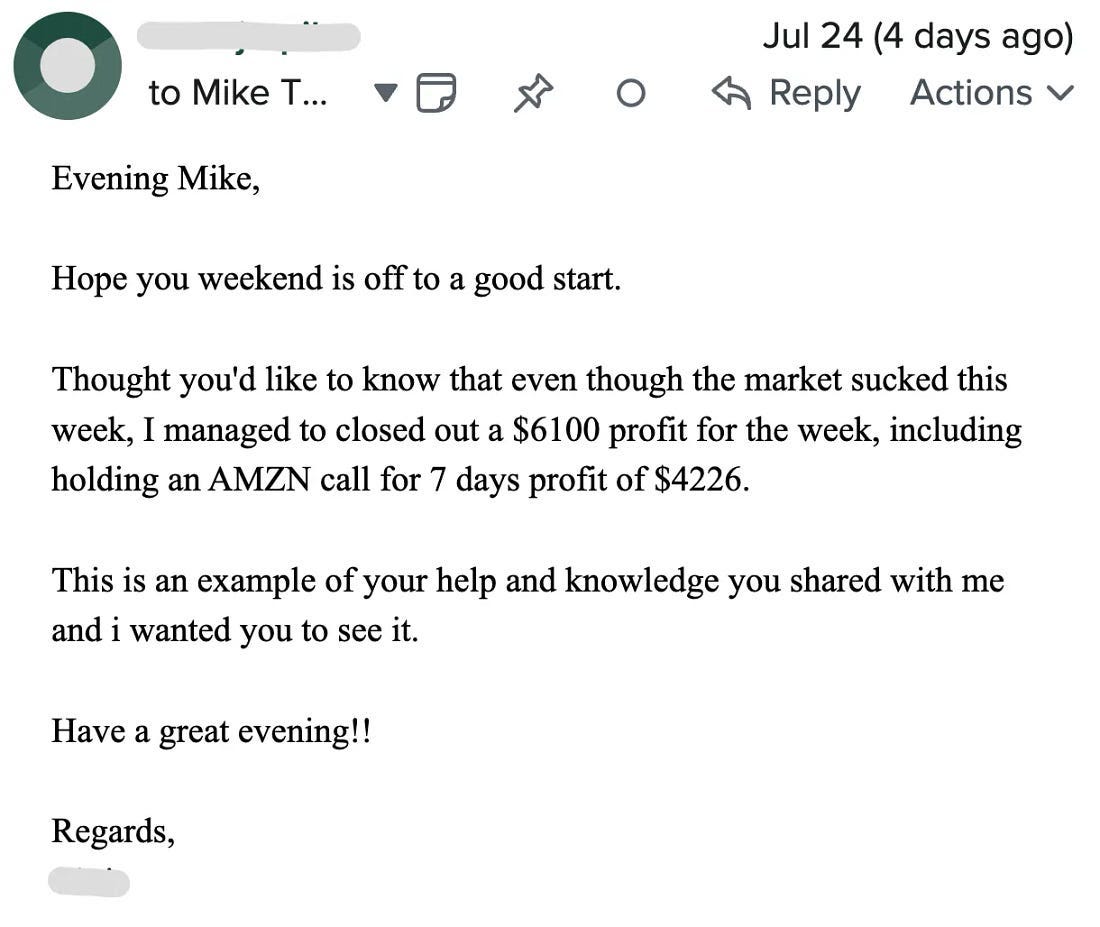
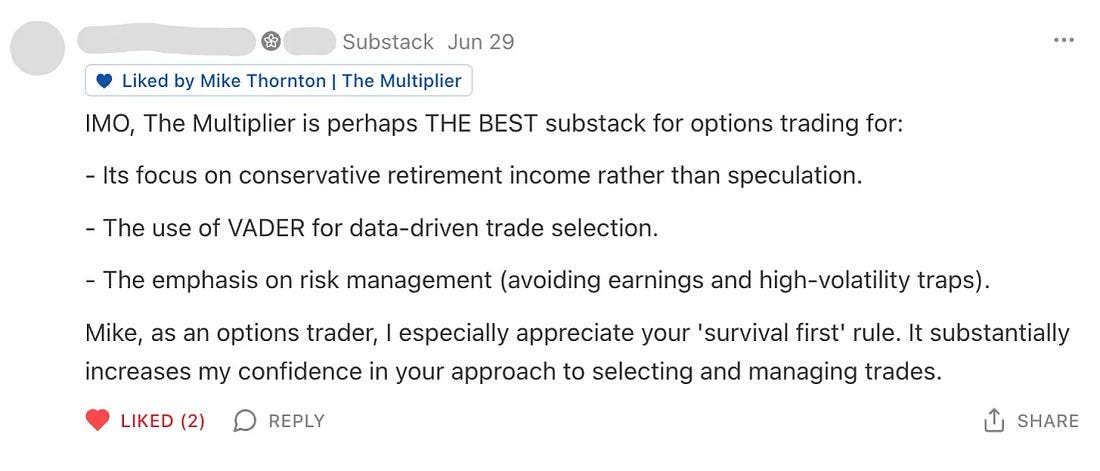
The Multiplier is a Substack Bestseller. 420+ people have already upgraded, and you can read their feedback below.
Reply to this email if you have any questions. If you are reading this on the web, you can reach out to me in DMs or at mike@themultiplier.co
What to do when the stock blows straight through your covered call strike. Twenty-three of our calls went in the money this week. Buying them all back on Friday would have cost $26,077. We spent none of it, and the reason is a rule you can apply to any call you have ever sold. This is the whole issue.
The one calculation that decides whether a call-away was good or bad. It takes ten seconds, it uses a number only you have, and almost nobody does it before selling the call.
Why a call sold barely 5% out of the money survived the best week since April. The thing that actually decides whether your strike gets taken, and it is not the market.
How to score a roll when the first leg lost money. Five lines including the loss, in a format you can copy onto your own trades. Plus the honest part: this roll turned out not to be needed.
Let’s start with the numbers.
$5,595 came in from the 22 positions closed for a profit and $602 went back out on the three roll close-legs, which is the $4,993 headline.
How I count this
A close for a profit counts as a win.
A roll close leg counts as a loss, and it sits in the denominator. That is why the hit rate is never 100% in a week with rolls.
An assignment counts as neither. It is a transition, and the shares carry their own basis forward from there.
The headline number is net of all of the above.
Twenty-two of the twenty-five legs that closed made money, an 88.0% hit rate, and half of them were done inside two weeks.
That second number matters more than the first. Collateral back in ten days goes to work again this month. Collateral tied up until October does not.
One thing about that red zone before we go on. A covered call goes red as soon as the option costs more to buy back than it was sold for, and a rising stock does that long before the strike is reached. Plenty of them are red while still sitting below their strikes.
That mark is also only ever half a covered call. What you see is the option leg, and the shares underneath moved the same week in the same direction.
New to this? An option is in the money when exercising it would be worth something to the person who bought it. On a call you sold, that means the stock is trading above your strike. On a put you sold, it means the stock is below your strike. In the money is not the same thing as losing money, and this week is the clearest illustration of that difference you are likely to see.
“Do I need a $300,000 account to do this?”
No. The collateral figure above covers 25 positions running at the same time, built up over months. One cash-secured put ties up the strike times 100 and nothing else. The smallest position in the book right now needs $3,250. Eight of them sit under $6,000.
One position is a complete version of this strategy. Everything after that is repetition.
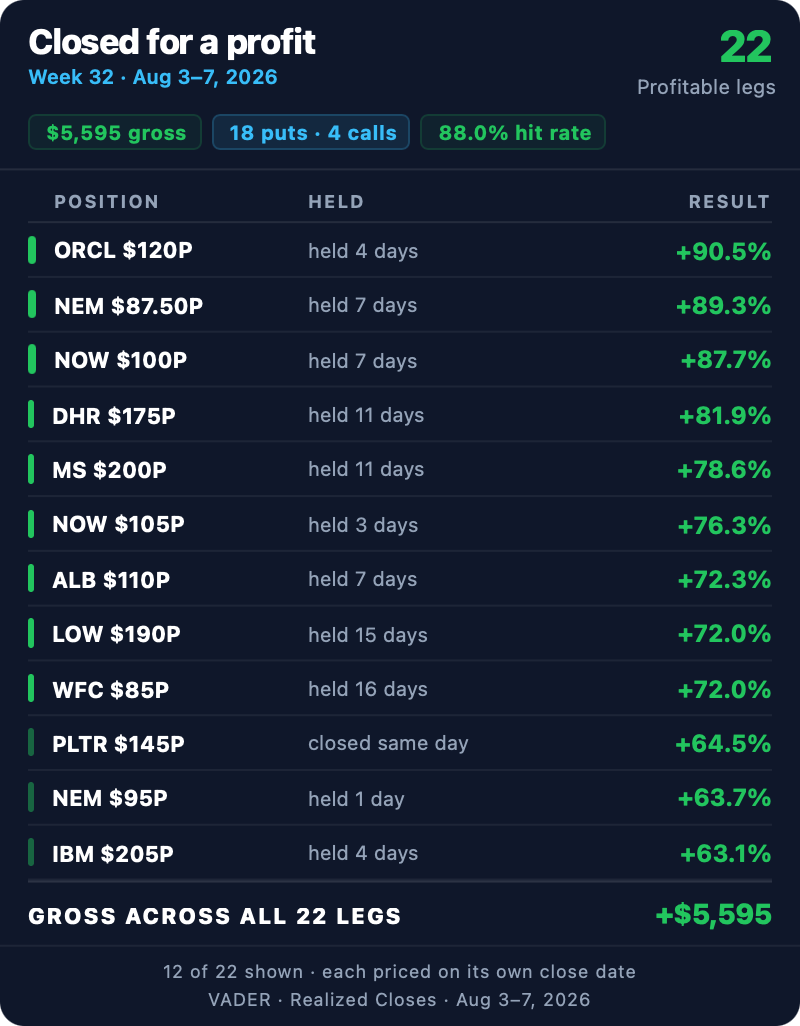
Eighteen of the 22 profitable closes were cash-secured puts. Every major index printed its low in the first hour of Monday and never went back, and when the market runs away from your put strikes that fast, the puts do all the work while you stay out of the way.
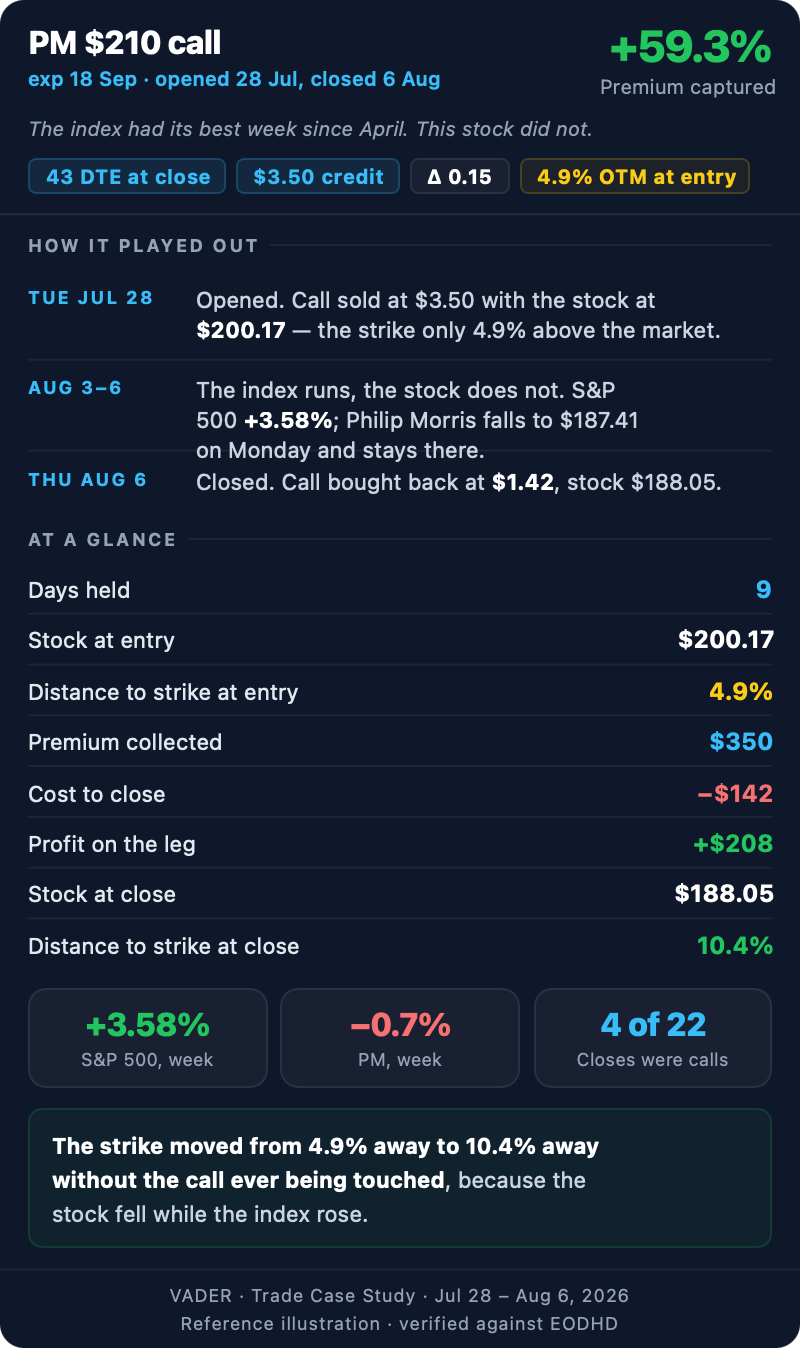
Only four covered calls closed for a profit this week. One was a Philip Morris $210 call: we sold it in late July for about $3.50 a share and bought it back on Thursday near $1.40. Just under 60% of the premium in nine days.
That strike was not far away. Philip Morris traded near $200 that day, so the ceiling sat under 5% above the market, close enough to lose the shares in an ordinary week.
Then the strongest rally since April arrived, the S&P 500 rose 3.58%, and Philip Morris went down. It finished the week near $190, further from the strike than when the trade started.
One of you asked in the comments this week about the upside you give up when you sell a call above the market. Here is the answer in one trade.
A covered call is paid by the stock standing still, not by the index behaving. Philip Morris sat out the strongest week since April and a strike less than 5% away was never threatened. The same 5% strike on a semiconductor name was through by Wednesday.
“How do I use the covered call picks if I don’t own the shares?”
You don’t, and you are not meant to yet. A covered call needs 100 shares sitting in your account, which is why the picks come in two kinds.
Start on the put side. Sell a cash-secured put on a stock you would be content to own at that strike. Most of the time it expires and you keep the premium. Sometimes the stock falls through and the shares arrive, and that is the moment the covered call picks start applying to you.
The two halves are one loop. Everybody starts at the put end.
Turn Your Retirement Accounts Into a Real Income Plan
Consider becoming a premium member for $299/year or $49/month.
Every morning, VADER (a proprietary, multi-step screening system) scans ~500,000 option contracts and filters down to the top 0.005%.
You get the best covered call and cash-secured put setups daily (Mon–Fri).
Read more here:
We rolled three positions this week, all of them puts, and did all three mid-week rather than on Friday.
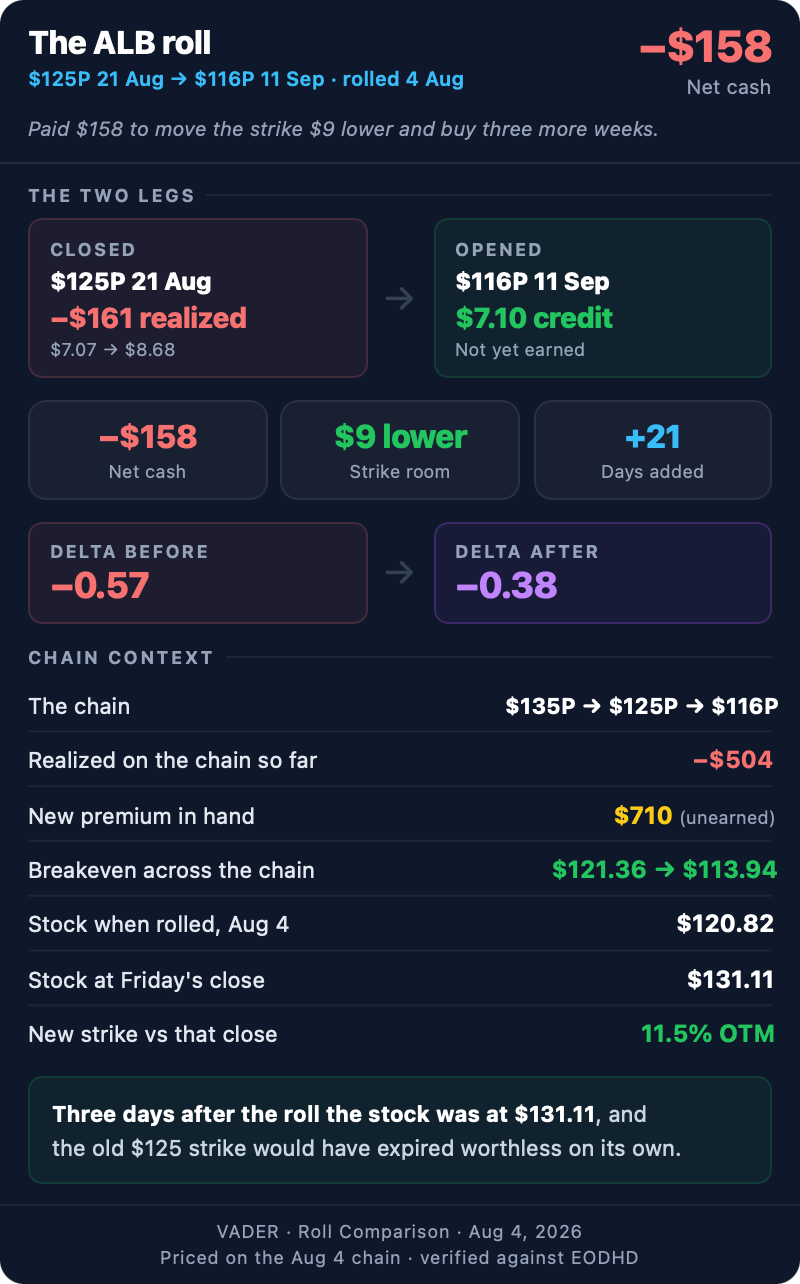
On Tuesday, with Albemarle trading near $121, we closed an August $125 put and opened a September $116 put in its place, taking the strike down $9 and buying three more weeks.
How this roll is scored
Premium collected when the position opened: $707
Debit paid to close that leg: $868
Realized on the closed leg: a loss of $161
New premium collected on the replacement leg: $710, not yet earned. It has to decay before any of it becomes profit.
Cash on the chain so far: a realized loss of $504 across both closed legs. What has to happen from here: Albemarle stays above $116 into September 11, the $710 decays to nothing, and the chain finishes around $206 in the black.
That chain started in June at $135 and has come down to $116 across two rolls, each step costing real money on the leg being closed.
Here is the uncomfortable part. Albemarle closed Friday at $131.11, up more than 8% from where we rolled on Tuesday. The old $125 put would have expired worthless on its own.
So the roll booked a $161 loss on the leg we closed and took $158 out of the account on the day, for protection that turned out three days later not to be needed. That is what insurance looks like almost every time you buy it.
A roll buys time and a lower strike, and it only pays off if the stock keeps going against you. Had Albemarle recovered on its own, holding the original put would have been worth more than rolling it. That is the trade: giving up part of the good outcome to make the bad one cheaper. It is worth making only while you still want to own the stock at the new strike.
Most rolls should collect a net credit. This one paid a debit, which is a higher bar, and only worth clearing when you would be content to own the shares if it goes the other way.
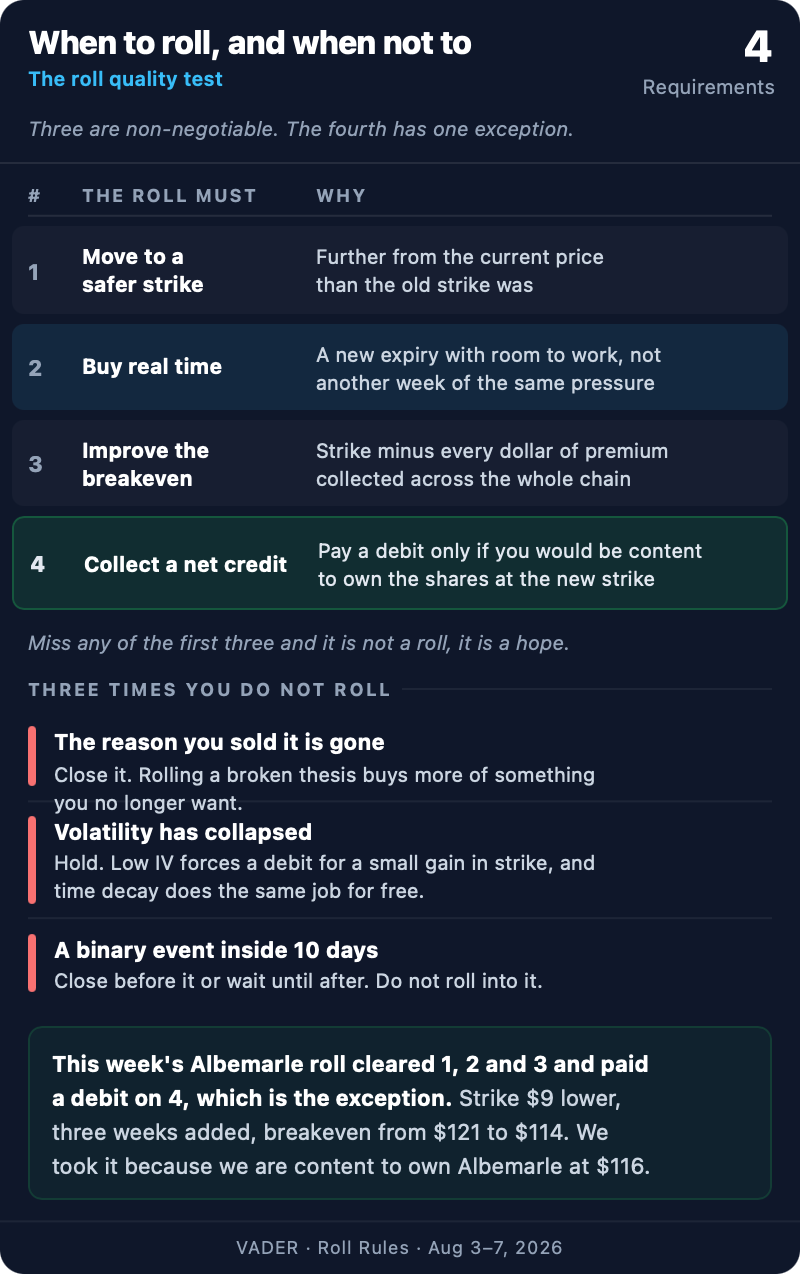
This is the part worth keeping. Three of these are non-negotiable. The fourth has exactly one exception, and knowing which is which is most of the skill.
A safer strike. The new strike sits further from the current price than the old one did.
More time. The new expiry gives the position room to work, not another week of the same pressure.
A better breakeven. Strike minus every dollar of premium collected across the whole chain has to move in your favor. If it moves against you, stop.
A net credit. You should be getting paid to make the adjustment. The one exception: pay a debit only if you would be content to own the shares at the new strike, and would happily sell that put today at that price. If the answer is no, the honest move is hold or take assignment.
Miss any of the first three and it is not a roll, it is a hope.
And three moments when you do not roll, whatever the numbers say.
The reason you sold it is gone. A guidance cut, a dividend cut, a downgrade that changed the business. Close it. Rolling a broken thesis buys more of something you no longer want to own.
Volatility has collapsed. Low implied volatility makes rolling expensive and forces a debit for a small improvement in strike. Hold instead and let time decay do the same job for free.
There is a binary event inside ten days. Earnings, a court date, a regulatory decision. Close before it or wait until after, but do not roll into it.
Tuesday’s Albemarle roll cleared the first three. The strike came down $9, the expiry moved out three weeks, and the breakeven across the chain improved from about $121 to about $114. It paid a $158 debit, which is the exception rather than the rule, and we took it because we are content to own Albemarle at $116.
The silver roll later in the week is the same test with a different answer on requirement four. We rolled an August $60 put out to October at $57, and the two legs almost exactly canceled, so no debit exception was needed. The closed leg still booked a $280 realized loss, and that loss is in this week's headline number. What the roll bought was delta down from 0.75 to 0.49 and a breakeven $5.73 lower.
Nothing was assigned or called away this week. One position resolves this coming Friday, and it carries the whole lesson of the issue.
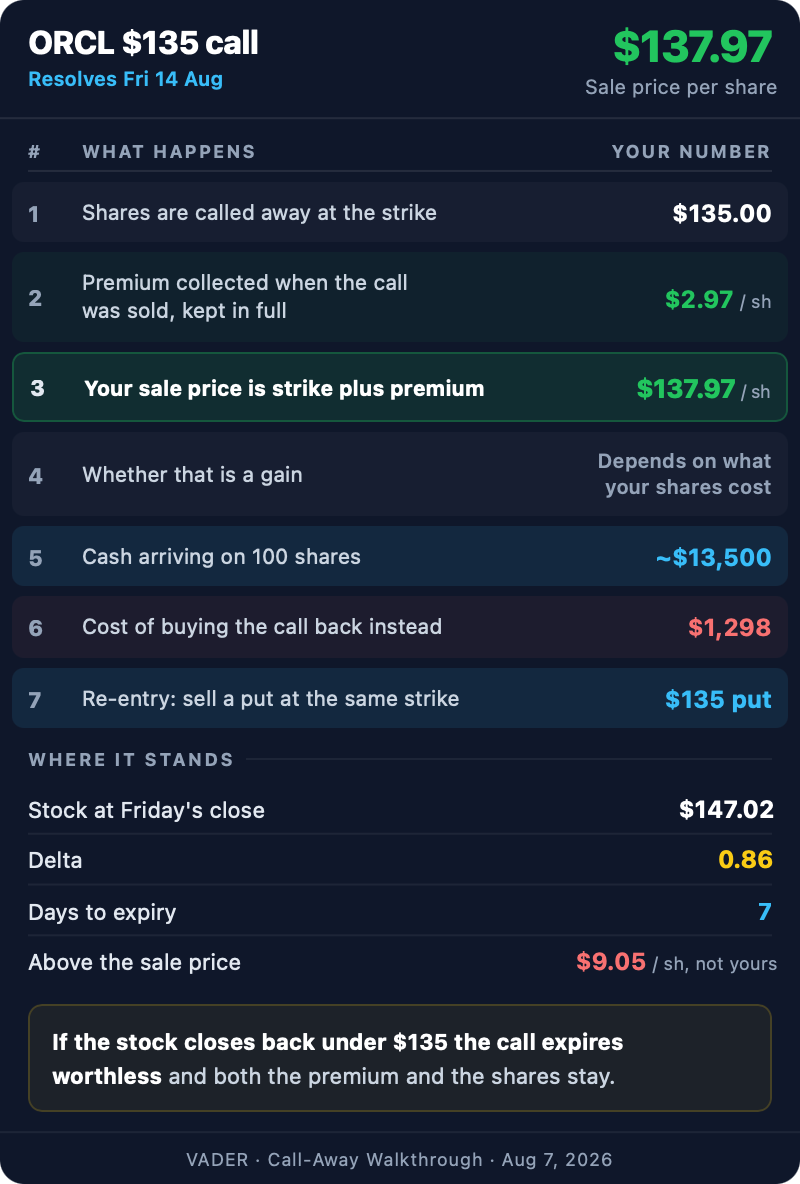
We hold an Oracle $135 covered call expiring Friday August 14, sold in late July for about $3 a share. Oracle closed Friday at $147.02, which leaves that call roughly $12 in the money with a delta of 0.86.
Buying it back would cost about $1,300. We plan to spend none of it and let the shares go at the strike.
The shares leave. If Oracle closes above $135 on Friday, 100 shares are called away at $135 and about $13,500 in cash arrives in the account on Monday.
What the sale is worth. The strike plus the premium collected on it. $135 plus roughly $3 is about $138 a share, and that number was fixed on the day the call was sold. Nothing that happened afterwards changed it.
The next trade. The re-entry is a cash-secured put at or near $135, which pays you a premium now and hands you the same shares back if Oracle comes down to that level. If it never does, you keep the premium and buy nothing.
Whether $138 is a good number. That depends on one thing: what the shares cost. Own Oracle from $120 and this is a gain. Come to it from an assignment in the $160s during a bad month and $138 books a loss, and no amount of premium changes that. Same trade, same $138, opposite outcomes.
If Oracle instead slips back under $135 before Friday, the call expires worthless, the premium stays, and so do the shares.
This is the question that comes up more than any other about covered calls. Your shares are underwater. Where do you sell the call?
Say the shares cost you $160 and the stock now trades at $147. Sell a $160 call and a call-away books no loss, which feels like the safe answer. You collect $4, the shares stay, and your cost drops to $156. So next cycle you sell a $156 call. Then a $152 call. You walk the strike down as the cost falls.
That feels like progress. It is treading water, and the arithmetic is worth doing slowly, because almost everyone gets this backwards at first.
Selling a call gives you one number that matters: the strike plus the premium you collect on it. That is the price you have agreed to sell at, and it is fixed the moment you place the trade.
Walk the strike down each cycle and that number never moves. When the shares finally go, the lower strike hands back every dollar of premium you collected getting there. The only money you keep is the last cycle’s.
Hold the strike still instead, and every one of those premiums is yours.
The strike is a ceiling. Let your cost slide underneath it. The gap between them is your profit.
One practical detail that catches people. Strikes trade in fixed increments, and further out they widen to five-dollar steps, so a $156 cost has no matching strike at all. Round up to the first listed strike at or above your cost, never down. Rounding down gives away the gap you are trying to build.
That rule has a hard edge, and it is better to meet it here than on your own screen.
If the stock has fallen a long way below what your shares cost, there may be no strike at or above your cost with a premium worth collecting. A $160 ceiling on a stock trading at $115 is not a trade. It is a listing with no bid.
You have two honest options and there is no third. Write nothing, wait for the stock to close some of the distance, and collect nothing in the meantime. Or sell a lower strike, take the income, and accept that if the shares go, they go below what you paid for them.
A covered call cannot rescue a position. It can only be paid for one.
That is why the lithium shares further down have no call written against them. The stock sits at $131 against a cost near $144, and nothing above $144 pays enough to be worth the ceiling.
Twenty-three of our covered calls went in the money during the rally. Buying every one of them back at Friday’s marks would have cost $26,077.
The premium already collected on those same 23 calls comes to $8,347, and all of it stays.
So the choice was to spend twenty-six thousand dollars keeping shares that had already run past the price they were promised at, or spend nothing and let them go at the strike as agreed. We spent nothing.
Notice what does not enter that decision. What the shares originally cost is money already spent, and it cannot make the buyback cheaper. The only question is whether you would pay today’s price for those shares today, while also handing over $26,077 for the privilege.
Paying to buy back a deep in-the-money covered call is buying back your own promise at the worst possible price. Let the shares go at the strike, take the strike plus the premium, and sell a put at the same level if you want back in.
Every position in these tables came from the Today’s Top Picks section of a daily report.

Comments
Nothing yet. Say the first thing.
Sign in to join the conversation.