
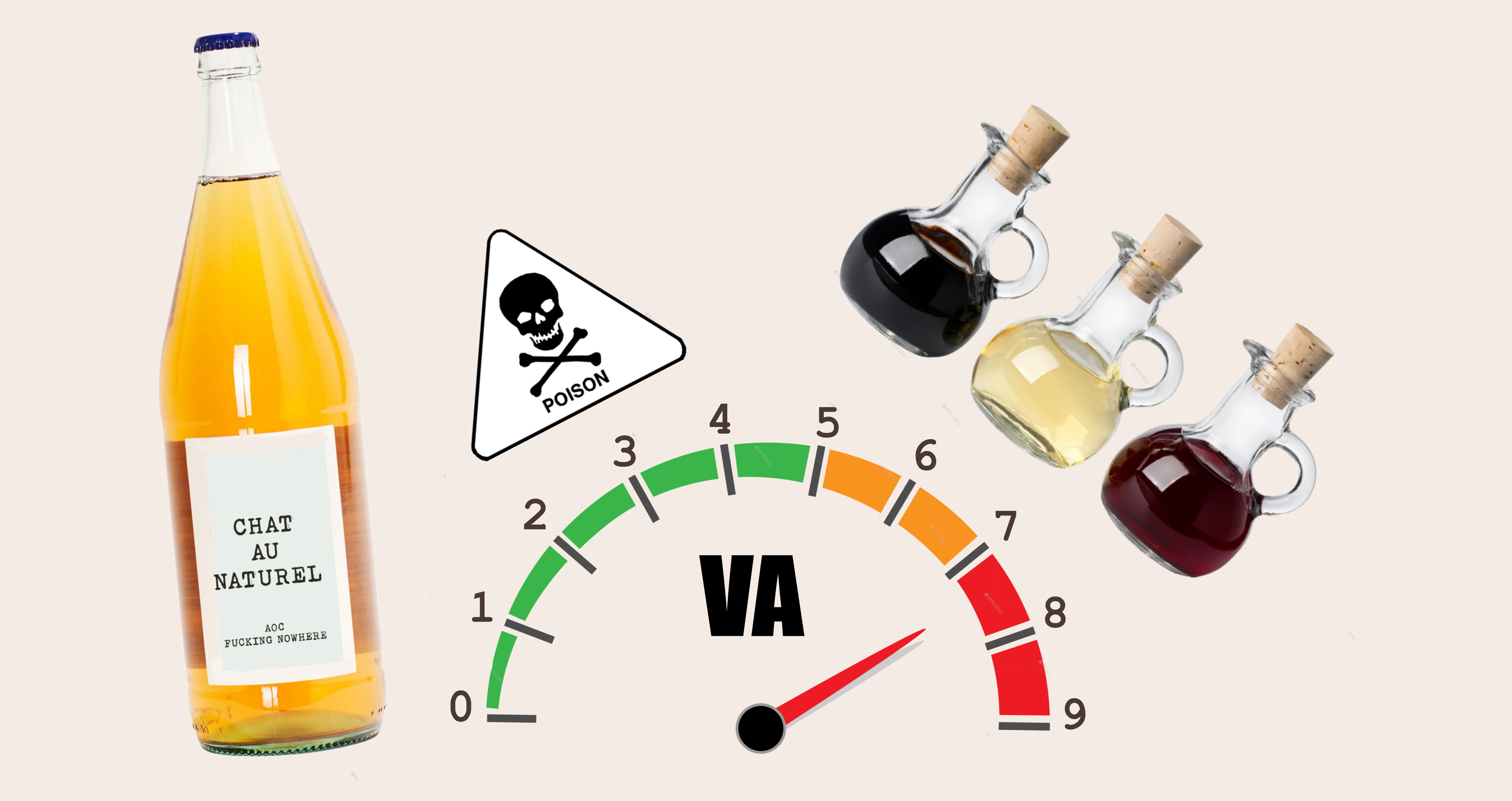
It sounds like a joke: what’s highly desirable in vinegar but illegal in wine? Punchline: high volatile acidity, AKA acetic acid1. But if you’re a winemaker on the wrong end of EU law, you’re not laughing.
Back in 2019, Loire-based vigneron Sébastien David was ordered to destroy over 2,000 bottles of a Cabernet Franc after the fraud police discovered levels of volatile acidity (VA) over the EU limit of 1.2 g/L.2 It became a cause célèbre, with a petition signed by almost 175,000 people.
Dão micro-estate Vizinho Vinhateiro had a similar issue with their Clarete in 2024. More recently, Pittis (Gerhard & Brigitte Pittnauer) were caught out with the latest vintage of their orange wine Mash Pitt, which tipped the scales at 1.3 g/L.
Here’s the rub: I’ve tried all three wines, and none of them tasted like vinegar or smelled of nail polish remover - the usual signs when something is awry with volatility. As Road Less Poured outlines in an excellent article, the number doesn’t tell you everything. How we perceive volatile acidity depends significantly on the levels of tannin, sweetness and alcohol - all of which counteract its sensory effects.
Why then does the EU feel it must protect us from wines with high VA? Do they carry a health risk? Not really. The maximum limit for wine is 1.2 g/L, whereas the minimum level for vinegar is 40 g/L - equivalent to 4% acidity. Only at concentrations of 10% or more does it become challenging for human consumption, morphing from condiment to cleaning product.
The sharp-eyed amongst you might notice a gap in those numbers, between 1.2 and 40 g/L. If both wine and vinegar are safe for us, what’s the problem with beverages that sit in-between? Elena Pantaleoni, owner of La Stoppa winery in Emilia-Romagna, thinks there isn’t one. I tend to agree.
I was curious about the regulatory history in Europe. It goes way back. The EU’s predecessor, the European Economic Community, already established the current limit in act 337 from 1979. A 1987 revision adds the vague justification “in order to protect consumers from wines with too high a volatile acid content, maximum values should be laid down”.
Might that long-established upper limit of 1.2 g/L be arbitrary? It looks like it to me. The US allows a more generous 1.4 g/L for red wines or even 1.7 g/L when super-ripe grapes (28 brix+) are used.
The EU permits higher limits in some cases. In 1993, the exceptions were just French and German sweet wines such as Sauternes or trockenbeerenauslese. But the latest list, updated 2025, includes hundreds of appellations from 18 countries, with allowed maximum VA ranging up to 2.4 g/L. The justifications include higher alcohol, sweetness and longer ageing. Some big names like Amarone, Madeira and Tokaji aszú are included.
In Slovenia, where a new wine law has recently come under scrutiny, any quality (vrhunsko) red wine aged for at least two years in oak gets a free pass up to 1.6 g/L.
With so many exceptions, why have a rule at all? Especially when it’s tone-deaf to orange wines which, being skin-fermented, often have tannin and VA levels similar to reds. But the legislation insists they conform to the lower white wine limit of 1.08 g/L.
Acetic acid gets a bad rep because it’s a major spoilage agent, causing wine to transform into vinegar. This is the endgame, but what about some nuance? A hint of volatility can add excitement and lift. Zero g/L is almost as dull as Watford. The perception threshold lies somewhere between 0.6-0.7 g/L, depending greatly on the style of the wine.
Legislating against high VA supposedly protects us from wines with microbial issues, or stylistic defects. But basing this on an arbitrary number is nonsense. It creates a senseless hoop through which winemakers must jump. Many great wines make it onto the market by evading analysis, not by conforming.
I’d prefer to trust the skill and experience of the grower, rather than penalising them over the measurement of a substance that has no harmful effects. Regulating volatile acidity really is a joke - just not a very good one.
This article was corrected on 14th August, to reflect that 4% acidity equates to 40 g/L of VA/acetic acid, not 4 g/L as originally stated.
For the pedants, yes I know that VA includes more than just acetic acid. Here is the detail.
EU legislation expresses these amounts in milliequivalents per litre, or meq. The limit for red wines is 20 meq or 1.2 g/L. For white and rosé wines the limit is 18 meq, or 1.08 g/L.
Comments
Nothing yet. Say the first thing.
Sign in to join the conversation.