
Machiavelli didn’t think peace kept republics alive. He thought conflict did. Where others praised harmony, he claimed liberty was born from the struggle between people and elites.
But why would the “prophet of tyranny” call war a requirement for freedom?
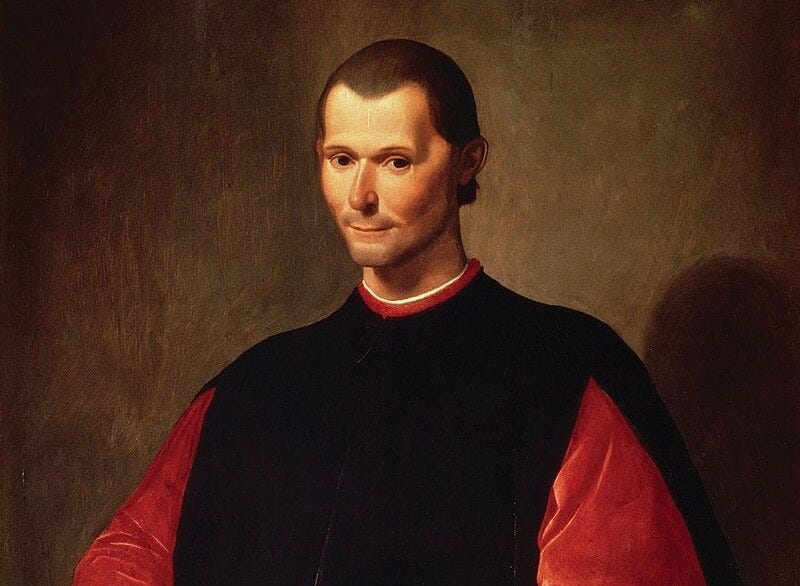
This wasn’t armchair theory. For 14 years, Machiavelli worked as a diplomat of the Florentine Republic, watching rulers across Europe. He saw tyrannies look powerful and then crumble.
But republics, noisy and divided, endured.
Then came 1512. The Medici, with Spanish assistance, regained control of Florence.
Machiavelli was dismissed, arrested, tortured, and exiled.
Cut off from politics, he poured his experience into two books that changed history: The Prince and Discourses on Livy.
People read The Prince and saw a handbook for tyrants. But Discourses shows another side. There, Machiavelli explains why republics last longer than any monarchy. And why their survival depends on constant struggle.
He turned to Rome as his model. Not the empire, but the republic.
Rome blended consuls, senators, and tribunes into a system that balanced monarchy, aristocracy, and popular power. Polybius called this mixed constitution as the best form of government for any state. Especially for those, who want to survive. This balance allowed Rome to adapt instead of collapsing.
Roman constitution blended monarchy, aristocracy and democracy into one functional body.
No side could take total power without other two pushing back.
The real insight was that balance came from fighting.
Patricians pushed one way, plebeians pushed back. Out of these clashes came new laws and institutions that protected liberty or guaranteed new freedoms and opportunities for different classes.
Without friction, Rome would have rotted.
Reminder: Our publication is readers-supported. This article is free but if you’d like to support our work and get access to more articles consider becoming a paid subscriber. You will get:
2 new and deep articles each week based on ancient sources
Access to our Roman battle series, where we have broken down 9 important Roman battles that teach us strategy
Full archive of content
Eternal gratitude
Become a part of fastest growing Roman publication on this platform. For only $50 a year. $4 a month. 13 cents per day.
But structure alone doesn’t save a republic.
It needs citizens with civic virtue. Laws should reward people who put the community before themselves. Not favor criminals of corrupt individuals. Once corruption takes hold, no system can survive.
That’s why Machiavelli, accused of atheism later, insisted religion mattered. Not for heaven, but for discipline and unity. He praised Rome’s early king Numa Pompilius for using faith to build order and strength.
Even later Roman emperors saw that religion was the only thing that could unite the Empire.
Aurelian, knows as Restitutor Orbis, started a new religion which worshipped the sun. His goal was to unite fractured imperial subjects under a common religion. His sun worshipping cult didn’t survive for long, but it paved the way for Christianity to take this crucial role.
Still, corruption was always a threat. Power concentrates, citizens grow soft, and leaders put themselves above the law. The cure was renewal. Sometimes through external shocks, sometimes through institutions designed to restore the founding spirit.
Rome had a brutal but effective tool for this: the dictatorship.
A short burst of concentrated power to crush corruption and reset the system.
Risky, yes.
But Machiavelli thought that without it, republics would decay beyond repair.
Here, his two works meet.
The Prince wasn’t a betrayal of republican ideals. It was the crisis manual. Sometimes survival demanded ruthless action. If the state lived, the ends justified the means.
But he knew the dangers. Once liberty is destroyed, it is hard to bring it back. Unchecked power can with ease corrupt any individual. And this was the danger of dictatorships.
Sulla and Caesar were great examples. Both men set to bring order to Republic, but eventually decided to use their extraordinary powers for their own purposes.
That is why reforms had to build on old foundations instead of wiping the slate clean.
Continuity was just as important as renewal.
Machiavelli’s obsession wasn’t tyranny. It was freedom. He believed republics lasted because they fought. Against enemies abroad, against corruption at home, and even against themselves.
Machiavelli’s name became a symbol of scheming and lies.
But the real Machiavelli thought republics, not princes, held the key to survival.
His lesson still matters. Because the struggle he saw in Rome has never really ended.
No posts
Comments
Nothing yet. Say the first thing.
Sign in to join the conversation.