
The power system behind a headline, before it shows up in your work, wallet, rights, or community
This made my brain hurt alittle. What we are about to get into is pretty technical. If you can’t make it halfway down the page before you start to feel a sharp pain behind your eyes, I don’t blame you. This is A LOT. But it is also extremely important that we all undertand the impact of what you’re about to read. So, before we get into the details, here is a simplified version of what i explain below:
The premise. AI companies build very large data centers. Until 2024, they paid for these data centers from their profits. Now the costs are larger than the cash that most of these companies make. They borrow the difference, and they keep much of this debt in separate companies. They also give money to their own customers, so that the customers can buy from them. They can make their own customers, but they cannot set their own interest rate.
These companies now do the work of a bank. They move money from savers to builders. They hold the risk between the two. A bank has government supervision. These companies do not.
Why this is important to people. The lenders include pension funds and insurance companies. These funds hold the retirement money of workers. The workers did not select these data center projects. If the projects fail, the funds can lose money. New York publishes a list of what its pension fund owns. Most states publish less, so most workers cannot see the risk.
The New York Comptroller controls that pension fund. In March 2026, he told 19 technology companies to pay for their own electric power. His pension fund holds investments in data center companies. The law tells him to invest for good returns. The law does not let him sell these investments for policy reasons. He must continue to invest in these same companies.
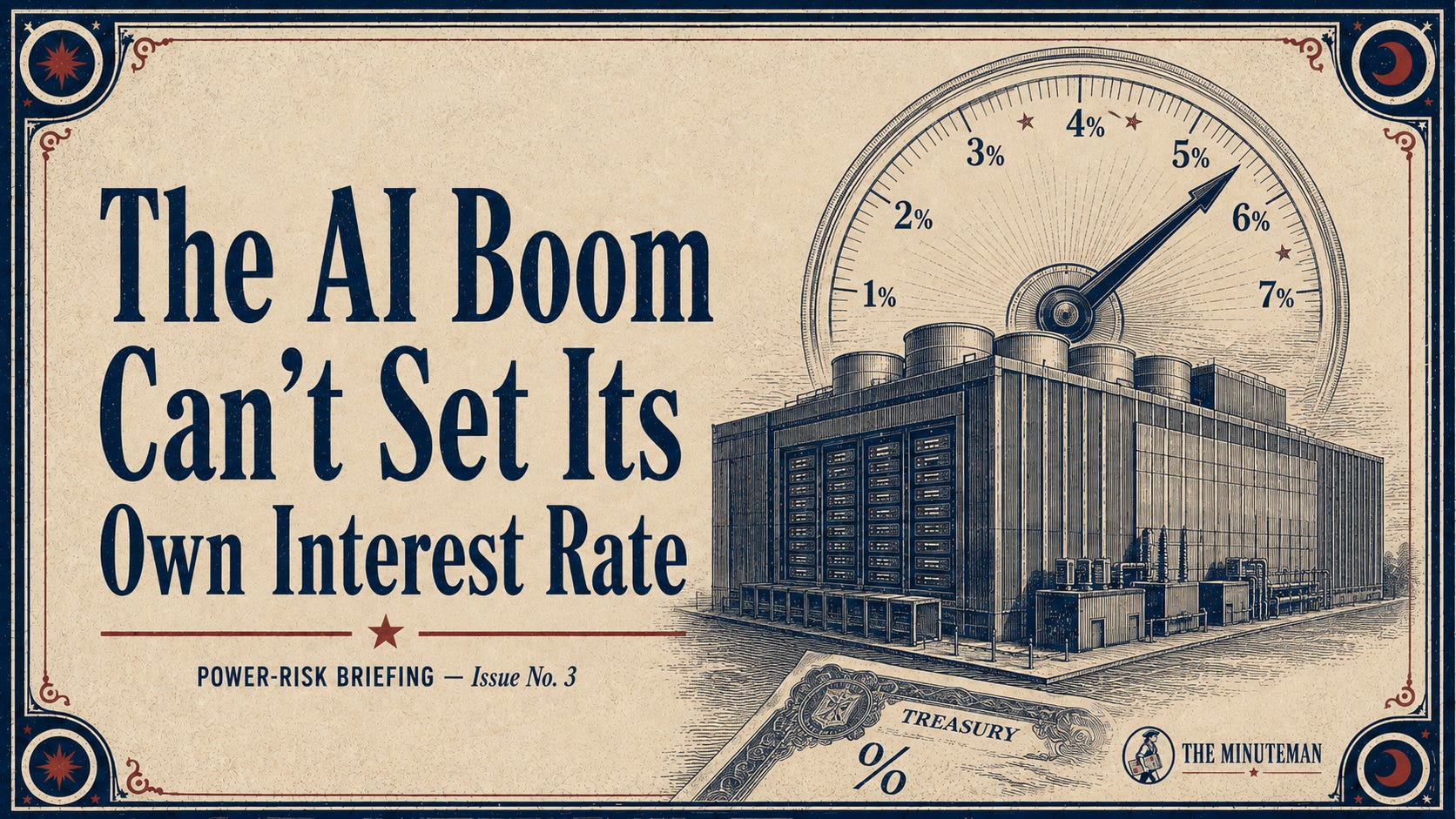
The implications. Investors do not quote these bonds as a simple percentage. They quote each bond as the United States government rate plus an additional amount. The additional amount pays for the risks of the project. In October 2025, one bond paid for a Meta data center in Louisiana. That bond had strong protection, and it still paid 2.25 percent more than the government rate. Today the government pays about 5.25 percent to borrow money for 30 years.
Each additional percentage point increases the money that a project must earn later. The AI companies cannot avoid this cost. If a bank lends, the bank includes the government rate in its price. If a private credit fund lends, it asks for more than the bank. If Nvidia promises to pay a customer’s rent, that promise has a cost. The rate is always in the price.
There is a limit to this argument. The government rate changes the cost of AI debt. This does not show that AI debt changes the cost of other loans. Your home loan is not part of this story.
What I bet, and why. I make three calls, and you can check them later. First, Microsoft, Alphabet, Amazon, and Meta keep good credit through June 2027. I do not include Oracle, because S&P lowered its rating in July 2026. Second, state insurance regulators publish the first good data on this risk in 2027. Third, AI bonds become a larger part of the bond market.
The same logic supports all three calls. Pressure on credit shows first in prices and in loan rules. It shows last at the largest companies. In the summer of 2026, CoreWeave paid 1.0 to 1.25 percent more than it planned for a loan. CoreWeave also accepted new conditions for the life of that loan. The weakest borrowers fail first.
Now for the nitty-gritty.
BRIEFING BOX
Core mechanism: The spread over Treasuries. Every AI infrastructure bond is priced as the risk-free government rate plus a premium for everything that can go wrong, which puts a number the industry doesn’t control inside every deal it signs.
Main risk: The build-out’s funding has moved off the tech balance sheets and onto pension funds, insurers, and private credit vehicles that hold long-dated paper the public can’t easily see or price.
Decision room: Bond and private credit markets, plus state insurance regulators. Congress and FSOC have both passed.
Time horizon: 2026–2028.
Who should care: Corporate finance and treasury teams, credit and fixed income investors, public pension trustees and staff, insurance and risk professionals, anyone advising on AI infrastructure exposure.
My call: Microsoft, Alphabet, Amazon and Meta keep investment-grade market access through mid-2027, and any early restructuring happens at a neocloud or a project vehicle instead (75%). Full reasoning below.
The story you’ve been given about AI spending is that the richest companies on earth are writing checks out of profits so large the rest of us are watching from outside the transaction. That was accurate through 2024. Since then the money has been coming from somewhere else, and a growing share of it belongs to people who never chose to lend it.
AI companies have gotten very good at manufacturing their own demand, and the price of the money that pays for it is the one thing they still have to buy from strangers.
On October 16, 2025, an entity called Beignet Investor LLC sold a single bond worth $27.294 billion. It priced at par with a fixed coupon of 6.581% and runs until May 2049. S&P rated it A+, one notch under Meta itself. Morgan Stanley, the only bank on the deal, quoted the price the way this market actually quotes prices: Treasuries plus 225 basis points.
That is roughly as safe as a data center deal gets. The lenders sit at the front of the line if anything goes wrong, the loan pays down across its whole life instead of ballooning at the end, and the borrowing entity is walled off so trouble elsewhere can’t reach it. The money to repay it comes from Meta’s lease payments on the Hyperion campus in Richland Parish, Louisiana, and Meta is one of the strongest corporate credits in the world.
The deal still cleared at 2.25 percentage points above what the United States government pays to borrow. Morgan Stanley had locked those terms in months ahead, with investors lined up by the start of the second quarter for an October pricing and no new buyers approached after April, and the bonds jumped about 10 points once they started trading, so a widely marketed deal might have come tighter. The 225 is a derisked price. It is still 225.
For most of the last decade these companies paid for their own construction. The cash from the existing business covered the new buildings, which meant no outside lender had a vote on any of it. That arrangement ended fast. Across the five biggest spenders, borrowed money went from 9% of capital spending in fiscal 2024 to 32% by the middle of 2026, and free cash flow is now expected to reach zero or turn negative this year at every one of them except Alphabet and Microsoft. Their bond issuance passed $100 billion in 2025, most of it borrowed for longer than five years to cover build-outs that take that long. In June, Alphabet priced an $84.75 billion equity raise, the largest ever by a listed company, with $44.75 billion of it pointed at AI infrastructure and general corporate use. Goldman Sachs expects more than a third of AI investment to be debt-funded by 2027.
Public bonds couldn’t carry all of it, and putting the rest on the balance sheet would have shown up in the leverage numbers investors watch. So the industry built a second route. A separate company gets created to own the data center. Outside investors put in most of the equity and raise the debt privately. The tech company takes a minority stake, signs a long lease, and sometimes guarantees payments. The building gets built, the tech company uses it, and the borrowing stays off the tech company’s books. The Bank for International Settlements has a name for this. It calls the whole arrangement “shadow borrowing”, meaning obligations that work like debt while living outside the borrower’s balance sheet.
Beignet Investor is what that looks like with the paperwork filed. Blue Owl Capital owns 80% of the vehicle and Meta owns 20%. PIMCO anchored the bond, and the whole $27 billion went to what the underwriter described as a low double-digit number of investors. The Louisiana campus gets financed, and Meta’s balance sheet reports a lease.
Here is the hinge the whole story turns on, and it has a boring name, call it the spread over Treasuries.
Bonds like these don’t get quoted in plain percentages when they’re sold. They get quoted as a Treasury yield plus a number of extra basis points, one basis point being a hundredth of a percentage point. A Hut 8 data center construction bond priced this year at T+165, meaning the matching Treasury rate plus 1.65 percentage points. The government’s borrowing rate is a term inside that contract, written into the price on the day it sold. And that rate has been climbing. The 30-year Treasury now pays about 5.25%, near the top of where it has traded all year.
That’s the trap. An investor deciding where to put money for twenty years can lend it to the United States government and take on no construction risk, no risk that the chips inside the building are obsolete in four years, no risk that a single tenant walks, and no risk that the power never gets connected. To pull that investor into a data center instead, someone has to pay the government’s rate and then pay again for every one of those risks. When the government’s rate goes up, the data center’s rate goes up with it, and every extra percentage point raises the amount of AI revenue the project has to earn someday to have been worth building.
There’s no route around it. If a bank writes the loan, the bank prices Treasuries into the loan. If a private credit fund writes it, the fund wants more than the bank did. If Nvidia guarantees the lease, that guarantee is a liability with a market value. If Nvidia funds a customer with equity instead, Nvidia’s own shareholders eat the return they gave up. The rate shows up somewhere every single time, and the only question is whose line item it sits on.
When the seller starts writing insurance on the buyer, the seller has changed businesses.
Nvidia now guarantees some of its partners’ facility lease obligations if those partners default. The company’s own quarterly filing puts maximum gross exposure at $3.5 billion across terms of five to seven years, notes that partners have placed $712 million in escrow against it, classifies the guarantees as credit derivatives, and calls them not material. Read the same paragraph for what Nvidia collects. It takes the guarantees on in exchange for warrants, which means it’s accepting credit risk on its customers and getting equity upside for doing it. That is what a lender does. Nvidia has since signed agreements with Blackstone, BlackRock, Apollo, Brookfield, Goldman Sachs and KKR to build financing platforms for its buyers.
The second tell came from the other side of the table. CoreWeave rents out AI computing power and has no second profitable business to absorb a bad year. Nvidia holds a stake in it and backstops some of its capacity. When CoreWeave went to raise a $2.6 billion facility this summer, the lenders made it pay, 100 to 125 basis points wider than where it started, and attached conditions the company has to keep clearing for the life of the loan, including a test of whether earnings cover the debt payments and a requirement to pay the principal down throughout instead of at the end.
You can watch the same repricing in the market for insurance against these companies failing. CoreWeave’s five-year default protection hit 855 basis points in late July, up from around 640 in November, a price implying something close to coin-flip odds over five years. Oracle’s went from about 145 basis points at the end of 2025 to above 215, and on July 9 S&P cut Oracle to BBB-, one notch above junk, on surging capital spending, negative free cash flow and customer concentration. The people lending the money have started charging for the risk the vendors keep describing as immaterial.
One complication, it’s the strongest thing anyone can say against this.
Nothing here is breaking. Bank of America puts AI-linked bonds at 2% to 3% of public investment-grade and high-yield benchmarks, which is small. Investment-grade hyperscaler spreads have actually tightened a little in recent months. The IMF’s spring assessment treats aggregate pension and insurer exposure to private credit as manageable. Anyone telling you a crisis is underway is ahead of the evidence.
Two things about that. Telecom bonds were 1% of the index in 1995 and 20.3% by 1999, so a small share is a fact about today rather than a fact about the direction. And I want to be careful about a claim I can’t make. “T plus a spread” proves the Treasury market prices AI debt. It doesn’t prove the reverse, that AI borrowing is making credit more expensive for everyone else. Extra bond supply can push spreads wider when buyers are stretched, and the AI issuers are competing for the same long-duration institutional money as other large borrowers. Whether that’s raising anyone else’s borrowing costs yet is an open question. Your mortgage isn’t in this story, yet.
The AI industry built a lending machine that can create its own customers, its own guarantees and its own demand, and then had to walk outside and buy the one input the machine can’t produce, which is the price of money, from lenders who owe it nothing.
For your wallet. If you have money in a public pension or a life insurance product, the chance that it’s funding data centers has gone up, and in at least one state you can read the line item.
Comments
Nothing yet. Say the first thing.
Sign in to join the conversation.