
The problem isn’t caffeine. The problem is building an entire morning around one fast stimulant hit and acting surprised when our brain clocks out before lunch.
A lot of the so-called coffee crash isn’t about hydration or proof that our body is too “stressed” for caffeine. It’s usually a stack of smaller problems happening all at once.
Light exposure, meal composition, sleep pressure, and the kind of caffeine we choose all shape how alert we stay and how rough the drop-off is later. Here’s the actual science.
Light is one of the biggest inputs into circadian rhythm, and caffeine works in part by blocking adenosine, the compound tied to sleep pressure. 1
If you want better focus without the heart-racing, snack-chasing, 11:00 a.m. slump, the answer is usually not another coffee. It’s this:

Coffee doesn’t instantly dehydrates you. That claim is shared far more confidently than the evidence supports. In moderate amounts, coffee doesn’t even appear to impair hydration compared with water in a controlled trial, and a 2024 review notes that the old dehydration claim is overstated. 2
Water first is still crucial. We have gone hours without fluid. Starting with a glass of water is a practical way to wake up, separate thirst from habit, and keep caffeine from being the first thing our nervous system deals with. It’s simple, unglamorous, and useful, which is usually how the best morning habits work.
That one small shift also fixes a common morning mistake. Many of us are not actually under-caffeinated at 7:30 a.m. We are under-rested, under-hydrated, under-exposed to daylight, and trying to solve all of it with espresso.

Morning light is one of the most underrated focus tools available, mostly because it’s free and therefore not packaged as a revelation.
Alertness begins with the removal of biological sleep signals. The human circadian system is synchronized by the suprachiasmatic nucleus (SCN) which receives direct input from specialized retinal cells sensitive to blue light.
Elevated morning melatonin levels are a primary driver of sleep inertia and the ‘dozing off’ effect frequently observed in educational and professional settings.
The National Institute of General Medical Sciences notes that light and dark are the biggest influences on circadian rhythms and helps regulate melatonin and cortisol timing, which is part of how the body transitions into wakefulness.
Light exposure increases in the morning, melatonin falls and cortisol rises as part of normal wake-up biology, and morning light exposure helps advance the body clock.3
This is one of the simplest sustainable morning habits for focus. Step outside, get actual daylight in your eyes, and let your nervous system register that the day has started. It’s not just a social media trend.

A lot of what gets blamed on caffeine is really a blood sugar and satiety issue. A 2024 randomized crossover study found that a high-protein, low-carbohydrate breakfast increased satiety and improved cognitive concentration before lunch compared with a low-protein breakfast or skipping breakfast altogether.4
Everything we learned about eating cereal and croissants with coffee is wrong! Coffee on top of a pastry isn’t the same as coffee on top of eggs and Greek yogurt, or something with enough protein to keep our brain from begging for a second stimulant an hour later. A better morning meal is often the difference between “caffeine makes me jittery” and “I can think until noon.”
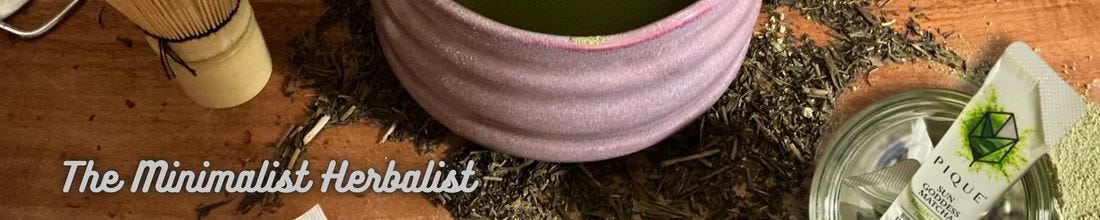
Pique sponsored this mention. They sent me their Sun Goddess matcha, for me to try and I’ve been drinking it or several months now. It’s worth writing about in regards to what actually matters and why people (me!) who know and enjoy tea are annoyingly specific about it.
Matcha actually earns its reputation. Phrases like “clean energy” and “calm clarity,” are vague enough to become nonsense unless somebody explains what’s actually going on.
Matcha contains caffeine, but it also contains L-theanine. A 2021 systematic review on caffeine and L-theanine found that the combination may improve attention and cognition, and a 2025 meta-analysis on tea compounds reported benefits for some cognitive and mood outcomes from theanine plus caffeine. Matcha-specific reviews have also concluded that randomized trials suggest modest improvements in attention and stress-related cognitive performance.5
That is the real appeal in the matcha versus coffee dilemma: a different caffeine experience. This is where most of the value is.
Matcha isn’t like an ordinary tea bag where you steep the leaves and move on. You’re not steeping leaves and discarding them. You’re consuming the entire leaf, ground into powder, which raises the stakes on quality. Reviews of matcha’s composition note that it contains relatively high levels of catechins, chlorophyll, caffeine, and theanine, and that cultivation and processing meaningfully shape the final product.
Shade-growing is essential. It is one of the core practices that helps create the smoother, more umami-rich profile associated with better matcha, and studies on shading show increases in chlorophyll and amino-acid related quality traits that producers actively target for matcha-grade leaves.
Origin is crucial too. Kagoshima isn’t a random label flourish. Japan’s Ministry of Agriculture notes that Kagoshima was No. 1 in Japan for tencha production in 2022, and tencha is the raw material used to make matcha.6
And because this is a powdered whole-leaf product, testing matters more than the average cup of tea. Organic is good. Third-party screening is better. A brand should be able to tell you something specific about contaminants, not just sell you a soft-focus purity fantasy.
So yes, a good matcha really is different from a random green powder in expensive packaging.
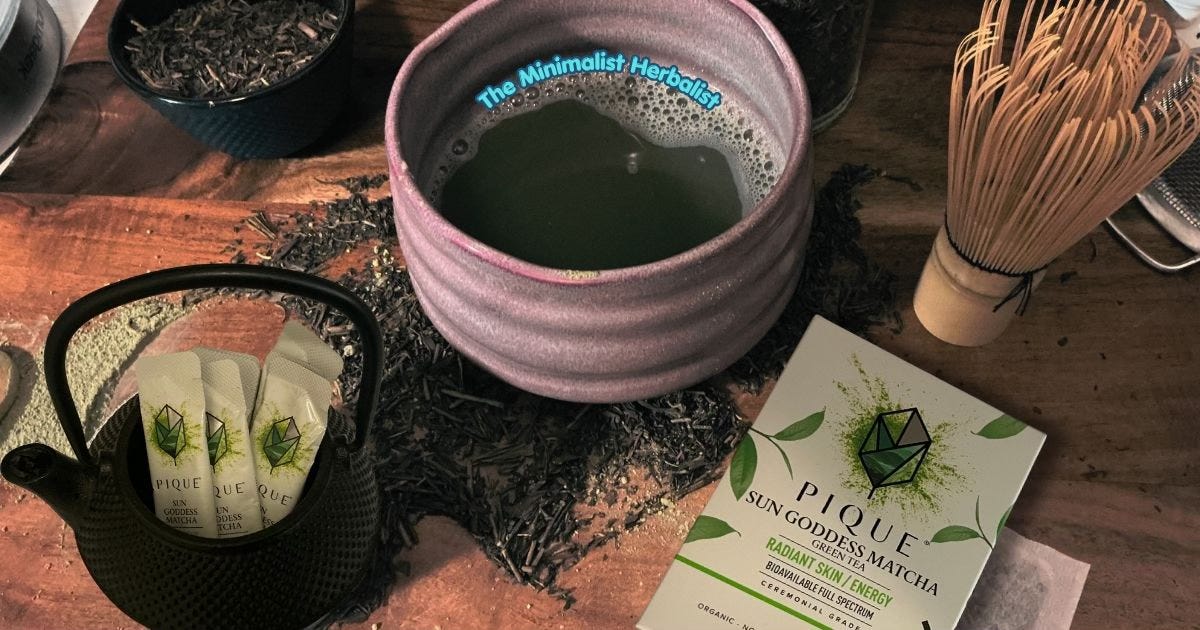
Sun Goddess Matcha gives you the information a serious matcha buyer should be looking for. It’s 100% organic matcha sourced from Kagoshima, and evaluated through independent third-party testing.
More importantly, the posted certificate of analysis is specific. The February 2026 COA for Sun Goddess Matcha lists testing by Eurofins and reports cadmium, arsenic, lead, and mercury as not detected above the method’s reporting limit. It also reports cesium-134, cesium-137, and iodine-131 below the listed threshold in that tested lot.7 That’s the kind of transparency I want.
That’s also what we’re actually searching for when we buy good matcha, Better leaf, better cultivation, better handling, and better proof.
Pique is offering 20% off for life and a complimentary gift through this link.
Scent is the only sense that bypasses the thalamus, traveling directly to the limbic system and hypothalamus. This allows specific volatile organic compounds to modulate brainwaves almost instantly.
Peppermint (Mentha piperita): Acts as a vigilance catalyst. It increases the ratio of Alpha to High Beta waves, promoting brain stability and reducing “false alarms” or errors during morning tasks.
Rosemary (Rosmarinus officinalis): A specialist for memory and attention speed. It increases Low Beta wave power, which facilitates faster information processing without inducing stress.

A good morning routine should survive a real life. It shouldn’t require twelve accessories and forty silent minutes.
Water first. Early light. A breakfast with enough substance to support actual concentration. Caffeine chosen on purpose, not by reflex.
The information provided in this newsletter is for informational purposes only and is not intended as medical advice, diagnosis, or treatment. Herbal practices and uses discussed are not a substitute for professional healthcare.
While herbs are natural, they are also bioactive substances, and proper dosage, preparation, and use are important. Always follow reputable dosing guidelines for each herb and consult with a qualified healthcare provider before using any herbs, especially if you are pregnant, nursing, taking medications, have known allergies, or have existing medical conditions.
Anyone experiencing severe symptoms or managing chronic health issues should seek professional guidance before using herbs.
Individual responses to herbs may vary, and no outcomes are guaranteed. The author makes no claims regarding the effectiveness, safety, or suitability of any herb for any particular person.
Readers assume all responsibility for their personal health decisions based on the information presented. The author disclaims all liability for any loss, injury, or damage allegedly arising from the use or application of the information in this newsletter.
Camille Charles is the voice behind The Minimalist Herbalist. Herbal researcher. Best-selling author. Food nerd. Professional over-doer of tinctures. Consumer advocate. Curator of coping skills and good sense. Currently earning a doctorate in curriculum design, on a mission to make herbal education less confusing and more honest.
She believes learning about herbs should feel empowering, not overwhelming. You’ll find her distilling rose water in an Instant Pot, repurposing olive jars for cacao butter, and making overnight nettle infusions like it’s a sacred ritual. She talks way too much about nettle and why your juicer is probably lying to you.
If there’s an herb for it, she’s tried it, and probably turned it into a teachable moment.
Tea’s brewing. Grab a cup.
Sources:
Antonio, J., Newmire, D. E., Stout, J. R., Antonio, B., Gibbons, M., Lowery, L. M., Harper, J., Willoughby, D., Evans, C., Anderson, D., Goldstein, E., Rojas, J., Monsalves-Álvarez, M., Forbes, S. C., Gomez Lopez, J., Ziegenfuss, T., Moulding, B. D., Candow, D., Sagner, M., & Arent, S. M. (2024). Common questions and misconceptions about caffeine supplementation: what does the scientific evidence really show?. Journal of the International Society of Sports Nutrition, 21(1), 2323919. https://doi.org/10.1080/15502783.2024.2
Killer, S. C., Blannin, A. K., & Jeukendrup, A. E. (2014). No evidence of dehydration with moderate daily coffee intake: a counterbalanced cross-over study in a free-living population. PloS one, 9(1), e84154. https://doi.org/10.1371/journal.pone.0084154
https://www.nigms.nih.gov/education/fact-sheets/Pages/circadian-rhythms
Dalgaard, L. B., Kruse, D. Z., Norup, K., Andersen, B. V., & Hansen, M. (2024). A dairy-based, protein-rich breakfast enhances satiety and cognitive concentration before lunch in overweight to obese young females: A randomized controlled crossover study. Journal of dairy science, 107(5), 2653–2667. https://doi.org/10.3168/jds.2023-24152
Anas Sohail, A., Ortiz, F., Varghese, T., Fabara, S. P., Batth, A. S., Sandesara, D. P., Sabir, A., Khurana, M., Datta, S., & Patel, U. K. (2021). The Cognitive-Enhancing Outcomes of Caffeine and L-theanine: A Systematic Review. Cureus, 13(12), e20828. https://doi.org/10.7759/cureus.20828
https://www.maff.go.jp/e/policies/market/dento_syoku/menu/kagoshima_tea.html
https://cdn.shopify.com/s/files/1/2135/4367/files/Copy_of_SGM_COA_Feb_26.pdf?v=1773731775
Comments
Nothing yet. Say the first thing.
Sign in to join the conversation.