
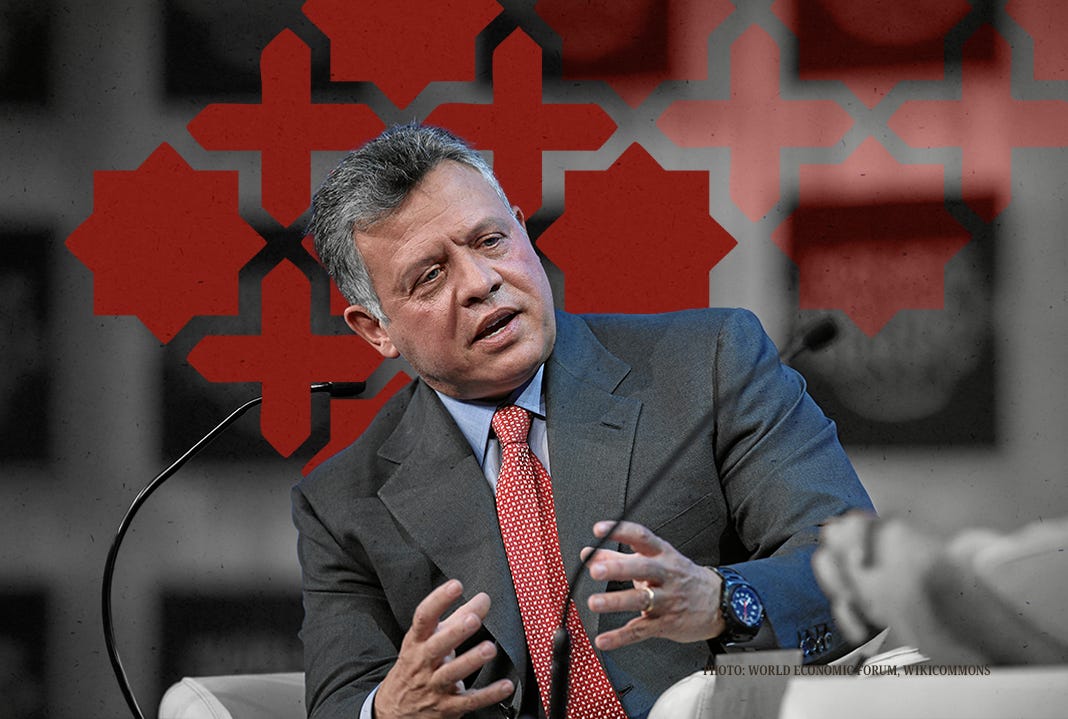
In 2004, Jordan’s King Abdullah II warned that the fall of Saddam Hussein at the hands of America risked creating a new crescent of Iranian influence stretching from Tehran to Beirut.
Speaking as Iraq prepared for its first post-Saddam elections following the American invasion in 2003, King Abdullah laid out what he saw as a danger in a remarkably clear manner during an interview with NBC’s Chris Matthews.
First he asked:
“There is Iranian influence on the Iraqi street. And that is I think the worst-case scenario, that an Iranian-influenced government comes to power and then, where do we go from there?”
And then he asked:
“If it was a Shia-led Iraq that had a special relationship with Iran, and you look at that relationship with Syria and with Hezbollah-Lebanon, then we have this new crescent that appears that would be very destabilizing for the Gulf countries and actually for the whole region.”
This was a clear-sighted warning.
The invasion of Iraq greatly affected the balance of power in the wider Middle East, including in ways that the Bush administration did not anticipate.
In fact, national security adviser Condoleezza Rice saw it in quite the opposite direction, with her expecting that the fall of the Hussein regime in Iraq and the fall of the Taliban in Afghanistan would pressure the clerical-theocratic regime in Iran. She said:
“We do believe that if you have a stable and democratic Afghanistan and a stable and democratic Iraq… sooner or later the Iranian leadership is going to have to listen.”
The Iranian regime, of course, would never have seen the situation this way. Their view of the world is Islamist, theocratic, and revolutionary. They viewed the American interventions in Iraq and Afghanistan not so much as attempts toward the establishment of stable democracies, but as a kind of Western/Zionist neo-imperialism—and something that they needed to push back against.
Could they have felt pressured if liberal secularists had taken control in Iraq and Afghanistan? Undoubtedly so. They would have felt tremendously isolated if this had happened. So, rather than allowing this, their strategy was to support pro-Islamist forces in both Iraq and in Afghanistan.
In Iraq, this included Shia Islamist parties such as the Supreme Council for the Islamic Revolution in Iraq, its armed Badr Organization, and later a constellation of militias including Kata’ib Hezbollah and Asa’ib Ahl al-Haq. In Afghanistan, this included a pragmatic turn to support for the Taliban, whom they had previously opposed during the 1990s.
Of course, the fall of the Taliban and the Hussein regime did create a power vacuum in both countries. While many may have hoped that American victories in Kabul and Baghdad might have created an impetus for the same kind of economic development and modernization seen in Europe after the fall of Berlin in 1945, this was never guaranteed.
There was already a precedent for Iranian-supported Islamist militancy. Hezbollah in Lebanon had since the 1980s benefited from support from the Iranian revolutionary regime. And there had also been mutual support between the Assad regime in Syria and Iran stretching back to 1979, including in the 1980s when Hafez Assad had supported Iran during the Iran-Iraq war.
The King of Jordan recognized this. He explicitly warned even in 2004 that there was already Iranian influence in the Iraqi street.
The intent was clear then, too.
Indeed, ever since 1979, the regime in Tehran had been explicit about its international revolutionary aspirations.
As Ayatollah Khomeini said in 1980:
“We should try hard to export our revolution to the world… We shall confront the world with our ideology.”
Indeed, Iran’s post-1979 constitution calls for ensuring “the continuation of the Revolution at home and abroad.”
Since then, the King’s warning has come true, and then some.
Tehran named this new emerging system as its “Axis of Resistance,” a loose mixture of governments, militias, and Islamist movements tied together by opposition to Israel and American influence in the region.
Some of these groups were Shia. But others were not.
Iran became a longstanding patron of Hamas and Palestinian Islamic Jihad, providing large-scale support to anti-Israel jihadists in Gaza despite the fact that Hamas is a Sunni Islamist organization.
That relationship illustrates an important caveat to the original “Shia crescent” concept: Iran’s leadership may be radical Shias, but Tehran’s strategy turned out to be more pragmatic and diverse than specifically sectarian.
Indeed, in Yemen, Iran developed a close relationship with the Houthis, who are Zaydis, which is a branch of Shia Islam, but is not the same branch as the rulers in Tehran. Iranian assistance helped the Houthis develop increasingly sophisticated drones and ballistic missiles, eventually giving the Houthis the ability to threaten Saudi Arabia, Israel, and commercial shipping through the Red Sea.
And so, this network allowed for a multi-pronged offensive against Israel in the war since October 7.
The “crescent” Abdullah warned of in 2004 has effectively become a network stretching from the Mediterranean to the Red Sea and Persian Gulf.
And as Abdullah warned, during the recent war between America and Iran, Iran’s network of revolutionary sympathizers has posed a direct threat to Gulf countries and the whole region. Kuwait, the United Arab Emirates, Bahrain, Qatar, Jordan, and Saudi Arabia have all been targeted.
Twenty-two years later, his warnings proved remarkably prescient. Washington believed the fall of hostile regimes in Baghdad and Kabul would put Tehran on the defensive. Instead, Iran exploited the disorder that followed and spent the next two decades expanding its influence across the region.
The result turned out to be larger than the “crescent” Abdullah imagined. Iran built a network capable of threatening Israel, attacking Gulf states, disrupting global shipping, and dragging countries with no interest in its revolutionary project into its wars. The danger Abdullah saw coming in 2004 eventually reached almost every corner of the region.
Middle East Uncovered is powered by Ideas Beyond Borders. The views expressed in Middle East Uncovered are those of the authors and do not necessarily reflect the views of Ideas Beyond Borders.
Comments
Nothing yet. Say the first thing.
Sign in to join the conversation.