
Quick Summary - This Month:
🔥 Heatwave Remedies for Northern Hemisphere gardeners
🌏 Frost Protection for Southern Hemisphere gardeners
☀ Subtropical gardening tips for my QLD climate [Printable Download]
🗣️ Upcoming Talks at the Queensland Garden Show
🔍 Dig into my Notes for inspiration and tips you may have missed
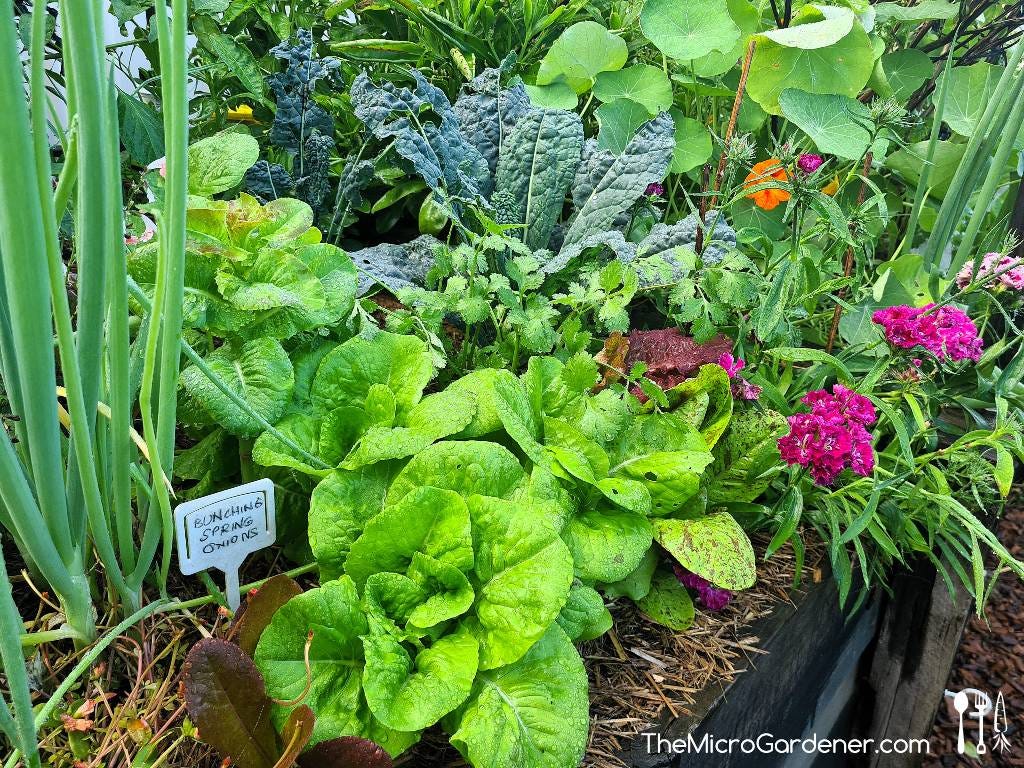
I’ve been away for a couple of weeks overseas, returning home to ‘winter’ in our subtropical climate. The night before last, I threw the covers off - during recent days it’s been 26-27°C (78-80°F). This morning it was freezing again! Many plants in my garden look confused! Some trees are flowering and fruiting already, thinking it’s spring. Agh … “Winter, where are you?” It’s dry, and I’m not ready for spring yet.
🌡️ Are you experiencing extreme weather conditions too? We notice the heat and cold because we’re outside, caring for our gardens - and need strategies to cope.
For us southern hemisphere gardeners, let’s enjoy the productive winter conditions while they last, prepare for a dry spring, and don't get caught out by frosts just because the averages say it's warm. For northern hemisphere readers, I feel your pain (my summer is brutal too), so I’m sharing a few ways to help plants cope in the heat.
Check your climate zone. Discover what to plant and when + tips below. 👇🏼

☀️ “To people who grumbled at the weather, he recommended a garden, as the best of remedies for that commonest of melancholies, for there is no weather that did not suit some plant. In the hottest and driest time, the portulacas are burning red in the sand.” - Liberty Hyde Bailey 🌻
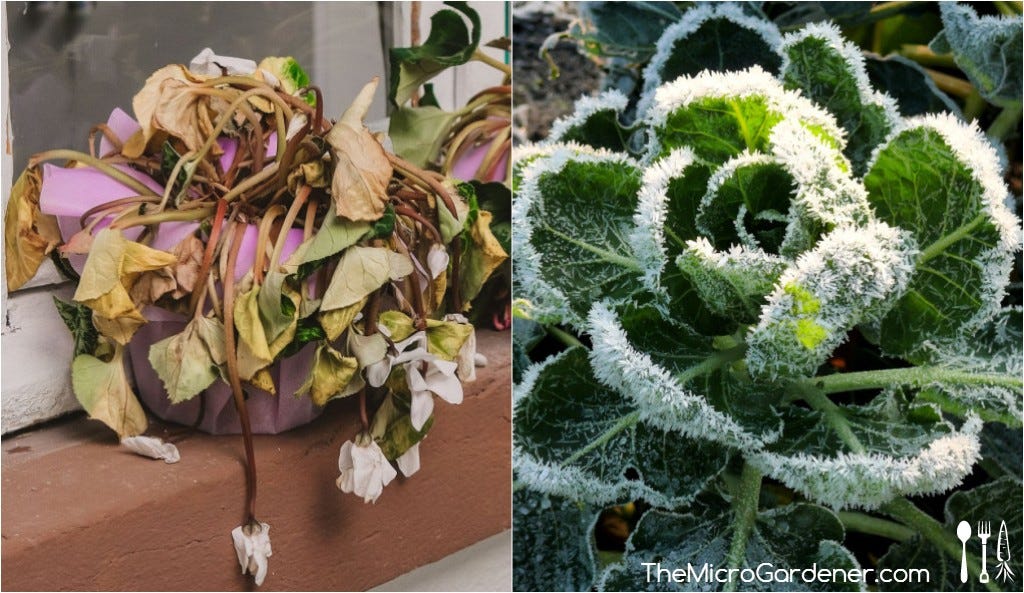
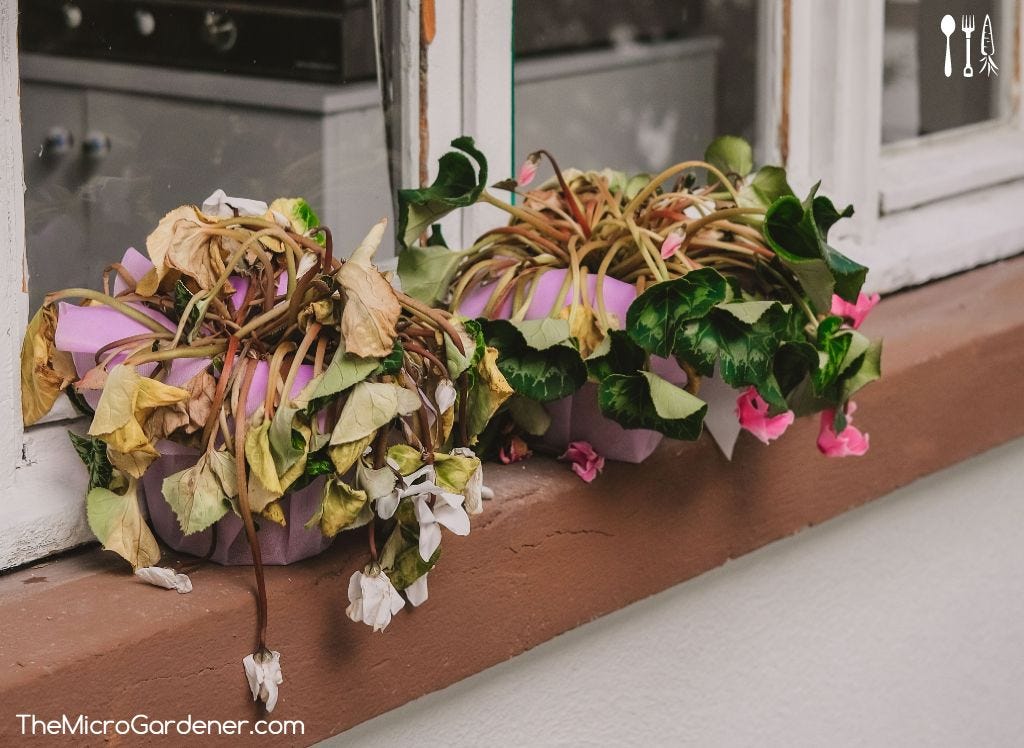
🥀 Are your plants trying to get your attention with a wilting tantrum? Is a tragedy unfolding in your garden? I’ve realised this dramatic ‘fainting spell’ behaviour is a plant’s visual clue that it needs urgent help. Our cast of plants can’t speak, but they’ll deliver a Hollywood-worthy performance if they’re literally dying of thirst!
♨️ When it’s hot, our overheated plant characters have a built-in ‘air conditioning’ system. They open tiny pores on their leaves (stomata) like ‘windows’ to let carbon dioxide in (food) and water vapour out (the cost of doing business). When temperatures are reasonable, a plant opens the ‘windows’, grabs CO₂, makes food through photosynthesis, and loses some water. A fair trade.
🥵 However, with temperatures of 86°F (30°C)+, photosynthesis slows to a crawl, but the windows stay wide open or open even wider. What’s happening?
During extreme heatwaves, the stomata stay open to cool the leaves, but the plant wastes massive amounts of water in the process, while making almost no food. Scientists call this “stomatal conductance uncoupling.” It’s like running the air conditioner with the windows wide open. This ‘suicidal’ behaviour temporarily prevents heat death for the leaves, but quickly depletes available water reserves.
A 2024 study* in New Phytologist found that at higher temperatures, the stomata open via a different pathway that doesn’t involve making food. The plant switches from “I’m working hard; I need air” to “I’m burning up; I need to vent!” It’s panic.
💧 If your plants are already short on water when the heatwave arrives, it gets worse. Sorry to be the bearer of bad news, but a 2022 paper in Global Change Biology found that some drought-stressed plants increase their water loss by six times during extreme heat. They’re pouring out their last reserves, trying to cool their leaves below lethal temperature. They’re trying to save themselves.
🌵🥵 Just like someone in a desert emptying their final water bottle over their head. It cools them for a few minutes. Then there’s nothing left.
What I’ve learned about plant care in extreme heat is that our job isn’t just watering. It’s equally important to prevent our plants from ever reaching the point where they have to make that choice. We can keep their roots cool and soil moist so they don’t panic-vent their way to an early death! These are a few practical strategies.
I stumbled onto ollas years ago during a punishing hot summer. No matter how much I watered my pots each day, my plants looked at me like I’d betrayed them. I couldn’t match their thirst needs.
Then I discovered that farmers in dry regions had been burying unglazed clay vessels beside their crops to keep soil moist without daily hand-watering for over four thousand years. A buried clay pot is so simple it feels like cheating.
Here’s how it works. You take an unglazed terracotta pot, plug and seal the drainage hole, bury it up to its neck in the soil, fill it with water, and put a lid on it. That’s it. [I highly recommend using a non-porous lid like a tight-fitting plastic saucer or ceramic plate. Fill with water and pebbles as a pollinator and bee bath]. Then your olla performs double duty - above and below ground!
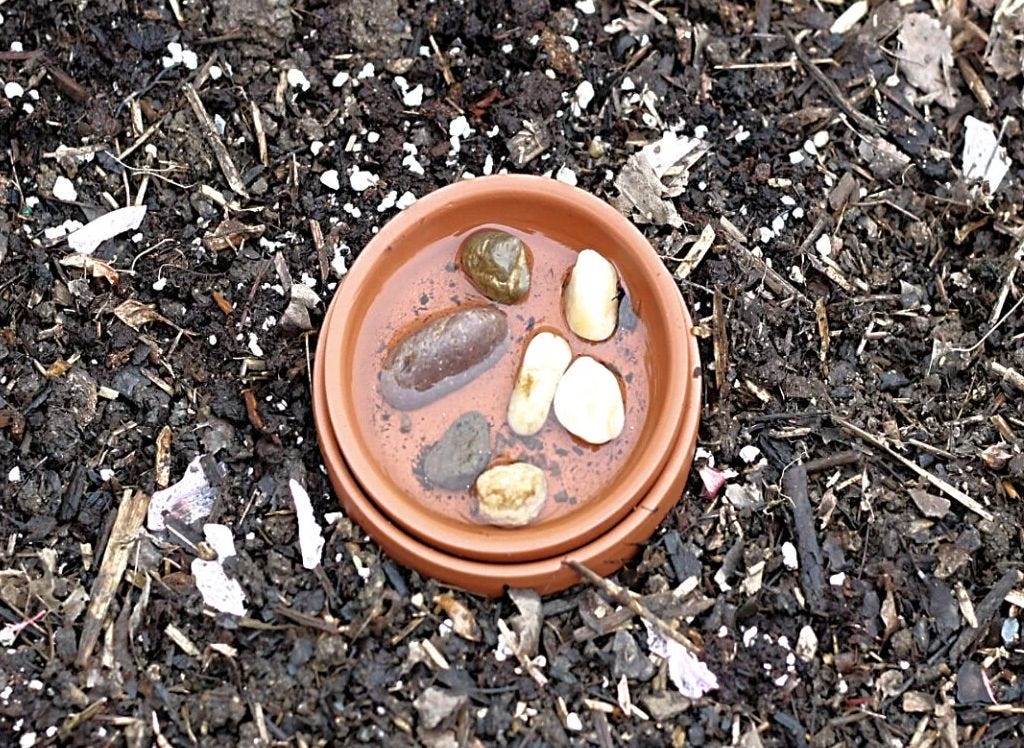
Since the clay is porous, when the surrounding soil dries out, it pulls water through the walls. When the soil is moist, nothing happens. The water stays put. No timer, dripper or app needed. You do have to sacrifice a small space in your container or garden bed, but in baking heat, it can be a lifesaver.
The plant drinks what it needs, exactly when it needs it. No evaporation, runoff or guessing. It’s a soil-based tug-of-war passing water from pot to roots.
University of Arizona Extension research* found ollas use 60–70% less water than surface watering. A 2017 study* by Ezekiel and colleagues found that a single olla irrigates soil roughly twice its own diameter. Bury an eight-inch pot and plants within sixteen inches self-serve their own drinks. 👍🏻
Roots figure this out fast. Within weeks, they grow toward the pot, wrap around it, and drink straight through the clay wall. I’ve pulled up plants at the end of a season and found roots woven into the terracotta like they were holding hands. 🫱🏻🫲🏻
🍾 The budget version is a wine bottle. Fill it, invert it, and shove the neck into the soil. Water trickles out as the surrounding earth dries. It’s less precise than porous terracotta and the flow depends more on your soil texture, but it costs nothing.
One bottle per large container. Three or four spaced along a raised bed. You drink the wine first. I’m sure that’s a legitimate and necessary step in the irrigation workflow! 😉
The catch is you have to remember to refill them. Your plants won’t text you. They’ll just sit there pouting, sadly dying of thirst three inches from a bone-dry pot you forgot to check. I have been that gardener. More than once. A phone alarm saves me!
Ever walked barefoot across a road in summer and done that involuntary hop-skip routine because your feet are cooking? Unprotected soil bakes too, but it can’t shout out for help! Dark exposed garden soil can hit 122-140°F (50–60°C) at the surface. That heat travels downward, straight into the top few centimetres, where most vegetables feed. The fine root hairs fry first. Our poor babies!
🍂 Living in a hot climate, I’ve seen firsthand that mulch is far more than just a decorative moisture-holding blanket. Mulch acts as a protective heat shield.
☀️ A hay or leaf mulch absorbs the sun’s radiation before it reaches the soil. The still air trapped inside is a lousy heat conductor - exactly the buffer we want.
🌡️ Researchers in Iran* measured loam soil under summer conditions. Bare soil swung 63.5°F/17.5°C between the day’s heat and the night’s cool. Under straw mulch, that range dropped to 52.7°F/11.5°C. A significant reduction in the daily temperature swing. The mulch buffer meant roots weren’t getting scorched at 2 pm and then shocked at 2 am. They were staying in a narrower, survivable band. 👍🏻
The same study* found mulch cut evaporative water loss by 27%. That’s water staying in the root zone instead of vanishing into the air. Cooler soil loses less water, and wetter soil heats up more slowly.
📌 My rule of thumb with mulch depth is a minimum of 2-3” or 5-7 cm. If I can see soil, it’s losing water, so I put a ‘hat’ on it!
🪴Container gardens with plants in black pots may need further protection. A Kansas State study* measured substrate temperatures on the sun-facing side of black nursery pots in summer conditions with 122.54°F/50.3°C on average, peaking above 131°F/55°C. That’s hot enough to kill root tissue outright in some species. 🥀
🖌️However, white containers at the same site averaged 96.8°F/36°C. Same plants, sun and conditions, just a different colour pot! Even painting a black pot white drops the root zone temperature by up to 44.6°F/7°C. If painting isn’t an option, I’ve covered mine with hessian or moved them behind other pots, out of direct sunlight.
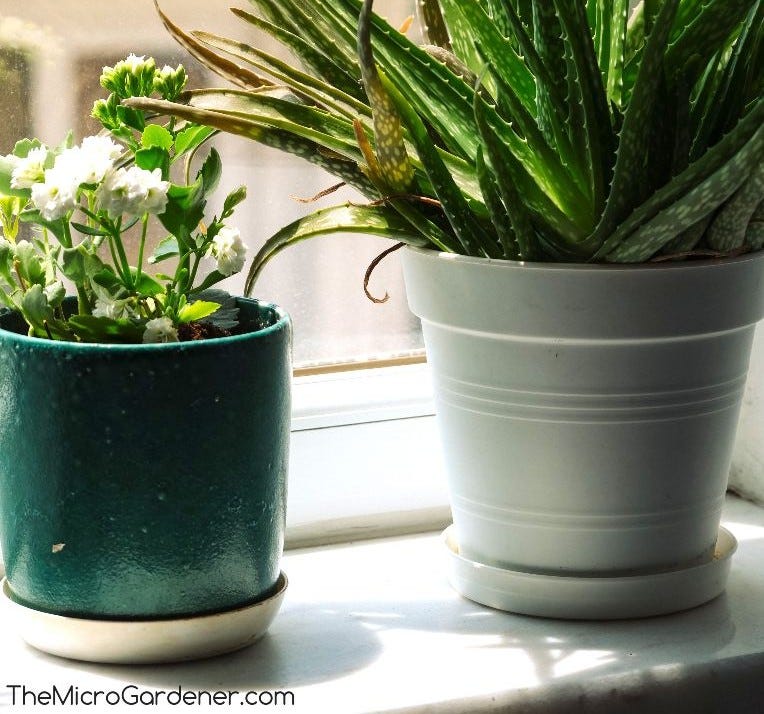
Even wrapping a pot in an old towel or a flattened cardboard box zip-tied around the outside will help shade the container. I hope these ideas help you in the heat.
If you’re local to SE Queensland, Australia, download my free guide for this month. 👇🏼
What to do in your garden this month, weather conditions, key garden tasks to tackle, common pests and helpful resources to dig into.
The Subtropical Planting Guide is designed for our five seasons, what to plant, seasonal garden tasks and common pests. A practical tool to use year after year.
Queensland Garden Show: 10-12 July @ Nambour Showgrounds.
I’m looking forward to speaking for my 13th year - these are my talk topics:
🫗 Friday 10th July @ 2 pm - “DIY Free Fertilisers: How to turn kitchen, animal and garden waste into nutrient-rich plant food.”
🪴 Saturday 11th July @ 9 am - “Survival Gardening: Must-Have Plants for Your Backyard Supermarket & Home Pharmacy Garden.”
There will be hands-on demos and a barrowload of tips. If you’d like to check out all the speakers and the full program over 3 days, see the QLD Garden Show website for more details. If you’re local, come and join us! Gain knowledge, solve plant problems, and leave feeling inspired to grow.
I’ve discovered from lived experience that frost damage can creep into your garden and create chaos overnight. Ice is like a prowling intruder ‘breaking and entering’ plants. It doesn’t just make them cold - it’s a weapon at the cellular level. If your garden is prone to cold snaps, don’t despair. I’ve learned some harsh lessons to share.
❄️ When ice forms inside plant cells, the crystals are sharp. They puncture membranes like needles through bubble wrap. When ice forms between cells instead, the frozen water outside the cell pulls liquid water out through osmosis, dehydrating the cell from inside. It’s a bit like the plant equivalent of freezer burn. The plant’s tissues aren’t just cold - they have dried out.
🌡️ One lesson I have learned is to watch for the overnight low temperature. In a frost-prone garden, the forecast is your best friend. However, what happens at dawn the next day is just as important.
☀️ Direct morning sun hitting frozen leaves causes rapid thawing. Ice crystals melt unevenly, cell walls rupture from the shock, and tissue that might have survived turns to sludge by breakfast. I know the disheartening feeling of plant loss.
☂️ However, I’ve found slow, shaded thawing gives cell membranes time to recover, letting the plant warm up gradually, like you’d thaw meat in the fridge.
These are a few strategies that have worked for me.
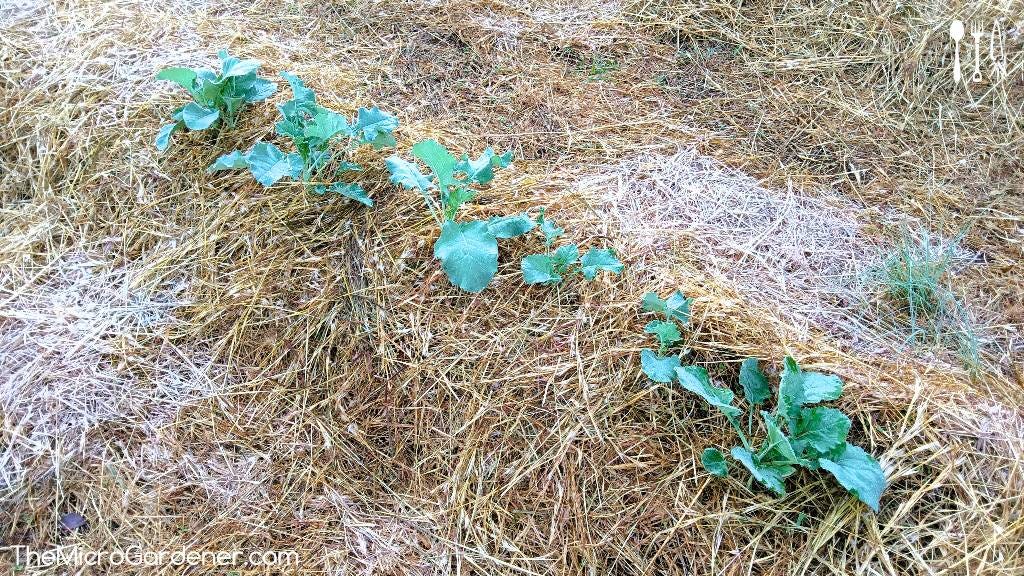
I know that thoroughly watering your soil before a forecast frost night sounds counterintuitive as a frost-prevention strategy! Adding water when freezing is the threat you’re trying to avoid may sound wrong, but the science backs this up. [See the References to dig deeper if you’re curious.]
Moist soil stores and conducts heat differently from dry soil. Water has a high specific heat capacity. It takes a lot of energy to change its temperature. So wet soil absorbs more heat during the day and releases it more slowly overnight.
The water in the soil acts as a heat battery, buffering the temperature drop around your plants' roots and the air immediately above the soil surface.
A 2022 laboratory study* published in the journal Water put it to the test. Researchers subjected three soil types (sand, loam, and clay loam) to subfreezing temperatures at two different moisture levels: 30% and 40% of field capacity.
💧 Across all three soil types, the wetter soil (40%) stayed warmer for longer than the drier soil (30%) at every threshold temperature tested. Loam soil at the higher moisture content took the longest to freeze of any combination.
The difference in time to reach freezing became more pronounced as temperatures dropped further. Interestingly, the moisture effect actually got stronger in deeper cold, not weaker. What did the researchers recommend?
🫗“Watering plants late in the afternoon when overnight freezing temperatures are forecasted would most likely lessen the negative impact on plant root systems.”
💦 There’s another factor at play. Water in the top layer of soil releases heat as it freezes - the same reason a bottle of water in the freezer stays at 0°C for a while before it actually freezes solid. That process creates warmth, buying your plants an extra hour or two through the coldest part of the night.
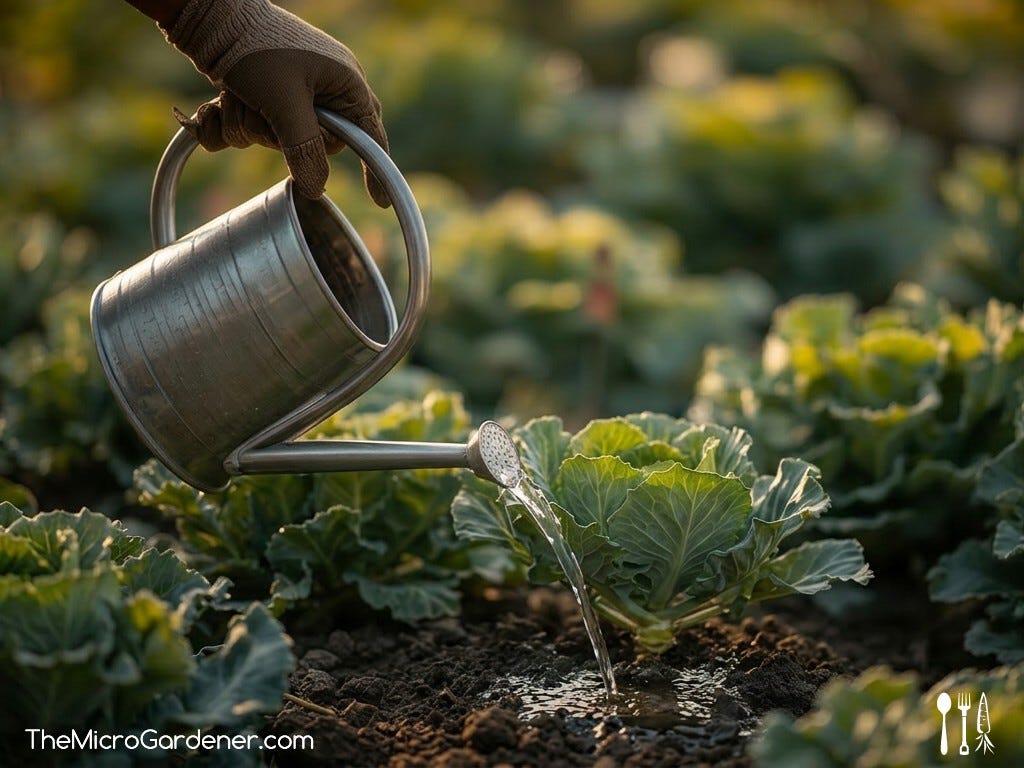
What I’ve learned to do:
Water at the base of plants, not the leaves. Wet foliage freezes faster than dry.
Water by mid-afternoon so the water has time to warm in the soil before temperatures start dropping at sunset. Think of it as tucking your plants into a damp, warm blanket that radiates heat all night. A comforting thought!
Avoid watering just before dawn. I learned the lesson that this can actually make things worse by adding evaporative cooling right when temperatures are bottoming out. 🙄
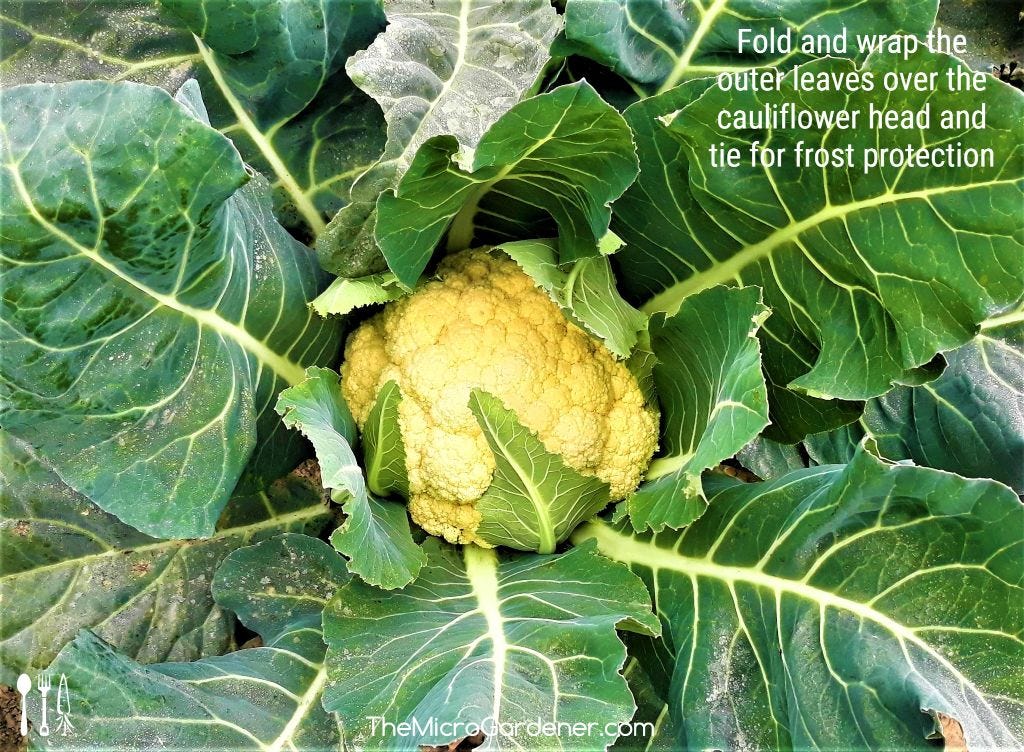
When I first used fabric to cover plants, I made a classic mistake - draping it directly onto the leaves. 🙄 Sure, any old fabric traps heat rising from the soil, but where it touches foliage, the heat conducts straight through, and the leaf freezes exactly at the contact point. The next morning, I found brown patches in the precise shape of where the sheet was resting - like a forensic fingerprint pointing out my mistake! A harsh but valuable lesson to take on board.
I also learned to avoid plastic, which keeps condensation in and can cause freezing.
With that renewed understanding, I have since hoisted the cover above the plants. You can use stakes, pruned branches, wire hoops, upturned buckets - anything that creates an air pocket.
I’ve raided the linen cupboard and hit the op shops. Old bedsheets or tablecloths, curtains, hessian sacks, drop cloths, ratty blankets and thermal landscape fabric all work. As long as the fabric traps rising ground heat and doesn’t touch your precious plants. Remove the cover once the temperature climbs above freezing. Polystyrene produce boxes are free and have worked well for me to save seedlings.
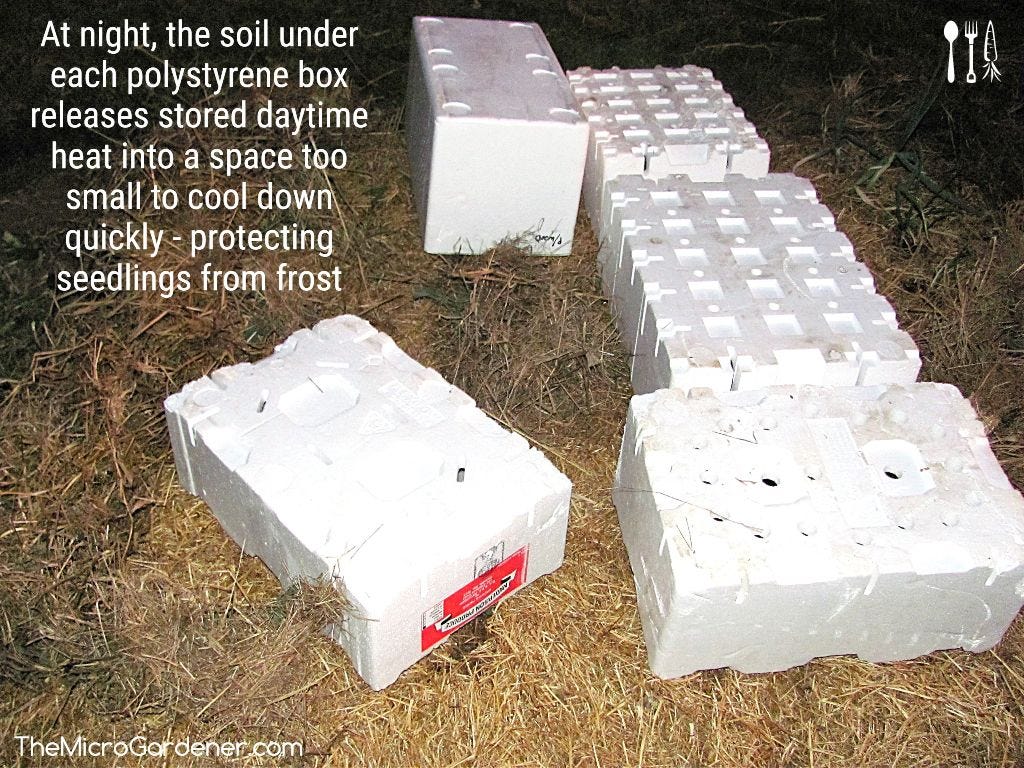
During the day, soil absorbs solar energy. After dark, that heat radiates upward. A polystyrene box blocks the escape route. The seedlings inside sit in a bubble of yesterday’s heat while the temperature outside the box keeps dropping. I store the boxes in my shed and use during extremes of cold and heat. They insulate both ways.
You may also notice the mulch. Studies* confirm it’s a thermal buffer, stabilising soil temperature and moisture levels, and reducing freeze-thaw cycles. Mulch is an insulating layer of trapped air and organic material that slows heat loss from the soil surface, like a blanket, using the same principle as the polystyrene box.
Heavy materials that absorb heat during the day and release it slowly at night have thermal mass. e.g. brick, stone, concrete, and water.
✔️ A few dark-painted bricks or large stones placed among your winter veg absorb solar radiation through the short days and release it back after sunset.
✔️ A 10-litre black bucket of water does the same thing. Water stores about four times as much heat per unit volume as soil, concrete, or brick.* It’s similar to a ‘hot water bottle’ we snuggle up with on cold winter nights - but in your garden bed. It recharges itself every day for free.
✔️ Tuck black-painted soft drink or wine bottles filled with water where they catch the direct winter sun, close to the plants you’re protecting. The impact is local in a small space, but even a few litres of thermal mass can buy you a degree or two. This can be the difference between damage and survival on a marginal frost night.
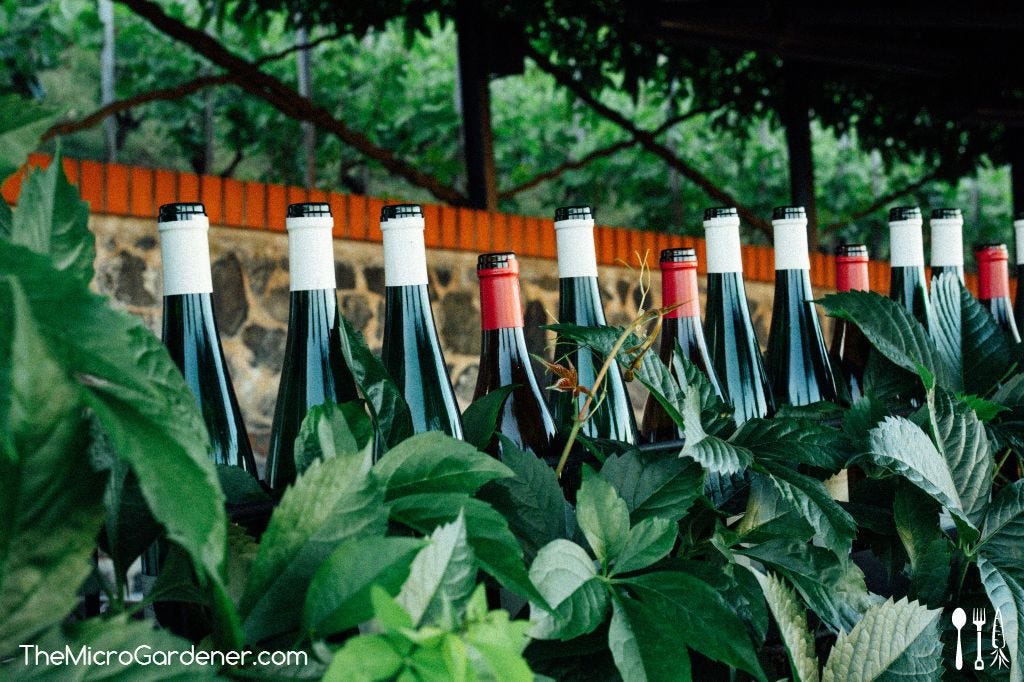
☀️ Where’s the best position? On the north side of plants, where it absorbs maximum winter sun. Against a north-facing brick wall is ideal because the wall itself becomes a heat battery.
🔎 I regularly observe the heavy fog ‘lakes’ in the valleys below our property. Cold air is denser than warm air and flows downhill, pooling in low spots the way water finds a drain. The difference between a frost pocket and a frost-free zone on the same suburban block can be 2–4°C.
👀 What I’ve found works well is to spend one winter morning just observing. Where does frost settle first? Where is it absent? Discover the danger zones. [I show you how in the post below.]
The Small Edible Garden Guide: Part 2
·
May 19, 2025
Learn how to observe your space with intention and tune into your garden’s natural patterns. Tracking sunlight, spotting microclimates, and picking up on the small, sometimes hidden clues nature leaves behind. Dig in!
🧭 North-facing slopes warm earlier and stay warmer. Brick walls radiate stored heat. Microclimates under roof eaves are typically 2–3°C warmer* than open areas. Concrete paths and driveways soak up daytime heat and moderate the soil beside them. Understanding and working with our unique microclimates helps us design out issues.
🪴 Uncertain which crops will flourish in your pots? Overwhelmed by conflicting advice on companion planting or troubleshooting dying plants? My 4-in-1 Container Gardening Bundle is your ultimate roadmap to edible abundance - whether you’re growing on a balcony, patio, small garden or windowsill.

Packed with easy-to-follow tables, actionable tips, and vibrant colour photos, these guides cut through the clutter and deliver practical, time-saving wisdom for urban gardeners and small-space growers.
Well, that’s a wrap from my garden to yours. Keep scrolling down for more resources.
🎁 My articles here are all free - my way of helping you grow good health. I’d be deeply grateful for your support on Ko-fi. Click the heart 💚, share with a restack 🔄, or leave me a comment. 💬 This helps more gardeners see this newsletter – like leaning over the fence to swap tips. Thanks so much. x

Bsoul, R., Al Qudah, A., Abu-Dieyeh, M., & Al-Omari, A. (2022). "Laboratory-Scale Study on the Effects of Freezing in Soils when Subjected to Different Moisture Content." Water, 14(12), 1892.
Yamada, M., Sato, T. & Takahashi, H. (2009). "A numerical simulation of the effect of water table levels on nocturnal air temperature and frost damage in Mire, Japan." Wetlands, 29, 176–186.
Kohnke, H. & Werkhoven, C.H.E. (1963). "Soil Temperature and Soil Freezing as Affected by an Organic Mulch." Soil Science Society of America Journal, 27(1), 13–17.
Chen, L. et al. (2019). "Effect of Straw Mulch on Soil Evaporation during Freeze–Thaw Periods." Water, 11(8), 1689.
Stomatal conductance mechanism: Ando et al. (2024), “Warming triggers stomatal opening by enhancement of photosynthesis and ensuing guard cell CO₂ sensing, whereas higher temperatures induce a photosynthesis-uncoupled response,” New Phytologist. Also, Marchin et al. (2022), “Extreme heat increases stomatal conductance and drought-induced mortality risk in vulnerable plant species,” Global Change Biology.
Olla irrigation water savings: Ezekiel, Ibrahim & Kwatmen (2017), “Effect of Radial Spacing on the Growth and Yield of Maize under Olla Irrigation,” Global Journal of Science Frontier Research, Vol. 17:1, pp. 83-88. The University of Arizona Extension publication “Irrigating with Ollas” (AZ1911) summarises the practical applications.
Yusefi, A., Farrokhian Firouzi, A., & Aminzadeh, M. (2020). "The effects of shallow saline groundwater on evaporation, soil moisture, and temperature distribution in the presence of straw mulch." Hydrology Research, 51(6).
Markham, J.W. et al. (2011). "Effect of Container Color on Substrate Temperatures and Growth of Red Maple and Redbud." HortScience, 46(5), 721–726.
Thermal mass: Kozai, T. (1986). “Thermal performance of a solar greenhouse with water tanks for heat storage and heat exchange.
Govind, R., N.K. Bansal, and I.C. Goyal (1987). "An experimental and theoretical study of a plastic film solar greenhouse." Energy Conversion and Management, Vol. 27, Issue 2, pp. 141–147.

Thanks for reading. I look forward to sharing more ways to grow good health soon. Happy planting this month, Anne🌱

Available for iOS and Android
✳ P.S. If your email provider truncates this post, click on “View entire message” or “…” at the end so you don’t miss out on the tips, resources and pics.
Disclaimer: This information is educational material only and is not a substitute for professional medical advice, diagnosis, or treatment. Consult a qualified healthcare provider for any health concerns. The author is not responsible for how you use this material or any resulting medical outcomes.
Comments
Nothing yet. Say the first thing.
Sign in to join the conversation.