
By any reasonable measure, the Long Reach Village Center redevelopment was done.
Not built. Done as in the zoning case was finished. Every step in the complex, iterative, years-long process a major village center redevelopment must navigate had been completed. All that was left was for the Howard County Zoning Board to vote, and to sign a Decision and Order on Case ZB 1132M that would make the approval official. The final vote could have come at the board’s June 10 meeting — the last one before a blackout period, beginning with the June 23 primary, that bars the Zoning Board, which is made up of the County Council, from deciding cases during its lame-duck stretch.
Then, the day before that vote, the developer asked for a delay.
Not the County. Not the community. The developer itself moved to substitute its own counsel, postpone the case, and disqualify a sitting councilmember. The Zoning Board obliged, shelving a redevelopment project that had been a decade in the making for yet another year, until a new County Council assumes its positions on the Zoning Board.
That alone is remarkably strange. Developers spend years and real money fighting for approvals. They don’t, as a rule, torpedo an approval sitting in front of them. And they typically don’t change attorneys at the very last moment either.
Here’s what turns strange into a pattern: Columbia Concepts is this developer — a recently formed entity led by Brian Kim of CDC Capital that landed two high-profile Howard County projects, both without a competing bidder, both aimed at turning vacant or unprofitable, but once thriving, Columbia properties into a community resource. One is Long Reach Village Center, the village center formally declared blighted that sits inside the otherwise thriving Dobbin/175 retail corridor.
The other is The Source, the Wilde Lake community center that received $25 million in public grants and still carries a financing gap no one will explain how it will be filled. Its finances have drawn months of questions from numerous community members, the Baltimore Sun, and me — and became a central campaign issue in Deb Jung’s failed bid for county executive.
These are two of the county’s most ambitious community projects. One developer. Both seemingly stuck.
The Long Reach Village Center redevelopment is a project with real community support, a financially viable plan anchored in real revenue streams — 505 housing units, tens of thousands of square feet of retail, the kind of uses that let a for-profit redevelopment support debt and attract investment — and an approval that was sitting right there. Now, the developer itself has delayed the approval it needs for at least another year. Why?
This article examines that “why.” A close look at the record suggests one explanation: Columbia Concepts doesn’t actually own — or have a contract to buy — a meaningful share of the land inside its own redevelopment footprint. Let that sink in. Columbia Concepts’ development plan for the Long Reach Village Center, one it has spent the last couple of years driving through the development approval process, is to redevelop properties it doesn’t own — and which, by all indications, it has not come anywhere close to a deal to acquire. What follows is an examination of exactly what Columbia Concepts still doesn’t own, who’s still saying no, and why a developer would walk away from the finish line it had nearly reached.
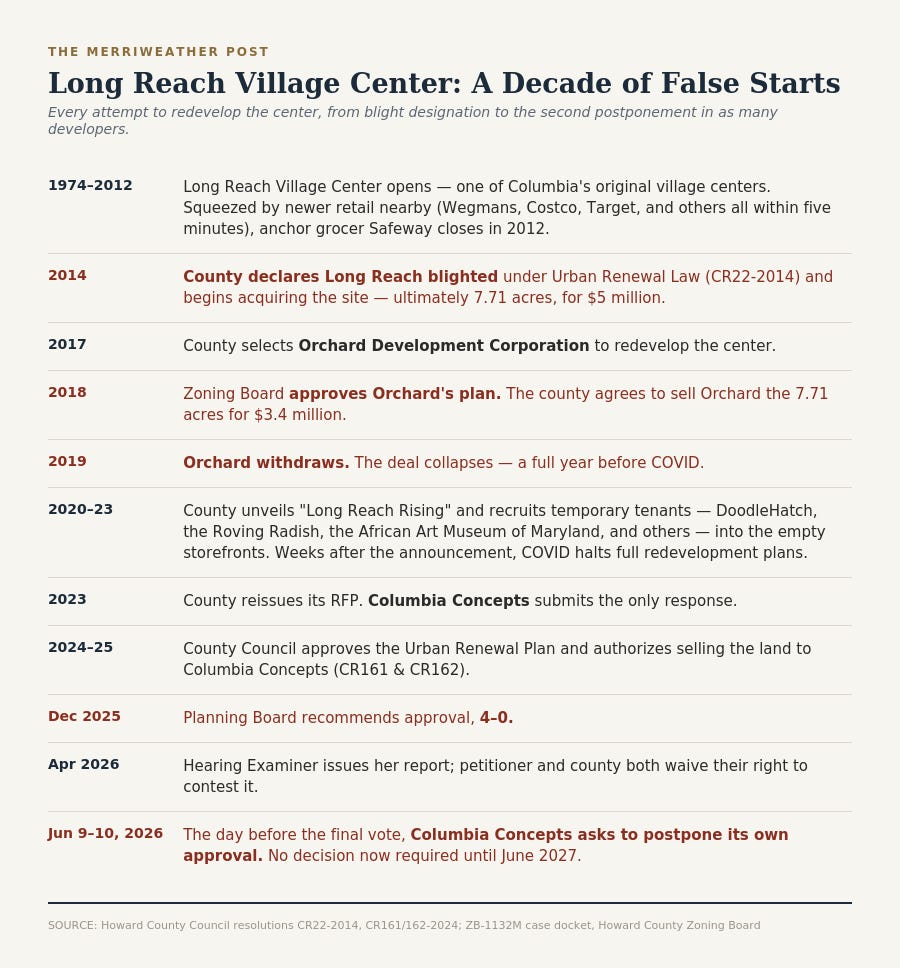
First, a bit of history. This is not the first attempt at redeveloping the Long Reach Village Center. The entire saga is captured in the table below.
Columbia Concepts calls their plan “Destination Long Reach.” Five buildings, five phases, 505 dwelling units in total — fifty townhomes for outright ownership, 255 rental apartments, 200 age-restricted senior units — plus a 136,300-square-foot indoor multi-sports complex with basketball, volleyball, pickleball, even a rock-climbing wall. Retail threads through several buildings. Six acres of open space knit it together, including a community park built for concerts and outdoor theater. Nine bus stops sit within a quarter mile. Multiple bike and pedestrian trails connect the center to nearby neighborhoods and CA pathways.
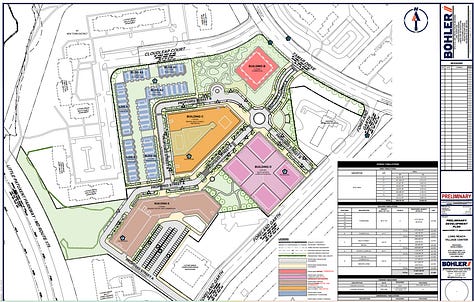

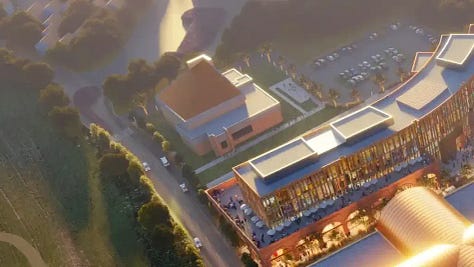
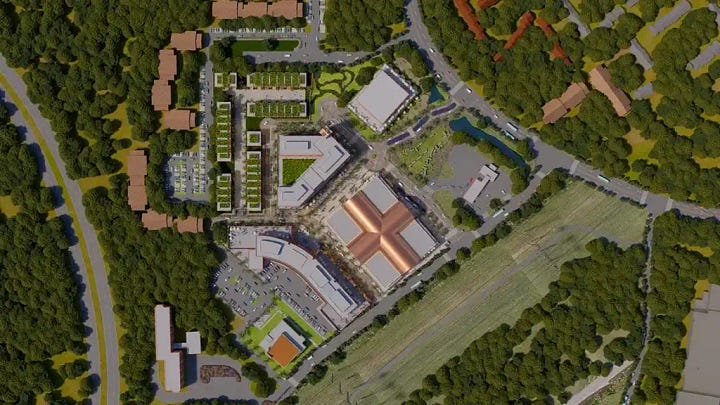
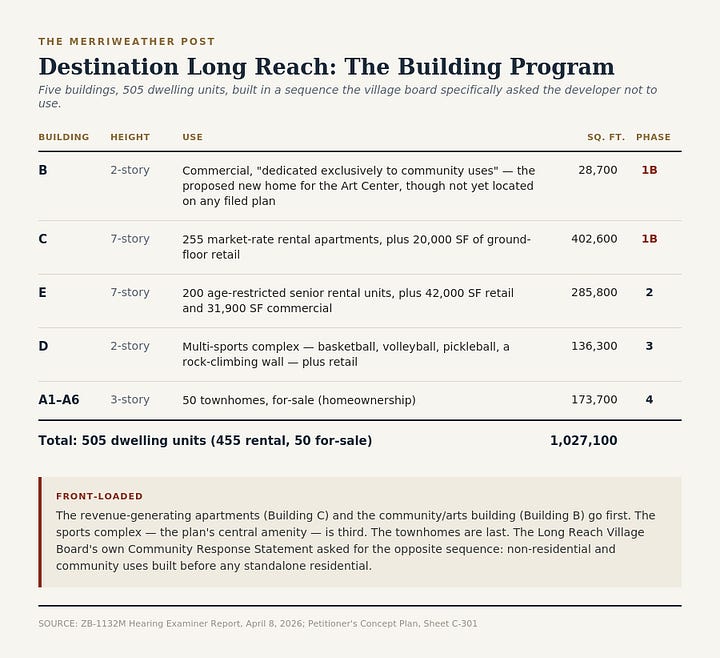
This is a good plan. It puts new housing exactly where the county’s own general plan says housing belongs. It replaces a decade of vacancies and temporary tenants with something that could actually work to attract and retain retailers and return the center to relevance.
Which is what makes everything that happened in June so remarkable. The Village Board of the Long Reach Community Association has expressed support (with some caveats regarding sequencing and parking), The Planning Board had recommended approval, unanimously, in December. The Hearing Examiner held her hearings in March, closed the record April 1, and issued a favorable report on April 8. Both the petitioner (Columbia Concepts) and the county’s own zoning counsel then waived their right to contest anything in that report — the legal equivalent of “we’re good, wrap it up.” By late April, every procedural box that could be checked, was checked. All that remained was a vote, then a signature on a Decision and Order from the Zoning Board, and Columbia Concepts would have had everything it needed to proceed with construction.
Instead, it asked the Zoning Board to delay that decision.
Now, everything is on pause. Lland acquisition, site development plans, permits, construction - none of that can happen until a new Council is seated at the end of this year and, puts their zoning hats on, and reconsiders the case — now with a June 30, 2027 deadline for a final decision.
Why so long a delay? The current Zoning Board was racing a real clock. Howard County Code § 16.211 bars the County Council — who sit as the Zoning Board — from signing any final zoning decision after the date of a primary election, until the newly elected Council takes office. This year’s primary was June 23. June 10 was the last possible meeting where the board would be able to vote to approve the D&O and still provide time a limited window for the order to be drafted and signed before the blackout began.
But on the eve of that vote, Columbia Concepts made a curious move. Owen Jarvis of Carney Kelehan — the attorney who had represented the Columbia Concepts from the start of this case, filed the original petition, argued the hearings, and only weeks earlier had waived Columbia Concepts’ right to contest the Hearing Examiner’s report — was out. In his place: Chris DeCarlo of Venable LLP, who told the board he’d been retained only the day before. His first act was to file a motion to Substitute Counsel, Postpone, and Disqualify.
A brand-new attorney to the case, unfamiliar with a record built across a year of hearings and filings, would reasonably need time to prepare. But that need didn’t exist the week before — Jarvis had carried this case from day one and now the case was at the finish line. Replacing him is what manufactured the case for delay. Nothing forced Columbia Concepts to make that swap on the eve of the vote. It chose to. So, needing to provide time for their new attorney to get up to speed doesn’t strike me as a reason for delay.
So why did they do it?
The most obvious explanation for the motion to delay is that Columbia Concepts didn’t think it had the votes, and instead opted to kick the case to the next Board.
Councilmembers Rigby and Jones are reliably supportive of housing initiatives like this one. But Walsh and Jung were both in the middle of a county executive race, and Columbia Concepts may have worried they’d be reluctant to hand a win to a politically fraught project weeks before the primary.
That worry, if it existed, sits in some tension with how the job actually works. When the Council sits as the Zoning Board, its members aren’t legislators casting political votes — they act in a quasi-judicial capacity, closer to judges. They’re expected to weigh the evidence in the record, remain impartial, and issue a reasoned decision tied to the applicable zoning criteria, not to politics. A denial that ignored a clean record could be challenged on appeal. Of course, in practice, a member inclined to vote no could usually find a process or procedural concern to hang it on.
Still, discount Walsh and Jung, and — as has so often been the case over the past eight years — it comes down to David Yungmann as the swinger vote needed for a narrow but still favorable 3-2 decision. He’s never been easy to predict ahead of a vote. But on a record as clean as this one, unanimous at the Planning Board and a favorable verdict from the Hearing Examiner, I suspect he’d have supported it.
So the outcome of a June 10 vote was a genuine open question — but still one I’d argue was likely to break in Columbia Concepts’ favor. Which is what makes the decision to postpone so telling. A developer confident enough to spend two years and real money reaching this point doesn’t suddenly walk away from a probable “yes” over a possible “no” — unless the approval wasn’t actually needed at this time. Maybe the real reason they delayed the case is because they aren’t actually ready to move forward, and so a delay doesn’t matter as much as one would think.
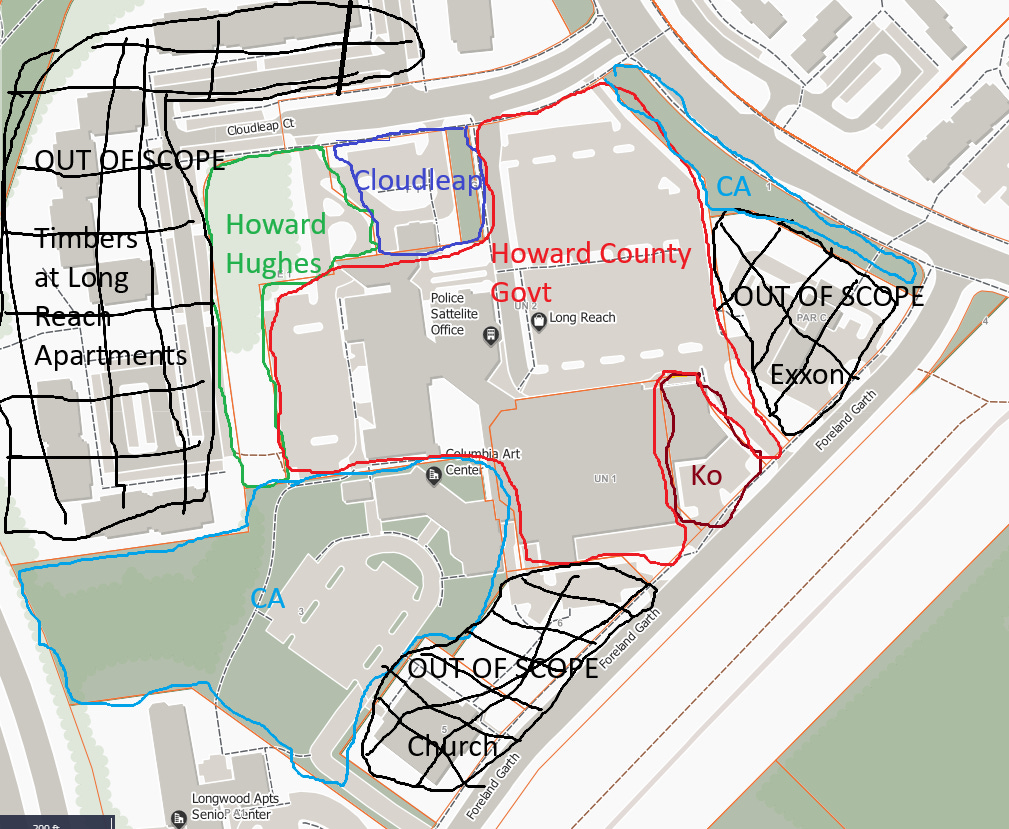
The Howard County government owns only a portion of the Long Reach Village Center. The redevelopment plan put forward by Columbia Concepts expands well beyond the county's site to include four other parcels, as depicted in this map below, which I have marked up to label the property owners using the property records obtained from Howard County's interactive map. So, to fulfill their proposed redevelopment plan, Columbia Concepts would need to acquire land from five separate owners: the Howard County government, the Columbia Association, Howard Hughes Holding, the Ko family, and Cloudleap LLC.
This table contains more information on each parcel.
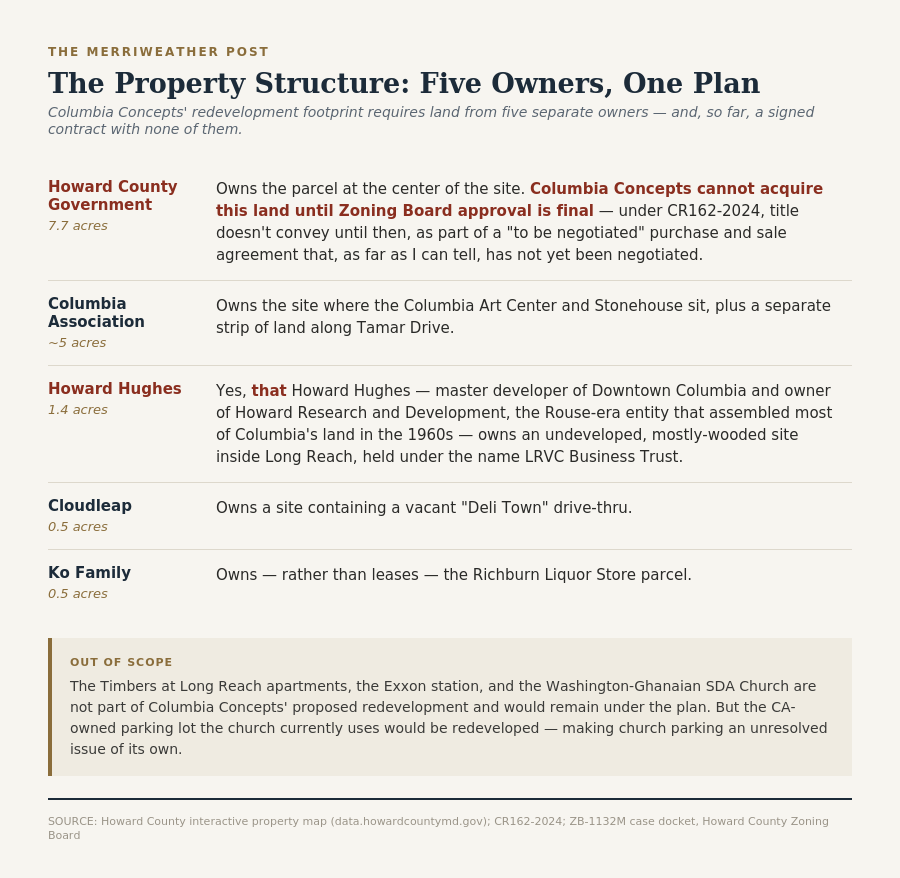
None of this land has been acquired.
To even file its zoning petition, Columbia Concepts needed sign-off from every landowner inside its 16-acre footprint — not just the county. As described in the table above, four other owners hold pieces of this site: Columbia Association, Howard Hughes (through a subsidiary called LRVC Business Trust), Cloudleap LLC (the entity that owns the vacant Deli Town drive-thru), and the Ko family, owners of Richburn liquor store. Columbia Concepts got the sign-offs they need but they aren’t uniform. Columbia Association and Howard Hughes — both with real legal counsel — negotiated narrow, heavily lawyered letters: explicit that they are not agreements to sell, not support for the project, revocable at will, with the owner keeping veto power over any design change touching their land.
The smaller owners, Cloudleap and the Ko family, signed something much thinner: a one-page Howard County boilerplate form that simply authorizes Columbia Concepts to act on their behalf — no revocability clause, no disclaimer, arguably broader authority than what the sophisticated owners agreed to, which hints that these properties would be easiest to acquire.
What all five documents share, regardless of form, is the one fact that matters most: not one of them is a purchase contract. The Hearing Examiner’s report itself noted this same gap — finding no written assent from the legal title holders anywhere in the record, and directing that the omission be “clarified prior to final approval of the subject petition.”
The clearest, and most consequential, example of this gap is the Columbia Association, which owns a third of the site that is being proposed for redevelopment.
Between 2023 and early 2025, CA invested in a multi-million-dollar renovation of the Columbia Art Center and the Stonehouse community center — a new elevator, upgraded electrical service and panels, a new sprinkler system, a replaced fire alarm system, new HVAC, flooring, and ADA compliance work throughout — that concluded in early 2025.
This was not a building CA was preparing to give up. It was a building CA had just reinvested in as a going concern.
In September 2025, Columbia Concepts came asking anyway, requesting that CA sign a property-owner’s authorization form to include CA’s land in its proposed redevelopment.
CA said no. A refusal letter went out on October 9, 2025.
Six days later, after more conversations, CA signed something — but not much. The October 15 authorization goes out of its way to say what it isn’t: it “does NOT constitute an agreement with or support of” the redevelopment. It lets Columbia Concepts show CA’s land on a zoning map. That’s it. CA kept veto power over any change to density, height, parking, or design touching its property. CA can force the whole petition to be withdrawn on written request. CA can revoke the authorization at any time, for any reason. And no contract to purchase CA’s land exists — Columbia Concepts’ own cover letter admits a purchase agreement “has not yet been prepared or negotiated.”
To be fair to Columbia Concepts, the pitch it made to CA wasn’t unreasonable on its face. The developer offered to buy CA’s parcels at appraised value, build the Art Center and Stonehouse a new home elsewhere on the site, and then sell the new building to CA or sign CA to a long-term lease. An appraisal was even commissioned. It’s the kind of offer that is at least worth CA’s consideration.
Nonetheless, CA spent millions renovating a building it operates today. It was asked to hand over a comparable stake in land in exchange for a replacement, and none of this has been negotiated or agreed to by either party. The state of these negotiations highlights the difficulty facing Columbia Concepts as it seeks to acquire 5 separate parcels necessary to move the redevelopment of the Long Reach Village Center forward.
Which brings us back to Deb Jung.
At the June 10 meeting, DeCarlo’s first act was to file the motion to substitute himself in, postpone the case, and disqualify Jung from voting — citing an ethics complaint Brian Kim of Columbia Concepts had filed against her, which led to Jung objecting that references to the ethics compliant must remain confidential.
Here’s what’s strange about it. Disqualifying Jung wasn’t necessary to win. They didn’t need her vote. They can get the D&O so long as they get yeses from 3 councilmembers.
So why the motion? If I’m going to speculate, and regular readers of my blog know that’s something I’m not afraid to do, I can think of two plausible explanations, and they aren’t mutually exclusive. One: this was personal or political — a councilwoman who’d been asking pointed questions about the developer’s other project was being targeted through the one case where the developer had leverage to do something about it.
Two: the ethics complaint and disqualification motion was cover — a public, defensible-sounding reason to keep the redevelopment dragging on instead of moving it forward and putting the onus back on them to get shovels into the ground. It’s preferable for Columbia Concepts to be able to say the “case hasn’t been decided” than it would be for the case to be decided in their favor, only for them to have to admit that “we’re not ready to build.”
If the motion is cover, I suspect the reason they aren’t able to move forward at this time is because they don’t have the land, the money, or both.
Start with the land. As detailed above, Columbia Concepts is trying to build on property it doesn’t own, held by five separate owners — including two, the Columbia Association and Howard Hughes, whose own letters make clear they are a long way from a deal. So one explanation is simple: Columbia Concepts doesn’t have the land locked up, isn’t certain it can get it, and opted to punt rather than win an approval it couldn’t act on.
The other is money. This is the same developer behind The Source, which carries its own unexplained financing gap. It’s now seeking investment to redevelop a site that drew no competing bid — and that the previously selected developer, Orchard, walked away from in 2019 after winning zoning approval. And while the development proposal has serious profit-upside, the financing math here is genuinely hard. The revenue that makes this project work comes from the housing. But the community, through the village board, asked that the community amenities be built first, before the revenue-generating units. Columbia Association, if it ever agreed to sell, would almost certainly want its replacement building constructed before it vacated the one it operates today. In other words, Columbia Concepts is being asked to finance the expensive, smaller-earning pieces of this project before the pieces that actually generate a significant return come online. That sequence introduces investment risk that makes it harder to finance.
If it’s the land, the money, or both, rather than push forward to collect a D&O it would then be expected to act on, Columbia Concepts postponed — buying time to (hopefully) resolve these problems while publicly appearing to simply be waiting on a new Zoning Board.
Let me be clear that this is speculation. Nobody but Columbia Concepts knows what drove the decision to delay. But when the facts of a case are this strange, I think it’s a more plausible explanation than any other I can construct.
I’ll be direct about where I stand. Every public move Columbia Concepts has made, on both of these projects, raises doubt in my mind about whether either project will be built. I’m skeptical Columbia Concepts gets Long Reach done just as I’m skeptical it gets The Source done. I hope I’m wrong on both counts — genuinely. I want Long Reach redeveloped. I want The Source to open. But “I’ll believe it when I see it” is where I am, and I’m not holding my breath.
A final word to anyone rooting for either project to succeed, because I’m one of them: giving Columbia Concepts the benefit of the doubt right now — assuming it all works out the way the renderings suggest, and treating anyone who asks questions as an opponent acting in bad faith to obstruct progress — is also a strange posture to choose. The more reasonable position, from my perspective, is for proponents to ask questions, and to keep insisting the developer be honest about any barriers they are facing and reasons for delay, so those obstacles, whatever they may be, can be overcome.
I’m Jeremy Dommu — a Columbia resident who writes about development, land use, and the entities operating in Howard County as an independent hobby. I have a real job and a family. This is what I do in my spare time.
Every article I write is free. No paywalls, no exceptions. Ever.
If you found this piece valuable — if you think someone should be pulling five separate property authorizations off the Zoning Board docket, cross-referencing them against the developer’s own filings, reading a 53-page Hearing Examiner report to the footnotes, and doing the work to figure out that a decade-in-the-making redevelopment rests on land the developer doesn’t own — becoming a paid subscriber is how you keep this going.
I’m also rolling out new benefits for paid subscribers, while keeping every article free. Paid subscribers get insights to my selection and writing process, the ability to suggest topics, and invitations to exclusive events — like a happy hour at Encore in late July.
If you’ve been reading for free, keep doing that. And keep sharing my articles. Seriously. But if you’re ready to support independent local coverage of Howard County — especially now, with a new Council and County Executive about to inherit some very big decisions, including this one — the button is below.
No posts
Comments
Nothing yet. Say the first thing.
Sign in to join the conversation.