
There are new signs in the parking lot at the Mall in Columbia.
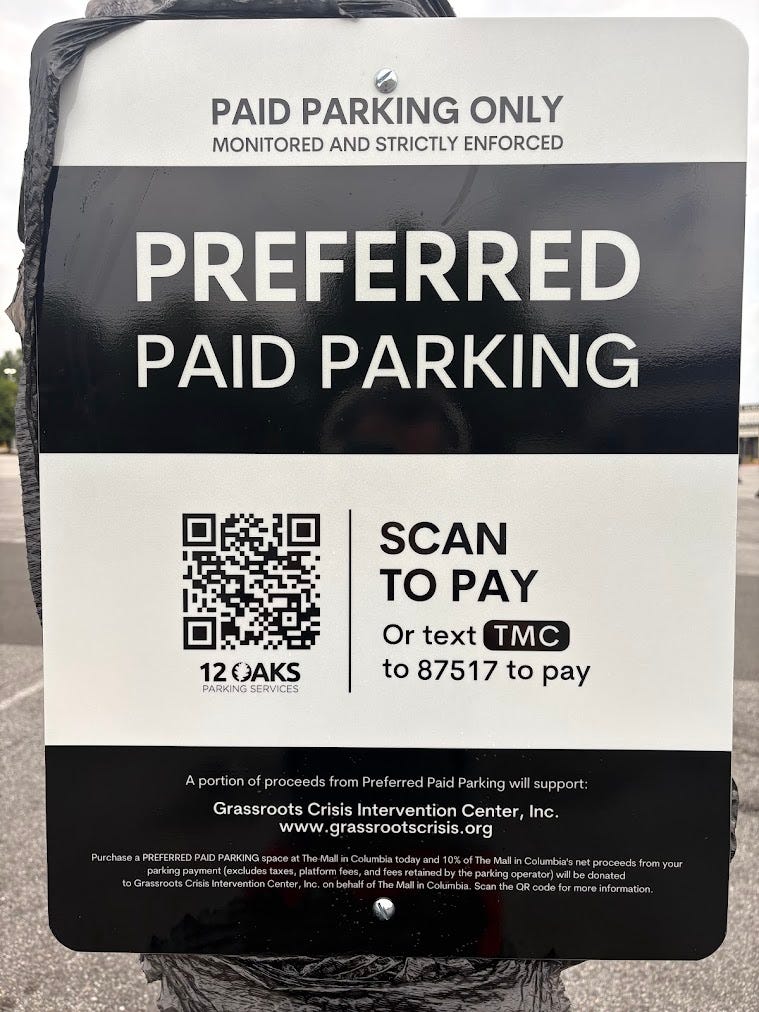
One hundred and twenty of the “best” parking spots at the Mall — out of 6,675 total spots — now cost money. And Columbia has some serious opinions about it.
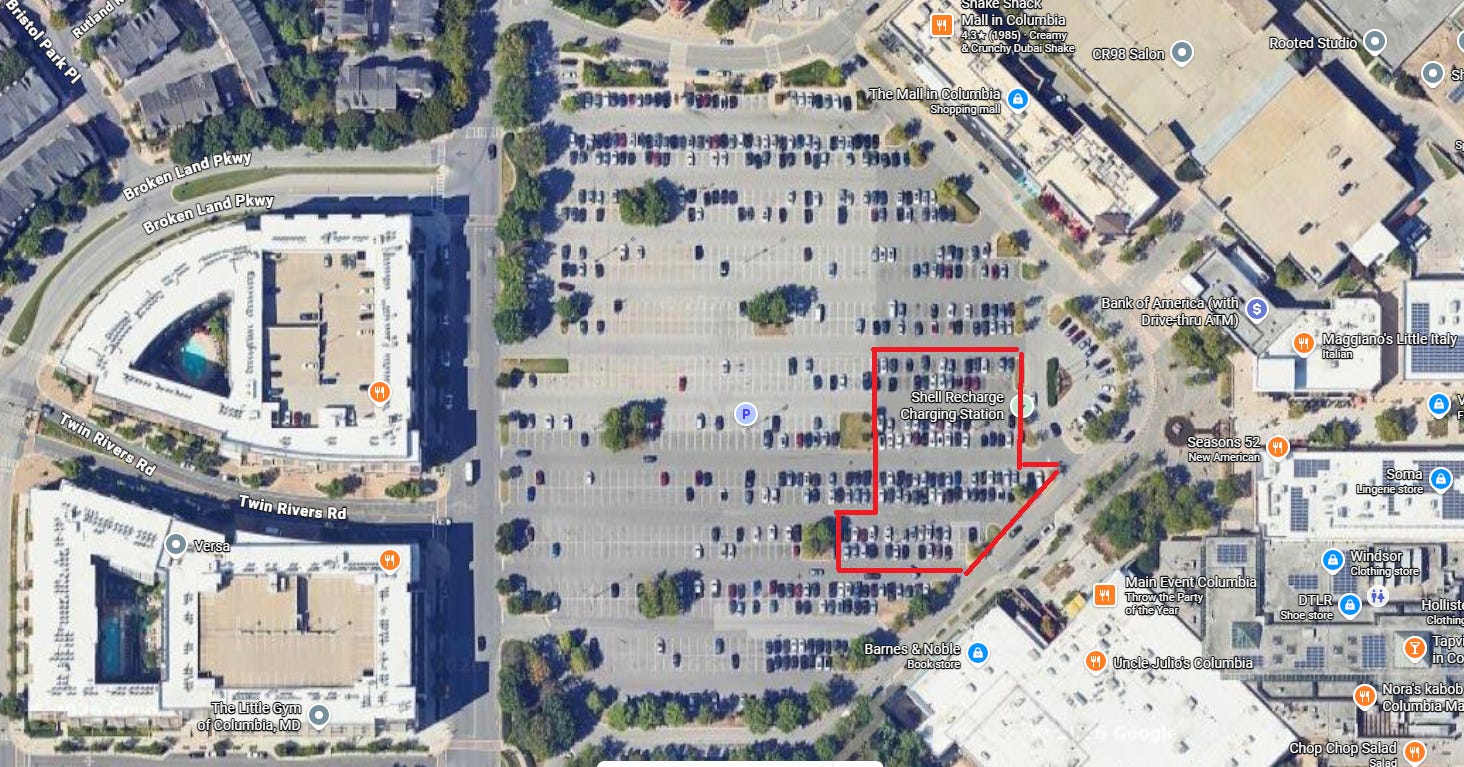
I went Sunday morning, the day before launch, to see them myself. The paid spaces are in the prime central lot near Main Event and Barnes & Noble — each marked with the above sign. I’ve circled the preferred parking area on the map below.
Paying is easy. Scan the QR code on the sign or text TMC to 87517, then enter your phone number and license plate, pick your parking duration, and input your credit card info for payment. No app to download, no account to create. The whole thing took me about sixty seconds.
I posted a quick take on Facebook on Saturday sharing my opinion that charging for these spots is a “nothing burger” that I have no problem with. Clearly, most people disagreed. The post got ratioed. 302 comments to 190 likes. Nonetheless, I haven’t changed my mind, and I’ll spend the rest of this piece defending it: charging for these spaces is fine. Good, even. But it’s also the least interesting thing that could possibly happen to this land.
While everyone argues about 120 parking spaces, very few are asking the bigger question — why is this land a surface parking lot at all? Why is some of the most valuable, best-located real estate in Howard County being used to store empty cars?
Here are the mechanics.
It’s $2.45 for the first hour and $2 for each additional hour, topping out at $10.45 for five hours or more. So two hours is $4.45, three is $6.45, four is $8.45. (The Banner reported $10.45 for four hours or more. I clicked through the QR code myself — four hours is $8.45. It’s five hours that cost $10.45.)
Enforcement is license plate recognition, 24 hours a day, seven days a week, with no grace period for running in quickly. Don’t pay and you get a “Parking Charge Notice” from a private parking ticket company. You can pay it or appeal it at parkinginvoice.com, with appeals due within 15 days. I could not find out how much the fine is, or what actually happens if you get one and don’t pay it. My research for this piece included spending $2.45 to try out a spot. I draw the line at intentionally getting ticketed to find out what a ticket costs, or what happens if you don’t pay it.
Handicap spaces are unaffected.
Ten percent of net proceeds go to Grassroots Crisis Intervention Center. The sign is specific about “net”: so, the donation excludes taxes, platform fees, and fees kept by the parking operator.
So who, exactly, made this decision?
The local management of the Mall in Columbia did not decide to charge for parking.
The Mall in Columbia is one of roughly 100 properties owned by GGP — General Growth Properties — a subsidiary of Brookfield. Over the past year, GGP has been rolling out this exact program across that portfolio. Per my research, at least 17 GGP malls have introduced preferred paid parking: Oakbrook Center outside Chicago in February, Columbiana Centre in South Carolina in June, Mall St. Matthews in Louisville in July, and now Columbia in August. All using the same vendor (12 Oaks Parking Services), same rate structure, same ten-percent-to-a-local-charity arrangement. I imagine that GGP will continue to add preferred parking to many other malls in their portfolio over the coming months and years.
So, this came from a boardroom in Chicago. Some executive had the idea to monetize our collective unwillingness to walk an extra two hundred feet.
The good news is that no mall has expanded its paid footprint after the initial rollout, and GGP told The Banner there’s no plan to add additional paid spaces here. This means that under 2% of total parking spaces at the Mall in Columbia are now paid, and the other 98% remain free. This strikes me as a reasonable trade-off — the overwhelming majority of spots stay free for mall patrons, while GGP carves out a small paid tier to create a new revenue stream without driving customers away entirely.
But this is clearly a revenue play. So, let me get out an envelope.
Assume each of the 120 spaces is occupied an average of four hours a day. It’s surely more on weekends and through the holidays, and less on a slow Tuesday, but four hours a day seems a fair enough assumption to build on. That gets me to roughly $400,000 gross a year, give or take. If taxes, platform fees, and the operator’s cut run about 30% — a total guess, mind you — net proceeds land near $280,000, which puts Grassroots’ ten percent at around $28,000 a year.
That’s not nothing. It’s a real donation to a good organization. It’s also clearly not why anybody is doing this. If anything, I suspect the charity line does its best work as permission — people will justify their decision to pay for parking because some proceeds go to a charity doing good work in our community.
After fees and their donation, GGP gets something like $250,000 a year off one lot. Roll that across the portfolio — if every GGP mall performed like this one, which it won’t — and you’re in the neighborhood of $25 million a year to the corporate bottom line. For some signs and a license plate camera. Not bad.
When I posted about this on Facebook, the response was… robust. Surely, corporate monetization of a previously complimentary service is a sore spot for us HoCo locals, even when it impacts just 2% of total parking spots.
The objections clustered. Parents pointed out that a close spot matters enormously when you’re wrangling toddlers, a stroller, and everything else. Readers with mobility limitations who don’t qualify for a handicap placard, made the same point in a different register. Several readers made a straightforward class argument: this monetizes convenience, and convenience shouldn’t come with a price tag. One reader raised something I hadn’t considered and think is genuinely sharp — putting a price on the closest spaces increases the incentive to misuse a handicap placard.
These are fair. Let me offer the other side.
Right now, if you’re willing to pay for a spot near the door, you can’t. It’s taken. Especially on a busy weekend. If it’s busy, the only way to park in one of these spots is to circle and get lucky. What paid parking actually buys is availability — the reasonable confidence that if you show up with two kids and a stroller, a space near the entrance will be there, provided you want it badly enough to spend a couple bucks on it.
So I’d flip the equity argument. The line this draws isn’t between people with toddlers and people without, or between people with mobility issues and people without. It’s not about people who legitimately need a close spot. It’s between people who can pay and people who can’t.
But we are talking about $2 an hour, at a shopping mall, a place whose entire reason for existing is that you brought money with you to buy stuff.
Enclosed shopping malls are not locally owned and operated. They were a corporate product, delivered to American suburbs on a national template, and the ownership of them has been sold, spun off, and re-acquired ever since.
Our guy was in it early. Jim Rouse was a developer who built malls. That’s what he spent the majority of his career doing. Before Columbia was even a figment of his imagination, Rouse spent more than a decade building malls across America’s suburbs — Harundale in Glen Burnie in 1958, the Charlottetown Mall in Charlotte in 1959, the Cherry Hill Mall in New Jersey in 1961. By the end of the 1960s, Rouse was behind more than a dozen malls in total.
Later in his career, after Columbia, Rouse continued mall development, as he re-envisioned shopping as a tool for reviving downtowns rather than serving suburbs. He created the “festival marketplace” concept — Faneuil Hall in Boston, Harborplace in Baltimore, South Street Seaport in New York. Over four decades, Rouse developed dozens of shopping destinations.
As much as we center Rouse as the hero of the Columbia story — and he was — Columbia was never the center of his business or career. Columbia was the passion project. The side quest. A remarkable one, and the reason many of us live here. But, first and foremost, Rouse was the leader of the Rouse Company, a national real estate corporation that built malls, and our mall was just one property in a large portfolio, built within the first five years of the Columbia experiment. Almost as if part of the point of building Columbia was to create a community of people who would shop at his Mall.
That's worth mentioning because it means the Chicago boardroom isn't some new intrusion into Columbia's story — it's the same corporate structure that built the mall in the first place. So when a parking decision gets made in Chicago, that isn't some betrayal of the founding vision. That's how it has always worked. The business of shopping malls has always been run by national real estate corporations, not by locals. It just so happens that a pioneer of the enclosed shopping mall is also tied to our history — here's that history, transaction by transaction.
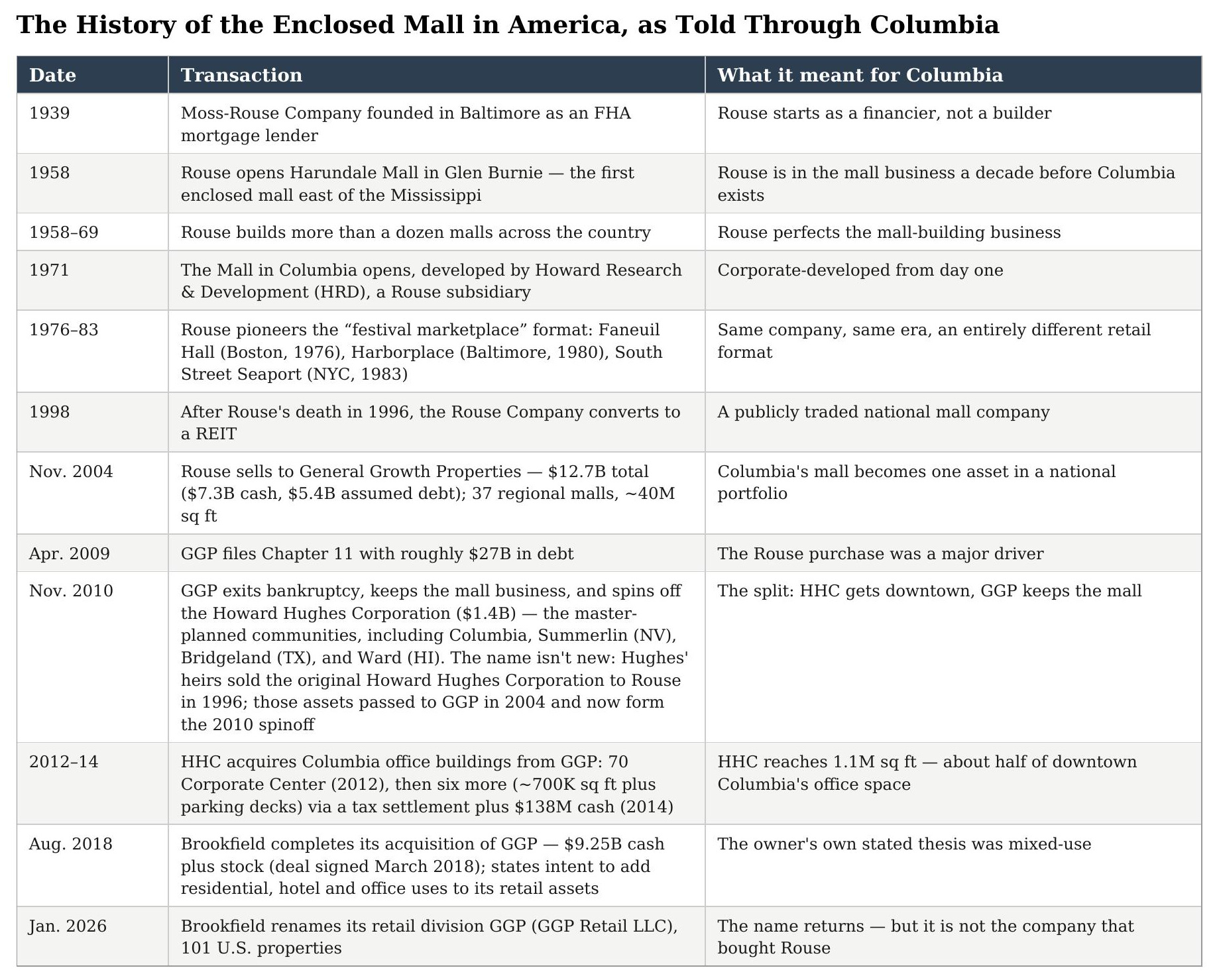
A few things worth noting specifically from the information I captured in the above table.
When GGP bought Rouse in 2004, it wanted the malls — and 37 of them came over. It didn’t care as much for all the other assets it acquired. GGP sold many of the non-mall office and industrial assets it acquired within the first few years after the acquisition. Then, coming out of bankruptcy in 2010, it spun off the master-planned communities — Columbia, plus Summerlin in Nevada, Bridgeland and The Woodlands in Texas, Ward Centers in Honolulu, and South Street Seaport in Manhattan — into a new independent public company: the Howard Hughes Corporation. The name wasn't new — the original Howard Hughes Corporation, the real estate holding firm for the famous aviator, businessman, and filmmaker, had been sold to Rouse back in 1996, and those assets passed to GGP in 2004, becoming the foundation of the 2010 spinoff.
2010 is the moment the mall and downtown Columbia became two different companies. It is also how Howard Hughes became our master developer: it emerged from that spinoff holding Howard Research and Development (HRD), and with it the land, the legal instruments, and the development rights across Columbia.
But the mergers and acquisitions don’t stop there. In 2018, Brookfield — another major mall operator, which had purchased a minority interest in GGP during GGP’s bankruptcy — fully acquired GGP, and operated its Mall business under the Brookfield name until earlier this year. Then, as if to make things even more confusing, in January 2026, Brookfield's retail division rebranded itself back to GGP. The name is back. But it’s still the same company.
Fortunately, for most of us, the Mall in Columbia is just the Mall in Columbia. We don’t spend much time thinking about its corporate parents or the corporate maneuvers that dictate its history. But the parents are where the decisions get made, which is why the structure matters.
Today the site is Brookfields, operating as GGP. Some of the department store boxes are owned by the retailers themselves — standard practice across the industry — but Brookfield owns the majority of The Mall in Columbia, roughly 62 of about 90 acres, including the parking lots that surround the building.
With one important caveat. While GGP owns the land, Howard Hughes holds a right of first offer on new development density within the Mall ring road, per HHC’s own 2020 annual report. It comes from the 2010 development agreement between HHC and GGP at the time of the spin-off, and it runs through 2030, so the clock on that right has four years left.
For the next four years, if GGP made the decision to add any development to this parking lot (and that’s a big “if”), Howard Hughes would get first crack at doing it. GGP’s options are (1) to do nothing and keep focusing on the existing mall business and tenants, (2) develop now and hand Howard Hughes the upside, or (3) wait until 2031 when Howard Hughes' rights expire, and redevelop itself.
For this reason, I wouldn’t bet on any development happening soon. Not only would it benefit GGP to wait, but even if it wanted to move forward, Howard Hughes, for its part, likely has its hands full elsewhere — as I’ve raised previously, I have some degree of skepticism that Howard Hughes is as committed to the Downtown Columbia buildout as it once was. There is some movement, though: Howard Hughes is seeking approval to demolish the One Columbia Center office building just north of the Mall and replace it with up to 150 residential units and an 80-bed assisted living and memory care facility, at heights up to 15 stories. But that’s a separate parcel entirely, not the mall parking lot. Beyond that, Lakefront North and the remaining Merriweather District surface lots are probably higher on Howard Hughes’ list than fighting for a piece of somebody else’s mall. The covenant is going to expire, and then Brookfield/GGP will have sole right to develop the mall lots if it so chooses.
Every surface parking lot in Downtown Columbia — the Lakefront, the Merriweather District, the Mall — is a waste of extraordinarily valuable land that should be mixed-use housing, office and retail wrapped around or beside parking structures. That isn’t my invention. That is what the Downtown Columbia Plan, the county’s own 30-year general plan for this area, calls for at full build-out.
But there’s an important distinction. The Plan sets what’s allowed. It doesn’t force anyone to build anything. Whether the Mall’s parking lots, or any surface parking lot in Downtown Columbia, actually get redeveloped comes down to one thing: whether the owner of that property - be it Howard Hughes, GGP, or Costello Construction - decides it wants to invest money to build out their property.
So will GGP build? I’m skeptical, at least any time soon, and not just because they’re waiting out Howard Hughes’ 2030 “first dibs” legal right.
Let’s start with the desire to build, which is real. Brookfield said back in 2018 that it intended to convert most of its roughly 125 malls into what it called “mini cities,” adding housing, offices, or hotels to the retail. This isn’t aspirational marketing copy nobody acted on. At Alderwood outside Seattle, it opened 328 apartments and new retail in 2022. At Cumberland Mall outside Atlanta, it plans to convert 20 acres of surface parking lot — exactly what I’m arguing for here — into two office towers, a 312-unit apartment building, and new retail. But the ambition to turn parking lots into buildings has gone slower than Brookfield itself hoped. Six years after the “mini cities” pledge, the Wall Street Journal reported the plan had “gone largely unfulfilled.” Brookfield’s own real estate CEO put it plainly: “These are big, complicated projects that happen over long periods of time.” The company has also been shedding malls, not just redeveloping them — 24 properties sold or handed back to lenders, another 16 targeted for disposal — while it concentrates new investment on its top 20 performers. So the ambition is genuine, the playbook exists, and Brookfield has proven it’ll follow through when a property earns the investment. Columbia just isn’t obviously in that first wave.
Whether that appetite reaches our particular parking lot is a different question, and it wouldn’t be Columbia’s to decide either way. A decision like this would come out of the same Chicago boardroom that set the parking prices, tied to a national read on where in the portfolio to spend next — not a one-off bet on Howard County. And there are real reasons a specific mall might wait its turn. Redeveloping a working, profitable mall’s parking is disruptive — you’re tearing up access and sightlines for existing tenants, potentially for years, in exchange for future foot traffic from apartments that don’t exist yet. Mall tenants, who depend on easy, visible parking to get shoppers in the door, are not going to be thrilled to trade free surface spaces for construction fencing. New on-site retail competes directly with GGP’s own tenants. And the thing suburban mall shoppers seem to want most — abundant, close, free parking — is exactly what a mixed-use conversion takes away, at least during construction.
None of this is an argument that the Mall itself is dying, or that it needs to go the way of White Flint in North Bethesda, which was entirely demolished last decade after its anchors fled and the property spiraled into vacancy, and is now slowly being replaced with mixed-use development. It’s true that many enclosed malls nationally are struggling — that’s not seriously in dispute — but the Mall in Columbia isn’t behaving like the next casualty. The Mall is always busy, and it’s home to tenants like Apple, Uniqlo, and lululemon — brands famous for being selective about where they open.
And it’s about to get busier: Brazilian steakhouse Fogo de Chão and the Michelin-recommended Nan Xiang Soup Dumplings are both moving into the spaces left behind by Walrus Oyster & Ale House and Chicken + Whiskey. Fogo isn’t a local operator making a sentimental bet — every Fogo location gets the same lavish, expensive buildout, open-flame churrasco grills, wine displays, the works, and the company itself is owned by Bain Capital, a private equity firm that paid $1.1 billion for the chain in 2023 and is actively expanding it at 15% annual growth. That’s a sophisticated national investor, with every incentive to underwrite carefully, concluding this mall is worth the capital. So this isn’t a White Flint argument. Nobody needs to bulldoze the Mall in Columbia. The ask is narrower: let the mall keep doing what it’s doing, but stop wasting the acreage around it on asphalt.
Downtown Columbia is supposed to become a city — a dense, walkable urban center. Fourteen million square feet, thousands of homes, offices, shops, parks, and streets people actually want to walk down. Density is what makes public transit viable. It’s what makes retail viable. More walkability, more bikeability, more accessibility, more life, more vibrancy, more events, more places to go, and things to do. You cannot have that if half the land is taken up by surface parking lots. The two are not compatible. Yes, you need parking. But it should be structured, and it should be paid.
Yes, I love cities and want a dense-city like environment in the heart of Columbia. But a major reason I’m so bullish on Downtown Columbia redevelopment is fiscal. Look at GGP’s 62 acres. The mall building takes up maybe a third of the site; the other two-thirds is parking. The current total assessed value is roughly $320 million — but the land itself is assessed at just $25 million. Under 8%. The improvements to that land — e.g. the mall buildings — are what generate value here. If the parking two-thirds were built out to be as productive as the third that’s already built, the assessment on that one site could plausibly approach $1 billion, and its property taxes would triple. Every acre of surface lot is an acre producing a small fraction of what a building on the same ground would produce — for the owner and for the county alike.
So do I mind that it will now cost $2.45 to park close to Uncle Julio’s or Barnes & Noble? To me, it's kind of beside the point. Even when those are my destinations, I don't park there — I already prefer the garage behind restaurant row or the steps in front of Lidl, in spaces that will remain free.
So whether these spots stay free or become paid was never the most interesting question to me about this surface lot. The interesting question is why there's a parking lot here at all, and how we turn Downtown Columbia from a place organized around where to put a car into a place organized around people. Pricing the asphalt doesn’t answer whether the asphalt should be there in the first place. What we need is for GGP to actually invest — to transform its parking lots into housing, office, and retail spaces that will ultimately pay off significantly better over the long run than 120 preferred parking spots ever will. Nothing about a QR code on a sign prompting patrons to pay $2.45 plus $2 each additional hour gets us any closer to that decision.
Turning 120 of the Mall’s parking spots into paid spots is not nearly the best way to monetize this land. Redeveloping it is.
Support The Merriweather Post
I’m Jeremy Dommu — a Columbia resident who writes about development, land use, and the entities operating in Howard County as an independent hobby. I have a real job and a family. This is what I do in my spare time.
Every article I write is free. No paywalls, no exceptions. Ever.
If you found this piece valuable — if you think someone should be clicking through the QR code to check a company’s own numbers against what got reported, pulling assessment records to find out what a 62-acre parking lot is actually worth, tracing a mall’s ownership back through five corporate transactions to 1939, and digging up the one buried legal document that explains why nothing’s been built here in fifteen years — becoming a paid subscriber is how you keep this going and support my effort.
I’m also rolling out new benefits for paid subscribers, while keeping every article free. Paid subscribers get insight into my selection and writing process, the ability to suggest topics, and invitations to exclusive events, such as the fantastic Happy Hour last month hosted by The Collective Encore. The next happy hour will be in the Fall!
If you've been reading for free, keep doing that — and please subscribe as a free Substack account so future articles land directly in your inbox or the Substack app. Please keep sharing and forwarding my articles. But if you're ready to support my independent local coverage of Howard County, the button is below.
No posts
Comments
Nothing yet. Say the first thing.
Sign in to join the conversation.