
“Hide your strength, bide your time.”
Deng Xiaoping
Merchants,
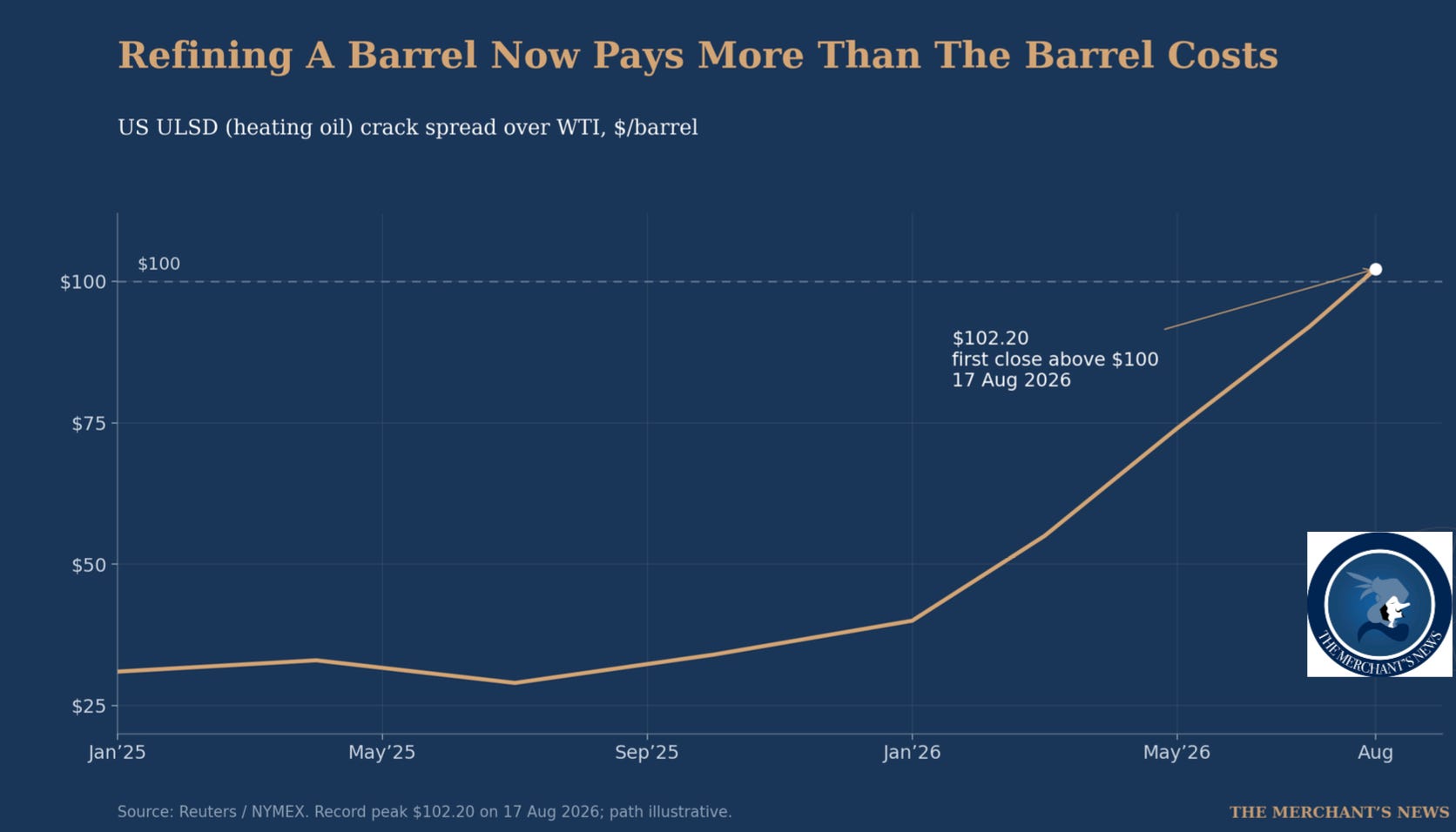
Some days ago I wrote that refined fuel had become worth more than the crude it’s made from (article here).
The profit from turning one barrel of oil into diesel had reached an all time high, and it hasn’t come back down since.
On Monday the US diesel crack settled above $100 a barrel for the first time in history, $102.20 at the peak.
A refiner today earns more from the cracking than the barrel itself costs to buy.
I won’t relitigate that piece here.
I only want you to hold the fact in your head.
And before that article, I asked whether Washington was about to shut the export door (article here). Big Oil had just printed a record second quarter, pump prices were climbing into an election year, and I walked through what it would mean if the White House started capping American crude and product exports to protect the voter at the gas station.
Palmerston gave us the frame back then: nations have no permanent friends, only permanent interests.
Both of those stories share a hole in the middle.
The hole is China.
Something in the crude price doesn’t add up and it should bother anyone who is long. WTI is sitting in the mid $80s while refining margins print records and two shooting wars bear down on supply.
On that setup Brent has every reason to be through $100, It isn’t for now… The reason has a single name, Beijing.
China has quietly stopped buying anywhere near the volumes it used to, and its absence from the market is the main thing holding the whole price structure down.
Crude is cheap for one reason, and the reason is that the world’ s biggest buyer has stopped showing up.
First, why the margin still matters?
The crack is at a record for a single reason.
There is plenty of crude in the world and nowhere near enough capacity to turn it into the middle of the barrel, the diesel and jet and heating oil that actually move the economy.
Even if oil is abundant, the fuel you make from it is scarce. That gap is the whole game right now and it deserves a moment before we get to Beijing, because diesel is the barrel that matters.
Diesel is the marginal barrel
For a modern economy, diesel is the fuel underneath everything that gets built, hauled or grown. Heavy trucking, shipping, rail, farm equipment, mines and construction sites all run on middle distillate. Nearly every physical good you own moved on diesel at least once before it reached you.
That is why distillate prices feed almost directly into producer prices and freight rates, and from there, with a lag, into the price of food and goods on the shelf.
When traders want to read the real economy rather than the financial one, they watch the diesel crack as closely as they watch crude itself.
Right now that gauge is screaming.
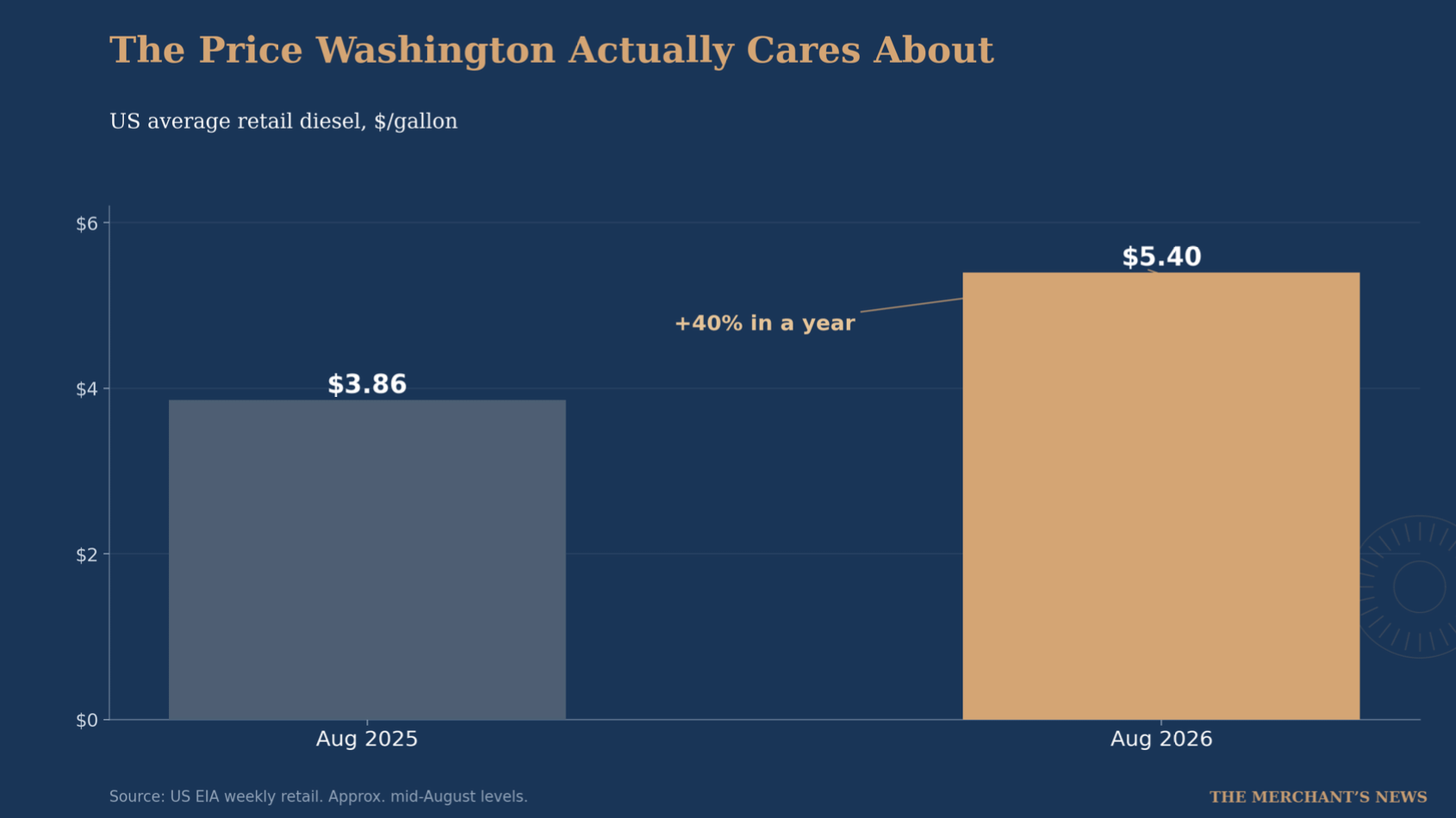
US retail diesel is in the mid-$5s a gallon, roughly 40% higher than a year ago. The crack over crude has gone into triple digits for the first time on record. Europe tells the same story, with low sulphur gasoil cracks pushing to records of their own in the mid $70s.
Everywhere you look, the same squeeze turns up.
This one is global.
The squeeze sits on top of a refining system that was already under invested and now it has two wars carving into it.
Repeated strikes on Russian refineries have knocked out one of the swing suppliers of diesel to Europe and emerging markets.
The conflict around Iran and the Gulf has snarled crude sourcing and product flows through Hormuz.
Both of those hit the middle of the barrel harder than they hit gasoline,so the diesel premium widens while refiners scramble to re-optimise yields and reroute cargoes around damaged plants and war zone shipping lanes.
Here is why that should worry a central banker…
Diesel is the cleanest channel there is from an energy shock into core goods inflation. A persistent distillate premium pushes through transport, food processing and construction, and it keeps rate setters from comfortably looking through the spike. The longer the crack stays near records, the more it argues for higher for longer and the more it risks quietly destroying demand in exactly the freight heavy corners of the economy that run on the stuff.
Call this cycle by its real name. A diesel shock wearing an oil price label, and it lands on freight, metals and construction long before it ever reaches the pump.
What China is actually doing?
Now to the country in the middle of all of it.
I want to start with the demand number, because it is genuinely startling.
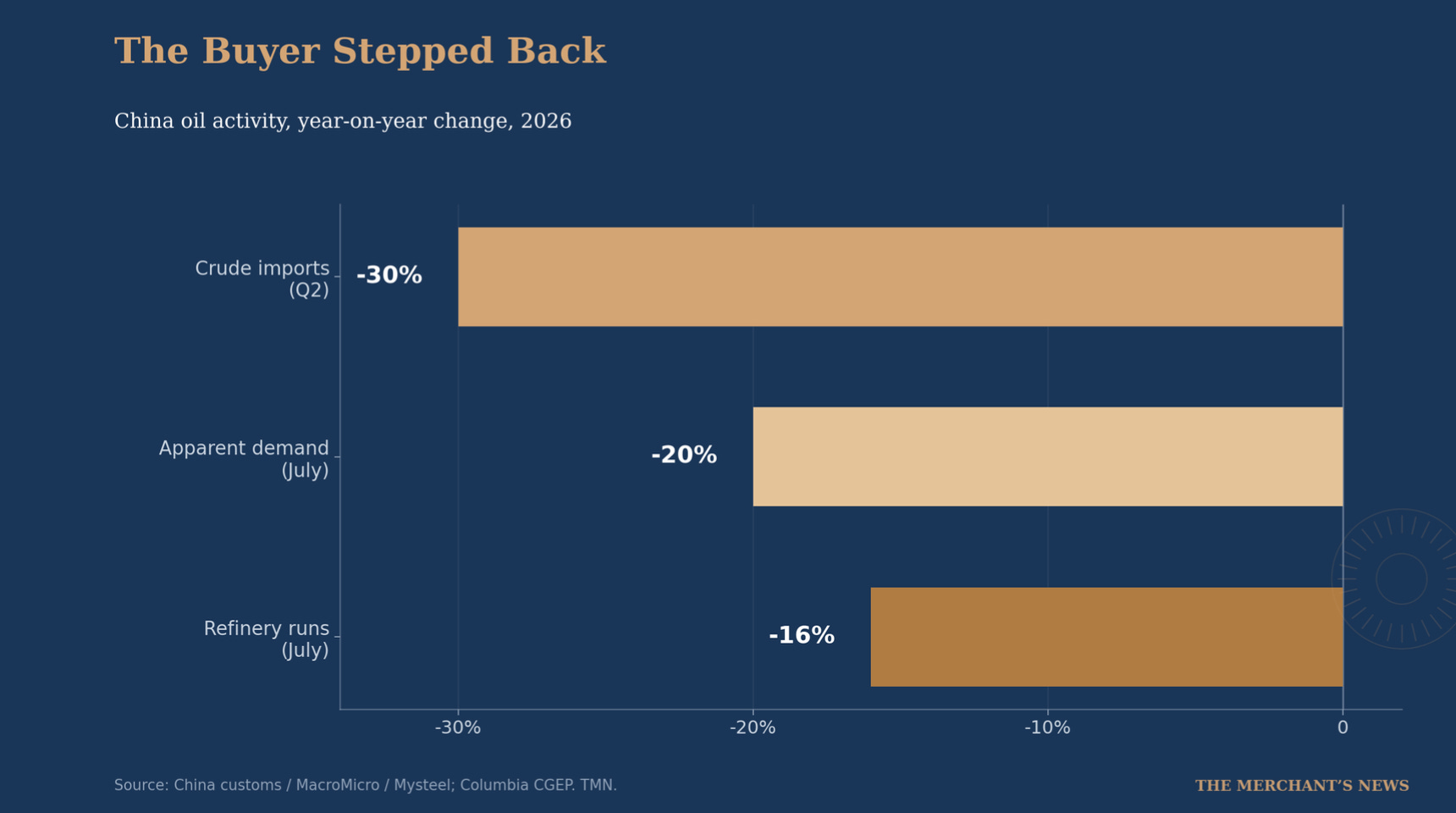
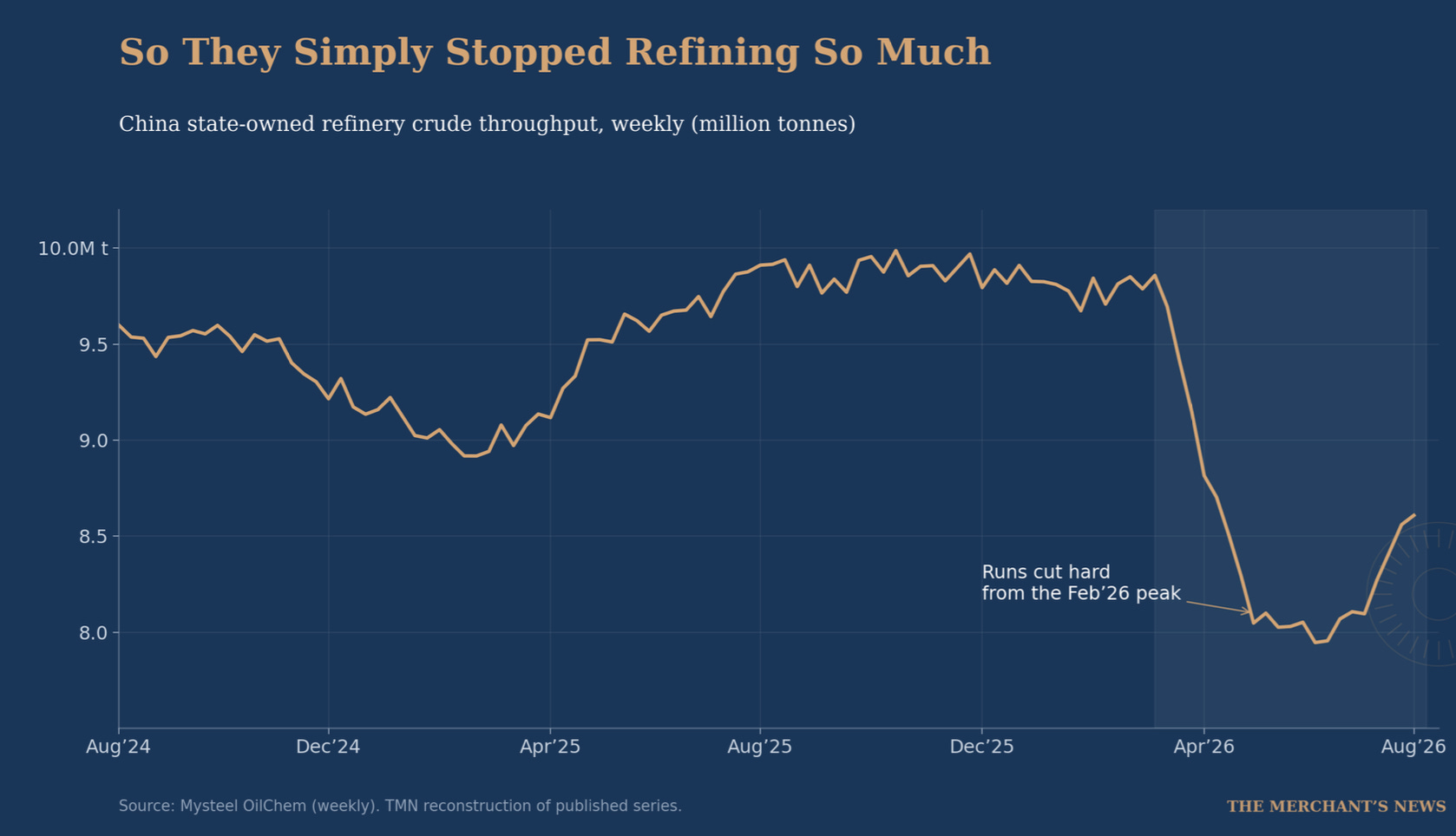
China’s apparent oil demand fell about 20% year on year in July, to roughly 12.0 million barrels a day.
Refinery throughput dropped around 16% over the same window, with state refiners running well below where they were a year ago and in the second quarter, Chinese crude imports were down close to 30% year on year, something on the order of 3.5 million barrels a day of buying that simply vanished from the market.
The obvious question is how China can throttle back that hard without running short. The answer is that it spent years preparing for exactly this.
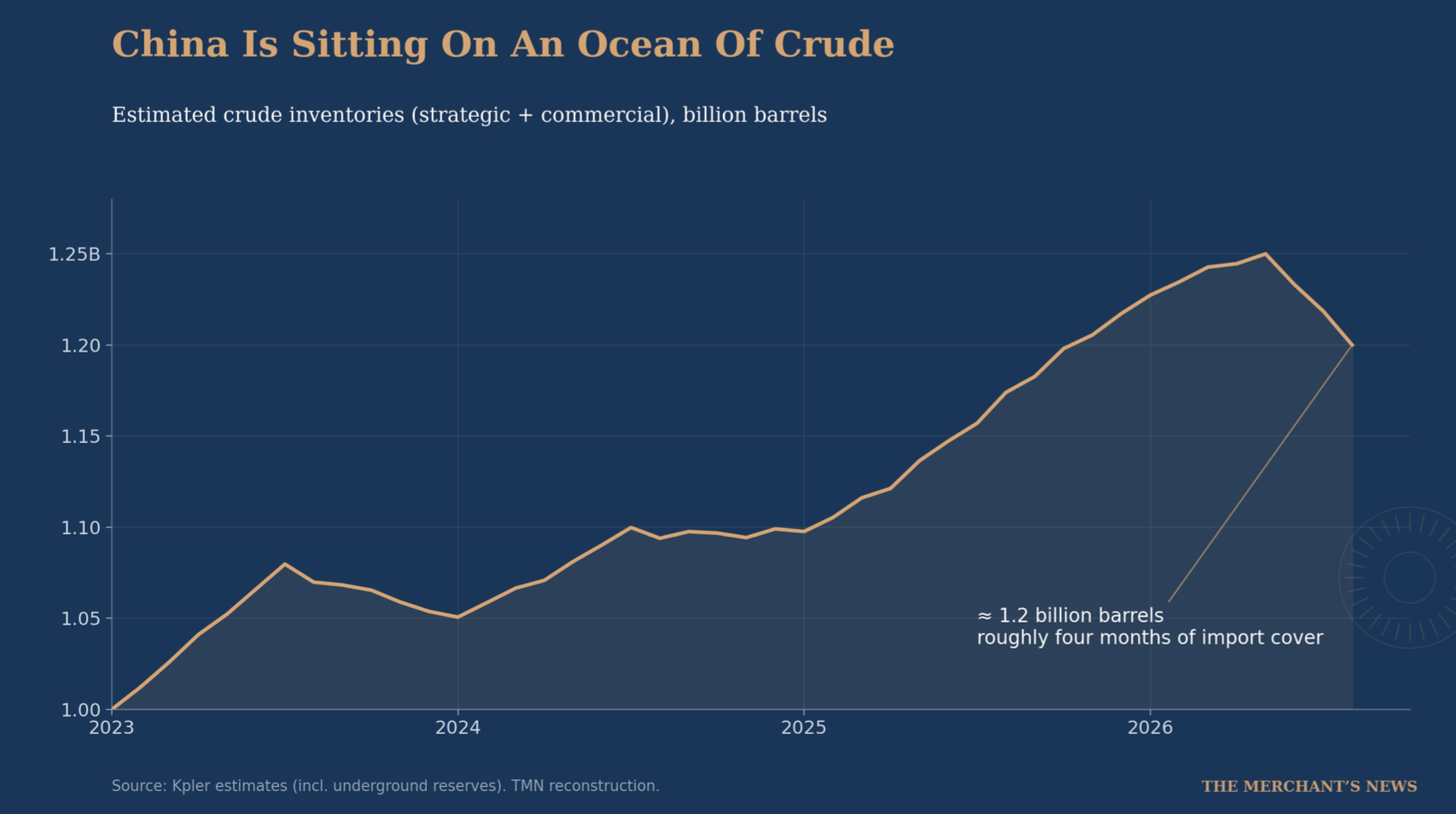
Beijing is sitting on something like 1.2 billion barrels of crude in strategic and commercial tanks (as far as we know), roughly four months of import cover.
When prices are where they are and two wars are raising the risk premium, China would rather lean on that buffer than pay up for fresh cargoes.
So it is buying less and drawing down more.
This is the mechanism behind the cheap crude puzzle.
When the single largest incremental buyer in the world steps out of the market and lives off its own stockpile, the marginal barrel loses its bid.
Prices that ought to be climbing on record margins and war premia sit flat instead, because the demand that would have chased them higher is asleep in Chinese storage tanks.
The same instinct governs what China does with its finished fuel.
Since the Iran war, Beijing has put domestic supply security first, letting refiners cut runs and keeping product at home rather than shipping it out.
The export quotas look, on paper, a lot like last year’s.
In practice they have been badly under used.
Earlier in the year, product exports to destinations outside Hong Kong were running at something like 1/6 of their usual volume.
July finally brought a bounce.
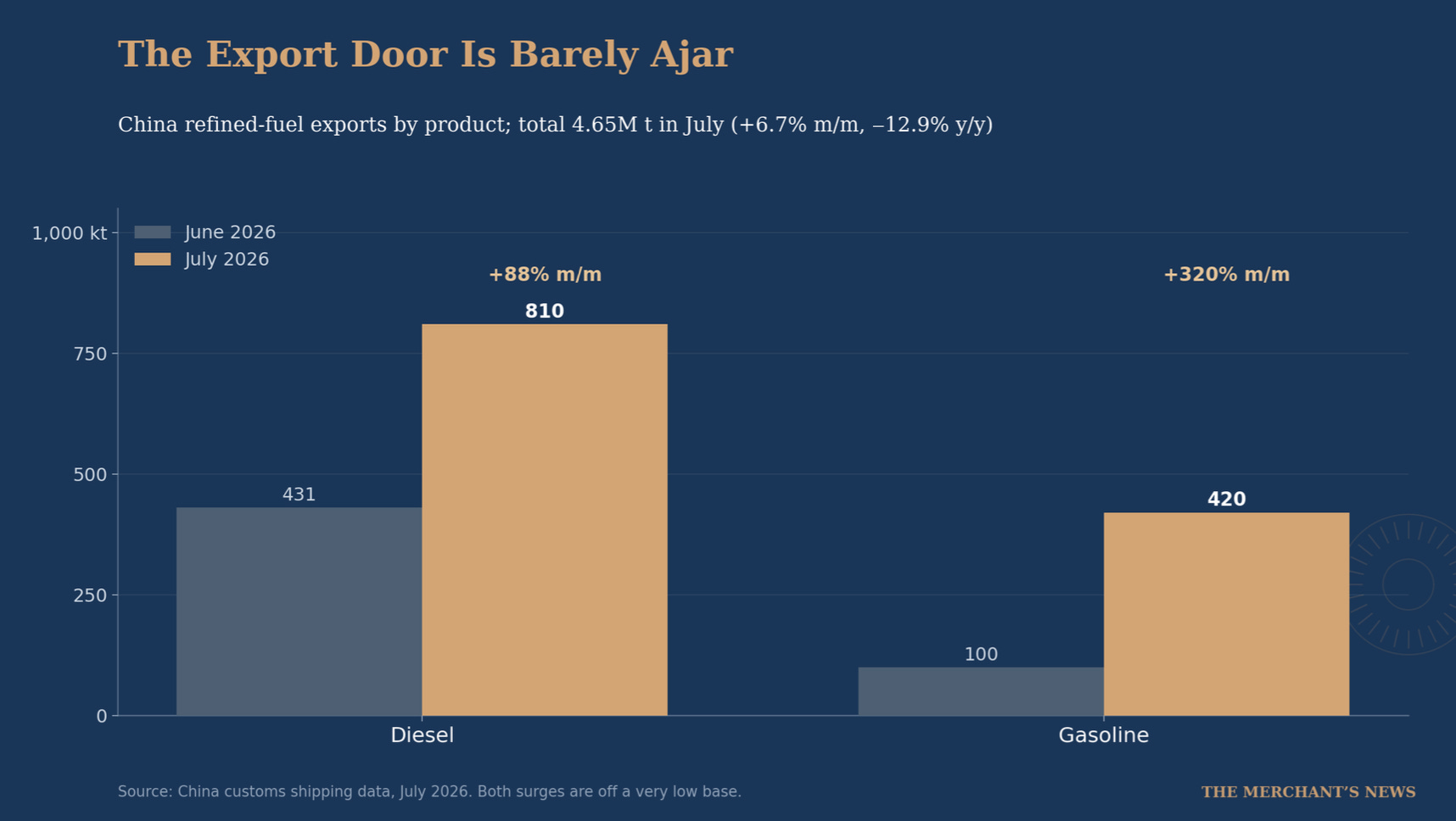
Total refined-fuel exports came in at 4.65 million tonnes, up almost 7% from June, though still down about 13% on a year ago.
Inside that number, diesel exports jumped 88% month on month and gasoline more than 300%.
Impressive growth rates, but both are climbing off a floor scraped very low.
The August quota of 2.7 million tonnes, closer to 3.6 or 3.7 including Hong Kong and bonded jet fuel, tells you the export door is easing open one notch at a time.
And underneath the policy there is something slower and more permanent moving. Even China’s own diesel demand is softening, dragged down by weak construction and property, and by LNG and electric trucks steadily eating into heavy transport.
Kpler has Chinese liquids demand still growing around 360,000 barrels a day this year, but that growth is petrochemicals, not road fuel.
Diesel itself is set to slip.
Zoom out and the IEA now expects global oil demand to fall by somewhere between 1-1.5 million barrels a day in 2026, the first annual decline since 2020, with Asia’s importers carrying much of the adjustment.
So part of what is capping crude is a policy choice China can reverse and part of it is structural erosion that no headline reverses.
China’s escape valve, across the top of the world
The same Hormuz closure that blew the diesel crack wide open has pushed China to finally do something it has wanted for a decade.
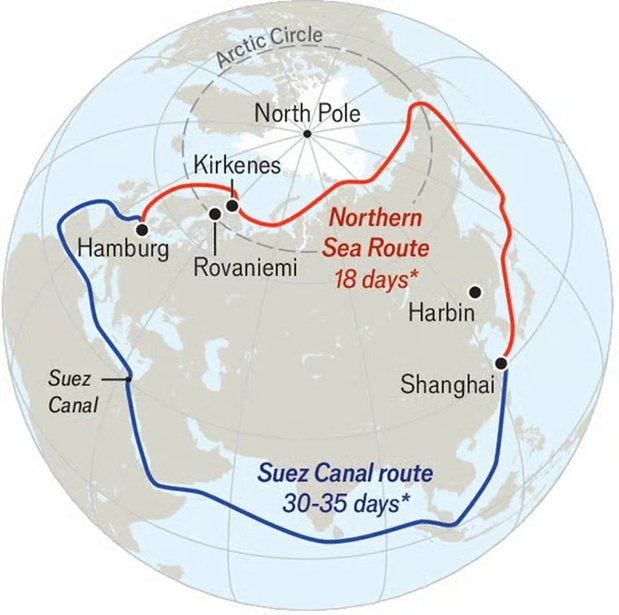
On Saturday a Chinese container ship slipped out of Ningbo, turned north, and set course for Britain across the top of the world.
The ship is running the Northern Sea Route, a 3,400 mile channel along Russia’s Arctic coast that owners have taken to calling the Ice Silk Road.
Its operator, Sea Legend, has pulled off what nobody had managed before, a scheduled weekly service through the ice rather than a one-off dash.
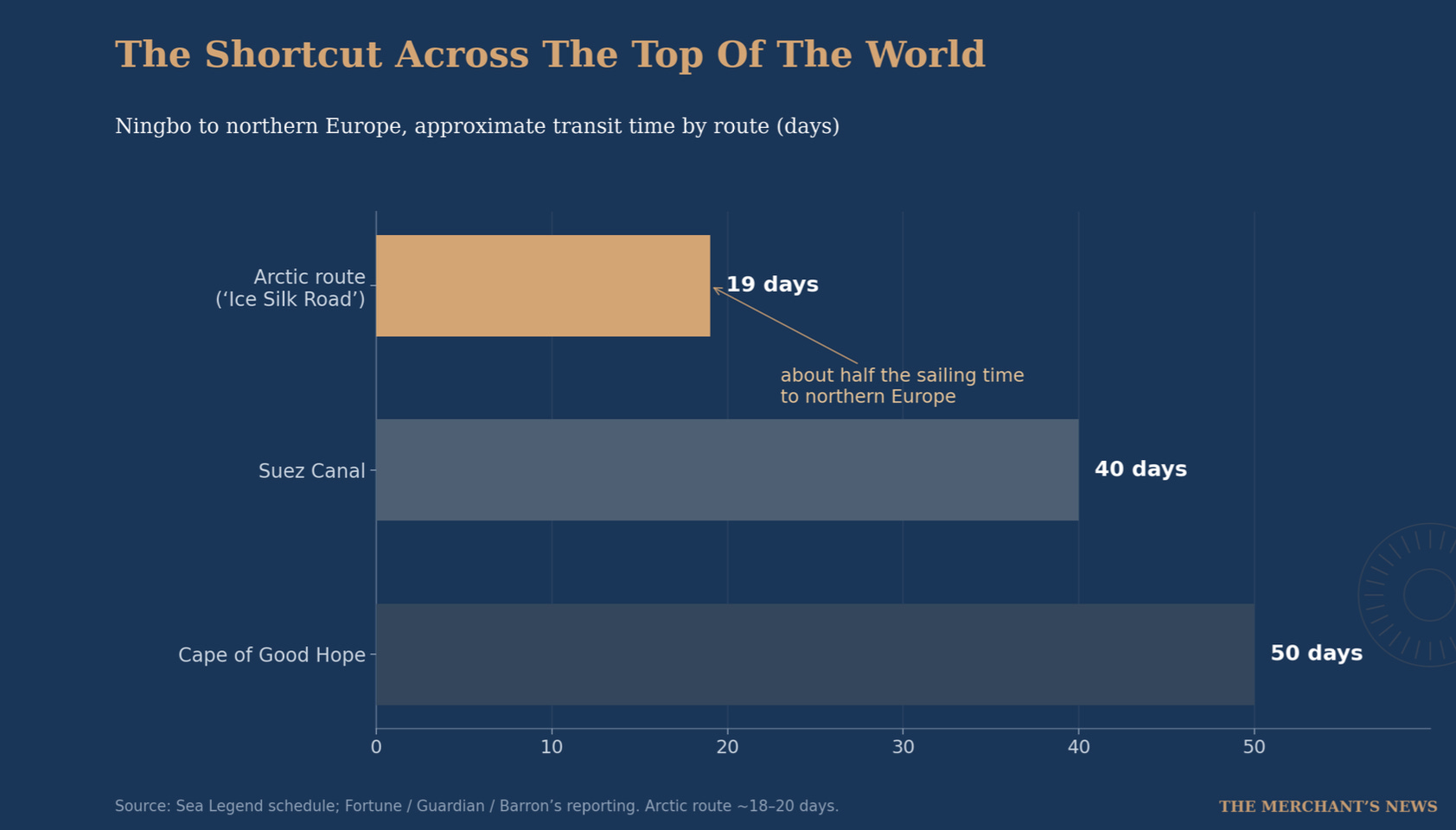
Ningbo to Felixstowe in something like 18 to 20 days.
The same voyage through the Suez Canal runs about 35-40. Around the Cape of Good Hope, closer to 50.
The trigger was the war.
Once US-Israeli strikes on Iran shut Hormuz in February, and Houthi attacks kept the Red Sea a shooting gallery, every shipper alive went hunting for a way around the world’s chokepoints.
Even Marco Rubio mused aloud about a permanent shift away from Hormuz.
China found its answer in about the last place anyone would have guessed, the frozen north.
2 reasons this belongs in an oil letter.
the risk premium.
That fat war premium sitting inside today’s crude and diesel is really a chokepoint premium. It exists because the world’s energy and goods still funnel through a handful of narrow straits that a single missile can close. Beijing is quietly building itself a way out of that geography. The more real its Arctic lane becomes, the less exposed China is to the very disruptions propping up everyone else’s prices. That patient hedge sits underneath this whole story.
the Malacca Dilemma.
Around 80% of China’s crude imports squeeze through the Strait of Malacca, the narrow gate between the Indian Ocean and the South China Sea.
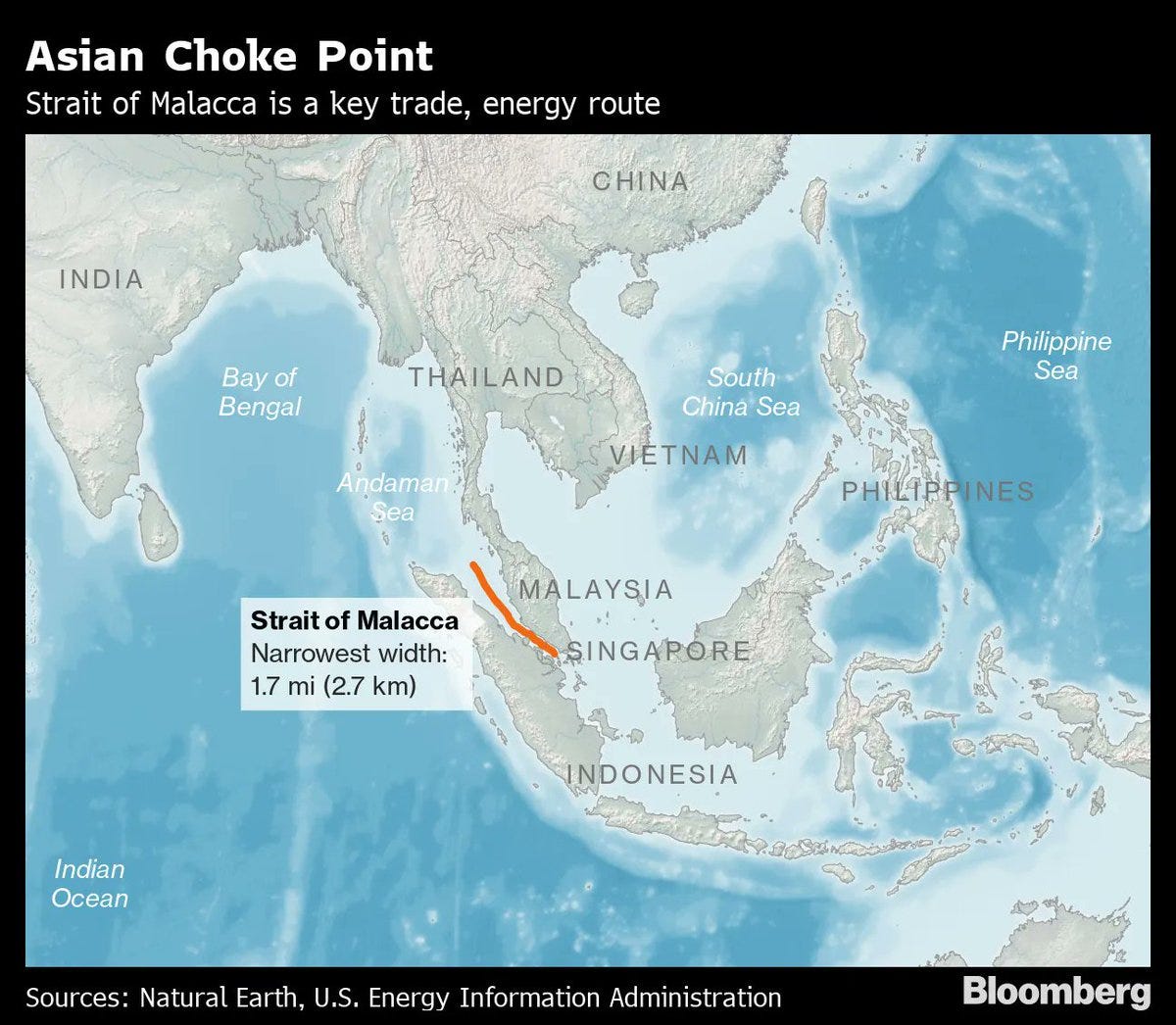
Chinese planners have lost sleep for years over the thought of that passage being blockaded and the country’s oil cut off in a crisis.
An Arctic route does not erase that fear on its own, though it adds one more thread to a long campaign to make China harder to strangle.
Xi called for a “Polar Silk Road” back in 2017.
This is what it looks like when the idea finally leaves the page.
None of it moves without Moscow.
Russia controls the Northern Sea Route, and its state nuclear firm Rosatom hands out the permits and supplies the nuclear icebreakers that shepherd ships through the ice.
Before Ukraine, the Kremlin was wary of letting China into its Arctic backyard.
Now, leaning on Beijing and shut out of the West, it is handing over the keys.
Russian tankers are already using the route to move sanctioned crude.
Just this past week, ship-watchers tracked an unusual convoy of them, reportedly carrying around 8 million barrels, passing within 500 miles of the North Pole. The shadow fleet has found its frozen highway, and China is the customer waiting at the other end.
Only 23 container ships made the full Arctic crossing last year, up from 15 the year before. The big lines, Maersk and MSC and Hapag-Lloyd among them, have pledged to stay out of the Arctic entirely. One analyst summed it up as a hedge rather than a pivot, a route that still lacks the predictability real trade is built on.
If you want to know the best stock position for this, read the following article:The $9 Billion Order Book Arctic Monopoly (p.s. now the entry price is interesting).
So keep the scale honest before declaring the map redrawn.
The lane is open only a few months a year, the
running costs are steep, the insurance is a nightmare, and a spill in that environment would be near impossible to clean up.
For now the Arctic is more promise than working highway but hedges are exactly what a patient power stockpiles while everyone else fights the last crisis.
Washington is still arguing over icebreaker procurement while China runs the first scheduled service across the roof of Russia. America can count its heavy icebreakers on one hand and owns no deep-water Arctic port worth the name. Whoever sets the standards and builds the hubs along these lanes now will collect the tolls for a generation.
Napoleon learned that wars are won on logistics and the oil market is about to relearn the same lesson (took this explanatory sentence from a bloomberg article).
This is the thread I keep pulling.
China shows no sign of panic about $80 crude or a record diesel crack. It is drawing down its stockpile, throttling its refineries, keeping its fuel at home, and quietly opening a back door to Europe through the ice.
Every one of those moves buys Beijing the same two things, time and optionality, while the rest of us keep paying the premium on a map we cannot redraw.
Washington’s problem
The politics are about to collide with all of this.
The administration wants pump prices lower before the midterms, and diesel and gasoline at the pump are the most visible price in American life.
The trouble is that the easy lever is almost used up.
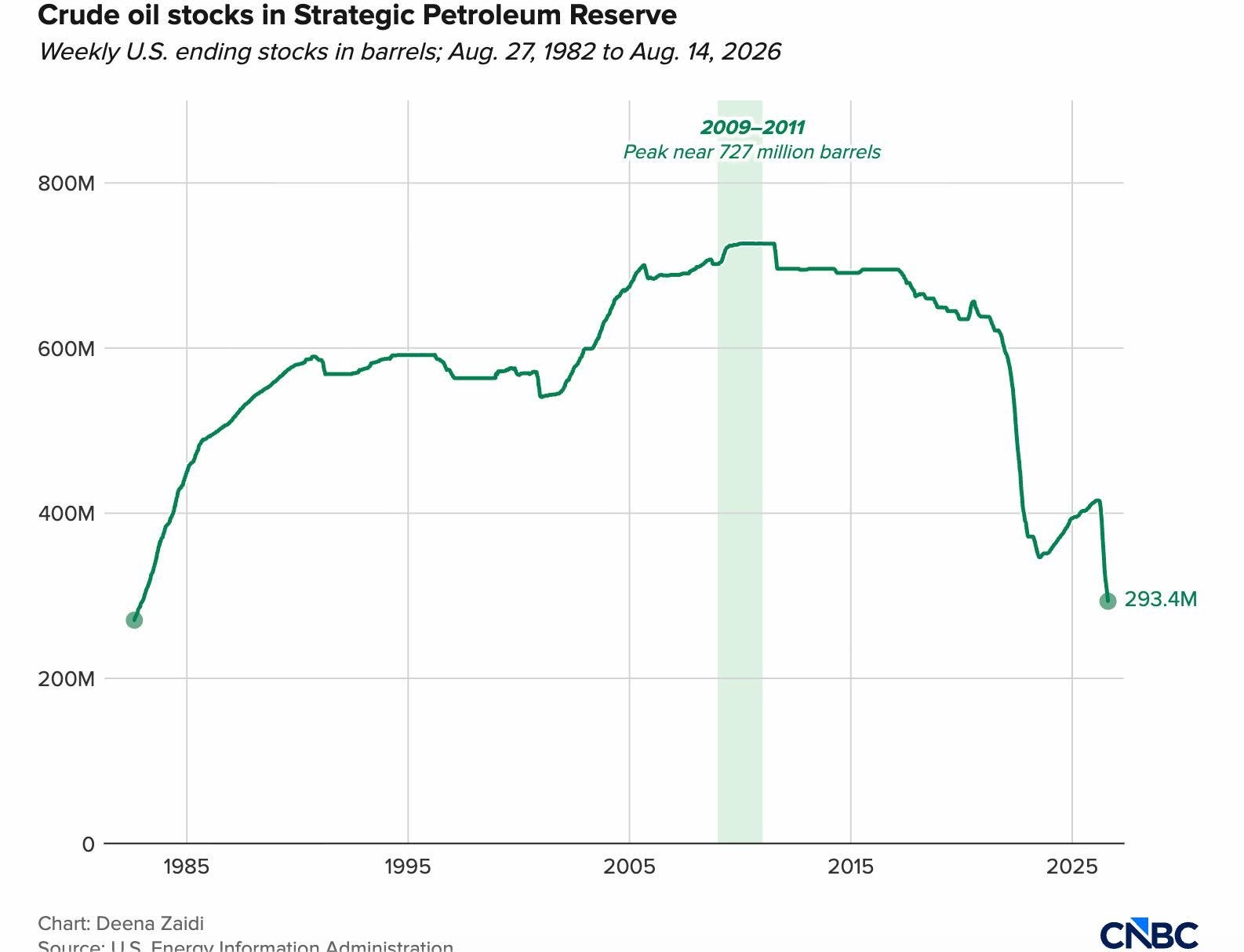
The Strategic Petroleum Reserve has already been drawn down to around 300 million barrels, after the President ordered a 172 million barrel emergency release when Hormuz was shut back in March.
There isn’t much left in the tank to dump onto the market.
So the White House has a voter angry at the pump, a diesel crack at a record, and its usual quick fix nearly exhausted.
It needs another way to push the domestic price down without cheap crude conveniently falling into its lap.
That’s the fiscal backdrop.
The political backdrop is just as tight, and prediction markets are pricing it with unusual clarity.
Embed live prediction markets to add real-time context, part of a data partnership with Polymarket.
The 2026 midterm picture is starting to look very asymmetric.
On Polymarket , Democrats are given an 88% chance of winning the House, while the Senate remains essentially a coin toss at 52%.
That would leave Washington facing a very different balance of power after November: a House flip looks increasingly priced in, but control of the Senate could still decide how much room the White House has to govern.
Embed live prediction markets to add real-time context, part of a data partnership with Polymarket.
Which puts the SPR problem in sharper focus.
If the House flips the way the market expects, the administration loses its easiest legislative lever on energy policy right around the time it’s already lost its easiest executive one there’s barely anything left in the reserve to draw down.
A 172 million barrel emergency release already took the SPR to roughly 300 million barrels, the lowest since 1982.
The next crisis, whenever it lands, arrives with the tank close to empty and a House that may no longer be inclined to help refill it.
The Senate number matters more than it looks.
A 52% chance of a Democratic Senate is the market saying the outcome is genuinely open, and that openness is the story.
Whichever way it breaks will decide whether the administration heads into 2027 negotiating energy policy from gridlock or from something closer to a mandate.
Right now, the crowd pricing that bet has it closer to a coin flip than a foregone conclusion.
Would US cap exports?
Which brings us right back to the scenario I raised in my previous article. If you can’t add supply, you keep the supply you have at home. Cap or tax American crude and refined product exports, and you flood the domestic market and pull the pump price down.
It works beautifully for the voter.
It is poison for everyone else.
Take US barrels off the export market and the rest of the world gets tighter, and global crude and diesel climb even as the American pump price eases.
Notice what that does to the very market we started with.
Capping US product exports would tighten a diesel market that is already at a record crack.
Washington would be relieving its own pump price by making the global distillate squeeze worse.
It is, in truth, the same move China is already making, keep the fuel at home, just with a ballot box behind it instead of a 5 year plan.
Palmerston, again: permanent interests.
The trade that reverses everything
Comments
Nothing yet. Say the first thing.
Sign in to join the conversation.