
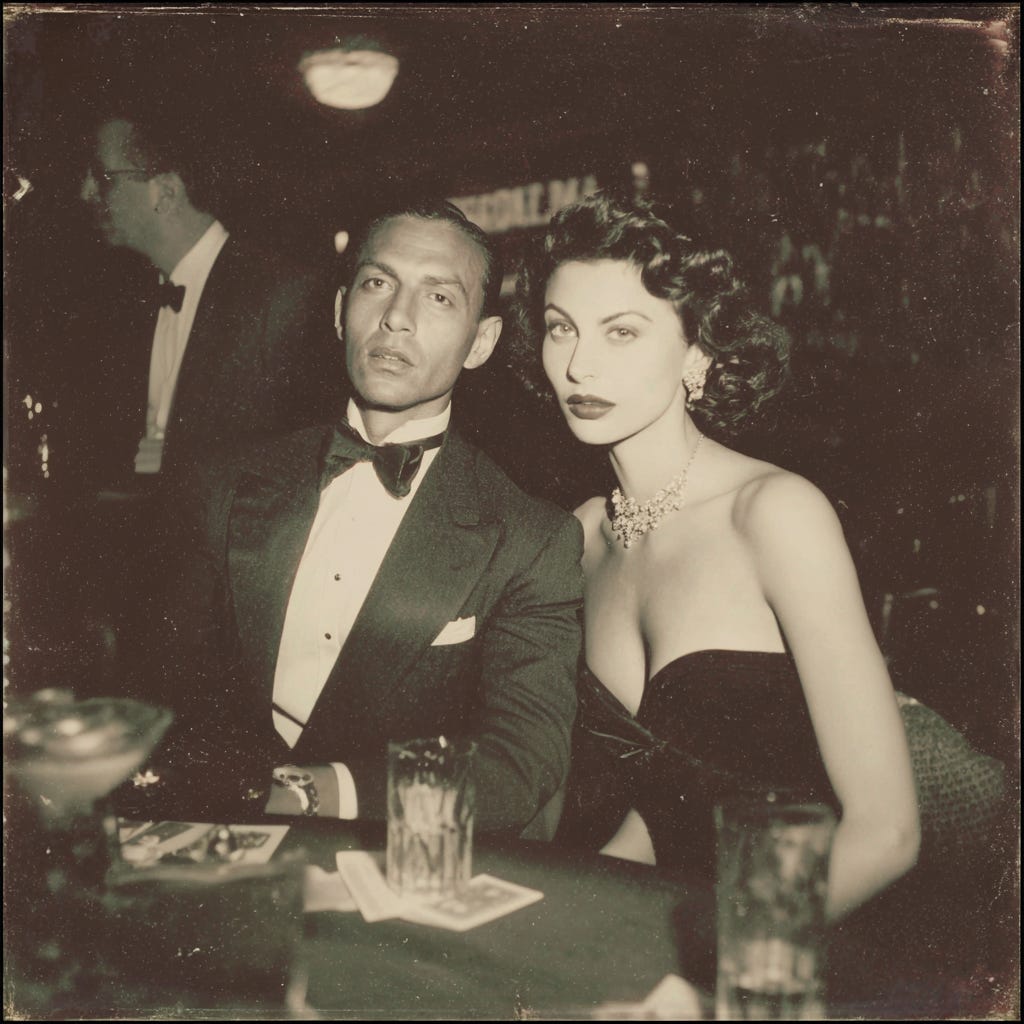
Over the course of several meals at his Lisbon hotel, Dušan “Duško” Popov became aware of a strikingly dressed young woman who moved through the dining room with confidence and ease. Though she arrived with an older companion, she quickly moved on to another table with a young man. “She probably noticed that I was intrigued by her, but although she cast many smiles and glances my way I wasn’t sure they were for me,” he recalled. He thought the attention could have been meant for someone sitting close to him, who happened to be Simón Iturri Patiño, a famously wealthy Bolivian industrialist.
One evening, a brief elevator ride with the woman seemed to settle the question: her eyes were focused on him alone. He thought quickly and told the lift operator “Room 25,” rather than provide his floor number. He left his door unlocked and when he exited the shower, she was already in his room, laying on the bed. She was wearing a sheer silk negligee that “both covered and revealed her completely.”
“Good evening,” Popov said in a husky voice; she invited him to join her. He went in for an embrace but she rebuffed him: “Let us talk for a while. You don’t even know my name.” Popov smiled: “Ilena Fodor. Desk clerks are very helpful.” She replied: “Yes, they are, Duško Popov. But your name doesn’t tell me much about you and I like to know a man first.” She proceeded to kiss him on the cheek, he recalled, “like it was a favor, pretending not to notice her breasts rubbing against my arm.”
Popov played along, letting her guide the exchange while offering false answers about his background and motives. Rather than rely on his official cover, he improvised an absurd story about his work involving stolen paintings, noting her visible loss of interest once her questions were answered. Her demeanor shifted from playful curiosity to detached expectation, as she indicated how much the night would cost. He remembered her lying back “in the bed with an empty, yawning, bored, you may-take-me now expression on her face.” Popov dismissed her coolly, handing her a near-empty bottle of scotch: “Take this with you if you can’t fall asleep. You’ve had your bedtime story.” She accepted the dismissal, and his remaining bottle of scotch, without objection.
Later, Popov’s station chief Major Ludovico von Karsthoff (whose real name was Albrecht von Auenrode) alluded dryly to the fictional art hunt, advising Popov to abandon this sideline work. Popov laughed it off, acknowledging the story for what it was: bait for “a not‑too‑nice young lady.” Von Karsthoff clarified that the test had not been his doing, but the work of overzealous German counterintelligence. The incident confirmed what Popov already understood: every encounter, no matter how personal it appeared, was potentially just another move in the espionage game.
Casino
Ostensibly, Popov was a Serbian spy working for the Abwehr, Germany’s military intelligence service. He was in fact a double agent for the British Secret Intelligence Service, commonly known as MI6. British Naval intelligence officer Ian Fleming watched Popov with intense interest while he gambled one day in 1941. In wartime Portugal, Popov had completed a risky exchange with the Germans and was temporarily carrying a substantial sum of cash intended for British intelligence. Fleming, acting on personal curiosity, tailed Popov through the Hotel Palacio, nearby cafés, and on to the Estoril Casino. Popov suspected that Fleming’s surveillance was meant to safeguard the British funds.
With Fleming as his target audience, Popov orchestrated a deliberate stunt at the baccarat table. When a boastful gambler from Liechtenstein named Bloch announced “Banque ouverte” (“the bank is open”), a public display of his apparent wealth in taking unlimited bets, Popov calmly declared an audacious wager: “Fifty thousand dollars” ($1.1 million today). The room fell silent and Fleming was visibly ill at ease. The Liechtensteiner gambler clearly did not have the money to match this bet given his own anxious reaction. “I suppose,” Popov said, turning to the chief croupier, “that the Casino is backing this man’s bet, since you didn’t object to his ‘Banque ouverte.” Popov was merely making a point, knowing full well that the casino would refuse to do so. “The Casino never backs any player’s stake, sir,” the croupier replied. Popov theatrically swept the money off the table and pocketed the cash, expressing his feigned disappointment: “I trust you’ll call this to the attention of the management and that in the future such irresponsible play will be prohibited. It is a disgrace and an annoyance to the serious players.” Fleming was amused by the performance and the Lithuanian was permanently chastened, never again daring to proclaim “Banque ouverte” at Estoril. When Fleming became an author and invented the fictional MI6 agent James Bond in the 1953 novel Casino Royale, Popov wondered if Bond was partly based on him: “Could be,” he mused. Fleming himself stated that Bond “was a compound of all the secret agents and commando types I met during the war.”
Jebsen
Popov was initiated into the world of espionage through a friend who saved his life. He first met Johann “Johnny” Jebsen in 1936, after completing his law studies in Belgrade and enrolling at Freiburg University to pursue a doctorate. Germany’s growing cultural and economic dominance in southeastern Europe, and Popov’s need to master German, made the choice practical, while Freiburg itself appealed as a vibrant university town offering “study, sports, and pleasure” in equal measure. At the time, Popov considered himself politically unformed: repelled by Nazism yet naïve enough to believe that its dangers were outweighed by academic and personal opportunity.
That illusion quickly dissolved when Popov realized how much Nazi influence pervaded university life. German students learned that conformity was the price of any future, while foreign students were courted with privileges and propaganda. The Ausländer (Foreign Student) Club became the center of Popov’s social life and the place where he met Jebsen. The two bonded over shared intellect, wealth, recklessness, and taste for fast cars and attractive women: “we were addicted to sports cars and sporting girls and had enough money to keep them both running.” Though their backgrounds differed in scale, their outlooks aligned, and Jebsen soon treated Popov as an equal.
Jebsen, admired and feared on campus, was a study in contrasts: aristocratic yet democratic, aloof yet magnetic, permanently ironic. Alongside another close friend, Alfred “Freddy” Graf von Kageneck, the trio treated Nazism at first as a farce. They openly defied party intimidation, most memorably by patronizing a café that refused to display the sign “Jews and Dogs Not Allowed,” coolly giving their names to SS men. “You wouldn’t know how to spell it,”von Kageneck taunted them about his prominent family name, to their apoplexy. The three friends took a table in full view of the street and at the time, the gesture felt like a prank rather than an act of courage.
Shortly after earning his doctorate, Popov was arrested by the Gestapo and interrogated for eight days and nights. Accused by turns of Communism, subversion, and spreading “propaganda,” he was subjected to relentless questioning designed to exhaust and break him rather than extract facts. Friends and acquaintances were interrogated en masse; most distanced themselves or denounced him. Only two men stood firm in his defense: Freddy von Kageneck and Johnny Jebsen.
“You’ll be listed as missing,” a friend informed Popov one day in Freiburg prison. Jebsen raced to Switzerland to alert Popov’s father that Popov was to be vanished into a concentration camp. Political pressure reached Hermann Göring himself, and Popov was released, with an order to leave Germany within twenty-four hours.
As Popov departed, few dared say farewell. Jebsen, barred from the platform, drove his Mercedes through the night and intercepted the train in Basel. Deeply moved, Popov gave him a solemn pledge: “If you ever need anything…you only have to say the word.”
Joining Intelligence
Popov encountered Jebsen again in Belgrade after three years and immediately sensed how deeply the war had altered him. Though Jebsen’s intelligence and elegance remained intact, they had hardened into cynicism, apprehension, and a dark humor. “Hitler is making fools out of the Germans,” he blurted out soon after greeting Popov, “and with their help he may take over the world.” World War II had been going on for five months and over whiskey in the Serbian King Hotel, Jebsen revealed his urgent problem: several German ships, including his own, were trapped in Trieste, and he needed Popov’s help to sell them, quickly and deceptively, to a neutral buyer before the German authorities understood the implications.
Using his financial, legal, and diplomatic connections in Yugoslavia and Britain, Popov devised a scheme to acquire the ships through a Yugoslav front company and quietly pass them to British interests. The transaction was executed before suspicion arose: London approved, funds were provided, and the British Admiralty expressed its gratitude for a valuable addition to merchant shipping. Afterward, in a private conversation, Jebsen disclosed the true scope of his activities. To avoid conventional military service and preserve his freedom of movement, he had joined the Abwehr’s Brandenburg Division, placing himself within German intelligence while remaining ideologically opposed to Hitler. He spoke of Admiral Wilhelm Canaris and a web of resistance-minded figures operating inside the Nazi system. Jebsen then asked Popov for assistance with an intelligence report identifying French politicians likely to collaborate after defeat, a request Popov accepted reluctantly, quietly forming a counter-plan of his own.
Popov compiled the report with ease, relying on his extensive social and diplomatic contacts. The findings were strikingly consistent: Pierre Laval emerged as the most likely collaborator. While providing the report to Jebsen, Popov also ensured that British intelligence received a copy, turning a Nazi assignment into a double-edged instrument. The accuracy of the report enhanced Popov’s standing with the German Embassy, which suddenly treated him with warmth and attention. When France soon capitulated, Jebsen grimly acknowledged: “Every hope we had of getting rid of Hitler by internal action vanished.” Jebsen became a constant presence in Popov’s home and Popov was invited to join the Abwehr as an intelligence agent. Jebsen admitted had been preparing the ground for some time and had personally recommended Popov as the kind of man the Abwehr desperately wanted; a “superspy” in the making. Popov understood that refusal or acceptance could each be fatal in different ways. Jebsen offered his own justification: “If you want to destroy a team, the best way is to become part of it.”
Sleep eluded Popov, disturbed by thoughts of whether the British would accept him as a double agent. If they refused, he would have had to decline the Germans, and Popov knew that their offers were not safely rejected. At dawn, he went directly to the British Embassy, where an official listened and warned him that what he was proposing allowed “only one mistake.” Popov was sent to a passport official, who in reality was the head of MI6 for the Balkans. After exhaustive questioning, the MI6 official confirmed London’s interest and, within days, instructed Popov to accept the German offer outright. He was to appear cooperative, buy time, and construct a solid business pretext for travel to London. Popov would pose as a lawyer expanding legitimate Anglo‑Yugoslav trade, supported by Navy Certificates arranged through British channels. He was also told, pointedly, to say nothing to Jebsen about his work for MI6.
Popov informed Jebsen only of his planned trip and a vague diplomatic intermediary. When Colonel Ernst Munzinger met Popov, the German was triumphant, congratulating him on his “right conclusion” and supplied him with secret ink to communicate with them secretly. Jebsen was assigned to train Popov in codes, contacts, and procedures. The Abwehr made it clear that Popov was being groomed seriously and would be kept generously funded. He was provided with a German questionnaire that revealed far more than it demanded. By the breadth of its questions on coastal defenses, unit locations, weapons, and industries, it exposed German priorities and anxieties, particularly surrounding a potential invasion of England. Popov passed everything to the MI6 official, who dryly noted that British intelligence had better ink but found the questions themselves invaluable, which included: “the locations of divisions, brigades, and commands, the names of officers. They were specifically interested in antitank guns but also wanted to know about other weapons, the armament industry in particular, and industry in general. And then there were many political questions similar to those they had asked me about France. Who were Churchill’s enemies? Who in Britain thought the war should be ended quickly? Who was in favor of starting to negotiate peace with Germany?”
While Popov was constructing his commercial cover, building an import organization and canvassing banks and clients, his BMW mysteriously broke down. Relying on his father’s chauffeur, Bozidar, he soon learned that Bozidar had sabotaged the car and was reporting on Popov’s movements to Munzinger. When Jebsen obtained a surveillance report, it revealed frequent visits to Milosa Velikog Street, British Intelligence headquarters, placing Popov and his family in danger. “I’ll take care of Bozidar,” Popov told Jebsen.
Popov ran this information by his brother Ivo, who replied, “Let’s look at this practically. Bozidar is corrupt. I know we can both remember when he rode us around on his shoulders. That makes what he did all the more horrible, Bozidar is a cancer now. There is nothing we can do that will alter him. As long as he lives, he always remains a threat to you. No matter where, as long as he lives.” Popov crept up to Bozidar’s room that night; he could hear the radio and peered through the keyhole to see Bozidar sitting in an armchair, listening to Yugoslav folk songs on the radio. Popov arranged for Bozidar’s disposal through criminals he had once assisted by securing for them suspended sentences on assault charges. Popov sent Bozidar out on an errand that ended in a staged robbery and death. “I hadn’t asked my two clients for the details of their execution plan,” he later remembered, “only stipulating that I wanted his body found. Disappearances cause more investigation than deaths.” The police accepted the situation as it appeared, telling him the next morning that Bozidar “had been shot to death at the scene of an apparent pillaging at the railroad yards.” Popov paid for the funeral, privately judging Bozidar as “Yugoslavia’s first collaborator.” Jebsen forwarded a forged report to Munzinger and the matter vanished. “You’re a determined man, Duško,” Jebsen told him. “Tell me, would you kill me, too, if you discovered I was playing dirty?” Popov did not want to think of such a thing: “You’d never play dirty, Johnny.”
Before leaving Great Britain, Popov was formally briefed by British intelligence and was instructed to behave like a genuine German agent. He had infiltrated the Abwehr at a level that normally took years. He was given the codename Tricycle and was told to listen for any word of “Operation Sea Lion” and remember everything, writing nothing. On the German side, Munzinger, now calling Popov by his code name “Ivan,” was elated to see him go. In his boastful send‑off, Munzinger confirmed details of invasion preparations: “We have assembled over twenty-five hundred barges, nearly as many motorized boats, and over a hundred and fifty ships.” Popov whistled softly in appreciation, absorbing this information for his dual role. Probing Munzinger for more, he did not reveal much else of substance, only boasting of the superiority of the German military. Jebsen seemed amused by the conversation, understanding exactly what Popov was doing.
Popov parted from his family under false pretenses, bound for Dubrovnik and then Lisbon, while London burned nightly under the Blitz. Only his grandfather saw through the fiction, winking at him and remarking, “It’s the war. You can’t wait for it to come to you.”
Cork
Popov’s first open clash with German counter‑espionage unfolded on a return visit to Lisbon, when he became aware of a man following him. A tall, thin man with floppy, rabbit‑like ears appeared wherever Popov went. Testing him with a simple maneuver exiting and then re-entering a train from Estoril to Lisbon confirmed Popov’s suspicion: the man, whom Popov nicknamed “Uncle Oscar,” was unmistakably shadowing him. Though Popov was not yet alarmed since he had had no recent British contact, he was determined to learn who was directing this surveillance.
The following evening, en route to a meeting with von Karsthoff, Popov used a diversion to slip free, only to encounter Uncle Oscar again on the dark Lisbon road. Concluding that the shadow must belong to Abwehr counter‑intelligence rather than the British, Popov executed an elaborate approach to von Karsthoff’s villa, entering over walls and through a rear gate. Von Karsthoff denied recognizing the man and promised to make discreet inquiries, while pressing on with business: Berlin wanted more detail from their agent, but Popov was praised for work they “thought very highly of.”
Uncle Oscar vanished for several days, only to reappear conspicuously at the Casino nightclub. Popov was occupied at the club with his French girlfriend, whom he nicknamed Margo Broche. Broche was clinging to him continually, which made him “confident about how the evening would finish.” Onstage was a drunk young woman, caterwauling with the band and annoying Popov tremendously since she was “under the illusion that she could sing.” Popov sent a nearby waiter to deliver a cork to her on a tray “with my compliments,” which greatly upset her. The woman charged at Popov’s girlfriend, mistakenly believing she had sent the insult. She grabbed Broche’s drink, intending to toss its contents until Popov grabbed her arm and the glass fell to the ground. Popov spun the stunned woman around, patted her on the behind and said, “Be a good girl now.” A Daily Mail correspondent rose up from his table, revealing he had an arm in a cast. “You have been insulting my guest,” the reporter complained. “I’m sorry, it was a stupid joke,” Popov responded. “Please ask the young lady to forgive me.” Instead, the reporter swung his unrestrained arm at Popov, who ducked and landed a punch on the reporter’s jaw, sending him sliding on the well-polished dance floor. The entire Daily Mail table stood up and anticipating a brawl, Popov took out the German questionnaire and other notes he had intended to share with British intelligence and placed them in his girlfriend’s purse. “Run for it,” he instructed her. “There’s a lot of cash and checks in there. Meet me in the hotel lobby.” Broche was frightened enough to leave and Popov, now alone, stared down the Daily Mail entourage.
“Are you a Nazi or something?” one of them asked. “Why?” Popov replied. The man explained: “’Cause you’re a fucking coward, hitting a man with a broken arm.” Popov responded with what he thought was a logical argument: “If you have a broken arm, you don’t start fights.” Popov noticed that Uncle Oscar was following his girlfriend out the door. He must have seen me put the envelope in her bag, he thought. A man began to attack Popov and shoved a table into his stomach. The singer jumped on Popov’s back, attempting to “gouge out my eyes.” He tossed her into the man, which temporarily distracted him such that Popov was able to hit him twice more. He ran from the premises to a chorus of boos; others yelled, “coward, stay and fight.”
Outside, Popov could hear Broche screaming from somewhere in a park that led to their hotel. He ran towards the hotel and saw two people in the midst of a struggle on the ground. As he got closer, he could identify Uncle Oscar attempting to snatch Broche’s purse from her grasp. The contents of the purse spilled onto the ground and Oscar grabbed an envelope. He then got up and was trying to run away when Popov approached and swiftly kicked him in the face, knocking him “unconscious, spurting blood and teeth but still clutching the envelope.” Popov recovered the envelope moments before the arrival of the hotel manager, who arranged cover stories for the incident and ordered Popov back to his room. By morning, Uncle Oscar lay hospitalized, badly injured, and the police believed he had been attacked by unknown ruffians. Popov felt satisfaction at having “drawn my first Nazi blood.”
At a subsequent meeting, von Karsthoff offered a bland explanation: Uncle Oscar had been assigned “purely for Popov’s protection,” ostensibly to ensure that the British were not following him. Popov challenged the logic, pointing out the attempted theft of the envelope. Von Karsthoff, embarrassed, blamed German clumsiness and contrasted it with his own “Phoenician” finesse. Before Popov’s renewed departure for England, von Karsthoff tested Popov’s mastery of codes, addresses, and questionnaires, advising him to concentrate on essentials and hinting that Popov might recruit additional agents among his British contacts. Popov readily agreed, precisely the outcome British intelligence desired.
Despite his demanding espionage work, Popov lived extravagantly in London, frequenting luxury hotels, restaurants, and social clubs. His personal life intertwined with his intelligence work, particularly his intense relationship with Friedl Gaertner, a woman who became Popov’s sub-agent through MI5. Their relationship quickly became passionate, illustrating how Popov mixed business with pleasure. “Never before in my life had I had such a dominating passion for a woman,” he later wrote. “I made up my mind to have it out with her; the situation was verging on the dangerous. I could understand, if not approve, how a man could drive himself to ruin, sell out, do anything to rid himself of such a consuming craving. This wasn’t sex or love. This was an addiction.” He continued to see a coterie of girlfriends in each city.
Pearl Harbor
The Germans considered Popov’s appointment as Delegate of the Yugoslav Ministry of Information perfectly suited to their needs. The post provided him with a legitimate reason to travel anywhere in the United States where Yugoslav communities existed, effectively everywhere of strategic value, from factories to dockyards, while also granting him automatic access to political circles in Washington. To Popov’s surprise, when he asked von Karsthoff how he was expected to build a spy network in America, he was told to build none at all. The Abwehr had learned that formal organizations collapsed under their own weight. Popov was instructed instead to operate independently, recruit sparingly, handle each agent separately, and value reliability over numbers. Above all, he was warned not to risk either his life or his official position.
The unavoidable delay in securing passage on a Pan‑American Clipper turned out to be providential. During the wait, von Karsthoff summoned Popov in high spirits and presented him with what seemed at first just another questionnaire. Under a microscope, however, Popov was shown something revolutionary: microdots. These tiny fragments of film could contain enormous amounts of information and be concealed anywhere: on paper, in luggage, even on the skin. Von Karsthoff treated the innovation with near‑childlike pride, toasting its potential with champagne: “This little dot will revolutionize our espionage system. Do you realize the immense possibilities it offers?”
While studying the questionnaire in detail, Popov noticed a section that alarmed him. Among naval and troop‑movement questions was a specific focus on Hawaii, particularly Oʻahu, Pearl Harbor, ammunition dumps, and mine depots. The text read, in part:
HAWAII.—AMMUNITION DUMPS AND MINE DEPOTS.
1. Details about naval ammunition and mine depot on the Isle of Kushua (Pearl Harbor). If possible sketch.
2. Naval ammunition depot Lualuelei. Exact position? Is there a railway line (junction)?
3. The total ammunition reserve of the army is supposed to be in the rock of the Crater Aliamanu. Position?
4. Is the Crater Punchbowl (Honolulu) being used as ammunition dump? If not, are there other military works?
[…]
NAVAL STRONG POINT PEARL HARBOR.
1. Exact details and sketch about the situation of the state wharf, of the pier installations, workshops, petrol installations, situations of dry dock No. 1 and of the new dry dock which is being built.
2. Details about the submarine station (plan of situation). What land installations are in existence?
3. Where is the station for mine search formations [Minensuchverbaende]?
How far has the dredger work progressed at the entrance and in the east and southeast lock? Depths of water?
4. Number of anchorages [Liegeplaetze]?
5. Is there a floating dock in Pearl Harbor or is the transfer of such a dock to this place intended?
The implications were unmistakable for him. When von Karsthoff confirmed that Popov himself was to travel to Hawaii “as soon as possible,” Popov understood that the Germans, and by extension their Japanese allies, were preparing for decisive action. “At that time,” Popov later recalled, “most people thought that Japan was likely to attack Dutch East India. It was only when I saw the questionnaire that I realized they were going to attack the United States.”
Popov quickly transmitted this intelligence to British MI6 in Lisbon. London ordered him to carry the information personally to the United States, anticipating that the Americans would want to question him at length. A German “expert” on America arrived to brief Popov on manners, dress, aliases, and shortcuts to identity papers, many of which Popov privately dismissed as naïve or unnecessary. “Take your hat off in an elevator if a woman enters but don’t do so if in a business elevator” was useless counsel for Popov since he did not wear a hat. As an obvious foreigner, he needed no elaborate preparation and ultimately ignored most of the advice.
On August 10, 1941, Popov departed Lisbon aboard a Pan American Boeing 314 flying boat bound for New York, carrying with him a substantial sum of money, German funds intended to support his American mission, supplemented by his own cash. Upon arrival at Port Washington, New York, Popov was quietly extracted from Immigration and Customs and placed under the supervision of FBI special agent Charles Lanman. Escorted into Manhattan with minimal ceremony, Popov was instructed to await further contact and to meet later with the regional FBI Assistant Director, Percy “Sam” Foxworth. Settled at the Waldorf Astoria, Popov briefly tasted American abundance and efficiency, opening a bank account in minutes and purchasing a new automobile with astonishing ease, before encountering a reminder of the trade: his luggage had been searched. He consoled himself with the knowledge that nothing was missing.
The following day, Popov was led through an elaborate security routine at Rockefeller Center and ushered into a meeting with Foxworth. He learned that the intelligence he had sent ahead, particularly warnings regarding Pearl Harbor, had not yet been forwarded to Washington. Suppressing his frustration, Popov put forward his case, explaining the reliability of his sources, especially Johann Jebsen, and arguing that the German questionnaire itself made no sense as a trap: “I can be categorical about Jebsen. He would have warned me of a trap, no matter what.” His credibility, he asserted, lay in the Abwehr’s belief that he was among their most valued agents. “You can expect an attack on Pearl Harbor before the end of this year,” Popov warned, “unless the negotiations with the Japanese produce a definite result.”
To demonstrate the seriousness of German preparations, Popov revealed the Abwehr’s microdots. With a microscope, he showed the Americans how entire documents could be hidden in specks invisible to the naked eye. The discovery impressed Foxworth deeply: “Fascinating,” he remarked. “I’ll tell you what I’ll do. I’ll take this to Washington myself. I’m sure Mr. Hoover will be very amused.” He left Popov temporarily idle and instructed him simply to “get settled” in New York.
Taking the advice at face value, Popov made New York his base, leasing a penthouse apartment and arranging its furnishing with efficiency he was not accustomed to in Europe. The ease and efficiency of American life buoyed his spirits; he recognized that beneath the comfort and apparent calm, momentous decisions were being delayed. As he settled into life in the United States, he began rebuilding his social circle, including renewing contact with Simone Simon, the French film star with whom he had shared a prewar romance in Paris. Their renewed association, sporadic though it was while she worked in Hollywood, later became a source of irritation for J. Edgar Hoover. Meanwhile, Popov waited for permission to begin his intelligence work. A planned visit to Washington to see the Yugoslav ambassador led only to further frustration: he was expressly forbidden from approaching FBI headquarters and told that instructions would come, eventually, in New York.
Installed in a Park Avenue penthouse, Popov was visited by his FBI handler Lehman, who immediately fixated on the money Popov had brought from Lisbon. Lehman requisitioned most of the cash for tracing and warned that Hoover would disapprove of Popov’s “plush layout.” Popov brushed the criticism aside, asking for invisible ink and assistance drafting a cover letter so he could report to von Karsthoff. He explained that he intended to tell the Germans he was preparing to travel to Hawaii, exactly what they expected, using a girlfriend as cover. Lehman hesitated but offered no objection, pending approval.
That approval never came. At a discreet hotel meeting, Lehman bluntly informed Popov that the Hawaii trip was canceled. Popov immediately grasped the danger: failing to go would destroy his credibility with the Abwehr. He argued urgently that the Germans had to be “led down the garden path,” but it became clear that the FBI had no intention of forwarding Pearl Harbor-related intelligence at all. Hoover would see Popov in two weeks, Lehman said weakly. Until then, Popov was advised to “take it easy.”
Popov diverted to Florida with another girlfriend, Terry Richardson, only to be confronted on a Miami beach by FBI agents invoking the Mann Act. They explained he could be put in prison for transporting a woman across state lines for immoral purposes. Although he had already been warned by Lanman of the Mann Act when he had first mentioned the trip with Richardson, he had ignored his threat. Under orders from Washington, they forced him to send Richardson home immediately. The clumsy intervention ended the relationship and convinced Popov that Hoover was actively undermining him. The FBI, in turn, was equally frustrated with Popov: “Confidential Informant ND 63 is inclined,” Lanman wrote, “to be rather temperamental.” Back in New York, after further delays, Popov was finally summoned for an interview and this time he faced Hoover himself.
The encounter with the FBI Director was openly hostile. “Sit down, Popov,” Hoover barked, his contempt obvious on his face. “I’m running the cleanest police organization in the world. You come here from nowhere and within six weeks install yourself in a Park Avenue penthouse, chase film stars, break a serious law, and try to corrupt my officers. I’m telling you right now I won’t stand for it.” Popov responded with controlled bluntness, listing what he had actually delivered: advance warning of an attack, exposure of microdot technology, and the opportunity to dismantle German espionage from within. Hoover dismissed it all, sneering at Popov: “You’re like all double agents. You’re begging for information to sell to your German friends so you can make a lot of money and be a playboy.” Recognizing that argument was futile, Popov walked out, convinced he had just witnessed “a victory of incalculable proportions” handed to the Germans.
British intelligence urged Popov to be patient. He remained in New York, restless and continuously watched by the FBI. The Bureau soon asked for his help in probing a suspected German agent, Stefan Otto Feldmann. Popov met with Lanman, who explained that the FBI was wary of his relationship with Richardson, suspecting that she had been planted by Feldmann to spy on him for the Germans. Popov thought this notion was ridiculous, telling Lanman he would kill her if she was provably a German spy. Lanman countered that with any such action, he would be tried for murder like any other resident.
Popov allowed his apartment to be wired by FBI, only to discover the supposed on‑off switch was a sham and that multiple rooms in his apartment were bugged permanently. Outraged but calculating, Popov muffled the microphones with cotton and waited. When agents were caught covertly entering his flat, Popov confronted Lehman and escalated the matter to Foxworth. In a final, forceful appeal, he argued that Hoover’s personal distaste was obstructing a historic opportunity: the chance to take control of Germany’s espionage network rather than merely arrest its agents one by one. Popov proposed replicating Britain’s coordinated “double‑cross” system, stressing that if he failed, Berlin would simply send a replacement, one not secretly aligned with the Allies. Foxworth listened and showed cautious openness. The first tentative step agreed upon was to explore establishing a short‑wave transmitter: “We put the last transmitter the Nazis had out of action,” Foxworth explained. “It’s quite likely they’re itching to have a new one. I think the scheme will appeal to the big boss.” Popov recognized this move as a Hoover fishing expedition rather than an Abwehr priority.
Playing along, Popov proposed instead traveling to Rio de Janeiro under Yugoslav government cover, where he could plausibly consult Albrecht Gustav Engels, codenamed “Alfredo,” the Abwehr’s chief agent in Latin America. The plan suited all sides: Popov’s Yugoslav cover involved recruiting émigrés in Brazil for the government‑in‑exile’s army, while the Germans would accept Rio as a natural communications hub. Still needing material to justify his months in America, Popov was dismayed when the FBI supplied intelligence no better than newspaper clippings. Undeterred, he went to the New York Times morgue, assembled superior data himself, and reshaped it into a credible intelligence package.
Popov traveled from New York to Rio de Janeiro by Pan American Airways, a journey that carried the grim shock of visiting Belém, where seeing a slave market disturbed him deeply: “Men, girls, and young boys, penned in wooden cages, for sale at a few dollars a head, a reminder of the concentration camps on the other side of the Atlantic that I hadn’t expected to see here.” In Brazil, Engels, the Abwehr’s chief agent for South America, received him warmly, confirming that Popov still stood in good favor with Berlin. Popov handed over the intelligence he had brought, disguising its modest value with plausible explanations and stressing how much time his Yugoslav cover work consumed. Engels reassured him, citing Popov’s reputation after his “wonderful job” in England, and launched into confident Nazi rhetoric about Germany’s impending victories. Recognizing Engels’ type, Popov played along, reinforcing his confidence with stories of American isolationism and discontent. The calculated flattery worked, and Engels soon trusted him enough to ask for Popov’s exclusive help on a separate set of information requests. Among them were for Popov to find out what the United States was doing with regard to processing and stockpiling uranium: “I hadn’t the faintest clue what use that obscure ore was to be put to,” Popov later wrote. “If Alfredo knew, he gave no indication of it. Nothing in his attitude even hinted at the race for the atomic bomb.”
During his three weeks in Brazil, Popov maintained his cover authentically, meeting officials, organizing recruitment for the Yugoslav government‑in‑exile, giving speeches, and enjoying Rio’s nightlife. Engels obligingly provided Popov with a ready‑made mail drop through a Brazilian gem dealer, turning Popov’s casual inquiry about semiprecious stones into an intelligence conduit. Behind the scenes, Popov reported everything to the FBI contact in Rio.
While en route back to New York, on December 7, 1941, the ship’s captain solemnly announced that the Japanese navy had struck Pearl Harbor: “We have no details,” the captain added. As lifeboat drills were ordered and fear rippled among the passengers that they may be attacked by German submarines, Popov felt elated. He had delivered the warning months earlier and surely the Americans had been prepared to counterattack and secure victory. “I was very, very proud that I had been able to give the warning to the Americans four months in advance. What a reception the Japanese must have had!” He felt like he was floating above the deck. “It was nasty for the Americans to be involved in the war,” he thought at the time,“but it was the saving of the world. Now there was no doubt that we would win.”
As details emerged, his exultant state gave way to horror. Battleships lay sunk at their moorings; the USS Arizona was destroyed; American naval power in the Pacific had been shattered in hours. He struggled to comprehend how such an assault could have succeeded when its outline had been known in advance. When Popov returned to New York after the attack on Pearl Harbor, Lehman met him at the dock: “Charlie, what happened?” Popov asked bluntly. Lehman appeared to be confused, so Popov followed up with: “Pearl Harbor, Charlie. Why?” Lehman responded: “Oh, I guess we were had. Those double-faced Japs, negotiating in Washington right up to the last minute while their fleet was sailing to attack.” Lehman retreated into vague generalities about bureaucracy, presidential authority, and interdepartmental processes. “Charlie, what the hell are you saying? You’re talking to me, Charlie, not the New York Times. To me. Tricycle, Duško Popov, the guy who came here in August and told you the Japanese were going to attack Pearl Harbor before the end of the year.” Lanman had no interest in discussing this matter further: “Take it easy, Duško, don’t get so excited...Things can go wrong. I do my job. Mine is not to question why.” Popov handed over his microdots and notes, hearing with disbelief that the FBI now intended to “start working seriously.”
FBI Assistant Director Foxworth informed Popov that a radio transmitter would be ready in January. Told to go enjoy Christmas, Popov instead pressed for an explanation of Pearl Harbor. reminding Foxworth that he had provided specific warnings months in advance. Foxworth refused to engage substantively: “It shouldn’t be on your mind, Popov. You are a soldier. You don’t ask questions. Do your job and let others do theirs.”
Over the years, Popov revisited the mystery without finding answers. He rejected the theory that Roosevelt had knowingly allowed the attack, arguing that logic, morality, and political reality made such a decision implausible. He cited a book by John Cecil Masterman, chairman of the Double-Cross System, who later admitted that British intelligence had underemphasized the questionnaire’s importance:
Obviously it was for the Americans to make their appreciation and to draw their deductions from the questionnaire rather than for us to do so. Nonetheless, with our fuller knowledge of the case and of the man, we ought to have stressed its importance more than we did. With the greater experience of a few more years’ work, we should certainly have risked a snub and pointed out to our friends in the United States what the significance of the document might be; but in 1941 we were still a little chary of expressing opinions and a little mistrustful of our own judgement. The lesson is, no doubt, that once an agent is firmly established, any questionnaire given to him has a much greater and more immediate intelligence value than that usually attributed to it.
Popov acknowledged the criticism but rejected it as insufficient. He concluded that the most troubling possibility was also the simplest: the information never reached the Army, Navy, or the President. It remained trapped within Hoover’s insular domain. Hoover’s paranoia, territorialism, and contempt for external collaboration may have led him to pigeonhole, or effectively suppress, the warning. Popov could not prove this, but his direct encounters with Hoover convinced him of the man’s irrational authoritarianism.
The release of declassified documents later revealed that in early September 1941 after receiving an FBI lab report, Hoover sent a letter to the White House highlighting the German use of microdots hidden in a telegram. However, he presented the material as a technical curiosity rather than an urgent intelligence warning. He failed to disclose critical context: that the telegram belonged to Popov, how it was obtained, and that the microdots were part of a German espionage questionnaire.
Most significantly, Hoover withheld the most sensitive content. The full questionnaire included detailed questions about Pearl Harbor’s defenses, airfields, ammunition depots, and naval infrastructure, clear indicators of Japanese and German intelligence interest in Hawaii. Instead, Hoover only forwarded less sensitive sections dealing with aircraft production and training, omitting all references to Pearl Harbor. As a result, the information reaching Roosevelt was incomplete and framed as a general example of espionage methods, not a warning of a potential attack.
Deception
During a weekend stay in England, Popov received what he regarded as an advanced lesson in high‑level political intrigue from “C,” Stewart Menzies, head of MI6. In private discussions at Tadley Court, Menzies explained his belief that, despite the Allies’ official commitment to unconditional surrender, “One should assure the proper-thinking Germans—and I think they will understand—that we do not mean to blot Germany from the map. That would be contrary to the ideal of freedom for which we are fighting.” Through Popov’s renewed access to Jebsen in Lisbon, Menzies hoped to signal to anti‑Hitler elements within Germany that the door to a different future was not entirely closed. For this purpose, Popov was instructed to report relevant intelligence directly to Cecil Gledhill, MI6’s station chief in Lisbon.
When Popov revisited the idea of an internal coup with Jebsen, he encountered blunt skepticism. Jebsen argued that Hitler’s interference in military strategy had already doomed Germany and that the German high command, though furious, had neither the cohesion nor the leverage to act. Any so‑called resistance consisted largely of retired or dismissed generals who quarreled endlessly, sought to preserve territorial gains, and hoped even to restore a monarchy. Jebsen concluded that only external pressure could end the war sooner. Popov dutifully forwarded Jebsen’s assessment to Gledhill and Menzies, who reluctantly accepted it but still chose to probe for any remaining opportunity.
By 1943, Popov’s work centered on elaborate deception operations designed to pin German forces in Western Europe while easing pressure on the Soviet front. He assisted in false‑flag operations such as Operation Starkey and played a minor but useful role in Commander Montagu’s celebrated Operation Mincemeat, confirming through Abwehr channels that Germany swallowed the planted documents whole. Reinforcements were diverted to Greece and Sardinia, Sicily’s defenses were weakened, and even where they did prepare, the Germans prepared in the wrong places.
Popov also stumbled upon a major German espionage success through an indiscreet remark by von Karsthoff, who boasted of an extraordinarily lucrative Abwehr agent supplying top‑level Allied documents, including the minutes of the Tehran Conference. From that clue, British counterintelligence quickly identified the culprit as Cicero (Elyesa Bazna), the codename for the Albanian valet at the British Embassy in Ankara. Although Cicero escaped, his information proved largely useless: German leaders distrusted it, partly because of their fear of Allied deception after Mincemeat, and the fortune paid to Cicero consisted mostly of counterfeit currency.
Internal leaks by this time threatened to expose multiple double agents, including himself. He was warned by London about possible betrayal: “You may be walking into a trap in Lisbon,” an official informed him.“You’re probably burned. As a personal friend, I advise you not to go.” Popov responded that the Germans would likely not kill him right away. “You might wish they had,” was the reply. In preparation for violence, Popov returned to Lisbon armed with a Luger pistol, not to survive capture, but to avoid torture should the worst occur.
Meeting a car to take him to the Abwehr, Popov was relieved to see a woman as the driver. This likely meant that it was not an assassination team or “garbage-disposal unit” coming to pick him up. “Herr Ivan?” she greeted him. “I am Friedl, a new secretary.” They followed the typical entry through a garage and then walking upstairs. She left him in a large room. “I shall tell Herr von Karsthoff you are here,” she stated. He examined the room layout, paying particular attention to the exits, if they would be needed. He walked toward a large French door to see where it would lead, taking the safety off his Luger. Von Karsthoff made his presence known in a firm voice: “Turn around slowly, Popov, and don’t make any sudden moves.”
Comments
Nothing yet. Say the first thing.
Sign in to join the conversation.