
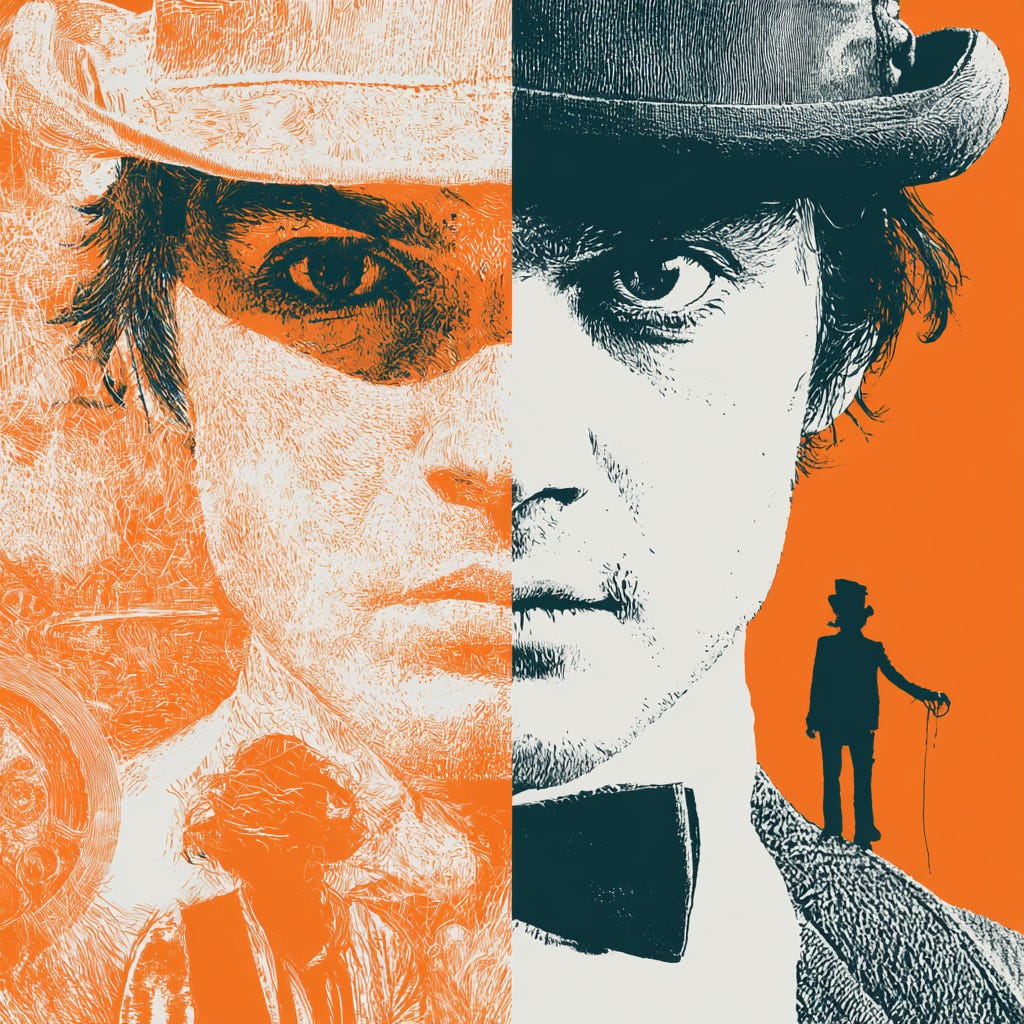
Anthony Burgess did not have much time and wanted to make his remaining hours on Earth count. He was diagnosed with a brain tumor at the age of 39 and was told that he had a year to live. He set out to write a flurry of novels to support his wife, Lynne, with royalties in the event of his death. Among the completed works in 1961 was A Clockwork Orange, a dystopian satire concerning a youth subculture of “ultra-violence” inspired by a Cockney expression he had heard in a bar, “as queer as a clockwork orange.” According to his own analysis, he “felt there might be a meaning in it deeper than a bizarre metaphor of, not necessarily, sexual, queerness.” He finished writing the book quickly, Burgess calling the effort “a jeu d’esprit knocked off for money in three weeks.”
In one early section of the book, the English writer “exorcised” a personal tragedy involving his wife Lynne. In April 1944, while he was stationed with the Army Educational Corps in the British overseas territory of Gibraltar, Lynne was working for the Ministry of War Transport in London. The city was subject to blackout periods at night during the Second World War to make targets less visible to enemy aircraft. During such a blackout, returning home from work after midnight, she was approached by four U.S. soldiers in civilian clothing, who had seemingly deserted their posts and spoke in a southern accent. Their aim was robbery rather than sexual assault; they grabbed her purse and tried to pry the golden wedding ring from her finger. One soldier “was prepared to break or even cut the finger,” according to Burgess. Lynne screamed for help, but none arrived; her yells were silenced by punches to her body and kicks were the last thing she recalled as she fainted to the ground. She happened to be pregnant at the time and lost the child. While recovering in the hospital, Burgess was informed through a letter written to him Lynne’s friend Sonia Brownell as she was too ill.
Burgess immediately approached his superior, Major W.P. Meldrum and requested leave to visit his ailing wife. Meldrum denied the request, which led to a contentious confrontation, Burgess writing: “it is more important to keep up this farce of Army Education than to fly to the bedside of a desperately sick wife? That is how the army sees it. God fuck the army.” Burgess neglected to salute as he left the conversation and his superior demanded that he return to do so.
In the years after they reunited, there were signs that Burgess’ wife could not fully overcome the attack she suffered: “Lynne could not bear to be left alone at night,” Burgess wrote, “even with a dog that flew into an ecstasy of noise at the scuffle of a mouse. She feared the dark, and the fear had its origin in blacked-out wartime London when she had been viciously attacked by four GI deserters.” The attack inspired an early passage in one of the most disturbing scenes of A Clockwork Orange, in which a gang terrorizes a young couple in a cottage by physical assaulting the husband and raping the wife. The final chapter of the book, where the main character outgrows his sociopathy, was cut by the U.S. publisher to maintain a darker ending for the novel: “Eric Swenson, Norton’s vice-president, insisted that the book lose its final chapter,” Burgess explained. “I had to accede to this lopping because I needed the advance, but I was not happy about it.”
Following Lynne’s death in 1968, Burgess was asked to return to the hospital to collect her rings. To obtain the wedding ring, her finger had to be broken, the same one the American GIs had attempted to break many years before.
This is the account you will read—or a slight variation thereof—if you open almost any non-fiction biography, newspaper article, book, or encyclopedia on the topic of Burgess and his famous novel. The only issue with the story is that none of it is true.
A Talent for Fiction
“If you could produce a symphony or write a book but the price was that you had a terrible disease, which would you choose?” This was the question John Wilson tried out on fellow instructors after joining Banbury Grammar School in 1950 as a secondary school teacher. By 1956, Wilson, with his first published novel Time for a Tiger, became Anthony Burgess, a pen name adapted from his middle names: Anthony, from his Catholic confirmation, and Burgess, from his mother’s maiden name. He was married in 1942 to his first wife, born Llewela Jones, known to others as Lynne Burgess.
Biographer Andrew Biswell found it “weirdly prescient” that Burgess had been already speaking of a fatal illness spurring the production of art and then living it himself a few years later. Burgess claimed to have obtained a tumor diagnosis in 1959, although indirectly: “One day in the classroom I decided that I’d had enough…I just lay down on the floor. I was picked up and shoved into the local hospital. Various elementary tests were given and then I was sent home to England. Eventually my wife was told there was evidence of a cerebral tumour, but it was inoperable. She told me that they gave me a year to live.” In terms of why a doctor would deliver such a serious diagnosis without telling the patient directly, Burgess did not attempt to explain. He later claimed that Lynne kept the news from him until Christmas 1959, because “women do not like keeping secrets” and he recounted the conversation with Lynne as follows:
‘What they told me at the hospital was that you have an inoperable cerebral tumour. […]
‘Inoperable? Tumour? I feel all right. The sea air is doing me good. You too.’
‘They said that feeling all right has nothing to do with it. They give you, at the most, a year to live.’
‘Nonsense.’
‘That’s what they say. They seem to know all about it.’
‘I don’t believe it, I can’t.’
‘That’s what they say.’
‘Nothing in writing?’
‘Nothing. But they spoke out loud and clear. Well, no. They mumbled rather.’
A friend who spent 8 years with the couple on and off in their home beginning in 1960 never heard of a supposed tumor: “He was in very good health. I never knew him to be ill,” Mrs. Sweetman is quoted as saying in The Real Life of Anthony Burgess. The tale provided a useful ending, however, to the first volume of his memoirs, Little Wilson and Big God, as the origin story for his prolific output as a writer: “No one would give me a job (‘How long do you propose staying with us?’ — ‘A year. You see, I’m going to die at the end of it.’ — ‘No future in it, old boy’). I would have to turn myself into a professional writer…I sighed and put paper in the typewriter. ‘I’d better start,’ I said. And I did.” Roger Lewis, in his biography of Burgess, refers to the story as “his famous brain tumour and the twelve-month prognosis: his autobiography is a litany of exaggeration and plain lies.” In the 1960s, Burgess gave the tumor anecdote to profilers who repeated it unquestioningly in publications such as The Diplomat and Time in 1966, and Life in 1968.
With the same literary flourish, Burgess decided to develop a tragedy to serve as the basis of the origin story for his best-known 1962 novel, A Clockwork Orange, which shot to fame with its film adaptation by Stanley Kubrick in 1971. After Lynne’s death, he tested with different acquaintances a story about her being assaulted by American GIs, but he could not decide on the details to include. Deborah Rogers, who first became his literary agent in 1968, was provided with three differing accounts of the incident by Burgess. In one version, Lynne was “attacked.” In another, she was raped by a group of deserters. In the third, she was raped, became pregnant, and had an abortion. “I could never work out the details of the GI rape,” Rogers stated. Burgess also tried out the story on the novelist Kingsley Amis, as he described in his memoirs: “he did tell me something about his wife’s rape by some GIs during the war, and went on to say that he was on the look-out for a sword-stick—he had with him a stout but conventional walking-stick—from which if ever menaced by ruffians he would draw and brandish the blade, shouting (and he shouted in illustration), ‘Fuck off, I’ve got cancer!’ Yes, I thought uneasily, seeing the look in his eye, you bloody mean it.”
The writing process for A Clockwork Orange took significantly longer than the three weeks Burgess later claimed. Sixty pages of the novel were completed by June 1961, and after completing seven chapters, he wrote to friends, with Dostoyevsky on his mind: “I’ve just completed Part I—which is just sheer crime. Now comes punishment. The whole thing’s making me rather sick. My horrible juvenile delinquent hero is emerging as too sympathetic a character—almost Christ-like, set upon by the scourging police.” His U.K. editor James Michie recalled receiving the first half of the book and that Burgess proceeded with writing the second half after receiving his advice. In the last half of 1961 he completed the novel, with typed drafts showing that his revisions took place from April to August 1961. The ending presented Burgess with a dilemma in terms of its inclusion in the 1962 U.K. edition and its exclusion in the 1963 U.S. version published by W. W. Norton & Company. Far from being solely excised due to the demands of Norton, Burgess’ own words at the time revealed his own misgivings about the redemptive final chapter: “Should we end here?” he wrote by hand at the end of the penultimate chapter. “An optional ‘epilogue’ follows.”
Eric Swenson, Vice-Chairman and Senior Editor at Norton, disagreed with Burgess’ portrayal of the editing process in the Times Literary Supplement in January 1980, in which the author claimed: “the managing editor was unwilling to publish without the excision of the final chapter…I was told that American readers would prefer unregenerability and thuggishness stretching to the crack of the doom.” A month later, Swenson wrote a rebuttal in a letter to the Times editor: “I am the editor of the American edition of CLOCKWORK ORANGE to which he refers. His claim that we refused to publish unless the last (up-beat) chapter of the published, British edition were dropped is hereby denied. We did tell him that the Polyanna ending left us unconvinced; he replied that he agreed, that he had added it only to mollify his British publisher, and that he would be pleased if we dropped it. As I have written him, we seem to have diametrically opposed memories of the matter. I, however, claim to have supporting documents and witnesses.” Swenson further clarified in an unpublished essay intended for a 1987 reprint of the novel, specifying “the dropping of chapter twenty-one was never a condition of publication.” He also wrote to Burgess directly about the new edition, hoping in vain that “somewhere in your Introduction you might introduce the thought that your publisher has a different memory of events…We would never have excised the last chapter over your objections.”
Burgess first publicized the attack story involving Lynne after her death as a promotion for Kubrick’s film. “Clockwork Orange Gang Killed My Wife” read the London Evening News headline on January 28, 1972. The connection to her death implied in the article was that the attack had supposedly driven her to drink, which ultimately caused her death from cirrhosis in 1968. Burgess sought to “refute” the eye-catching headline, adding however that “it is conceivable that the shock and injury she suffered led to her death 24 years later.”
On February 17, 1972, Burgess published an essay entitled “Clockwork Marmalade,” in which he presented yet another variation on the story: this time the event took place in 1942 and his wife was “robbed and beaten by three GI deserters.” This meant that the event was two years earlier and with one less deserter than the version offered in his memoir, Little Wilson and Big God, published in 1986. In his 1974 Playboy magazine interview the number of deserters was also increased to four and he added speculation regarding beer not present in other accounts:
“My first wife had a traumatic experience during the war, when she was working at the Ministry of War Transport on ships for the D-day landings. She was working very late one night, and coming home off the dock she was very severely mauled by four GI deserters. It often happened that young GIs, probably from unsophosticated states, would think that warm English beer was very weak stuff and would drink too much of it. They’d get drunk, perhaps assault an officer, get frightened, desert and live underground. A lot of these people did odd jobs, but some of them went around mugging and, of course, the blackouts were a natural cover and there weren’t very many police around. My wife was one of their unlucky victims. It wasn’t a sexual assault, it was an attempted robbery, and they tried to take her wedding ring off and she screamed and then they hit her: she was pregnant at the time and lost the child. Involuntary abortion.”
Burgess gave a similar account to Russell Harty in a television interview the same year: “she was attacked by four American soldiers who were not attempting sexual assault, but merely wanted to rob her. They stole her handbag and they wanted to take her wedding ring off...she was carrying our child at the time, she lost the child.” These versions were consistent only in that they no longer involved sexual assault as they did in the earlier iterations. To accept Burgess’ extended memoir account, however, one would need to believe that he never questioned his wife in their remaining 24 years together to fill in the details on the attack missing from Brownell’s second-hand account in her letter. In the same way, he was never curious enough to ask his own doctor about a supposed prognosis giving him a year to live. Both stories employed the literary device of Burgess learning of the news through third parties, who were by that point deceased and, as a result, unable to offer any differing remembrances. How a group of American men in civilian clothing in London could be identified as U.S. soldiers who deserted their posts solely based on their appearance and voices in the middle of the night was never explained by Burgess in any of his retellings.
Although a letter from Brownell was allegedly the source of the story, Burgess misspelled her last name in his 1986 autobiography as “Brownwell.” As he indicated in his autobiography, Brownell later became Sonia Orwell, and her inclusion may be linked to a desire to bolster his connection with the famous author George Orwell, whom he claimed to have seen in pubs. Sonia’s name was easy to drop as she had died in 1980 and could neither confirm nor deny the connection. Brownell was, in Burgess’ words, “an occasional drinking friend of Lynne’s,” but Lynne’s name does not appear in the only published biography of Brownell, entitled The Girl from the Fiction Department. Although it is unknown if he ever actually denied Burgess leave, Major W.P. Meldrum’s name appeared in The Journal of the Army Educational Corps in 1946, in conjunction with an article he contributed describing his work in Gibraltar.
Regarding the origin story for the expression “clockwork orange,” Burgess also had difficulty keeping these anecdotes congruent over the years. In the 1972 essay, the tale was that: “In 1945, back from the army, I heard an 80-year-old Cockney in a London pub say that somebody was ‘as queer as a clockwork orange’.” Forgetting what he had written just a year later, in an article for the New Yorker in 1973, he changed the date of hearing the expression to over six years earlier: “I first heard the expression ‘as queer as a clockwork orange’ in a London pub before the Second World War.” Writers who have researched the phrase, finding no linkage to a known Cockney expression, have suggested that Burgess simply invented the phrase himself.
The term “pathological liar” is applied twice to Burgess in Roger Lewis’ Anthony Burgess: A Biography. It also happens to be the only book cautious enough to append the adjective “allegedly” to the attack incident, assigned to the 1943 portion of a chronology of events in Burgess’ life: “In London, Lynne, pregnant, is allegedly mugged and attacked by GI deserters; she miscarries.” In a short biography of Lynne written on the 100th anniversary of her birth in 2020, Andrew Biswell, who had given the attack story more credence in his biography The Real Life of Anthony Burgess while footnoting the inconsistencies, neglects to mention the alleged incident at all.
Most writers covering the assault story involving Lynne Burgess, even when acknowledging contradictions in the story, quite understandably refuse to believe that Anthony Burgess would invent such a serious incident. His 1972 essay provides a clue as to why he may have, since he used the story as a device to mitigate against criticism of the violence described in his best-known novel and displayed onscreen in Kubrick’s film: “What hurts me, as also Kubrick, is the allegation made by some viewers and readers of A Clockwork Orange that there is a gratuitous indulgence in violence which turns an intended homiletic work into a pornographic one…For my own part, the depiction of violence was intended as both an act of catharsis and an act of charity, since my own wife was the subject of vicious and mindless violence in blacked-out London in 1942, when she was robbed and beaten by three GI deserters. Readers of my book may remember that the author whose wife is raped is the author of a work called A Clockwork Orange.”
The New York Times obituary of Burgess in 1993 placed the onus for the veracity of the story on Burgess himself: “The brutality depicted in ‘A Clockwork Orange’ stemmed in part, he once said, from an assault on his wife during World War II in London that resulted in the loss of their expected child.” The story has been repeated over the years in several books on Burgess and those covering other topics, including The Practice of Writing, The Utopian Dilemma in the Western Political Imagination, Science Fiction Language in Action, and The Complete Kubrick. The story also made its way into a Ph.D. dissertation on “The Blackout in Britain and Germany during the Second World War” in 2011.
Even if meant in jest, Burgess once gave a revealing answer in response to the question, “On what occasions do you lie?” to which he replied: “When I write, when I speak, when I sleep.” In the book Portraits of the Artist in “A Clockwork Orange,” the authors objected to Roger Lewis’ prominent placement of this quotation in his biography of Burgess:
“By this Lewis, who seems somewhat allergic to Burgess’s lies, puts forward the hypothesis that Burgess never told truth. Burgess’s attitude towards the twenty-first chapter seems to substantiate Lewis’s assumption. Is Burgess a liar? Perhaps so. But then Burgess is an artist. As Richard Ellmann pointed out in his analysis of Oscar Wilde’s Intentions, ‘an artist’s task is to make up lies to account for genuine truths whose interest, importance or value cannot necessarily be perceived by his contemporaries without his mediation.’ In which case, Lewis’s quotation is being misused for it is not so much a confession of guilt on Burgess’s part as a declaration of his genius.”
Fiction and non-fiction writing are separate enterprises, and literary talent is no excuse for the insertion of innumerable falsehoods into the decades of text presented to the public as fact. The lies ultimately distort our understanding of a famous work, its author, and a small aspect of the history of World War II. Burgess’ defenders would be better served to read the advice of Mark Twain, who in his essay, “On the Decay of the Art of Lying,” wrote: “Lying is universal—we all do it. Therefore, the wise thing is for us diligently to train ourselves to lie thoughtfully, judiciously; to lie with a good object, and not an evil one; to lie for others’ advantage, and not our own…”
No posts
Comments
Nothing yet. Say the first thing.
Sign in to join the conversation.