
(Warner Bros)
When people talk about stories that feel prescient in recent times—whether it be political, cultural, artistic, etc—they bring up George Orwell’s novel 1984 from 1949 about growing government surveillance, or Sidney Lumet’s Network (1976) with its biting screenplay by Paddy Chayefsky on the power of the media. After decades of being accused of promoting propaganda by some liberals and progressives, more movie viewers nowadays are seeing that Frank Capra’s drama Mr. Smith Goes to Washington (1939) might actually have been ahead of its time. To me, the piece of fiction that is most relevant right now is A Clockwork Orange, written as a novel by Anthony Burgess in 1962 and adapted to screen by Stanley Kubrick in 1971. Whether it’s repugnant men like Nick Fuentes, Clavicular and the Tate brothers having platforms and large followings, or the lethargic, “who cares” mood of society on decay. Anyone remember when Elon Musk was trying to make ‘Neuralink’ happen a while back? That process almost sounded eerily reminiscent of the Ludovico Technique from Burgess’ story. Since films are my forte more than books, I’m going to discuss the screen adaptation of A Clockwork Orange primarily here. The thing is, this isn’t one of those obscure ‘underrated gems’ suddenly popping up years after its initial release. A Clockwork Orange is one of the most famous and controversial movies of all time, received mixed reviews, but also earned multiple award nominations the year it came out, and is consistently influencing various forms of arts & entertainment for the past 55 years. But what made this infamously polarizing, yet beloved, picture still endure and find dedicated fans?
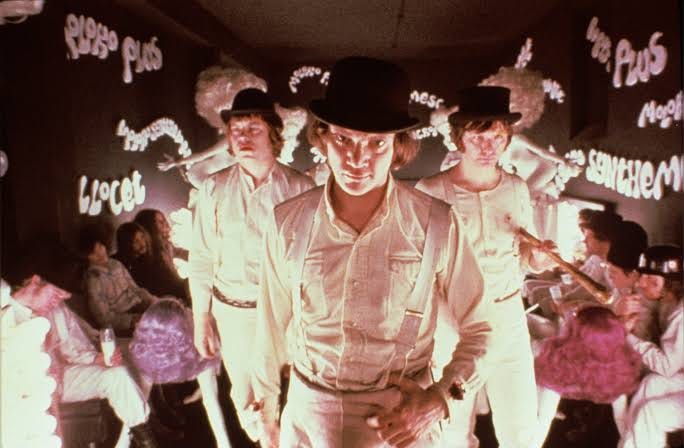
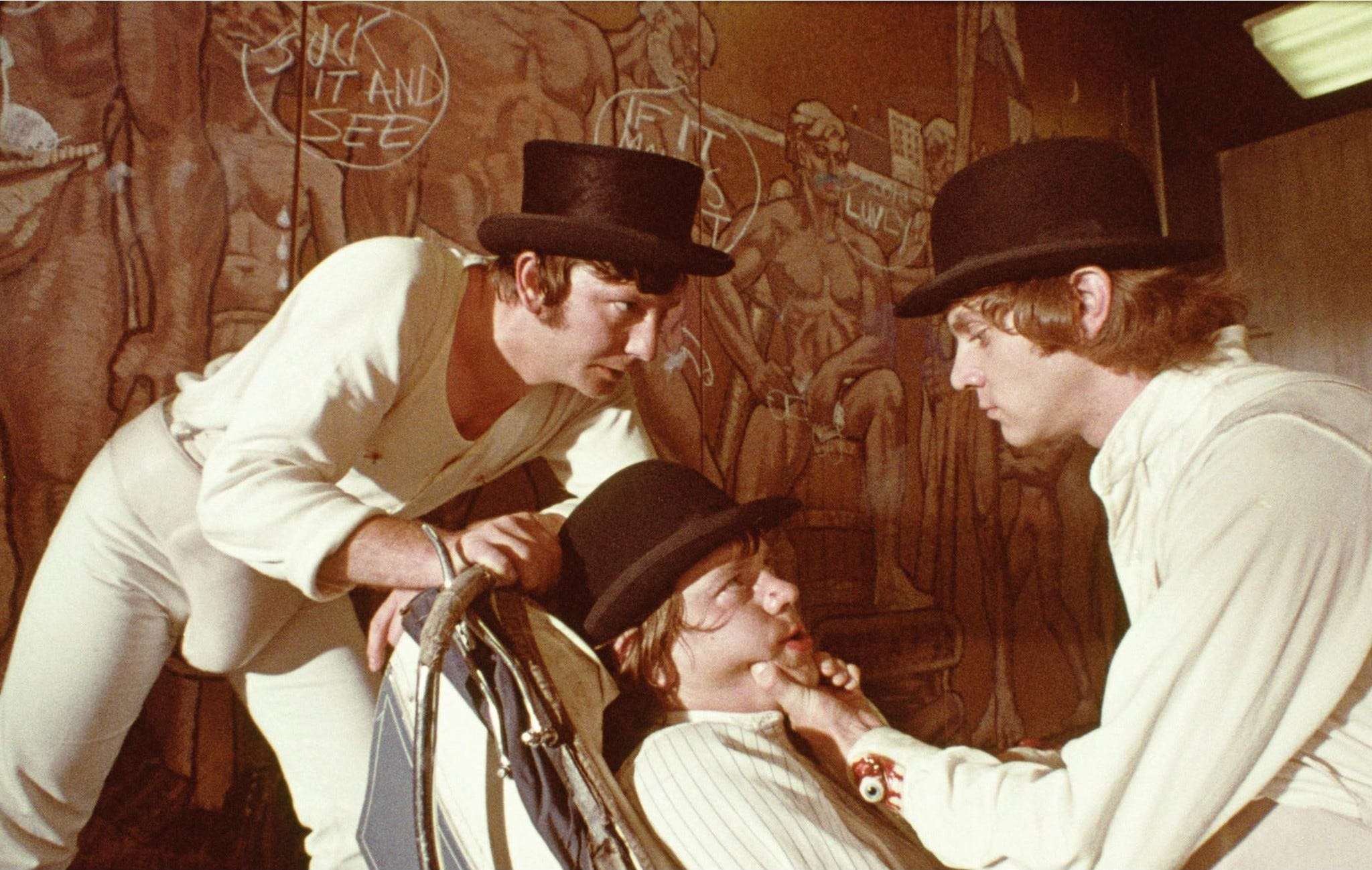
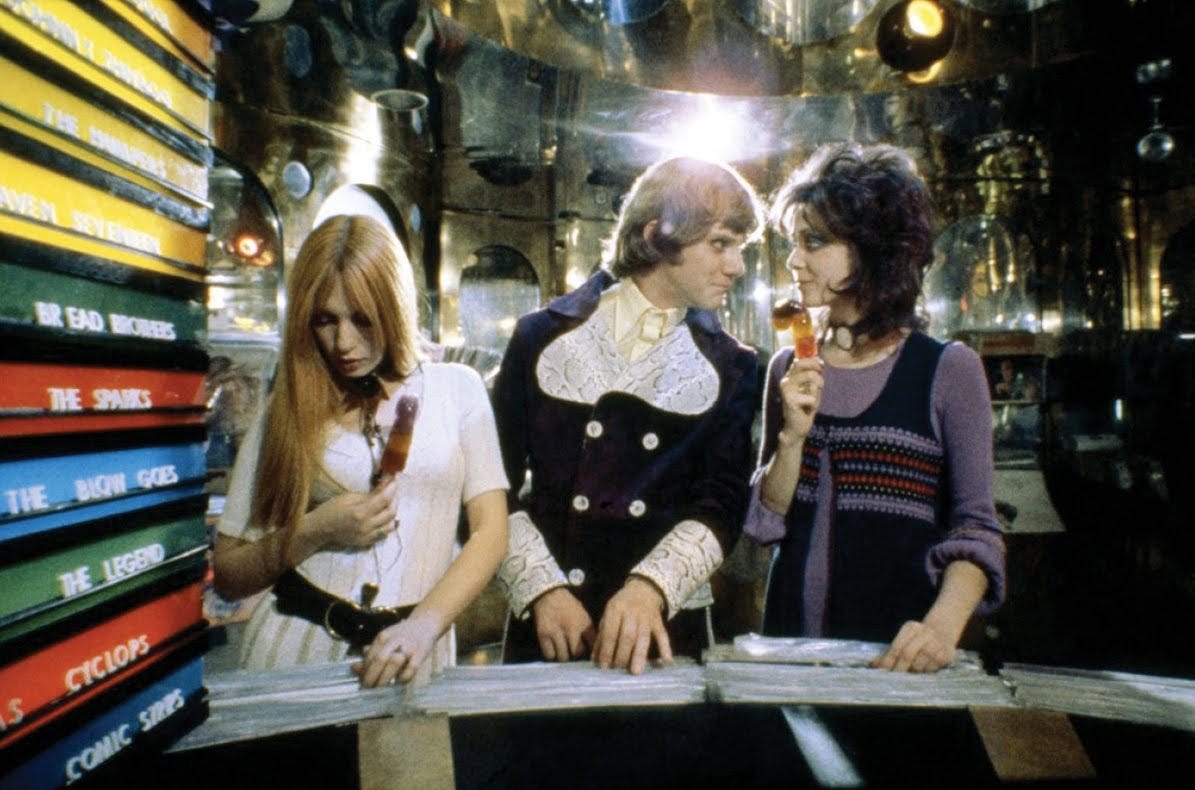
Honestly, I think what attracts young people, especially teenagers, to Clockwork Orange initially is purely the aesthetics. You can tell the film had a big impact on the future punk, goth and emo alternative movements, and there has probably been plenty of Clockwork merch found at Hot Topic over the years. Which makes sense, since this is a story that includes anti-establishment and juvenile delinquency as a theme, although in their most extreme, evilest forms; and in eye-catching costumes consisting of white jumpsuits, black boots, bowler hats and fake lashes on a single eye. The design of the semi-futuristic Korova Milkbar and the local record store with their rainbow-like colors and erotic imagery; Wendy Carlos’ whacky and infectious electronic soundtrack that features classical music. The young characters speaking in a whole slang language referred to as ‘Nadsat,’ which mixes English and Russian words. It’s a very unique universe for world building. Much like Walter Hill’s The Warriors (1979) or later films such as David Fincher’s Fight Club (1999) and Richard Kelly’s Donnie Darko (2001), Kubrick’s classic has a historically large cult following with youths who discovered it with wide-eyed precociousness or while going through a naïve, edgy phase in school. The difference between the protagonists of the later movies and Alex DeLarge (played by Malcolm McDowell) from ACO though, is that Alex truly does not have any good qualities about him other than maybe the natural good looks and charm of McDowell as an actor. It isn’t just teen rebellion going on in this dystopian London, England, but Alex and his fellow ‘Droogs’ lie, steal, incite fights with other gangs, break into homes, rape women, and other crimes late at night.
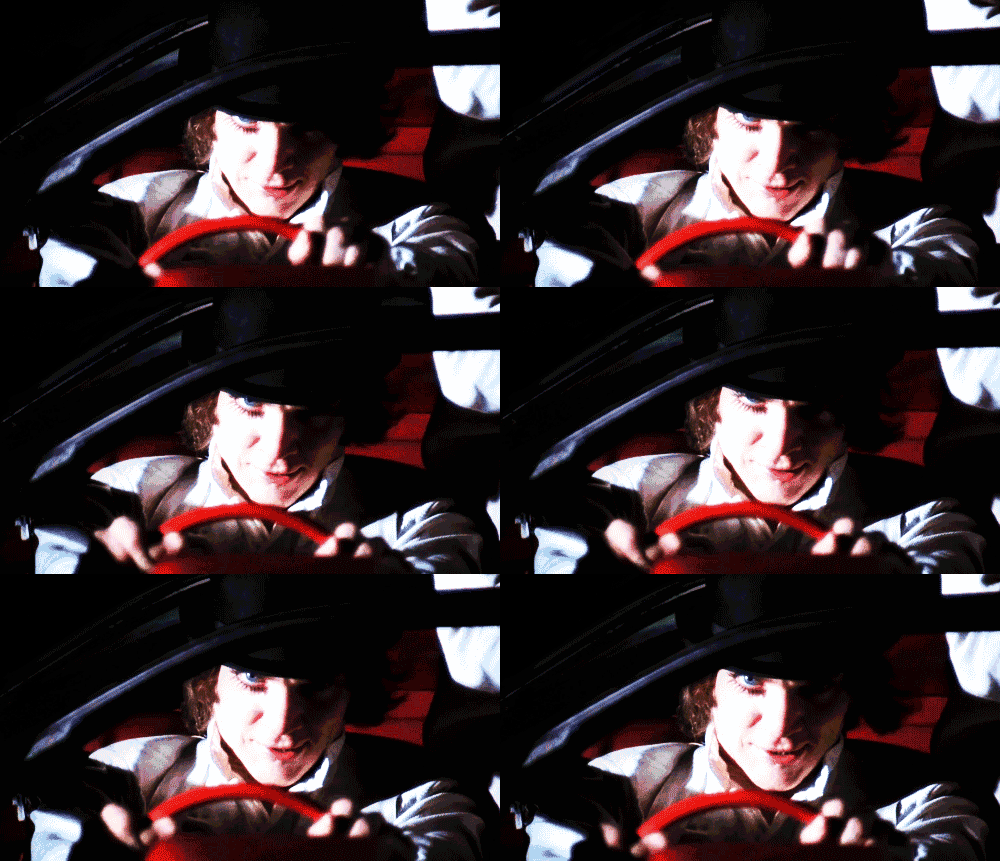
And if you can believe it, nearly all of the famous, controversial aspects of ACO are within the first 40 or so minutes. The rest of the 130-minute runtime focuses on Alex spending time in prison for murder after being set up by his friends, and then the disastrous results from him volunteering for the Ludovico Technique to get out of prison early. The first act is some of the foulest content you’ll see in a major motion picture, while the second and third acts have our lead getting his ass kicked over and over again. I have to assume most of the young fans obsessed with ACO’s visuals also appreciate that the story has a legitimate moral question running throughout, especially as the fans age and get more real-life experience. And that question is: does someone who willingly enjoys wrongdoing deserve to have his free will taken away? I actually did go through a Clockwork obsession in 10th grade, and it’s still one of my favorite movies. This was something I would generally keep to myself as I got older because some of the movie’s biggest criticizers are women, understandably. The movie begins full throttle with so much of the infamous ‘ultra violence,’ which includes two sexual assault scenes and a woman getting murdered by Alex [though he does look a bit spooked by his own action in the moment]. Naturally it’s a very jarring first-time watch. I’ve seen the same complaint from a lot of female viewers over the past two decades on how upsetting it is to watch these parts of ACO, making it not a surprise there are more men than women in the fanbase. On the other hand, it’s also amusing to notice when viewers seem to be somewhat divided on whether the film peaks in the first half or gets better in the second hour.
(Warner Bros)
One of the most impressive elements of A Clockwork Orange is how inherently British the whole film feels even though it was adapted and directed by a native New Yorker. Everything from the tone, the location and the cast, to the characters and the original author are so distinctly English, and yet for 26 years the average person in England couldn’t even watch it. Two years after the film’s release, Kubrick personally withdrew the movie’s circulation in the UK after numerous public claims and articles accusing ACO of motivating young men to be violent and inspiring then recently reported street crimes; with a particularly large amount of these accusations coming from Great Britain. The film also found itself legitimately banned in Brazil, Malta, Singapore and South Africa, just like the original novel was in various locations a decade earlier. Amusingly, Clockwork had no problem being shown in the US other than Kubrick having to appeal for an R rating over an instant X after the MPA were screened the film. Clockwork Orange was fully available globally not long after Kubrick’s death in 1999. This is another part of its cult status and association with the youth, a la wanting to see something you’re forbidden to out of instant curiosity.
I’ve never believed a single movie viewing can suddenly inspire someone to be a bad person. If said person never watches the violent film in question, then something else would likely trigger their poor judgment anyway. If anything, like I said earlier, it’s more probable Burgess and Kubrick were ahead of the curve on where humanity might be nearing. Especially when I think of how I’ve read four different news reports about women murdered by men this past month. But the thing is, blaming film, as was also the case with future releases like The Warriors, Fight Club and Oliver Stone’s Natural Born Killers (1994), also expose that the accusers haven’t seen these movies or aren’t paying attention. Clockwork in particular is pretty egregious to this point. Yes, the fight between the Droogs and another local gang is stunningly stylized, and so are Kubrick’s direction, Carlos’ music, McDowell’s performance, et al to effective use. But unless you specifically only watched the first 20 minutes, I don’t know how you can say this movie is pro-violence.
The setting in general is very bleak and cynical, with Alex’s own neighborhood appearing run-down and practically none of the adults in his life seeming to care about his well-being. His parents are terrified of what he might be doing out of the house and too cowardly to confront him about their suspicions. His probation officer is transparently a pervert. The police, government officials and medical experts all see him as a useful tool. The prison chaplain does appears to have good intentions and wants to help Alex change, but he is gone after a couple of scenes. One of Alex’s victims, wheelchair-bound Frank Alexander (Patrick Magee), is angry and hates the delinquent for obvious reasons, eventually attempting to torture Alex into suicide near the end of the story. When Alex returns home from prison, he finds his parents have moved on and turned his bedroom into a guest room for a renter. Even the pseudo sad cue from the score during this scene sounds like it’s mocking Alex’s misery. No one in the film is actually gassing up Alex or his ego, save for Alex himself because he’s the narrator and every scene revolves around him. The only real moment of positive human behavior in the whole picture happens when Alex successfully propositions two young women to spend the night with him [one who is played by yé-yé popstar Gillian Hills].
I’ve seen book fans complain about the threesome scene because it’s much different and disturbing in Burgess’ original story, where 15-year-old Alex tricks and forces himself on two 10-year-old girls. This clearly wasn’t going to be shot on film, even simulated. So what we get instead is a consensual romp with Alex, who is probably much closer to 18 and played by McDowell at age 27, and both actresses in the scene who are also over 20; with the sexual footage sped up for comedic effect. Fans of the novel argue this goes against how Alex was supposed to be portrayed as a character; since Burgess notes that Alex is a rapist who torments little girls and older women because girls his own age are disgusted by him. By showing him a genuinely charismatic young man who can easily participate in consensual sex, there’s no reason for him to be a rapist. I don’t agree with this. Alex successfully wooing pretty ladies actually makes his crimes even more sinister to me, because he’s still choosing to rape “for the love of the game.” And to be honest, the fact that sex is the only non-grotesque moment in Clockwork really goes to show how rancidly pessimistic this story’s world is.
(Warner Bros)
Fans and other Clockwork Orange viewers/readers have considered the story has an anti-government control theme as well, with Alex willing, yet naively, volunteering to be the first human experimented on for the Ludovico Technique; where he is physically brainwashed into becoming non-violent by feeling nauseous any time he gets a violent thought. But during this process, things Alex also enjoyed while being violent, such as his favorite music artist Ludwig van Beethoven, make him sick too. While Alex can’t physically attack anyone anymore, the experiment is also a failure because the violent urges aren’t actually blocked from his brain. Instead, Alex is now just forced to be chronically uncomfortable. Sure, a lot of people naturally think, “Good, he’s a psychopath with no remorse anyway.” While others argue this could be a slippery slope for prisons and the government to take advantage of those committed for less offensive charges and proves people can only choose to do good willingly. Thus, this section of ACO brings up an ever relevant and philosophical discussion.
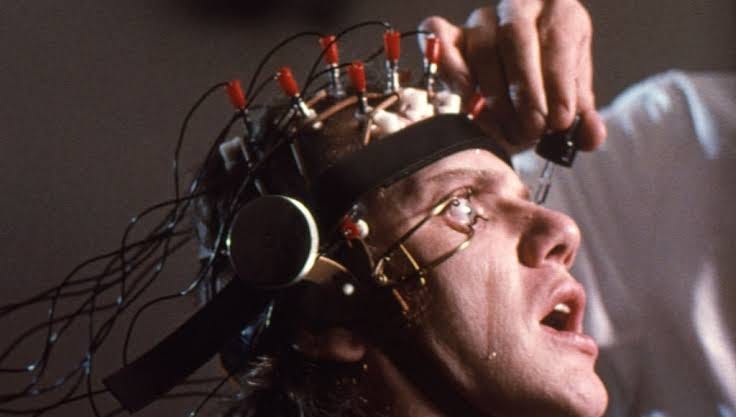
(Warner Bros)
To be honest, I’m not sure if Kubrick’s film completely answers this question, especially with how different the ending is compared to the novel, where Burgess decides to double down on showing free will can be the only successful way of change. Originally the US publication of Clockwork omitted an epilogue where Alex explains how he grew bored with crime and decided to go straight and settle down after seeing one of the Droogs married and have a job. Kubrick opted to conclude his film with the Ludovico Technique being reversed while Alex is resting from his suicide attempt in the hospital, accepts an office job from the Prime Minister (Anthony Sharp) as a bribe and/or apology for Alex’s misfortune, and the final shot of the film and final line heavily suggesting Alex did not learn anything and will go back to his old ways. I can see both endings working for different reasons. Burgess seemed to be an optimist who wanted to believe people could do better, so that’s reflected in his story’s conclusion. While Kubrick’s inverse of this is an example of sardonic irony, which also compliments the dark comic relief featured throughout the picture.
A Clockwork Orange is one of those classics where you can delve into so many subjects regarding the film/book/story, as you can see. I haven’t even explained where this strange story’s strange title comes from [a line in the original novel]. I don’t think there’s any movie quite like this, and it simply could only be made in 1970/71. Any time earlier would have been impossible and any time after the 1970s would have been too reluctant to tackle topics this brazenly. Ever influencing filmmakers and other artists, offering challenging questions for audiences, striking visually, a gateway to New Hollywood and pop counterculture. There really isn’t anything like it.

Editor note: This is a reminder that e-mailed responses to my articles are still being sent to my inbox’s spam folder. If you would like to share something with me, you can currently message me directly on Substack or upgrade to a paid account and leave a comment under the article you’re reading. ✏️
Editor note 2: If you enjoy reading my newsletter, please consider upgrading to a monthly or yearly paid subscription. If you don’t feel comfortable committing to an annual payment, you can also send a donation to my PayPal account instead. Since this is currently my main source of income creatively, it would be greatly appreciated and very helpful. Thank you again for your time and support of The Meggie Sue. 😊
No posts
Comments
Nothing yet. Say the first thing.
Sign in to join the conversation.