
Listen, I have never heard of Hito Steyerl before, but shout out to my algorithm for putting me on.
Ok so boom. I’ve been reflecting on so many intersecting theories and realities, largely spurred by my decision to live true to my delusions (aka trululu to my delulu) and have the audacity to dream of different worlds beyond what I’m currently experiencing, beyond what I’ve studied and observed. The major themes in my current reflections are as follows:
Money - because it does change your life, especially when you don’t have it.
Artificial Intelligence and…all the things
The Democratic Socialists of America/ Progressive politics and whether it is possible to live in a world with structure; without hierarchical leadership; without anti-Blackness.
Quantum Physics - The theory the undergirds my ability to imagine possible realities beyond what I am currently experiencing. The theory that also tells me that time is a construct and that I can access any time table consciously or subconsciously.
So when my algorithm suggested this episode of Doom Scroll, I decided to watch this instead of Love Island while retwisting my locs. In this video, Hito Steyerl — filmmaker, author, professor of digital media at the Academy of Fine Arts in Munich — sat down with host Joshua Citarella and basically confirmed every prophetic (or paranoid) thing I’ve been chewing on lately.
On Money.
Steyerl said something near the top of the conversation that I usually quip whenever I’m asked about the function of contemporary art: that contemporary art has functioned, quietly, as a tax evasion mechanism dressed up in the language of prestige and reputation and that betting markets are now doing that same job faster, cheaper, with less pretense. No more need to buy the painting to launder the money or the name. Just bet on it. They called the emerging economic order a kind of “nationalizing capitalism,” top-down and self-referential, running on speculative capital gains rather than anything resembling the reproduction of human life. Money that refers to nothing, propping up an economy that doesn’t need you to earn a living, only to gamble well. They even likened the U.S. trajectory to a new Soviet Union — a superpower pouring itself into a military-speculative economy it can’t actually sustain, while the “well” of New Deal-era public wealth, decades of infrastructure built by us and for us, sits fully drained, transferred, extracted, gone.
As I text my landlords another “white” lie about when they can expect rent from me, I’m reminded that currently, my reality is intimately intertwined with the fallout (pun intended) of the aftermath of these past and present gray wars. Nearly every aspect of my identity situates me as a bystander, an observer of national and natural demise as if watching a well run dry and still being told to draw water (labor) from it.
On Artificial Intelligence.
Steyerl’s central claim is that AI is being used to automate not just labor but judgment — the deliberative, collective faculty that political philosophy once held as the very thing that builds a public, a society, a shared space of meaning-making. Automate the judgment, they say, and you don’t just lose a decision, you lose the decision-making. You lose the public sphere itself. They trace a straight line from Hayek’s mid-century theory that markets are a kind of perfect computer, superior to any human mind, to the current AI moment where you just swap “capitalism” for “AI” and the ideology holds. The machine as oracle. The machine as excuse to stop deliberating altogether. And Steyerl is building their own small act of refusal against it: an image-generation model trained only on consensually collected data, one that renders bodies with bad skin, missing teeth, the visible wear of a public domain that’s been neglected and looted for decades. A model that, in its glitches, shows you exactly the condition of the public sphere it was trained on. Which is not a technical failure. It’s actually a mirror.
I’m building Polibot as a social experiment as well. Built upon the central question: Can harmful environmental (and other) regulations be thwarted before their effects coalesce into expensive impacts on communities that are already vulnerable to systemically designed extraction and otherwise designated as habitual dumping grounds? The other question I keep ruminating is can AI be used for good? And do we have enough time to reverse the authoritarian regime’s stronghold on the technology to reverse the already massive damage it has caused?
Recently, I spent time with the work of the artists involved in Eyebeam’s Speculating on Plurality Residency: Artists instigating us towards a pluralistic commons. The theme of this residency encompasses core inquiries namely:
We are more digitally connected than ever, but are we sharing realities?
What do these disparate and parallel realities invite us to consider urgently?
In an era of technofeudalism, is it possible to escape technology’s deployment in state surveillance?
Do our most popular technologies have an impulse towards creating sameness?
And, what is required to move us towards a pluralistic commons—a space that might hold our multitudes and their potentials towards shared futures
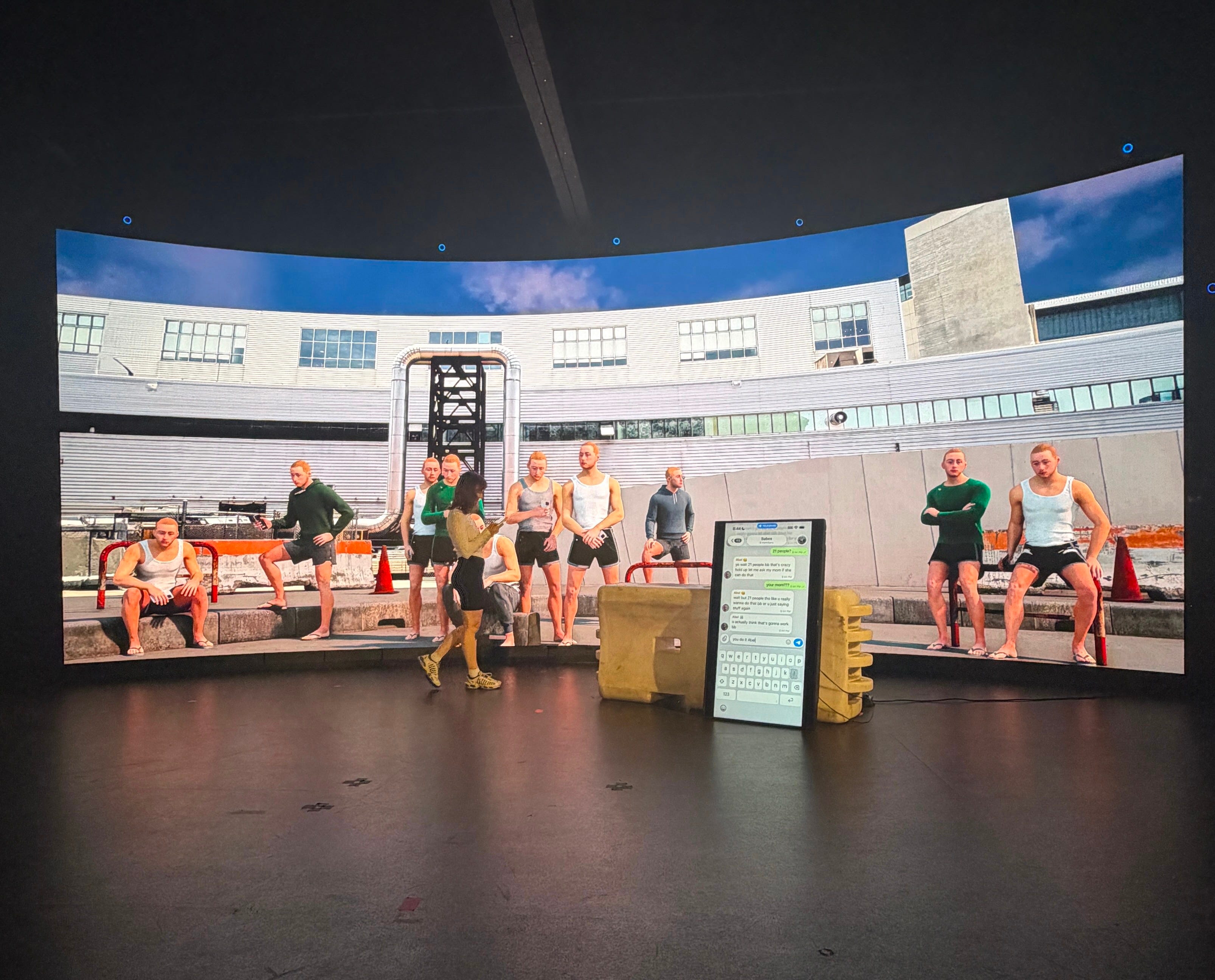
Artist, Aurora Mititelu captivated me with her work, Abel and I. On her website, this work is described as:
[A]n interactive simulation centered around [her] romantic relationship with Abel, the synthetic male version of [her]self. Synthesized from an extensive archive of texts exchanged with former partners, Abel is the perfectly distant boyfriend. He is a character present in multiple works, including Gen/esis (2024) and Meta-Mahala (2023). Abel was created using a custom system involving an LLM-based autonomous agent, a live simulation in Unreal Engine and a custom Python script that enables users to interact with the character through text messaging on an iphone placed on the bed. Through this convoluted relationship, [Mititelu] reflects on what it means to give up power for safety, and what autonomy looks like for a woman in a traditional, heteronormative society.
Watching AI being used to articulate reflections on aspects of society that I am not only affected by, but that I also affect, I reflected on the purist argument that AI is evil (full stop). I agree with this argument and reserve parts of my own reflections for the aspects of the technology that push boundaries beyond the limits we’ve been socialized to accept. In other words, when AI is used to critique the realities of the zeitgeist, when it’s turned inward and made confessional, or made to hold the specific weight of one woman’s convoluted love and her negotiation of safety versus autonomy, I find myself less interested in condemning the tool and more interested in who’s holding it and toward what end. Mititelu isn’t asking AI to solve her relationship to power. She’s asking it to show her the relationship, the way Steyerl’s broken-skinned, missing-toothed renderings show us the condition of the public domain without pretending to fix it. That distinction between AI as oracle, AI as excuse to stop deliberating, and AI as mirror, as instigation toward a harder look is the hinge PoliBot is built on too. Can the machine that’s currently accelerating the harm also, in different hands, with different data, different consent, different intent, be pointed back at the harm itself?
On the DSA, progressive politics, structure without hierarchy or anti-Blackness.
Steyerl brought up Vincent Bevins’ If We Burn. The book’s argument, as she lays it out, is that the last decade-plus of mass protest — Arab Spring, Brazil, and beyond — produced enormous visibility and almost no durable structural change, partly because so much of it was organized horizontally, leaderlessly, as a kind of vibe and accelerant rather than an organized political force. She named the overcorrection plainly: earlier left movements were too centralized, so the response became total horizontality, total consensus, total flatness and that flatness became its own gridlock, a structure so committed to non-hierarchy that it couldn’t ever actually decide anything. She’s careful, and so am I, to say the answer isn’t a return to rigid top-down leadership. It’s structure — some throughline of accountability and decision-making that doesn’t collapse into either autocracy or paralysis. This is, I think, the exact tension I hold when I think about DSA, about progressive spaces more broadly, about my own community organizing: how do we build the muscle of shared governance without either crowning a leader or drowning in a thirteen-hour debate about pizza toppings, all while making sure the structure we build doesn’t quietly reproduce the same anti-Black hierarchies it claims to be an alternative to. Nobody in this conversation solved that. Nobody has solved that. But naming the overcorrection honestly felt like a starting point.
I’d be remiss to say that I am not wary of the DSA, not because of its core public-facing principles, but because the party is a container for “well-meaning” white progressives who refuse to credit, if not center, the struggles and contributions of Black Americans who laid the foundation for socialism in America. It’s giving, we didn’t lick your boots clean enough when you marched in the streets during the racial uprisings of 2020 and so now a political party has emerged to cloak your disdain for not being praised enough, centered enough, financially stable enough. And there is no time to cherry pick struggles when the world is burning. Side note: The Hulu documentary #SkyKing is an excellent example of this tension between what white progressives think they are owed by the State and what they are willing and able to do to mask their resulting activism as a catchall for everyone’s struggle. The point is, Black progressives haven’t had the time, space, or agency to tighten our own threads because the machine of racialized capitalism requires constant motion -- constant unraveling. Which, for a migratory people, is survivable yet exhausting.
On Quantum Physics, time, and the audacity to imagine otherwise.
Steyerl, riffing off the Pope’s recent invocation of centuries-long institutional time in response to the AI moment, named it outright: there is geological time, there is TikTok time, and there is eschatological time, the time of the apocalypse, and all of them are operating on us simultaneously right now. They talked about the current wave of protest possibly being a prelude — pointing to nineteenth-century France, five failed revolutions that nobody remembers, decades of people being shot in the street before anything coalesced into something durable. Time is not linear in Steyerl’s framework any more than it is in mine. And when Citarella pushed them on what “public” even means for the AI model they’re building, a public that doesn’t exist yet, an international public sphere that has never existed, they said something that felt like it was lifted directly out of my own Quantum Physics practice: that by building the thing, you call the public into being. You conjure it. You summon a reality that doesn’t yet have precedent by simply, insistently, beginning to build as if it already does.
That’s the whole theory behind my decision to stay trululu to my delulu, dressed up in a German media theorist’s vocabulary. You don’t wait for the public, the movement, the structure, the world to already exist before you act like it’s possible. You access the timetable you need once you decide that timetable is possible. You build the mirror model with the broken teeth and call it honest instead of hiding it. You hold the tension of structure without hierarchy without flattening anyone in the process. You watch the well run dry and you dig somewhere else.
Comments
Nothing yet. Say the first thing.
Sign in to join the conversation.