
As per the Trump administrations goals, the Restraining Judicial Insurrectionist Act of 2025 allows the processes of the courts to be disrupted and unreliable.
Previously, I broke down the No Rogue Rulings Act of 2025, which makes implementing injunctive relief more difficult for district courts. The bill requires several district courts from different states to implement broad injunctive relief. The catch is that a three-judge panel is who will decide the validity of the order. The process of deciding the three-judge panel is established in section 2284 of title 28.
Interestingly, it seems that NORRA is the bill receiving the most attention rather than S.1090 making news headlines and spreading on social media with independent journalists reporting on it. In reality, NORRA would help the Trump administration, but it would not prevent these district court judges from doing their job and a few cases would still get through. To close the loophole the Republican Senator Mr. Lee introduced the bill that would alter the selection process of the three-judge panel that has been established for years.
If you do not wish to read the following changes to section 2284 of title 28 then scroll down to the section titled: How does that affect me?
Any statements in italics are understood to be modifications to the original section. Further, any slashes through words are the words struck to be terminated from the section as proposed.
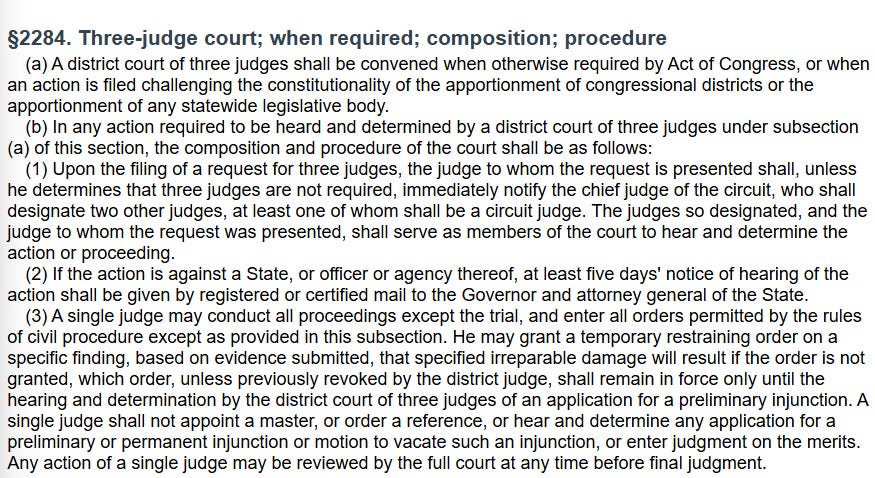
(a) IN GENERAL. — A district court of three judges shall be convened when otherwise required shall be convened when— (1) otherwise required by Act of Congress, or when an action Congress; (2) an action is commenced against any department or office of the executive branch that seeks declaratory relief, a temporary restraining order, a preliminary or permanent injunction, vacatur, a stay, or other equitable relief against an action of the executive branch or executive order of the President; or (3) an action is filed challenging the constitutionality of the apportionment of congressional districts or the apportionment of any statewide legislative body.
(b) In any action PROCEDURES GENERALLY. — Except as provided in subsection (c), in any action required to be heard and determined by a district court of three judges under subsection (a) of this section, the composition and procedure of the court shall be as follows:
(1) Upon the filing of a request for three judges, the judge to whom the request is presented shall, unless he determines that three judges are not required, immediately notify the chief judge of the circuit, who shall designate two other judges, at least one of whom shall be a circuit judge. The judges so designated, and the judge to whom the request was presented, shall serve as members of the court to hear and determine the action or proceeding.
(2) If the action is against a State, or officer or agency thereof, at least five days' notice of hearing of the action shall be given by registered or certified mail to the Governor and attorney general of the State.
(3) A single judge may conduct all proceedings except the trial, and enter all orders permitted by the rules of civil procedure except as provided in this subsection. He may grant a temporary restraining order on a specific finding, based on evidence submitted, that specified irreparable damage will result if the order is not granted, which order, unless previously revoked by the district judge, shall remain in force only until the hearing and determination by the district court of three judges of an application for a preliminary injunction. A single judge shall not appoint a master, or order a reference, or hear and determine any application for a preliminary or permanent injunction or motion to vacate such an injunction, or enter judgment on the merits. Any action of a single judge may be reviewed by the full court at any time before final judgment.
(c) PROCEDURES FOR ACTIONS SEEKING TO RESTRAIN EXECUTIVE BRANCH ACTIONS—
(1) SELECTION OF JUDGES FOR A THREE-JUDGE DISTRIC COURT. —
(A) IN GENERAL.— Upon the filing of a request for three judges in an action described in subsection (a)(2), the judge to whom the request is made shall, unless the judge determines that three judges are not required, immediately notify the Chief Justice of the United States, who shall designate three judges at random from a list of all judges in active service regardless of circuit—
(i) one of whom shall be a circuit judge in active service; and
(ii) not more than two of whom may be serving in the same judicial circuit.
(B) SERVICE BY JUDGE RECEIVING REQUEST. —The judge to whom a request described in subparagraph (A) was presented may serve as a member of the district court to hear and determine the action if—
(i) the judge is selected to be a member at random in accordance with subparagraph (A); and
(ii) the judge is a district judge in active service.
(2) NUMBER OF JUDGES REQUIRED TO CONDUCT PROCEEDINGS. —No temporary restraining order, stay, preliminary injunction, or other equitable relief may be granted in an action described in subsection (a)(2) unless a majority of the district court for the action orders that such relief be granted.
(3) APPOINTMENTS OF MASTERS. —No single judge shall appoint a master, or order a reference to a magistrate judge, or hear and determine applications for preliminary or permanent relief in an action described in subsection (a)(2).”.
In subsection (a) the additional requirement would be that if any action were to be issued against the executive branch's offices or departments there would be required a three-judge panel to decide if the requested relief is valid.
As previously stated in my last post, DANGER: Trumps Plan to Break the Separation of Powers in the United States, this bill would ensure that if any district judge were to find an Executive Order, or any other executive action, to be an unconstitutional act with the possibility of being dangerous to the parties involved, including the nation, that it would prevent the injunction or temporary restraining order from immediately going into place. Following that, the lengthened process could allow corruption in the process of selecting the three judges, or as we have seen from the Trump administration following the orders of the executive branch shortly after being signed making the relief ineffective. If a district judge had to go through the process of waiting for the three-judge panel to be convened, come to a decision, the likely appeals, and then the decision from the Supreme Court at that point the damage to the parties would be done.
A quick side note the definition of every listed relief in the bill is important and should be reviewed.
Section (b) indicates that the common procedure for the use of three-judge panels will be for the following three paragraphs with the exception of section (c).
Section 2(c) is new as a whole. The title “Procedures for actions seeking to restrain executive branch actions” already persuades the reader to believe that the judiciary branch is targeting the executive branch. The connotation of the word “restrain” can be used to assume that the judiciary branch is forcefully holding back the actions of the executive branch rather than following their duties as judges. Aside from that, the additional paragraphs are proposed to limit the ability and equality between the branches of government.
Paragraph c (1) establishes that generally, the Chief Justice will randomly select three active judges without concern of the circuit and select no more than two judges from the same judicial circuit. I would like to mention Chief Justice John Roberts has mentioned a couple of times in the past month about the possibility of his retirement. If he were to retire, we would need a new chief justice, which would be selected by Donald Trump and voted in by his small majority of loyalists in the Senate. Meaning, that the new judge would likely be one of the most conservative judges in the Supreme Court. Another condition allowed is that the judge who the panel request was sent to is allowed to be a member of the panel as long as they are selected at random and are active.
Section 2(c)(2), as previously stated, establishes that the purpose would be to prevent any “temporary restraining order, stay, preliminary injunction, or other equitable relief” from being granted allowing the executive branch to take the action ordered by the executive branch which would then essentially make the relief ineffective for preventing the seemingly dangerous, unconstitutional action.
Section 2(c)(3) prevents the three-judge panel from turning the case over to a master or magistrate judge, someone who specializes in particular duties usually in complex legal situations by assisting district judges. This may be to prevent outside parties from providing insight, although the purpose that MAGA states is to prevent the decision from being granted by a single party to supposedly "avoid judicial overreach."
All I have to say is that you must not avoid the news, and you must seek out new information. Although we are being bombarded with information 24/7, we have to stay informed.
If you want to ensure you have sufficient information, you must educate yourself because nobody, but you can help you become well informed.
I hope the case building against the Trump administration will help inspire you to take action.
Without risks, without fear, we would not be where we are now. We would not have Civil Rights without people risking their careers and lives due to the fear of living within an oppressive state.
History will tell you that this is the moment people should be taking action, not later.
Take that calculated risk.
Protest, non-violently of course, but assert your morals and stance.
Be safe, stay educated, and be committed to your morals.
From Martha Van W.
No posts
Comments
Nothing yet. Say the first thing.
Sign in to join the conversation.