
Exactly one year to the day of Trump’s 2nd inauguration, Prime Minister Mark Carney delivered a speech in Davos Switzerland that has been lauded as ‘historic’ and compared to famous speeches by Churchill and Canada’s Louis St Laurent. It’s been widely praised and a hot topic of serious discussion around the world for the past several days. Even Opposition Leader Pierre Poilievre praised Carney’s eloquent and pragmatic approach to ‘actively take on the world as it is, not wait around for a world we wish to be.’
Without ever mentioning Trump or the US directly, Carney frankly and succinctly described the ‘rupture’ in the US-led rules based order (’Pax Americana’) created after the second world war that we’ve all comfortably lived under and relied upon for the past 80 years. Younger generations may not truly understand the implications of this moment as clearly as those of us whose parents and grandparents fought for democracy in Europe in the first half of the 20th century.
As Prime Minister Carney clearly warned... ‘Canadians know that our old, comfortable assumptions — that our geography and alliance memberships automatically conferred prosperity and security — that assumption is no longer valid.’
Prime Minster Carney’s speech in Davos describes the reality of what the world now faces in light of US withdrawal from it’s previous role as the hegemon of the global rules-based order. It’s both an eye-opening description of ‘the world as it is’ and a prescription of how ‘middle powers’ like Canada can withstand the pressures of financial and military threats imposed by ‘great powers’ such as the USA & China while maintaining our sovereignty.
‘A rupture, not a transition’
Let me be direct: We are in the midst of a rupture, not a transition.
Over the past two decades, a series of crises in finance, health, energy and geopolitics have laid bare the risks of extreme global integration.
But more recently, great powers have begun using economic integration as weapons. Tariffs as leverage. Financial infrastructure as coercion. Supply chains as vulnerabilities to be exploited.
You cannot “live within the lie” of mutual benefit through integration when integration becomes the source of your subordination.
The multilateral institutions on which middle powers have relied — the WTO, the UN, the COP — the very architecture of collective problem solving, are under threat.
And as a result, many countries are drawing the same conclusions — that they must develop greater strategic autonomy: in energy, food, critical minerals, in finance and supply chains.
And this impulse is understandable. A country that cannot feed itself, fuel itself or defend itself has few options. When the rules no longer protect you, you must protect yourself.
But let’s be clear-eyed about where this leads. A world of fortresses will be poorer, more fragile and less sustainable.
Canada’s geography places us in a more vulnerable position to those ‘weapons’ than any other country in the world. We embraced free trade in the 1980’s with NAFTA despite Liberal leader John Turner’s 1988 debate warning to Prime Minister Mulroney that it would lead to where we are today...
TURNER: On terms of definition then, the political ability of this country to remain as an independent nation, that is lost forever and that is the issue of this election, sir.
MULRONEY: Mr. Turner, Mr. Turner. Let me tell you something, sir. This country is only about 120 years old, but my own father 55 years ago went himself as a labourer with hundreds of other Canadians and with their own hands, in northeastern Quebec, they built a little town, schools and churches, and they in their own way were nation-building. In the same way that the waves of immigrants from the Ukraine and Eastern Europe rolled back the prairies and in their own way, in their own time, they were nation-building because they loved Canada. I today, sir, as a Canadian, believe genuinely in what I am doing. I believe it is right for Canada. I believe that in my own modest way I am nation-building because I believe this benefits Canada and I love Canada. I, today, sir, as a Canadian, believe genuinely in what I am doing. I believe it is right for Canada. I believe that, in my own modest way, I am nation-building because I believe this benefits Canada and I love Canada.
TURNER: I admire your father for what he did. My grandfather moved into British Columbia. My mother was a miner’s daughter there. We are just as Canadian as you are, Mr. Mulroney, but I will tell you this. You mentioned 120 years of history. We built a country east and west and north. We built it on an infrastructure that deliberately resisted the continental pressure of the United States. For 120 years we’ve done it. With one signature of a pen, you’ve reversed that, thrown us into the north-south influence of the United States and will reduce us, I am sure, to a colony of the United States because when the economic levers go, the political independence is sure to follow.
So here we are…under economic and political pressure from a vindictive US president who has no guardrails at home to prevent him from wreaking havoc on our economic sovereignty.
Carney presented a path forward for middle powers to navigate the brutal reality of the new world order we now face...
Middle powers must act together because if we’re not at the table, we’re on the menu.
But I’d also say that great powers can afford, for now, to go it alone. They have the market size, the military capacity and the leverage to dictate terms. Middle powers do not. But when we only negotiate bilaterally with a hegemon, we negotiate from weakness. We accept what’s offered. We compete with each other to be the most accommodating.
This is not sovereignty. It’s the performance of sovereignty while accepting subordination.
In a world of great power rivalry, the countries in between have a choice: compete with each other for favour or to combine to create a third path with impact.
We shouldn’t allow the rise of hard power to blind us to the fact that the power of legitimacy, integrity and rules will remain strong — if we choose to wield them together.
First it means naming reality. Stop invoking “rules-based international order” as though it still functions as advertised. Call it what it is: a system of intensifying great power rivalry where the most powerful pursue their interests using economic integration as a weapon of coercion.
It means acting consistently, applying the same standards to allies and rivals. When middle powers criticize economic intimidation from one direction but stay silent when it comes from another, we are keeping the sign in the window.
It means building what we claim to believe in. Rather than waiting for the old order to be restored, it means creating institutions and agreements that function as described.
And it means reducing the leverage that enables coercion. Building a strong domestic economy should always be every government’s immediate priority. And diversification internationally is not just economic prudence — it is the material foundation for honest foreign policy. Because countries earn the right to principled stands by reducing their vulnerability to retaliation.
If you haven’t listened to Carney’s world-shaking Davos speech I suggest you do so. You can find the video and a transcript here.
As we know there’ve been plenty of ups and downs in negotiations over tariffs on sectors not currently covered under the CUSMA trade agreement, which is under review for renewal in the coming months. Tariffs on steel, aluminum, copper, forest products and the auto industry are having the largest impact on Canada. Negotiations on these were paused after Ontario Premier Doug Ford launched his obviously very effective Reagan TV ads in the fall.
Public hearings were held in December 2025 to get input from businesses on whether the CUSMA agreement should be renewed and what changes might be warranted. U.S. industry groups strongly back renewing CUSMA.
A couple of key pressure points for Canada will be front and centre in the coming CUSMA review.
The auto sector has been increasingly integrated between Canada and the US since the ‘Auto Pact’ created in the 1960’s. Cars and parts cross the border up to 7 times between assembly and delivering finished cars & trucks. At a US-Canada Summit in October US Commerce Secretary Howard Lutnick said that’s over...
U.S. Commerce Secretary Howard Lutnick is dismissing any prospect of a comprehensive auto deal with Canada, according to three sources in the room when he made the comments.
Lutnick made the comments during a discussion under Chatham House Rules at the US-Canada Summit, hosted by BMO and Eurasia Group in Toronto on Wednesday, one day after the second in-person meeting in Washington between U.S. President Donald Trump and Prime Minister Mark Carney.
According to the sources, Lutnick said the U.S. could continue buying parts from Canada, “but that’s about it.”
The U.S. has had 25 per cent tariffs on all foreign-made autos since April. In the case of Canadian auto exports, for those that comply with the Canada-U.S.-Mexico Agreement (CUSMA), the levies apply to the non-American components.
Those levies are stacked on a slate of other tariffs on Canadian goods, including all goods that are not CUSMA-compliant, as well as sectoral tariffs on steel, aluminum, and copper.
Canada also has countermeasures in place, including 25 per cent on autos that are not covered by CUSMA.
According to sources, Lutnick also said Canada should “come second” to the U.S. on autos.
US Ambassador Pete Hoekstra has linked Canada’s previously planned purchase of F-35 fighter jets to renegotiations of the CUSMA agreement...warning Canada not to pursue a potential partnership with Sweden to build Saab Gripen jets in Canada. Without getting into the weeds on the pros and cons of each of these aircraft the bottom line comes down to two critical points.
Sovereignty
European countries like Denmark and Switzerland have discovered that when purchasing F-35 jets they do not if fact have control of maintenance, parts and software... which remain firmly in the hands of US supplier Lockheed-Martin. Denmark recently found that parts required their jets were re-directed without warning to Israel... leaving them with no ability to service their own jets. Switzerland realized that they really have no ability to upgrade or adapt necessary software without relying on the US. With recent events making that relationship less trustworthy they have raised the warning that your defence capability relies completely on the whims of a mercurial US president. Not a great position to be in when your country’s sovereignty is at stake.
Readiness is also a concern as a significant proportion of F-35 jets are not flight capable at any given time.
Cost & Industrial Policy
The major benefit of Sweden’s proposed Gripon partnership is that Canada would have full sovereignty...allowing us to build, adapt, upgrade and sell Gripon jets built in Canada to other countries such as Ukraine. This fits with Carney’s industrial policy of merging defence procurement and production within Canada. The proposal suggests this could mean up to 10,000 well paid jobs in Canada’s aeronautics industry.
On top of all this the Gripon fighter jets are designed for arctic. They’re less complicated, they can land and take off from a highway and be maintained and re-armed by a crew of six. Gripons are also considerably cheaper and less expensive to maintain... meaning more time in the air for training or on mission in the arctic.
In light of recent events...particularly Trump’s threat to take Greenland by any means... we absolutely can not put our defence capabilities in the hands of the very country that poses the most imminent threat to our own sovereignty.
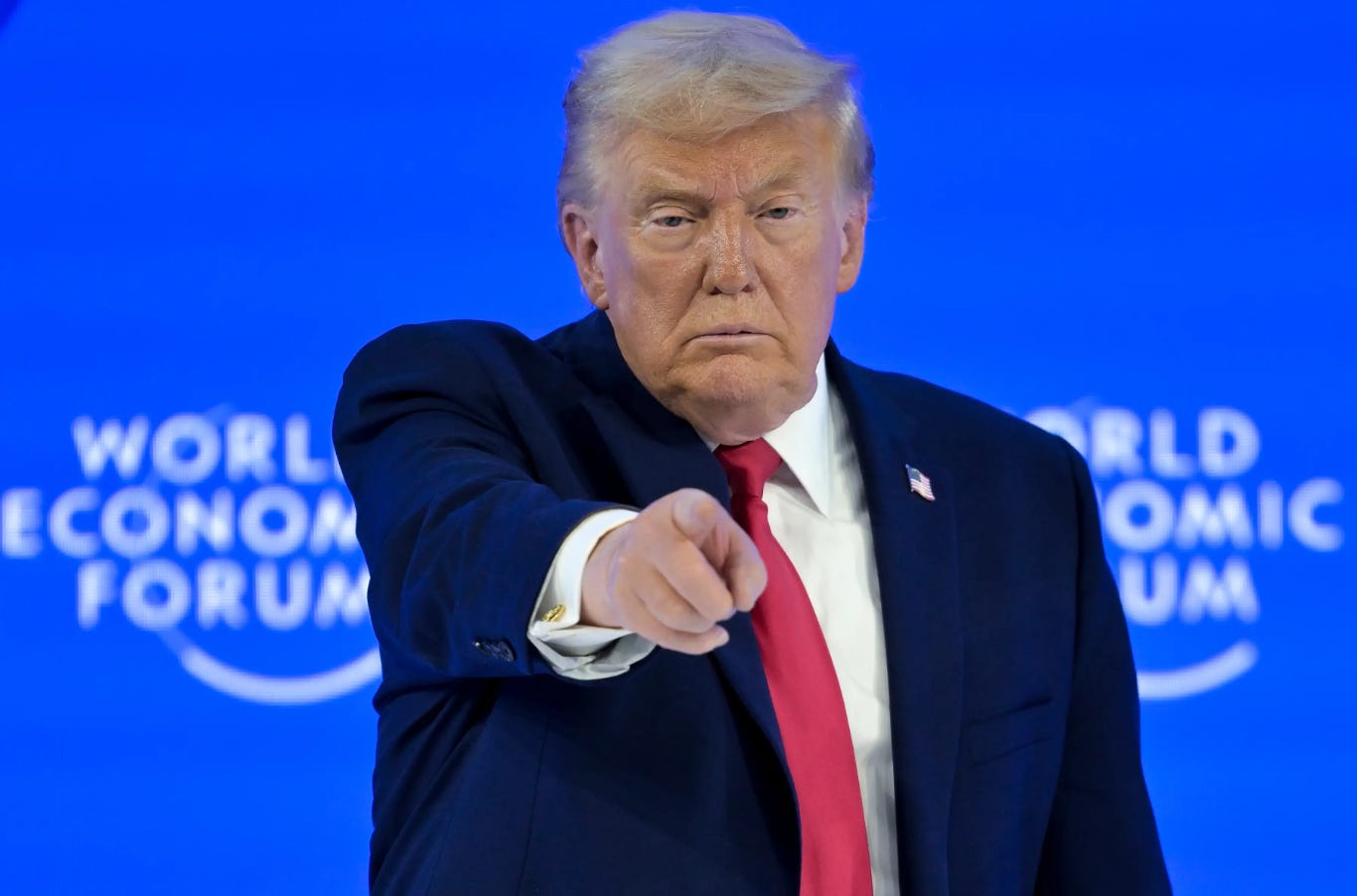
The day after Carney delivered his speech...Trump took the stage in Davos and delivered an unhinged diatribe against Europe, NATO and took a shot at Mark Carney with a warning in his typical Godfather fashion.
“Canada gets a lot of freebies from us, by the way, they should be grateful also, but they’re not,” he said. “I watched your (prime) minister yesterday, he wasn’t so grateful.”
“They should be grateful to us, Canada,” he added. “Canada lives because of the United States. Remember that, Mark, the next time you make your statements.”
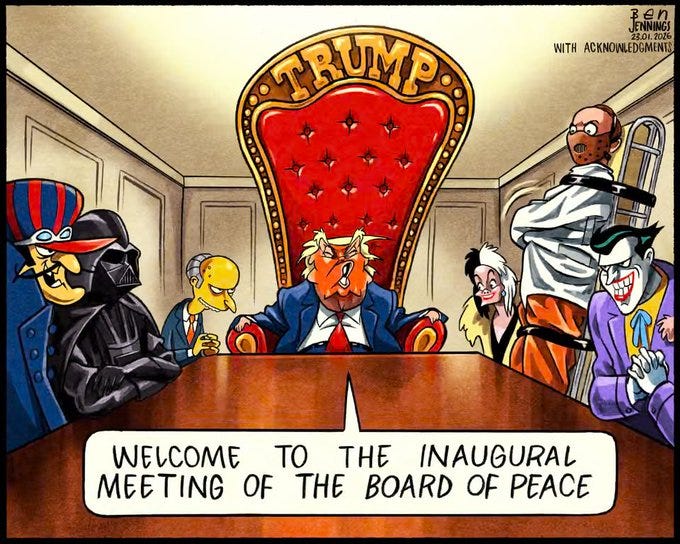
Since Trump’s Wednesday comment he has disinvited Carney from joining his so-called ‘Board of Peace’ which actually appears to sound more like a cabal of global Batman villains than any trustworthy organization truly invested in achieving peace. Trump’s Treasury Secretary Scott Bessent has openly supported Alberta’s separation movement (which is purportedly in contact with and financially supported by the Trump administration).
And to no one’s surprise Carney’s speech has triggered the latest threat of retaliation this morning...warning ‘Governor Carney’ of 100% tariffs on Canada if we pursue any trade deals with China.
Buckle up gang...2026 is going to be a stomach-churning roller coaster ride like we’ve never seen before
.
No posts
Comments
Nothing yet. Say the first thing.
Sign in to join the conversation.