
I’ve often criticized the Biden administration for pushing through the American Rescue Plan (the final stimulus package), as it became the primary driver of inflation. To the same extent, I’ve also criticized Federal Reserve action/inaction for the reason we’re dealing with persisting inflation.
The truth is, inflation is everywhere and always a monetary phenomenon, as Milton Friedman famously proclaimed. If this is the case, how can I in good faith say that the March 2021 stimulus is to blame? Allow me to explain.
It all starts with the equation of exchange, being defined as MV=Py. In the equation, M stands in as any aggregate of the money supply, V being the corresponding aggregate’s velocity (in other words how many times each of those units of money is spent), P is the price level, and y is real Gross Domestic Product (GDP adjusted for inflation), or output. As a note, the inverse of Velocity is the demand to hold money.
On the right side, real GDP (y) can also be written as Y/P, where Y is nominal GDP. Therefore the right side of the equation, Py, can be simplified to nominal GDP (Y).
The left side of the equation represents how much money there is in the economy, multiplied by how many times each of those units of money is spent. This in turn, is also equivalent to nominal GDP (Y), or final output/spending. For this reason, the equation of exchange is known as a tautology, meaning it is true in any case.
Both the price level (P) and NGDP (Py or MV) are directly related to money supply and money demand (the inverse of Velocity, V). The Fed has direct control over the supply of money. Thus if either NGDP or P are to be kept stable, money supply simply must rise when velocity falls, and vice versa. In other words, money supply must meet money demand. This is a concept known as monetary equilibrium, and one that is often ignored.
Just like any good or service, maintaining equilibrium (that is the meeting of supply and demand) is important to prevent both shortages and excesses, in addition to indicating the true value of the good. Money is no exception.
Since the Federal Reserve is the only legal issuer of money, it is their responsibility to maintain monetary equilibrium. Hence, if money demand falls (Velocity rises), then money supply should be contracted; if money demand quickly rises, the money supply should be adequately expanded.
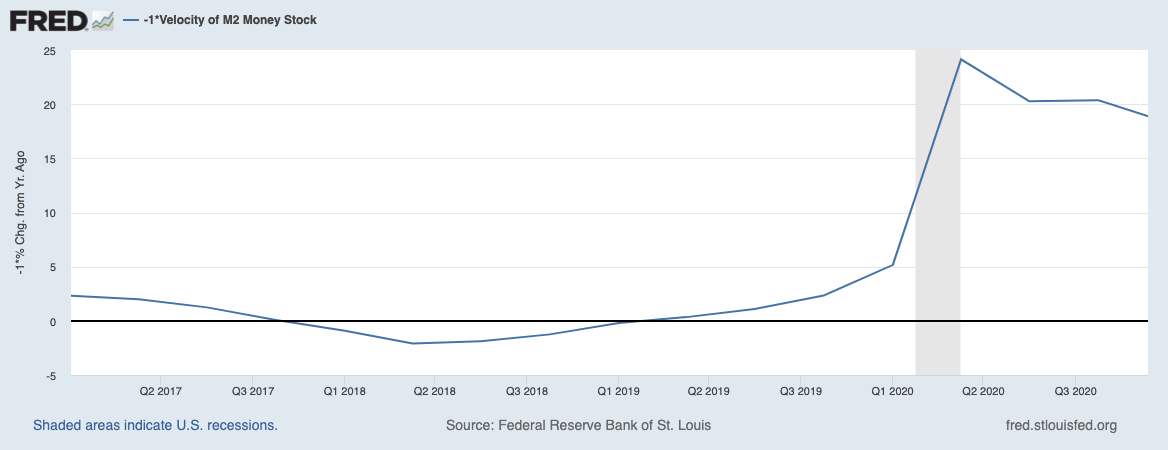
The demand to hold money tends to rise during times of uncertainty, thus we can see a sharp rise in money demand at the start of the Covid pandemic, represented below in Figure 1-1.
In order to maintain monetary equilibrium, the sole monetary authority in the United States, the Federal Reserve, must adequately increase the money supply in order to offset this change in money demand. This was done well, as seen in Figure 1-2.
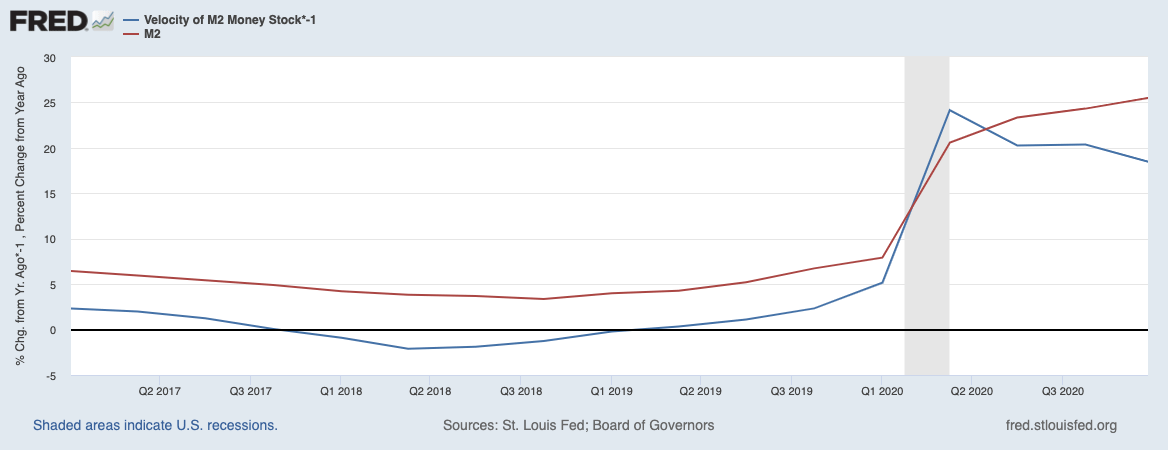
The Federal Reserve clearly increased money supply enough to offset the rise in money demand. Although many people only looked at the massive money supply increase and proclaimed inflation was imminent, this view was misguided. For this reason, we did not see inflation rise during the period shown in Figure 1-1 and 1-2. Unfortunately, this did not last very long.
The American Rescue Plan was passed in the last month of Q1 2021, and its effects were clearly seen in the succeeding quarters. The first two stimulus checks passed by the Trump administration were largely saved and/or used to pay off previous debt obligations. On the contrary, ARP was excessive, and at large, was spent quickly. This spending quickly reduced the demand to hold money, and so we saw a reduction in money demand relative to money supply starting in Q2 2021, as seen in Figure 2-1.
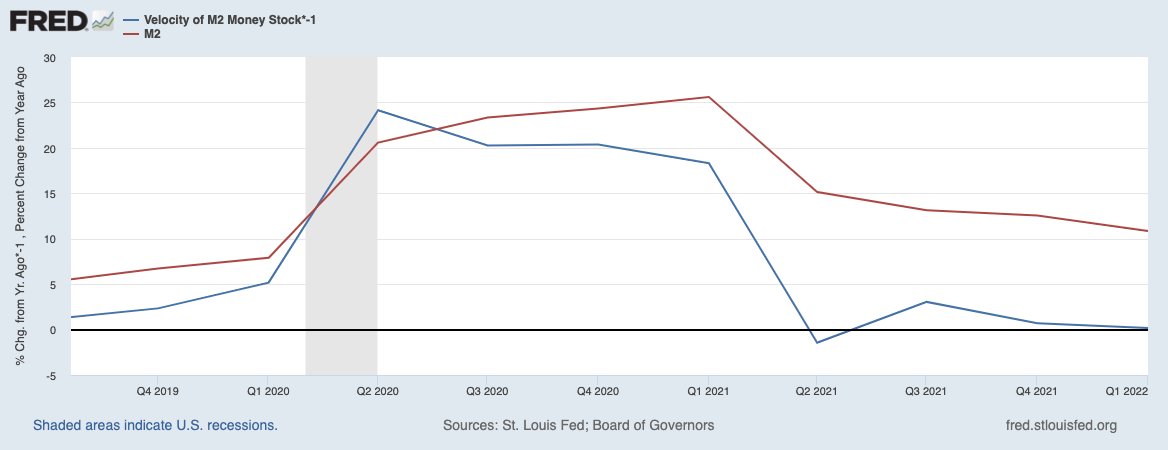
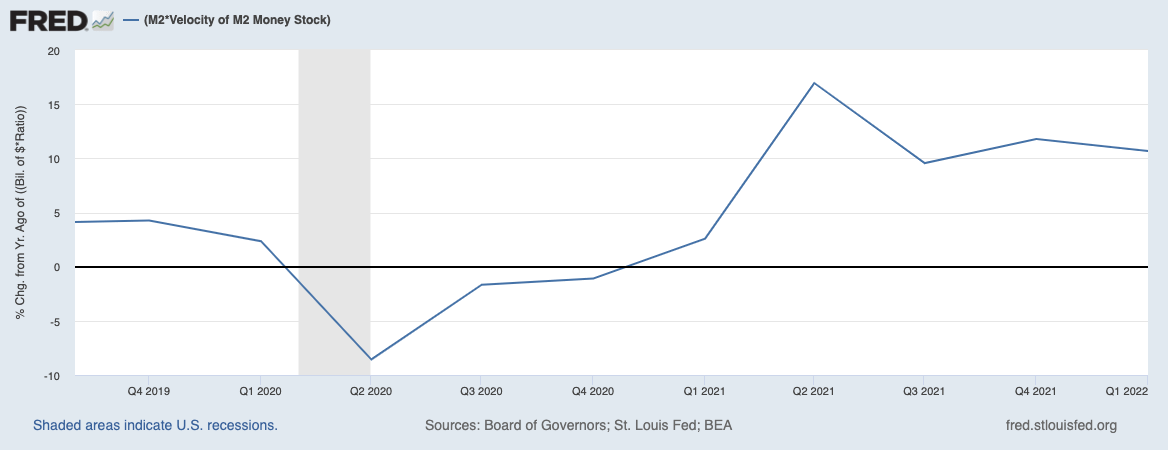
This created a major imbalance in the equation of exchange, MV=Py, with the increase in M being much larger than the fall in V (the inverse of money demand or the red line in each graph). This monetary disequilibrium can also be seen in rapid NGDP growth (remember, NGDP is equal to both MV and Py) following passage of ARP, as shown above in Figure 2-2.
Real GDP (y) continued to increase as a result of consumer spending remaining strong1, thus the last variable in the equation, P, must be affected. For this reason, we began to see P rise quickly, in order to make up for monetary disequilibrium.
To make this relationship clear, Figure 3-1 shows MV/y, which perfectly models the GDP Implicit Price Deflator, a common measure of inflation.
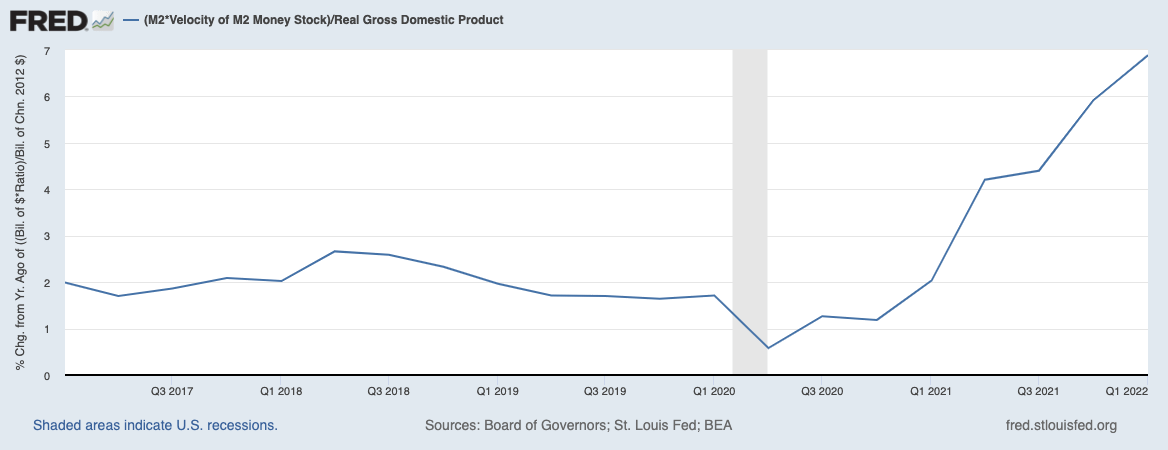
On that account, if one desires solid inflation and real GDP growth, monetary equilibrium between M and V must be maintained, which corresponds to stable NGDP as well. While I believe the fiscal policy which strongly influenced money demand was ill-advised, that does not mean all hope is lost.
If the federal reserve can bring about monetary equilibrium and stabilize NGDP, then the price level can stabilize in the foreseeable future. For this reason, I have been increasingly in favor of the Federal Reserve targeting stable NGDP growth as opposed to 2% inflation and full employment, as a state of monetary equilibrium can appropriately bring about both.
To do so, the Fed must contract the money supply enough so that it is brought to par with money demand/offsetting Velocity. Raising the federal funds rate by 75 basis points in May was a solid start, but a lot more of the same is needed to curb inflation. In June, the Fed will be meeting again, and hopefully will come to a similar conclusion.
All in all, while fiscal policy may influence many monetary variables, at heart, inflation is everywhere and always a monetary phenomenon.
A future commentary will be written regarding measures the Federal Reserve can take to avoid such economic ruin going forward. For a little sneak peak, I plan on prescribing a set of rules for a computer to follow to maintain the money supply, which will alleviate Federal Reserve employees of all discretionary tools. Stay tuned for more by subscribing below!
If supply shock factors, such as the Ukraine-Russia war or supply chains being held up, were the real driver of inflation, we’d see real GDP falling. Q1 2022 was the only quarter in which this was the case, as that was the peak of the war. In any other quarter, growing real GDP indicated that the factors mentioned throughout the article were evidently the primary drivers of inflation.
No posts
Comments
Nothing yet. Say the first thing.
Sign in to join the conversation.