
After a Wall Street Journal survey of registered voters found that 74% of registered voters (and 92% of registered Republicans) believed inflation had moved in the wrong direction over the last year, economists were sent into a frenzy. Justin Wolfers of University of Michigan took to twitter to comment on the survey “Maybe surveys of economic feels tell us more about tribal partisanship than anything else.” Paul Krugman also chimed in, “So it's possible that voters are less sophisticated than they were 40 years ago…” In his weekly column for the Times, Krugman goes on to masquerade about how Republicans are inconsistent and "may have engendered a sourness, an unwillingness to acknowledge good news even when it happens.”
Are consumers really this blinded by politics? Or is there some rationality behind believing that inflation is moving in the wrong direction, despite commonly used measures of inflation indicating otherwise? To answer these questions, a discussion of what inflation is, must preface.
While inflation is typically measured in a one year time frame, this practice is quite arbitrary, and is only used out of convenience. Most goods and services are not being purchased on a strictly yearly basis, and so yearly inflation is not a perfect representation of how inflation is affecting a given consumer.
Cars, refrigerators, and computers are examples of goods that are typically not purchased on a yearly basis. If the price of such goods rise (ceteris paribus), that will be represented in a given yearly inflation measure, but that alone isn’t something that would lead consumers on the aggregate to state inflation is a problem. Those who are not purchasing cars and refrigerators in that year are unlikely to notice any inflation, let alone be affected by it, even though one may conclude from a PCE reading that inflation is occurring. But say a consumer chooses to by a car only two years after its price rises, and once year-over-year CPI has normalized (assuming no further increases). Then
To demonstrate why this is important, here is an example:
Suppose at time t that a one-time, permanent increase in the price of cars and televisions occurs. Assume that inflation is viewed by period (similar to how view year-over-year inflation). Due to the nature of this inflation being non-transitory, we can assume that by t+1, the price level remains unchanged from t, but inflation has stabilized to its t-1 rate. This is in contrast to time t, where there is both an elevated price level and inflation rate.
Suppose further that consumers are said to purchase cars and televisions only every 3 periods, since these are not goods that people buy very often. For simplicity, we shall also assume that a third of all consumers are buying these goods each period, and only doing so every three periods.
It is to be expected that the third of consumers purchasing cars and televisions at time t will likely “feel” the effects of ongoing inflation. In contrast, the two-third of consumers who purchase cars, televisions, and refrigerators in time t+1 will be “feeling” the same effect of inflation, despite inflation having subsided in t+1. The t+1 car consumers would not be without reason for believing inflation is a problem in t+1, even if the inflation rate indicates normalcy by t+1.
This clearly lies in contrast to the idea that one year inflation must be indicative of how inflation is affecting consumers, asserted by Krugman and Wolfers. If people were to consistently purchase the basket of goods measured by price indices on a yearly basis, only then would one year inflation be perfectly representative of the burden of inflation.
Krugman has also argued that even considering that consumers’ problem is the level of prices, as opposed to the rate of growth, that does not explain why consumer sentiment about inflation was far more positive during the 1980s disinflation.
This line of reasoning falls short when considering inflation in a longer time span, say three or five years, as pictured below.
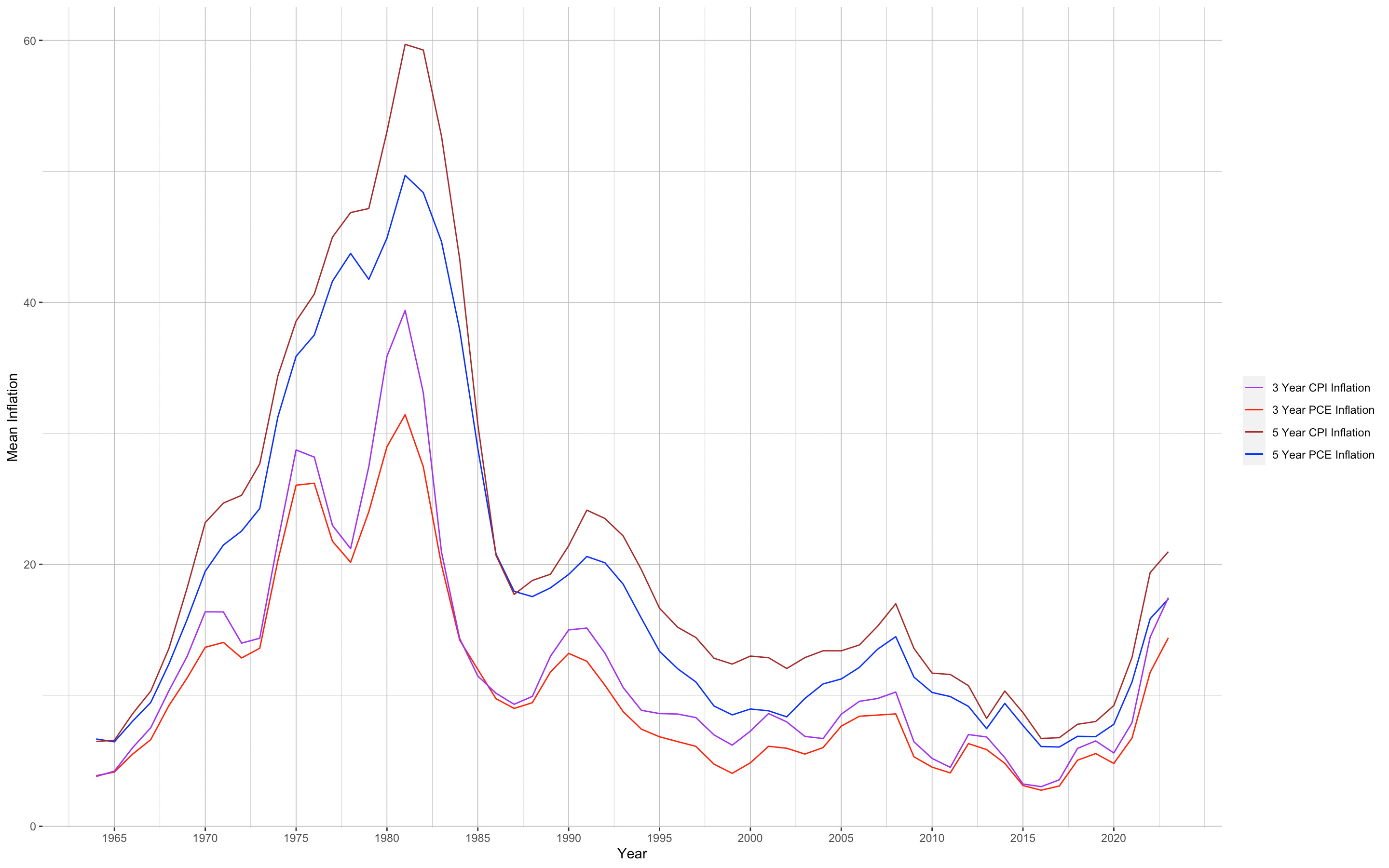
During the 1980s, there was a massive disinflation in both yearly inflation (not pictured) and inflation measured over longer periods. The same cannot yet be said for today, where inflation measured over a longer period remains elevated. Because of this, we can understand why voters may have felt the 1980s disinflation far more satisfactory to that which is currently going down. The political party in office does not seem to be the driving factor in doing so, given the economic trends at play.
All this being said, this is not to understate the tremendous disinflation we’re currently observing, and people should be confident that in time longer term inflation will also taper off.
Furthermore, while one year price indices have their limits, this piece does not seek to argue that the arbitrariness of the time frame implies a different time frame should be used to gauge inflation. Rather we ought to remember the claims that one year inflation measures allow us to make, and utilize various datasets for sound analysis.
No posts
Comments
Nothing yet. Say the first thing.
Sign in to join the conversation.