

That distinction explains much of the resistance, irritation, and quiet institutional or social pushback that accurate structural reading can provoke—far more than all the stories we hear about fragility, ego, or people simply “not being ready.”
Most psychological and personal development work, even when rigorous, leaves the surrounding structural forces intact. It can improve the individual’s capacity to function inside the existing arrangements—a more regulated nervous system, a clearer identity, fewer limiting beliefs, greater consistency, etc. The person is supposed to become more resilient, more skilled at self-control, and much more able to tolerate conditions that otherwise overwhelm them.
From the standpoint of many institutions, markets, networks, and business models, this is not a threat—it’s often a personnel upgrade. A more regulated, more responsible, more self-aware participant is easier to manage and retain and less likely to directly name a structural issue as the source of the strain. The problem remains located in the person, the person remains the primary site of repair, and the structure can remain as it is.
This is why psychological language is so readily adopted by many organizations and industries that have no intention of altering their incentive designs, compensation structures, or power distributions. Inner work can be sponsored, celebrated, and even required without disturbing the underlying configuration of who benefits and who absorbs the cost.
Structural diagnosis does something different. It is the practice of identifying when recurring outcomes are better explained by the architecture of an arrangement rather than by the psychology of the people within it.
It relocates the primary unit of analysis from the individual to the structure—roles, incentives, authority, value-routing pathways, recognition economies, hidden subsidies, and selection pressures. It asks whether the configuration itself is capable of producing the outcomes being demanded of the people inside it.
Once that question is present, several things may become newly visible:
How high capacity often gets used as unpaid infrastructure that allows weak structures to remain functional.
How stalled results that have been framed as personal unreadiness are frequently the predictable output of misaligned incentives or poorly built structures.
How warmth, belonging, and mission language can function as cover for economic exclusion or extraction.
How business models optimized for retention have a structural interest in keeping certain problems personalized and unfalsifiable.
These observations are not primarily psychological. They are architectural.
And architecture, once seen clearly, is harder to unsee.
It also becomes harder to keep treating as neutral or inevitable.
Much of the coaching and personal-development economy depends on the ongoing conversion of structural friction into personal development opportunities. If the ceiling is architectural, then additional belief work, embodiment work, or consistency work will not clear it. Accurate structural diagnosis can therefore function as an exit ramp from certain forms of paid help. Business models optimized for retention experience that exit ramp as a problem.
Many incomplete or extractive structures survive by framing the costs they impose as personal growth opportunities or necessary sacrifices. In the arts, the same cost can be renamed devotion, exposure, professional dues-paying, gratitude, artistic purity, or simply “how the field works.” When the costs are redescribed as design failures rather than developmental necessities, the moral permission structure weakens. People who have been subsidizing the extraction with their capacity, underpayment, or over-functioning begin to experience the subsidy as optional rather than virtuous. That shift is destabilizing for anyone whose position depends on the subsidy continuing.
As long as problems are located in persons, those in control of the setup retain a quiet form of power: the power to define what counts as a legitimate explanation. Structural diagnosis moves explanatory authority outward. It makes incentives, authority distributions, and value-routing pathways visible and available for inspection by the people who previously had to treat those things as background conditions. Power that depends on remaining invisible does not welcome the light.
Working on oneself is a culturally legible and often an admired activity. Redesigning or exiting is often less legible; it can look like blame, disloyalty, or insufficient personal responsibility. For the individual, structural clarity can therefore feel more destabilizing than psychological insight because it removes the well-rehearsed project of self-improvement as the primary response. The next action is no longer “do more inner work.” It is “change the conditions or leave them.” That demand is heavier and less socially supported.
Psychological work that becomes inconvenient can be met with calls for more compassion, more nuance, or more personal responsibility. Structural work that becomes inconvenient is harder to neutralize in the same way. Once the numbers, the incentive design, the hour caps, the profit split, or the retention logic are visible, appeals to tone or readiness often register as attempts to return the problem to the safer, more absorbable layer.
Case in point: consider a multi-teacher music school where teachers earn $24 per contact hour, are limited to 24 paid hours per week, are expected to be on call, prepare lessons on their own time, and correspond with students in between lessons.
When a teacher mentions he’s doing way more work than the paycheck says—the manager can respond with mission language or question his career seriousness. Both responses move the problem back to the person. That is what structural diagnosis resists.
For the individual, the threat is not abstract. Structural diagnosis can dissolve stories that previously organized suffering into meaning. If the exhaustion was not primarily a nervous-system problem but the predictable result of a structure that required continuous over-functioning, then years of well-intentioned inner mindset work may need to be re-understood, and that re-understanding is not always comfortable. It can feel like a loss of narrative coherence before it feels like clarity.
This is one reason people sometimes prefer sophisticated psychological explanations even when structural ones fit better.
The psychological frame keeps the project familiar and within your perceived control. The structural frame demands a different class of action—and different classes of risk.
At scale, the preference for psychological over structural explanations protects entire industries from having to examine whether their own structures produce the very dependency, burnout, and stalled results they then offer to treat.
As long as the primary intervention remains the improvement of the individual, the arrangements can continue operating with relatively low scrutiny no matter how taxing they are to individuals. Structural diagnosis raises the cost of continuation. It shows how internal work applied to the wrong layer becomes another form of overcompensation.
That claim can be more threatening than most psychological insights because it does not stay inside the self. It reaches for the design of the rooms, the incentives, the power arrangements, and the business models that shape what the self is required to carry.
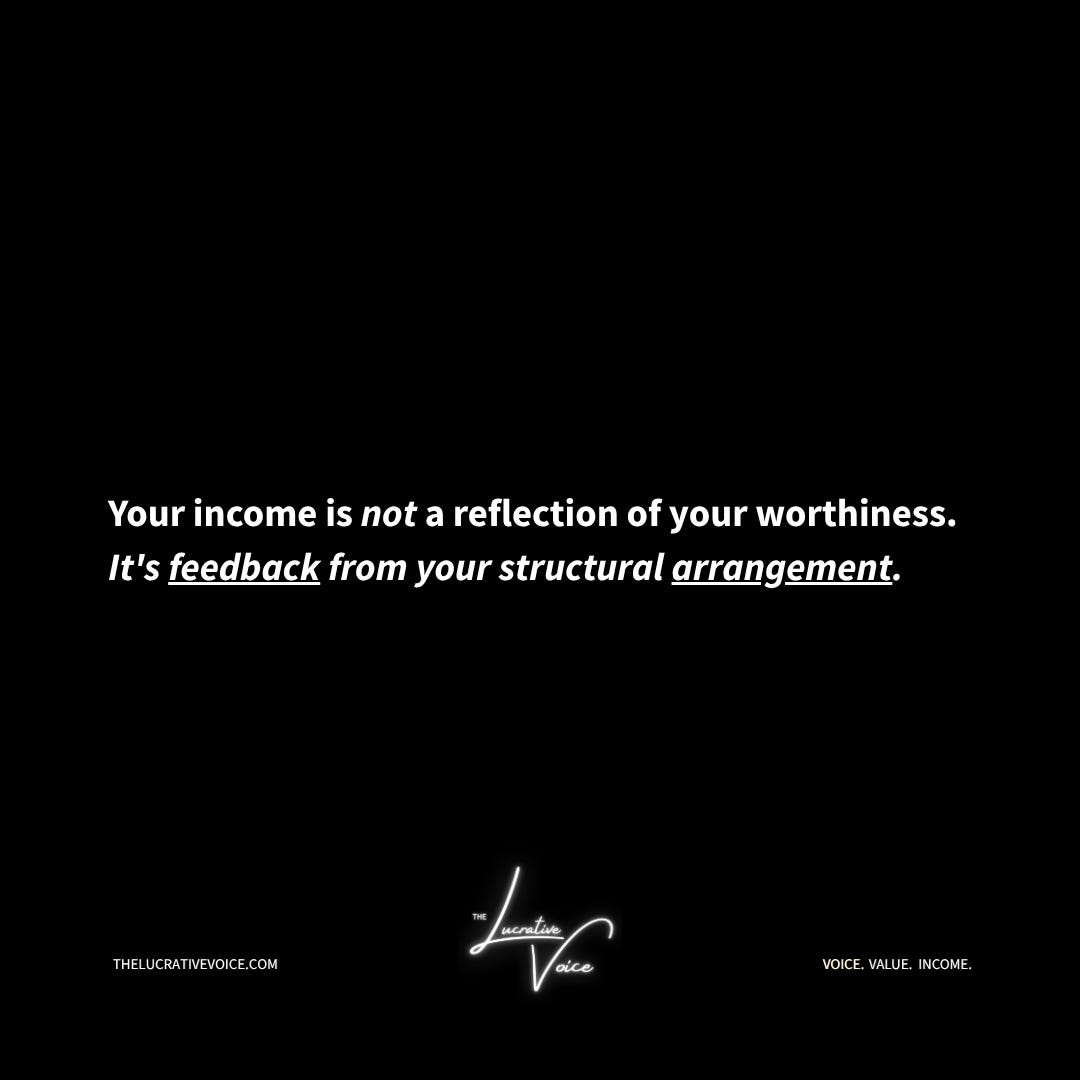
I did not set out to do this kind of work. I originally just wanted to help my fellow artists and educators earn more. Then, after working in this industry long enough, I realized I needed to offer something far more intellectually honest than most of what wins the algorithms.
I didn’t want to help clients feel better about the limited money they had; I wanted to help them actually earn more. And through trial and error in my own work and with certain clients, I realized that many people don’t really need a new mindset; they need a structural intervention so they can finally earn in a durable way.
That process also showed me that my enterprise risk management experience was more important than my degrees and certifications when it came to determining where clients really needed that intervention to take place—and it fueled the frameworks I’ve developed.
Structural diagnosis asks a fundamentally different question than psychology. Psychology asks why people behave as they do. Structural diagnosis asks why particular patterns of behavior reliably emerge within particular arrangements.
The threat of structural work is not the point.
It is the evidence that the work is reaching the correct layer.
Psychological insight has helped many people regulate, reframe, and endure. It has value. It is also the intervention that existing arrangements can most easily metabolize without changing themselves.
As long as the primary response to stalled income, chronic over-functioning, or extractive conditions is further internal development, the arrangements that produce those conditions remain protected.
High-capacity people keep improving themselves inside situations that were never designed to carry them. The subsidy continues, the epistemic debt compounds, and the person becomes more sophisticated at surviving a structure that should have been redesigned or abandoned long ago.
Many capable people are not failing at belief, consistency, or sales skill. They are frequently compensating for flawed or incomplete systems—and then they’re being taught to interpret the cost of that compensation as evidence that they still need more personal development.
This body of work exists to interrupt that closed-loop pattern at its source: by making the structure itself visible as a causal force and by giving people the tools to diagnose and redesign it rather than merely endure it more skillfully.
This is for highly capable people who have already done significant internal and tactical work and are no longer willing to keep personalizing their structural ceilings. It can also be for those who may be suspicious of coaching and related support, but they still can’t explain the deeper problem they know they have.
It is not against psychological work. It’s against the misapplication of psychological work to problems that live in incentives, authority, value routing, compensation design, and the selection pressures of rooms.
It treats the persistent need for heroic self-management as diagnostic information about the situation, not as proof that the person still needs more fixing.
Where much of the industry offers improved functioning inside the current game, this work offers the capacity to see when the game itself is the constraint.
Where high capacity is celebrated as an unlimited resource, this treats the ongoing need for heroic capacity as evidence that the architecture is underbuilt.
The practical result is that people stop using self-work as the default response to problems that are architectural.
My clients gain the ability to tell the difference—and to act on it.
This work exists because a culture that keeps sending highly capable people back to work on themselves while leaving extractive or misaligned circumstances unexamined will continue to burn through the very people it claims to value.
High capacity is not an infinite subsidy. Attention, authority, and economic dignity are not renewable resources that institutions and business models can keep drawing against without consequence.
Structural diagnosis is more threatening than psychological work because it refuses to keep the problem safely inside the self.
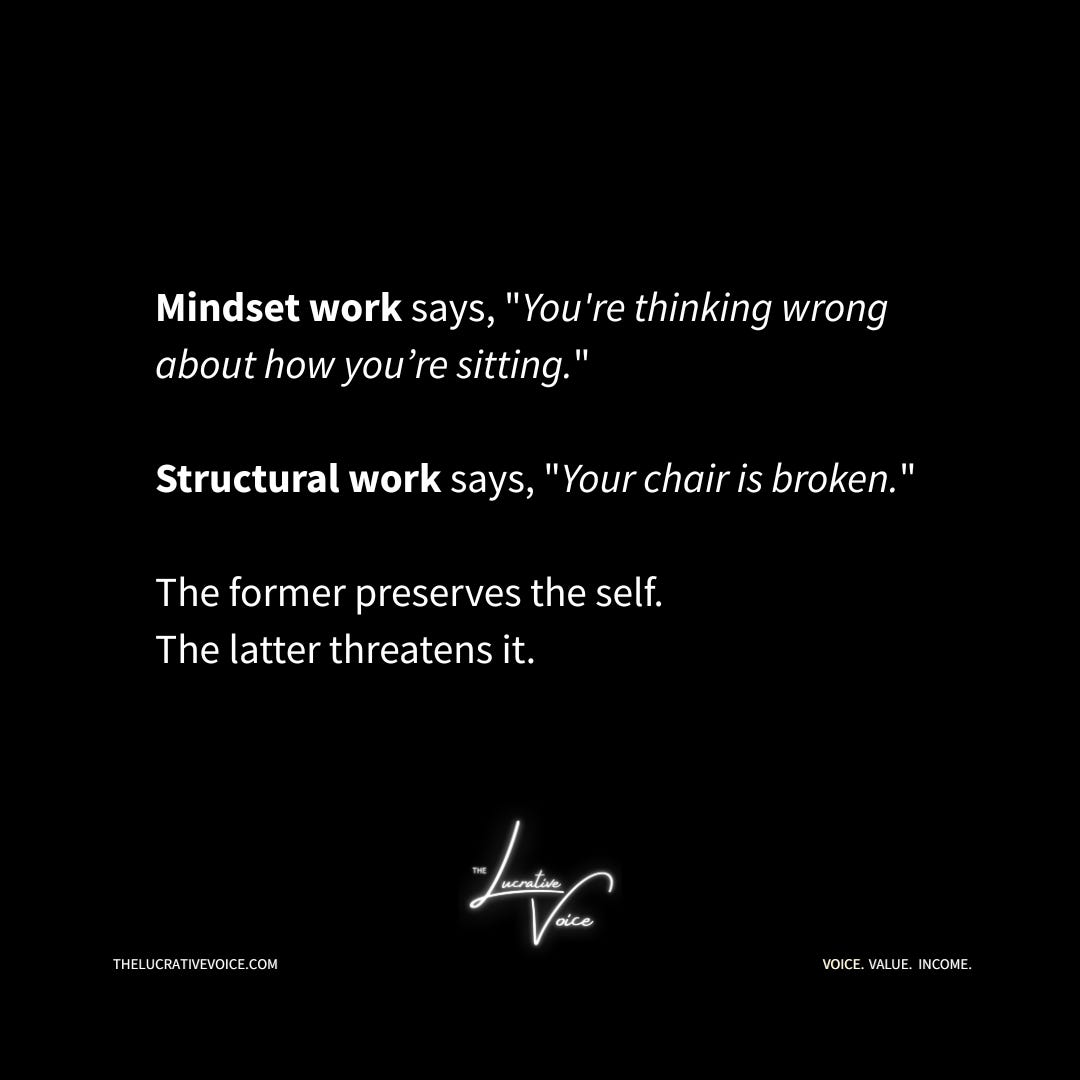
At some point, becoming better at carrying the same structural problem stops being development. The next step is to diagnose what keeps recreating it.
If you’re already at that point, this is the work I do with clients.
Comments
Nothing yet. Say the first thing.
Sign in to join the conversation.