
My Parisian friend Sorrel thinks I take words too seriously. The French, she tells me, whenever she gives me advice on my personal life, understand the truth: that words are only ever a game. Words can be repartee; they can be a dance; they can be a match of wits. They can be a seduction. But what they are not, she always tells me, are truth. Actions, she tells me -- those are real. Words? Enjoy them. But take them for the joke they are.
I’ve spent most of the past year thinking about this, in one capacity or another. I’m a writer, after all, to say nothing of a romantic. I want there to be a compact — a trust, even — between words and their meanings and the people saying them. And for various reasons (the rise of generative AI; reading too much about magic; spending time with musicians) I’ve found myself struggling to defend what, if anything, is special about verbal language. What makes words, as opposed to any other form of communication or symbol or sign, anything more than a stopgap measure for those of us who can’t do anything better. Compared to the expertise involved in painting an allegorical fresco, say, speaking words aloud, or even writing them down, seems (as Sorrel suggests) too easy and too free. In my writing classes at Catholic this year, I’ve been asking my students to think about this, too -- what can a novel do that a film or a play or a painting can’t? What can it do better? What are words good for?
Until very recently I would have defended writing as the attempt of an individual consciousness to communicate itself. I love reading novels because I love getting inside the head of a particular author, because I love the precise metaphors that occur to someone who isn’t me, the details that stick out to them, the qualities of people they note, the references they echo. When I read somebody’s writing, I do feel like I’m getting access to the specifics of someone else’s consciousness; that I -- someone who struggles to pay attention at the best of times -- can benefit from the way other people pay attention to the world. (This is, I think, why To the Lighthouse is one of my favorite novels, even though it is Mrs. Ramsay’s quality of attention to everyone and everything around her -- subsumed into the everyday business of her marriage and the practicalities of child-rearing -- that makes her, I think, the book’s primary artist).
Even this past February, when I spent a month in Venice communicating with friends and family exclusively via postal letter, I found a very particular delight in how much of each person I cared about in each letter I received. One person (another novelist, naturally) wrote me a beautifully calligraphed and meditative account of his time in Vermont; another friend sent me, in essence, a practical joke (and an update on how the Mets were doing pre-season). Every letter I received captured -- in the choice of paper as much as the choice of syntax -- as close to the essence of the person writing it I could have hoped for. (Because of course: the paper, the handwriting, the pen selected -- all these were part of self-disclosure, too).
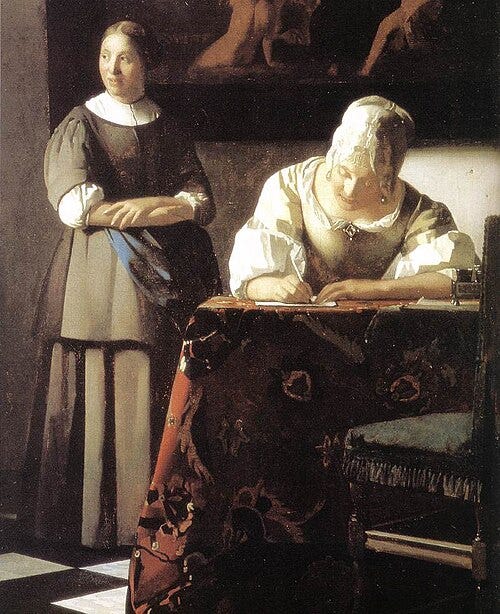
I want to say: yes, the words too, were something. They said something. Or, at least, everybody’s relationship to words — reverential or transgressive, conversational or high-falutin’, self-consciously epistolary or stream-of-consciousness — told me something, too, about who they were.
But of course I can’t defend this. I’m all too conscious, now, that reading words is no guarantee that another consciousness tried to translate itself into them. Whatever you think about generative AI -- which I think probably has limited positive use-cases outweighed by the repellent ones -- that compact has, in the past year, been broken. We can no longer trust that verbal language is the site of person-to-person communication. We cannot assume we can learn anything about individual people by their self-disclosure to use -- unless it is that they are willing to sacrifice that self-disclosure in favor of ostensibly more polished prose. (I could tell the story, here, of someone recently who told me some of her Hinge matches had been using chatGPT to DM her, but that’s been well-documented already).
But I’m conscious, too, that another counter-argument here is that verbal language is hardly the only mechanism for self-disclosure I learn about people on the dance floor -- that I learn about their relationship to their bodies, and to other people, and to sex, of course, in the same way that in receiving letters I learn about the one to language.
So is verbal language just one language among many? Does it matter, on any level but that of my personal ability to communicate with someone efficiently, if somebody is uncomfortable with language, or out of my conversational rhythm, or steps on my sentence’s toes? Is verbal language really just dancing? (At least we are not sending robot avatars on the dance floor, just yet)
And yet I want to say there is something distinct about verbal language: compared to painting, or music, or the gestures of the dancing body. Not that it is superior -- convenient though that would be for me as a writer to think that the best one is the one I’m halfway decent at -- but that it has a certain theological weight. I am a person of the book, after all, and although in my faith the Logos became flesh rather than ink our central metaphor is not “the sound became flesh” or “the image became flesh” (though those metaphors exist elsewhere in the Bible). But rather that verbal language -- and the way that we encode both music and (in the case of writing) image in this particular meaning-conveying way -- reflects a particular set of dispositions towards the world, a set of dispositions that I happen to think are right. At its best, I think, words can help us perpetually experience, and affirm, the synchronicity of the visible and invisible worlds.
A few months ago my spiritual director, talking about various vocations currently on my mind -- of which novelist is always the paradigmatic one -- had me think about the idea of an artist, and a writer in particular, as as a bridge. Between the divine and the human; between ideas and people, between the inner world of one’s own individual consciousness and the outer world of perceptible things. It was one of the most fruitful conversations I’ve ever had with anybody, and ever since I’ve been feeling that I understand myself a little better. The qualities in myself that frustrate me most -- that I’m so often torn between opposing things, and opposing ways of being, and opposing lives; that I feel too often at the center of an x-y axis instead of at the arrow’s edge -- might actually be good for something, after all.
Anyway, if you’re reading this, do me a favor. Picture a bridge.
So, a weird thing I’ve been thinking about, recently, about language is that there is no obvious distinction, on the page, between words that refer to concrete concepts and those that refer to abstract ones. “bridge” and “love” are not obviously distinguished, at least not formally. When you read the previous sentence, you probably pictured a bridge (maybe even a particular bridge); I have no idea at all what you pictured when you read love (although if you felt inclined to comment and tell me what you pictured, I want to know!). Sure, you can paint an allegorical figure representing love, or draw two people in love, or musically try to capture the feeling of love -- all things I admire (it’s been three weeks since I saw Tristan & Isolde at the Met and I’m still blasting it in my apartment). But it’s only in language that bridge and love get equal weight, can be presented as equally real, that abstractions and phemonena live together in a world that affirms them both. The world of language is the world where they’re always together: not just as “inner” and “outer”, as “mental” or “physical”, but both part of creation. Not only that -- they reinforce each other. The kinds of associations we can draw, in metaphorical language -- love is LIKE a bridge -- help us see the visible and invisible worlds not merely as “mirrors” of one another (as in the Hermetic principle -- as above, so below) but rather as part of a world in which all of reality operates on the same plane: reflecting each other not hierarchically, but in infinite, present harmony. Charles Williams (whom I do not otherwise like) described it as a great dance. I’ll take it.
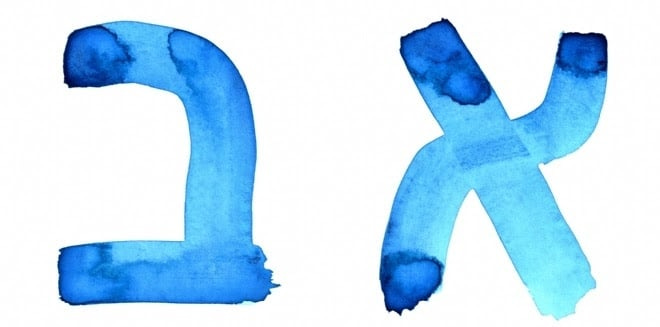
And yet it’s precisely that loss -- of our individual engagement with that plane of faith, with speech that, in affirming that kind of reality, always doubles at as a prayer -- that I mourn most, when I like every other writer mourns the rise of generative AI. There are, I admit (sorry, Duns), individual places it fascinates me. I find the oracular ideal of training a machine on centuries of text — and hearing a kind of commonality in their voices — beautiful in theory. I’d watch the heck out of a tragedy where Claude compiled the chorus. To speak, to write, to engage with language -- for me, it’s to engage with precisely the problem of visible and invisible reality. Is the invisible stuff (justice, mercy, love?) even real, or are we only speaking it into existence?
One of my favorite books on language is Real Presences by the Jewish critic George Steiner. Steiner writes about the “postulate of transcendence”: that it is God, or at least the assumption of a transcendent meaning, that in essence underwrites the contract we enter into when we encounter language: that there is something there. That the meaningfulness of language, as something more than mere human game-playing, rests upon a fundamentally theological orientation towards the world. Words mean things – even the abstract ones. And it’s hard to for me to see the widespread normalization of generative AI as anything but a collective decision to sever ourselves from those assumptions of trust: to treat language as merely the site of theoretical exchange: a place where the invisible world is real only because we make it so, and meme other people into agreeing. And so I struggle, so often, with thinking of written language as almost as outdated, as it were, of the vintage jazz I dance to, or maybe the Episcopal Church: something to hold onto out of stubbornness, or instinctive conservatism, rather than engagement with reality.
And yet I’m not willing to cede language as prayer, as well as declaration. That all of reality can be held together: that there is a bridge, and something on both sides of it.
In Real Presences, Steiner writes of Holy Saturday as the soul’s condition. Between the Good Friday – which even, maybe especially, for the nonbeliever is the “iinterminable, suffering, of the waste, of the brute enigma of ending” and the Sunday that is the “day of liberation from inhumanity and servitude,” Saturday waits: itself a bridge. “The apprehensions and figurations in the play of metaphysical imagining,” Steiner writes, “in the poem and the music, which tell of pain and of hope, of the flesh which is said to taste of ash and of the spirit which is said to have the savour of fire, are always Sabbatarian. They have risen out of an immensity of waiting which is that of man. Without them, how could we be patient?”
I can’t think of anything I’d rather do, on Holy Saturday, than write.
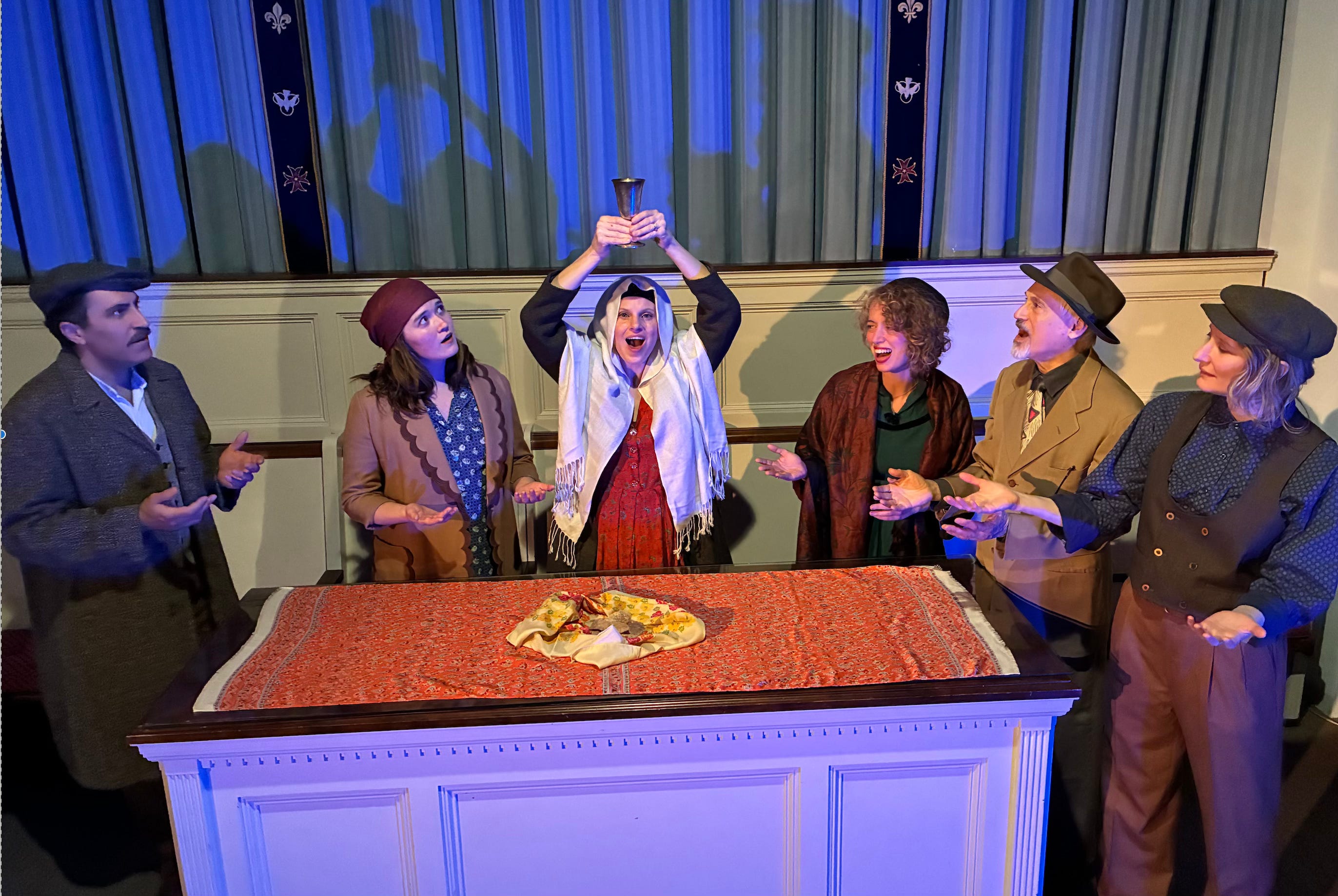
Also, if you have no plans in exactly three hours, there’s one more performance of Dzieci’s A Passion — how I’ve been spending my Holy Week — at Judson Memorial Church in NYC, at 7 pm this Holy Saturday night. It’s pay-what-you-wish — show up!
No posts
Comments
Nothing yet. Say the first thing.
Sign in to join the conversation.