
I’ve been slower at publishing lately as I focus on other pieces, such as my latest on Rilke and Duino for Romanticon, and a review of Paul Kingsnorth’s Against the Machine, subject of a forthcoming post, for The Dispatch. Expect me back next week with more on magic, technology, and whatever is going on with that tree in Eden.
For ten or fifteen years, when I was very young, and only sometimes Christian, if you’d asked me when I’d felt the closest to God, I’d have given you the same answer. I was thirteen, and there were silk lilies in the dining-room vase, which I have a perhaps false memory that I’d asked my mother for because Oscar Wilde always had lilies in his room at Oxford, though maybe we’d always had them, and there were a dozen people in the room, and I was in love with all of them.
We’d done Much Ado About Nothing that season. It was spring, and the play had just ended, after a disastrous run of rehearsals and cast changes. The director, a teacher, had been mugged, and injured, and at the last minute a mix of seniors and backup faculty (whom we instinctively mistrusted) had stepped in. We’d lost our Dogberry, I think. I’d started as the messenger, an appropriate role for a seventh-grader nobody knew, but whom people made much over, for I had outsize ambitions and staggering dreams and no sense whatsoever of self-preservation, and worked my way up to Borachio: the villain Don John’s drunken functionary. I’d never been drunk, but I’d read about drinking, which I felt sure sufficed. I was in love with the boy who played Don John, because he quoted William Blake in his AIM away message, and because he looked —pink hair notwithstanding, or perhaps because of it— like I imagined Dorian Gray. I wore a pink wig to impress him, and I think I did, although like most girls in love with boys who do high school theatre my passion was in vain.
But that night it all made sense. I lived closest to school, and so although I was in no other regard the heart of the group the cast party was in my house, and we hid a bottle of vodka in my mother’s freezer, and drank it after my mother herself had gone to bed, and the boy who played Claudio took out a copy of Frank O’Hara’s Lunch Poems, and the girl who played Hero told me all about Edna St. Vincent Millay, and at some point (my poor mother) we decided that what we should really do, to finish off the night, is head down to Veselka in the East Village, and drink bubble tea, and all sleep on the floor of the girl who lived closest to there. I don’t remember who she played. On the way down Claudio told me, very seriously, that I was Isabel Archer, from Henry James’s Portrait of a Lady. Not like Isabel Archer -- he was clear on this -- but Isabel Archer herself. Either before or after this he said the same thing about me and Jack Kerouac. In the morning I woke up before everybody else, and took a cab home up Park Avenue, and the tulips in the median were red and yellow and bright in that cultivated way that doesn’t seem to belong to any natural realm; thank God, I thought, thank God.
I keep trying to get back there. Most of the decisions in my life, then and later and probably, if I’m honest, even now, have come out of that glimpse of the life I wanted. It was beauty; it was art; it was sex — crystallized, because unconsummated; it was poetry; it was late nights and lilies. I would have said then it was life like the lives I had read about, which to me meant real life. I had read my Wilde: earlier that year, (auspiciously) in a garden. Life imitated art. Art —like I knew what that meant, beyond velvet and lilies and people I was in love with reciting poems at me— was what I lived for. Beauty and art were synonymous to me then. I was never one for Nature. I was a New Yorker, after all.
Anyway, the night I was Kerouac —or so I mythologized it on Livejournal, to followers who were both strangers and cast-mates who took pleasure in my adoration— remained for years the night against which all other nights would be measured. It was easy to encase it. We moved briefly to Italy a month or so later, which allowed me to keep loving everyone exactly as I remembered them. I wrote a since-lost novel about that night, in my teens, trying to make sense of it from too little distance, and the only scene I remember is one in which the actor who played Don John (in my manuscript I called him Julian) spent an hour in front of a mirror, putting on makeup very slowly and falling in love with himself as a glittering androgyne. I listened to a lot of David Bowie at the time.
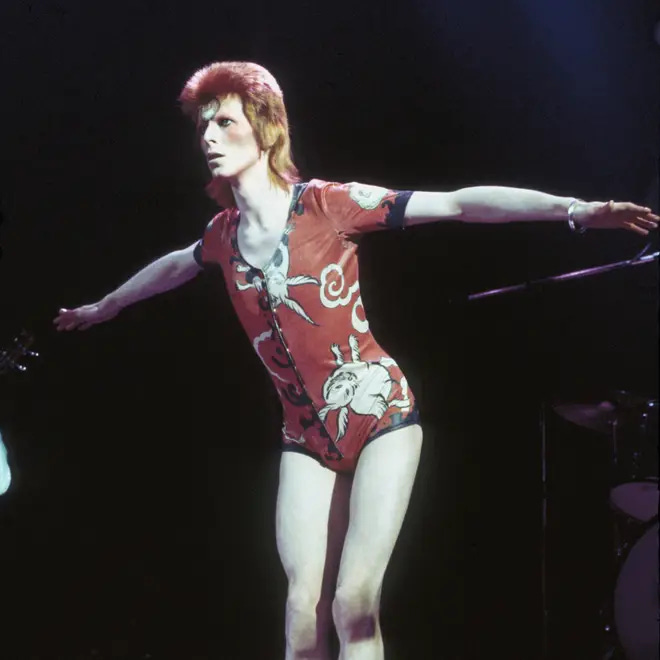
It’s easy to dismiss all this, now, as the typical arc of a theatre kid of the more literary kind, with a typical literary-theatre-kid’s obsession: to start with Wilde and Bowie, and move through Brideshead, and end (as I joked, even then, if just because Wilde and Waugh had) at the foot of the cross. That I am not actually Catholic is a relief; it might be too neatly novelistic for me to end that way, though I know other theatre kids, from other cast parties and their more-adult equivalents, who have. But the pull of that night brought me, directly and indirectly, in spiral search of its ever-realer recurrence: to Oxford, yes, and then latitudinally to Venice, where I fell in with a bunch of bohemians who live most of their lives like it is still the 1920’s, who dress in Edwardian boots and spend the day painting, and go every year to the carnival where they can dress like it is 1780 instead, and although that is a different and maybe stranger story for another essay it’s part of the same one. Beauty pulled me in, or art pulled me in, or the very particular beauty of human beings putting on makeup, and (as I would have then understood it) transcending nature pulled me in, and then one day out of all of this there was Evensong, and then faith.
But what I am trying to understand after all this time, is why I wanted this so badly. Beauty is not the only way to Christ—God knows as often as not it’s a snare. I wonder sometimes if it was just a gloss on friendship: beauty drew me to people I loved; in doing something lovely with them I glimpsed what community might be like. If I’d been good at sports it might have been that instead.
But here’s what I didn’t want. I didn’t want a life that didn’t mean anything. I didn’t want an “ordinary” life, which I understood to mean a life of chasing only temporal contentedness, or immediate pleasure. I wanted the value of my life, maybe, to be understood from outside more than from its center: for the narrative of it to make sense. If I was not thinking of God, at the time, I was at least thinking of readers of my future biography.
Sure, I wanted to be special. But if I wanted to feel anything it was not so much happiness but intensity: a sense of being caught up in a world no less richly textured, no less teeming with symbol and image and parallels and metaphors and moods and recurring motifs than my own soul.
A world, in other words, made entirely of art.
Art, I thought then, took the raw materials of life and made of them something that mattered. It sacralized the formless. Art, I thought, had purpose.
That nature didn’t was a notion I’d received uncritically from Wilde’s influences: the French decadents. Writers like Huysmans, implicitly the author of the little yellow book that so corrupts Wilde’s Dorian Gray. for whom “Nature has had her day,” exclaims Des Esseintes, the protagonist of the “yellow book,” Huysmans’ 1884 novel whose French title translates to Against Nature.
Nature, for the decadents, is nothing but a “disgusting sameness of her landskips and skies....a banal agency of mountains and seas.” Nature is, for Des Esseintes, a “driveling old woman”, and “the moment has come to replace her by artifice.”
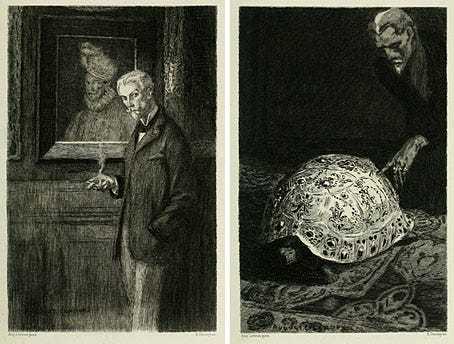
In the Wildean telling, art is that which gives the stuff of meaning -- shape, symbol -- to what otherwise has none. Art and nature are in this telling at war. And why would you not war against it, if that is all nature is: the Greeks’ nature, or the decadents’, or Nietzsche’s: senseless and terrible, tending towards annihilation, interrupted only (from time to time) by sex? If those are our only options, how can we not be on the side of the artists? How can we not refuse the ticket to entropy?
Art is an affirmation of meaning, and presence, and vision, that isn’t reducible to the cycle of birth and sex and death. There is something else in us: something that art, and in particular art that has the erotic charge I think comes specifically from beauty, is always a defense of. We can affirm ourselves, and desire one another, outside our evolutionary purpose.
This queer theatre kids at a cast party and Christian monastics have this in common: that the beauty we find in art, though we desire it, is both analogous to and distinctly separate from the desire to sexually reproduce, to project ourselves physically into the future. There is another way to communicate ourselves into the future. There is more to who we are than our bodies, or our genes. In one of his letters Wilde calls art “superbly sterile,” and he has a point. There is a reason for the stereotype (though it may be wrong in practice) that good artists cannot be good parents. They are parallel and analogous vocations.
At its best, artistic beauty — and the distinctly erotic urge it provokes, which is both like and unlike the lust of the body — is an affirmation of creativity beyond, and alongside, the sexual generation of children. My experience of beauty -- of pink-haired boys who didn’t love me back, and of lilies, and of Shakespeare alike -- was, let’s face it, always erotic. You might even define artistic beauty, like its interpersonal analogue, as the erotic power that draws us towards art. And with it, across time and space and other circumstances that make literal reproduction with them possible, to artists. The encounter we have with art, and the people who make it, is a love-encounter. But it’s a love-encounter that does not demand that two people become one, and then create a third.
This is the best and the worst part. To write a novel, say, or a poem, requires no other person: It is not a coming-together, nor is it a generation of a third. It is only myself, worth translating into words or images or sounds, affirming that something I saw or thought or wondered or was is worth anchoring amid the flotsam time brings. Selfish, maybe, but a loving selfishness. There is something, in my life, worth somebody else’s while to remember.
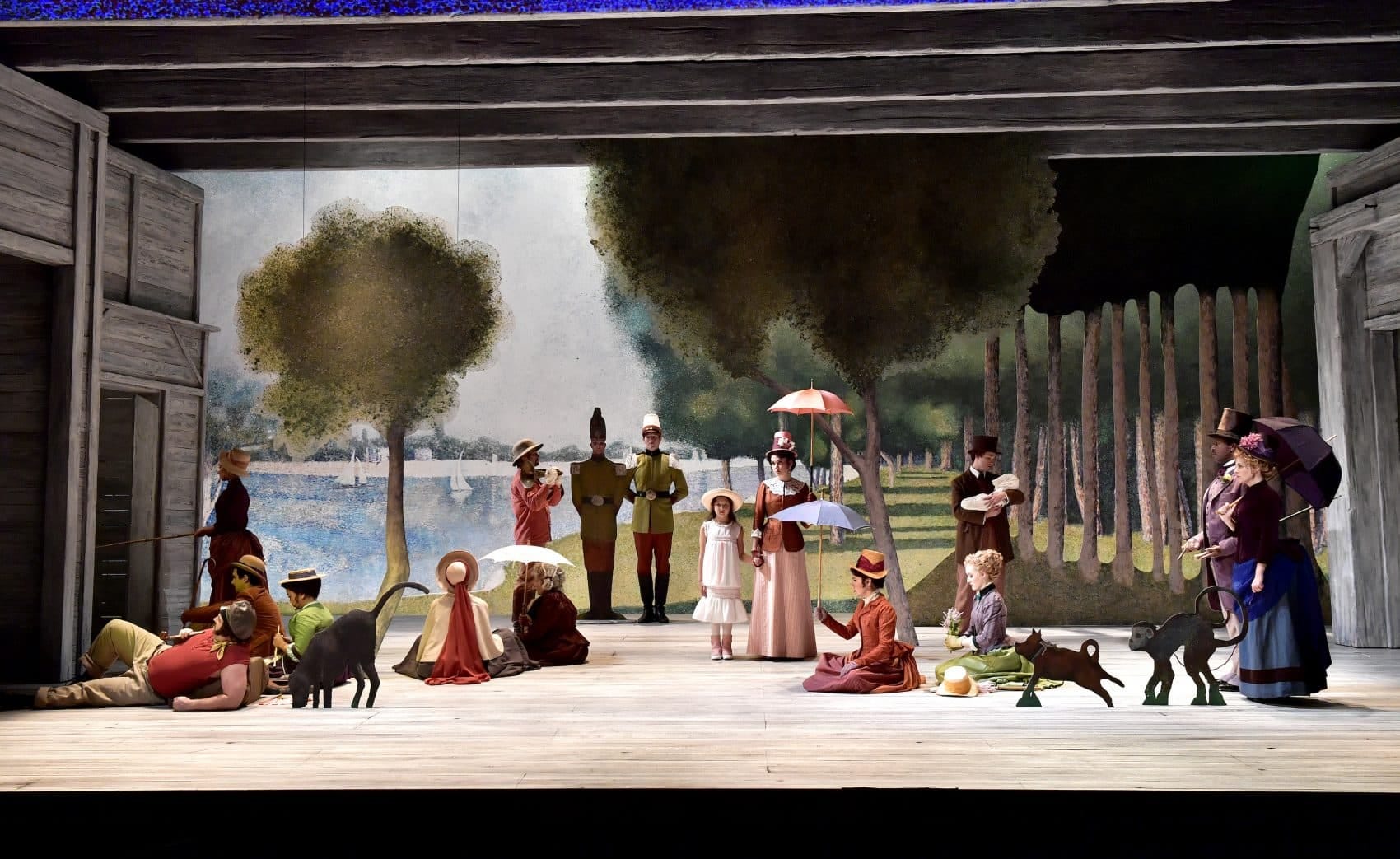
Sondheim (of course) says it pithily. “Children and art,” goes one of the lovelier songs in Sundays in the Park with George, the Seurrat-biopic musical about precisely that dichotomy. To make art is to do something like, and unlike, getting children. It is humanistic; it is also individualistic. I make art because I think my life matters. I am drawn to art because I think other people’s lives matter, too, and because I am drawn to the realm of mattering, and it was that pull that got me to the realm of the sacred to begin with.
But what do we do if we don’t actually hate nature? What do we do with art if it is not simply an affirmation of human value against nature’s uncaring bleakness? This is the part, I think, my thirteen-year-old self got wrong. It is impossible to see the world as I now do, as a Christian, as “charged with the grandeur of God”; it is impossible to look at fish or flowers and not admire what seems like handiwork in them, too. If art isn’t making meaning where there is none there otherwise, what is it doing at all? Shouldn’t we all leave creation to God and just have babies instead?
It’s possible, of course, to veer too adamantly in this direction. I sometimes anxiously do this, in an effort to correct for what I once was. It is possible to think that the created order is God-given, and that the only good impulses in us are those that propagate it and that all things that take us out of this immediacy of nature, from art to tools, are an appropriation of divine right. I could talk myself out of language, if given enough time.
But, whether it is my own ego, or my faith in other people’s, I haven’t been able to give beauty up, nor art. That the world is rich with meaning, with symbols, with parallels and metaphors and images and similes and motifs and themes and sounds, that life is art, already, whether or not we accept it as much, does not seem to me a prohibition on hungering for such things, or even making stories and songs and plays that contain them. If anything it seems the only appropriate response. If life is art, already, then the only way to affirm that is to echo it: to in all aspects of our lives and works reflect that richness, to not only make art, in the literal sense of stories and songs and plays that hint at that meaningfulness, but to make everything into art, to wager in all we do on a world where nothing, even those vestigial parts of us that do not make it into the next generation, is in vain. Maybe the aesthetes didn’t go far enough. Maybe everybody needs to be an artist, all the time. A constant affirmation of the meaningfulness of the life that is, instead of its literal projection into the future. A communication that’s generative within, rather than beyond, a human life.
This is, I think, what rescues art from the charge of mere sterility. The idea that art is a cope, or a distraction: something to be opposed to the continuation of human life, to make us die easier, rests on the assumption that biological, human life itself is the only force of meaning in the universe. Life exists to perpetuate itself; beauty is useful only insofar as it pulls us to find a sexual partner with which to reproduce. But if creation is sacred, in a broader sense, there are ways of sub-creating, of tending to creation, of reflecting it, of deepening it, of cultivating it, that sanctify the present, and not just the future. Things matter because they matter, in and of themselves, and not instrumentally: because they keep us moving forward, with better genes, in time.
Above, I said that to write a novel requires no other person. That is true in the most immediate and literal sense. I can write a novel in my notebook, if I want to. But it’s not true, of course, in the sense that of course writing a novel requires everyone who has ever spoken my language, or thought in terms of stories. The conversation towards which I’m always working as a writer, though it is literally unfeasible (at least, until the new Jerusalem), is one in which the now-dead, and the now-living, and the not-yet-born exist in the same present, as part of the same dialogue.
It’s a conversation that reminds me a lot of Mass.
A few months ago I started serving at the altar at church. Sometimes I am a crucifer, sometimes an acolyte, increasingly -- and improbably -- a thurifer. It’s an odd analogue to cast parties. We change costumes; we await places; the bell rings and then whether or not we know what we are doing we are onstage, and the flow feels the same as it did when I was Borachio. There are props. (I still instinctively call the Credence Table the “props table.”)
It almost doesn’t matter which beauty moves you, then, or all of them at once. If you are like me and moved by words you have the Book of Common Prayer; you have “the remembrance of them is grievous unto me/the burden of them is intolerable,” which are among the poetic lines that first moved me into faith; if you are someone else maybe it’s the Tallis that gets you, or the stained glass lamb, or the smell of the incense, or the way it catches -- when I swing the thurible right -- the light. There are a multitude of ways to God.
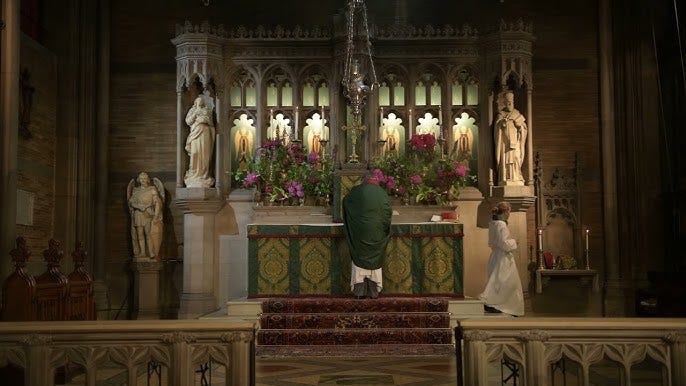
But in the liturgy they work together; they refer to each other; they refer to this thing, the Eucharist, that would still be happening at the altar even if we had only grape juice and Carrs water crackers and no music at all; they make us want it; they help us see it. The generativity they stoke, in turn, in me is for it all together, too: for more music, and more incense, more poetry, and yes, more children, whether or not I end up as someone who ends up having them. It is an expansion of, a sacramentalization of, all life, all creation, which is not quite the same thing; there is more in the world, and not just because there are human beings, even as human beings are a good thing, too, for there to be more of.
It is an affirmation that creation itself is good, and the right response to creation is for there to be more of it all. It matters, all of it, both children and art. There’s more to creation than life.
No posts
Comments
Nothing yet. Say the first thing.
Sign in to join the conversation.