
We had a symposium on Christmas Eve. Technically it was Christmas Day. We’d all had dinner and then gone to Midnight Mass and then gone to piano bar we all knew in Midtown East. The people who go to a piano bar at two in the morning on Christmas are as riotously lonely as you’d expect. A man in a fur coat held the door for us. The pianist sang “Jesus Freaks” and “Tradition.” We ordered garlic bread and got onto the subject of love.
One of us made the case that “falling in love” was not only unnecessary, when it came to one’s life partner, but actively undesirable. This was just controversial enough to keep us arguing past last call.
I took the side of the romantics. Whether this was out of habit or principle or stubbornness I’m not sure. If there was ever a year for one to decry romantic impetuousness it is the year of one’s divorce, but I’ve never dropped a cause for being lost.
We all weighed in. We came to no conclusions. Some of us saw each other eighteen hours later for Chinese food and kept debating, even though the person who’d tossed the the gauntlet was no longer there, and then I spent a month trying to work out what I thought.
We were drunk, and didn’t define our terms, and probably all enjoyed playing into our expected roles more than we enjoyed narrowing down the precise limitations of our disagreement, but the rough contours of the proposition, edited in the service of an interesting essay, are these:
Falling in love, understood as a erotic vulnerability, or a stronger form of infatuation (but distinguished, let’s say, from sexual attraction), is a bad idea because:
a) it makes you crazy;
b) it makes you make ill-advised decisions about who to marry and’
c) is likely to be more a result of your own projections and idealizations about the other person, downstream of your own projections and idealizations about yourself, and the kind of relationship a person like you should be in, and the fantasy of the other person playing that role, than it is about the kind of actual mutuality and engagement with true otherness that lasting, real, agapic love requires.
Points granted. C) is, I think, the most compelling.
You should probably do it anyway.

No doubt we shouldn’t marry most people we fall in love with. But even sober, even granting the necessity for social order and the begetting of children, even granting that “falling in love” is primarily about the interplay of illusions and not whole human beings, I still think it’s no less worth doing than any other form of artistic creation.
It’s only by falling in love that we learn to be ourselves in the first place. I can’t think of a more foundational requirement, for a partner, than the person with whom you act out the illusion of who you think you are.
I have been in love a handful of times in my life. Fewer, maybe, than you’d think if you knew me. With the benefit of hindsight I’ve imagined I was in love more times than I actually was, which is to say that I experienced a)-c), and made myself insufferable in the process. But the distinction between “intense physical attraction” and “idiotic infatuation” and “truly falling in love” can be made in hindsight only. Falling in love is less about how you feel (or make your exasperated friends feel) in the moment than about who you become afterwards.
The times in my life I have actually been in love, by the definition I’m proposing here, I have become somebody else. However the fantasy started, whenever the pas des deux began, whatever pattern of call-and-response led me to imagine that life as the counterpart to say, a cast-mate in a high school Shakespeare play, or an antiquarian book dealer over a decade my senior was the apotheosis of my entire narrative identity, what I ended up left with, after it was all over, was the recognition that my entire narrative identity was completely wrong. Each imagined endpoint — this settles the story of who I am — turned out to be a place where my sense of self began.
If anything, falling in love signifies, to me, those relationships in which I have so completely absorbed into myself the person I fell in love with, that I can only say that after them I became someone else, and that the someone else in question more closely resembled the person with whom I was in love than the person I fancied myself to be. But the illusion of someone else as the answer — always, like a witch’s prophecy, right, just never in the way I expected — was what snared me. It was what made me willing — the way Tallis’s Lamentations of Jeremiah makes me willing; the way Four Quartets makes me willing; the way an all-night dance party makes me willing — to gamble on a version of myself, and lose. The experience of falling in love for me has always been the experience of good art. Something you recognize snares you; something you don’t keeps you there.
And, of course, falling in love is an art: in the sense of “the art of love,” and in the sense of a created production. Lover and beloved are always characters. We make characters of everyone we meet. God knows I make a character of myself. My friends from the bar have all known me long enough to call me on that one. But it is in the experience of falling in love – an experience I’ve had mostly with lovers, but sometimes with very close friends – that we get close enough, or foolish enough, or erotically messy enough, to let those characters merge: to create (or, in those blessed cases of reciprocated love, co-create) a shared expression of reality.
Falling in love to me is less about the fostering of illusions than the creative wielding of them. It’s saying something true behind a mask. It’s unselfing, and then it’s re-selfing, or a transformation into the beloved, or else the spaces the beloved leaves behind.
Of course it’s not the same thing as “loving someone.” That’s the lasting love, the self-sacrificial love, the love that requires really seeing someone else, not as character, or as fantasy, or as projection, but as another distinct human being – as artist, and not just art.
But I think part of being able to love, in that way, comes from having learned to take ourselves less seriously. And that’s what falling in love, for me at least, has always taught me to do.
In Plato’s Symposium: Socrates famously has Diotima instruct him in the “ladder of love.” She informs him that the “right way to proceed in matters of love” is to “to be led by another…as though using the steps of a ladder, from one to two, and from two to all beautiful bodies, and from beautiful bodies to beautiful practices, and from practices to beautiful studies, and from studies one arrives in the end at that study which is nothing other than the study of that, the Beautiful, itself.”
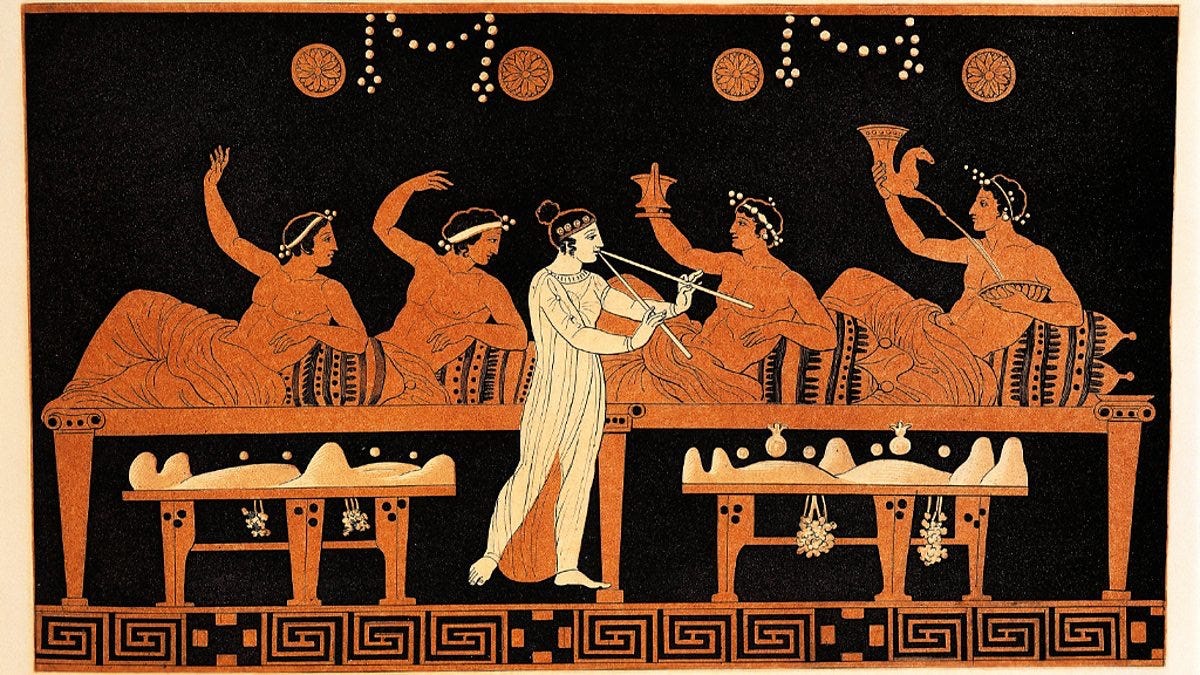
I think there’s something to the idea of love as a ladder. Falling in love has always felt, in part, like an ascent. Every time I’ve fallen in love with someone I’ve fallen in love with everything they love, and from that certain kinds of art, or music, or philosophy, or God. And I can think of no better way to love me than to fall in love, in turn, with the things I love: to see Eliot, or Virginia Woolf, or Britten, or The Sacred Harp, or The Cook, The Thief, His Wife, and Her Lover, or the problem of magic and modernism currently keeping me up at night, through my eyes.
But you could easily make the case, granting all this, that it is good for a person to fall in love in one’s youth a few times, for practice, only to in the flower of maturity jump straight into agapic love with a prudently-chosen spouse, and enjoy one’s Schiele and one’s Tallis and a solid relationship with God on the side. A version of this kept Athens stable, after all.
But I think the counterargument to this lies precisely in where Diotima gets it wrong.
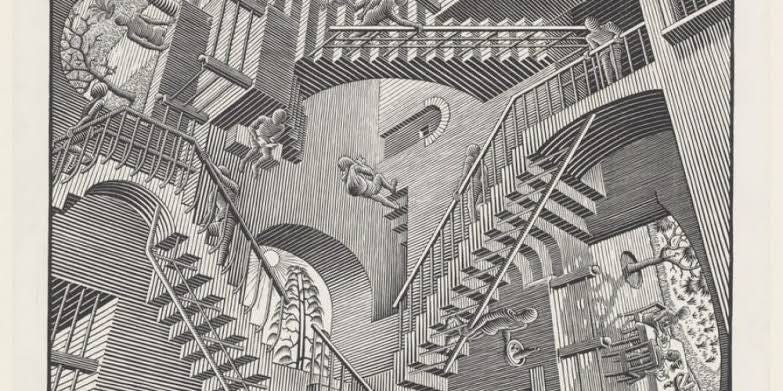
The ladder of love, for me at least, looks more like Escher’s staircase. I fall in love, so I fall in love with a version of them-and-myself, so I fall in love with them, so I fall in love with what they love, so I fall in love with a more expansive vision of the world, so I fall in love with them some more, so I see the world through their eyes, so I see myself through their eyes, so I see their fantasy of me, and my fantasy of them, and also their other fantasies, of other things, and through some kind of interplay of their fantasy and my fantasy and the thing our shared fantasy becomes as we stop being able to to distinguish our follies, and then I see the world anew; not as it really is, maybe, but through a different lens.
To be in love, I think, is to be perpetually, renewably, entering into a space of creation. I’m an artist. It’s the only way I know how to live.
If there is any rejoinder to my friend, I think it is not that we should fall in love less, but more. Sometimes I think we should fall in love all the time with everybody we meet. I have a limited degree of sympathy, in theory at least, for free love.
But if there is a rejoinder to that, in turn, it is that we have neither world enough, nor time, in this life, to do such a thing, that is part of what finitude is, and that is where I think my friend was right, that when you make a decision about the building of a life with someone, it also matters whether you like to leave parties at the same time. You have to keep the frame in place somewhere.
But I think finitude — the inevitability of change, and of death — is also evidence in favor of falling in love with the person you spend your life with. If could be sure that I would remain myself, as I am now, with my precise passions and my precise hobbies and my precise philosophical outlooks and theological hangups and aesthetic tastes – Tallis yes; Mozart no; Sacred Harp yes; Truffaut no – maybe it would indeed be prudent to make a rational decision based on my stable self, and another person’s stable self, and let fixed-me lovingly appreciate the radical otherness of fixed-them.
But we aren’t stable. Life changes us. We never get to say we have it all figured out. We’re never too good to be made fools of. Our children (or so I hear) are likely to change us far more than anyone else will. And I can’t think of anything more important, when facing the kinds of changes we can never anticipate, than someone with whom you can do the perpetual, creative work of playing around with who you think you are.
Someone, in other words, with whom you can share a stage.
This past weekend, I attended a thirty-six hour mostly-wordless, watchless, phoneless, sleepless sacred theatre retreat with Dzieci: the theatre company with which I’ve been performing since late last year. I’m going to write about it in a different essay, but suffice to say it was, in essence, an extended, and often ecstatic, period of play: of singing and chanting and exploring how any two people, with little more than an orange ball and a single song and a couple of lines of verse from the Nordic Edda, can create an evanescent theatrical relationship: and with it, become new versions of ourselves.
And it struck me, somewhere in the twentieth or twenty-first hour (there were four of us awake, tending to LED candles that were and were not a campfire, with drums in hand, who had without speaking come to the conclusion that we could not, on pain of some kind of desecration, let the drumbeat die out; we slept in turns and made the sound last until morning), that the kind of reality that we experience, in that kind of play, is not really so different from the theatricality of falling in love. You create illusions together, and discover which of them are true.
We experiment with ourselves, in dialogue with somebody else, experimenting with themselves. We become and let somebody else become a fool. We mess around with who we are. We let ourselves be made different in relation: a seduction scene; a destruction scene; an embrace. We experiment with being someone else, in relation, and see what of that someone else stick. We go a little crazy, and we make irrational decisions, and from those moments of instinctive unselfing we learn something about the self we become next.
Of course, I’m hardly well-placed, at present, to give anyone advice. And maybe it’s evidence in support of my friend’s point that I’m thinking about all this too much like an artist, and not enough like a sensible thirty-five year old woman facing her future clear-eyed. But the whole point of eros — isn’t it? — is creation, whether of children or art. That requires a little frenzy, first.
No posts
Comments
Nothing yet. Say the first thing.
Sign in to join the conversation.